


Gaussian Beam Propagation Calculator
Calculate the relationships between the beam waist radius, divergence angle, Rayleigh range and M² beam quality factor of a Gaussian beam, and gain a deeper understanding of laser beam propagation characteristics
🔬 Gaussian Beam Parameter Calculator
Enter the wavelength and any one beam parameter (beam waist radius / divergence angle / Rayleigh range) to automatically calculate all the others
💡 Tip: wavelength is required; fill in any one of the other parameters and the rest are calculated automatically
Gaussian Beam Core Parameters Explained
A deeper look at the five core parameters of a Gaussian beam and their physical significance
Laser wavelength
Wavelength λ
Unit: nm / μm
The spatial period of the laser’s electromagnetic wave, which determines the beam’s colour and how it interacts with matter. The shorter the wavelength, the smaller the focusable spot.
Beam waist radius
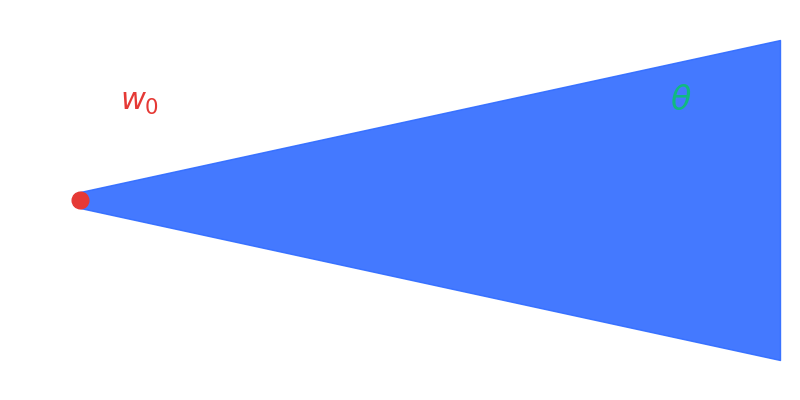
Beam Waist w₀
Unit: μm / mm
The position along a Gaussian beam’s propagation where its cross-section is smallest, defined as the 1/e² intensity radius. The beam waist is where the beam is narrowest.
Far-field divergence angle
Divergence θ
Unit: mrad / rad
The slope at which the beam radius increases linearly with distance as a Gaussian beam propagates in the far field. It normally refers to the half-angle; the full angle is 2θ.
Rayleigh range
Rayleigh Length z_R
Unit: mm / cm
The distance from the beam waist to the point where the beam radius has grown to √2 times the waist radius. Within the Rayleigh range, the beam can be considered approximately collimated.
M² beam quality factor
Beam Quality M²
Dimensionless, ≥1
The degree to which a real beam deviates from an ideal Gaussian beam. M²=1 is an ideal Gaussian beam (diffraction-limited); the larger the M², the poorer the beam quality.
Depth of focus
Depth of Focus
DOF = 2z_R
The distance either side of the focus over which the beam size remains within an acceptable range, equal to twice the Rayleigh range. Within the depth of focus, the beam radius does not exceed √2 times the waist radius.
Gaussian beam propagation diagram
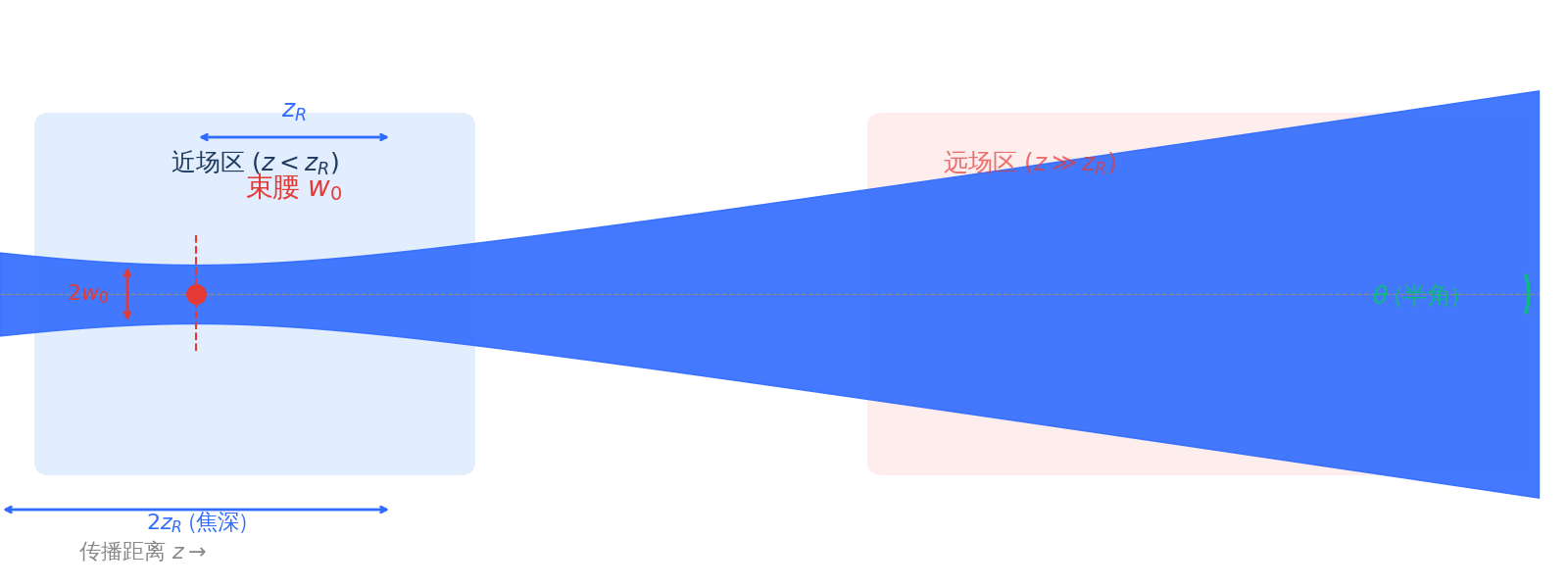
Beam profile (1/e²)
Beam waist position w₀
Rayleigh range z_R
Divergence angle θ
Core Gaussian Beam Formulas
Master the following formula groups to calculate all Gaussian beam parameters with ease
M² Beam Quality Factor Grades
Beam quality and typical application scenarios corresponding to different M² values
Single-mode fibre lasers and single-mode diode lasers. Suitable for precision machining, scientific research and interferometry.
High-quality solid-state lasers and low-power fibre lasers. Suitable for marking, precision welding and cutting thin materials.
Multimode fibre lasers and rod solid-state lasers. Suitable for metal welding, cutting thick plate and surface treatment.
High-power multimode CO₂ lasers (axial-flow / high-power multimode types; sealed RF CO₂ lasers with M²≈1.1~1.3 are not in this category), lamp-pumped solid-state lasers and high-power diode lasers. Suitable for heat treatment, cladding and welding.
💡 Physical significance of the near field and far field
Near field (z < z_R):The beam radius is approximately equal to the beam waist radius and the wavefront is approximately planar. In this region the beam is highly collimated, making it suitable for applications requiring delivery of a fine beam.
Far field (z >> z_R):The beam radius grows linearly with distance, w(z)≈θ·z, and the wavefront is approximately spherical. The divergence angle completely determines the rate of beam expansion.
Common Misconceptions
Avoid these misunderstandings and truly master Gaussian beam characteristics
‘Beam diameter’ and ‘beam waist radius’ are often confused
In Gaussian beam parameters, w₀ normally refers to the1/e² radius, while d₀=2w₀ is the diameter. The ‘beam diameter’ quoted in laser datasheets sometimes refers to the 1/e² diameter and sometimes to the FWHM (full width at half maximum), with the conversion d_FWHM = d_1/e² × 0.5887. Always confirm the definition in use!
Is the divergence angle the full angle or the half-angle?
In the formula θ=λ/(πw₀), θ is thehalf-angle(i.e. the angle from the optical axis to the beam edge). In practical measurements, ‘divergence angle’ sometimes refers to the full angle 2θ. Always check how it is specified in laser specification tables.
M²=1 does not mean zero divergence
Even an ideal Gaussian beam with M²=1 stillhas a divergence angle! The divergence angle of a diffraction-limited beam is the physical lower limit imposed by diffraction. It is impossible to make a beam completely non-diverging with any optical system — this would violate the laws of diffraction.
Is a longer Rayleigh range always better?
Not entirely. A long Rayleigh range means a large depth of focus, which is an advantage in cutting thick materials. But a large depth of focus also meansa large beam waist radius, a larger minimum spot and lower power density. Precision marking requires a small spot (short depth of focus), while welding thick materials requires a long depth of focus.
Are shorter-wavelength beams better collimated?
For the same beam waist radius, a shorter wavelength gives a smaller divergence angle (θ∝λ) and is indeed better collimated. However, shorter-wavelength lasers are generallyharder to generate and more expensive, and their absorption characteristics differ in some materials. Practical selection requires considering all factors.
Does the M² factor affect beam power?
M² describes beam quality (spatial distribution) anddoes not affect total power. A 100 W laser with M²=3 and a 100 W laser with M²=1.1 deliver the same total power, but the former has a focused spot diameter 2.7 times larger and an area about 7.4 times larger, greatly reducing the power density (W/cm²) and making a huge difference in processing capability.
Calculation Examples
Learn Gaussian beam parameter calculation through practical examples
Beam parameters of a 1064 nm fibre laser
- Divergence angle:θ = λM²/(πw₀) = 1064×10⁻⁹ × 1.2 / (π × 100×10⁻⁶) = 4.06 mrad
- Rayleigh range:z_R = πw₀²/(λ·M²) = π × (100×10⁻⁶)² / (1064×10⁻⁹ × 1.2) = 24.6 mm
- Depth of focus:DOF = 2z_R = 49.2 mm
- Physical significance:Within ±25 mm of the beam waist, the beam diameter does not exceed about 283 μm (radius about 141 μm). Beyond this distance the beam diverges rapidly.
Minimum divergence angle of a collimated beam
- Beam waist radius:w₀ = d₀/2 = 1 mm = 1000 μm
- Divergence angle:θ = 532×10⁻⁹ / (π × 1×10⁻³) = 0.169 mrad = 169 μrad
- Rayleigh range:z_R = π × (1×10⁻³)² / 532×10⁻⁹ = 5.9 m
- Physical significance:A green beam with a 2 mm diameter has a Rayleigh range of nearly 6 metres, meaning the beam hardly spreads over a distance of several metres. This is why a laser pointer can reach so far.