


Laser Power / Energy Unit Converter
Bidirectional conversion between multiple units of laser power (W/mW/dBm), energy (J/mJ/eV) and intensity (W/cm²), with a quick assessment of laser safety class
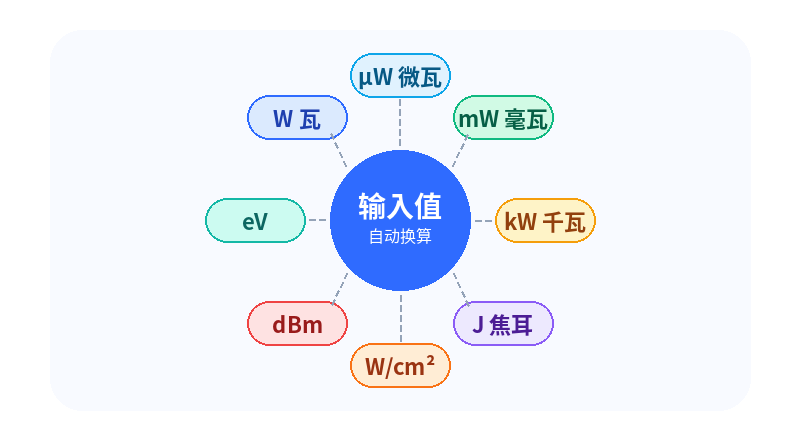
🔄 Unit converter
Enter any value and unit to convert automatically to all other units
Laser Units Explained
Understand the definitions and conversion relationships of power, energy and intensity units
Watt (power)
Watt / W
1 W = 1 J/s = 1000 mW
The SI unit of power, representing energy delivered per unit time. Laser power is the most fundamental parameter in laser processing.
dBm (decibels relative to one milliwatt)
decibel-milliwatt
P(dBm) = 10log₁₀(P(mW))
A logarithmic power unit referenced to 1 mW. Widely used in communications and optoelectronic measurement, it conveniently expresses a large dynamic range.
Joule (energy)
Joule / J
1 J = 1 W·s
The SI unit of energy. For pulsed lasers the single-pulse energy (μJ/mJ level) is of interest; for continuous-wave lasers, power × time.
Electronvolt
electron-Volt / eV
1 eV = 1.602×10⁻¹⁹ J
The energy gained by an electron moving through a potential difference of one volt. Photon energy is commonly expressed in eV, corresponding one-to-one with wavelength.
Intensity (power density)
Intensity / Irradiance
I = P/A (W/m² or W/cm²)
Power per unit area, which determines laser processing capability. 1 W/cm² = 10,000 W/m².
Calorie
calorie / cal
1 cal = 4.184 J
The heat required to raise 1 gram of water by 1 °C. Occasionally used in laser thermal-effect calculations and referenced in photothermal conversion analysis.
dBm Conversion Quick Reference
A conversion table for the logarithmic power unit most commonly used in communications and optoelectronics
dBm → W conversion formula
Every 10 dBm increase multiplies power by 10; every 3 dBm increase roughly doubles it.
W → dBm conversion formula
1W = 30dBm,1mW = 0dBm,1μW = -30dBm。
dBW reference
dBW = dBm – 30。1W = 0dBW = 30dBm。
| dBm | Power | dBm | Power |
|---|---|---|---|
| -30 dBm | 1 μW | 20 dBm | 100 mW |
| -20 dBm | 10 μW | 30 dBm | 1 W |
| -10 dBm | 100 μW | 40 dBm | 10 W |
| 0 dBm | 1 mW | 50 dBm | 100 W |
| 10 dBm | 10 mW | 60 dBm | 1 kW |
Laser Safety Class Standards
Under the IEC 60825-1 / ANSI Z136.1 standards, laser products are classified into seven hazard classes
Key Points of Laser Safety Protection
① For Class 3B/4 lasers, eyewear protecting the corresponding wavelength must be worn; ordinary sunglasses are ineffective;
② The beam path should be enclosed or screened to prevent unauthorised access;
③ Beware of diffuse-reflection hazards — reflection of a Class 4 laser from a white wall can also injure the eyes;
④ Invisible lasers (infrared/ultraviolet) are more dangerous because the eye cannot perceive them and the blink reflex is not triggered;
⑤ For pulsed lasers, both single-pulse energy and peak power density must be considered.