


Wavelength / Frequency / Photon Energy Converter
Linked conversion of four parameters — wavelength λ, frequency f, photon energy E and wavenumber ṽ; enter any one to calculate the other three automatically, covering the entire electromagnetic spectrum
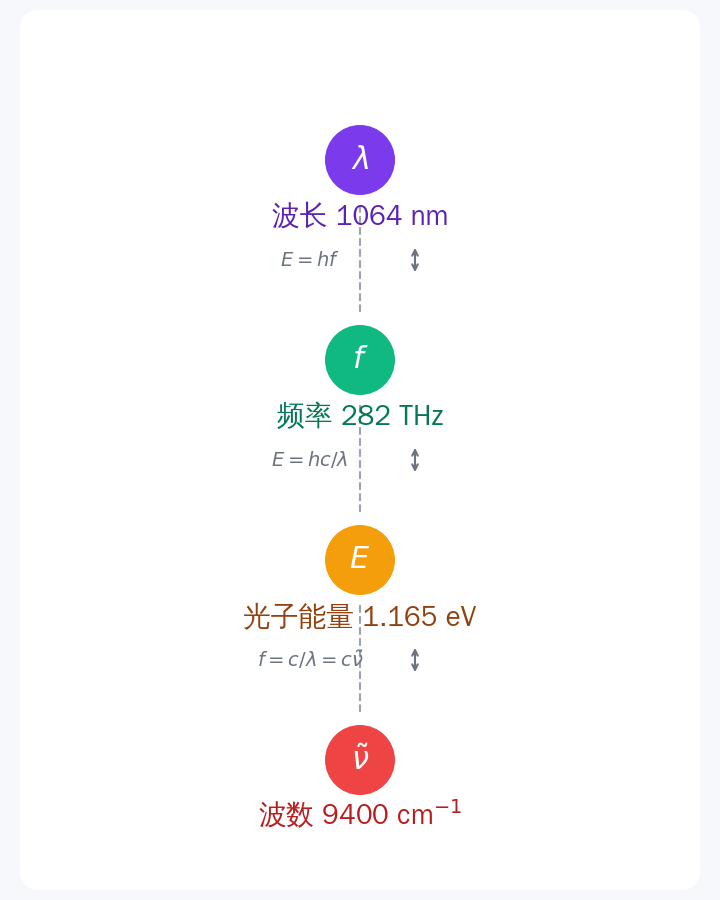
⚛️ Wavelength–frequency–energy–wavenumber linked conversion
Change any one parameter and the other three update automatically (multiple units supported)
Electromagnetic Spectrum and Common Laser Bands
Common Laser Wavelengths Quick Reference
Click a card to fill in the corresponding wavelength
Core Concepts Explained
Understand the physical significance of the electromagnetic spectrum, photon energy and wavenumber
Wavelength
Wavelength λ
The spatial length of one complete cycle of an electromagnetic wave. Visible light spans roughly 400–700 nm, infrared >700 nm and ultraviolet <400 nm.
Frequency
Frequency f
The number of oscillations of an electromagnetic wave per second, in Hz. Frequency and wavelength satisfy f = c/λ, with the speed of light c≈3×10⁸ m/s.
Photon energy
Photon Energy E = hf = hc/λ
The energy carried by a single photon. Planck’s constant h=6.626×10⁻³⁴ J·s. The shorter the wavelength, the higher the energy of each photon.
Wavenumber
Wavenumber ṽ = 1/λ(cm)
The number of wavelengths per unit length (cm), expressed in cm⁻¹. Widely used in spectroscopy and infrared analysis, it is proportional to photon energy.
Core Conversion Formulas
Mathematical relationships between the four parameters
Comparison of Photon Energy at Different Laser Wavelengths
Understand why short-wavelength lasers suit precision processing
💡 Photon Energy and Laser Processing Mechanisms
Infrared laser (~1 eV/photon):Photon energy is lower than the bond energy of most chemical bonds (3–10 eV), so processing occurs mainly throughthermal effects— the material absorbs light energy, converts it into heat, then melts/vaporises.
Ultraviolet laser (3–6 eV/photon):A single photon has enough energy to break chemical bonds directly, achievingcold processing(photochemical ablation), with a minimal heat-affected zone. This is the fundamental reason ultraviolet lasers can perform precision micromachining.
Ultrafast laser (femtosecond):Although the photon energy is not high, the extremely high peak power density leads tomultiphoton absorption, effectively doubling the photon energy and likewise achieving cold processing.
Related Calculation Tools
Spectral Bandwidth Converter (Δλ ↔ Δν): an interval-width conversion tool that calculates how many GHz correspond to 1 nm, how many nm correspond to 100 GHz, and how many pm/fm correspond to an MHz laser linewidth. It supports precise two-sided edge conversion and provides coherence length, Q factor and transform-limited pulse duration.