


Coherence Length Calculator
Enter the source spectral width to calculate coherence length and coherence time; supports both Gaussian and Lorentzian lineshapes, with a quick reference of coherence parameters for common light sources
📏 Coherence Length Calculator
Enter the centre wavelength and spectral width of the light source to calculate the coherence length and coherence time
💡 Tip: single-frequency lasers have a Lorentzian spectrum, while multimode sources/LEDs have an approximately Gaussian spectrum — coherence length can differ by up to a millionfold
Quick reference of coherence parameters for common light sources
Coherence lengths vary enormously between light source types — from sub-micrometre to kilometre scale
| Light source type | Typical wavelength | Linewidth/spectral width | Coherence length | Coherence time |
|---|---|---|---|---|
|
White light (sunlight) |
~550 nm (centre) | ~300 nm (400-700nm) | ~1 μm | ~3 fs |
|
White LED |
4500K | ~200 nm | ~2 μm | ~7 fs |
|
Monochromatic LED |
525 nm | ~20 nm | ~10 μm | ~33 fs |
|
SLD superluminescent diode |
1310/1550 nm | ~40 nm | ~50 μm | ~170 fs |
|
Femtosecond laser |
800/1064 nm | ~10 nm (10 fs pulse width) | ~100 μm | ~330 fs |
|
Multimode diode laser |
650/808/980 nm | ~2-5 nm | 0.1~1 mm | 0.3~3 ps |
|
DFB laser |
1310/1550 nm | ~10 MHz | ~2 m | ~7 ns |
|
Single-frequency solid-state laser |
532/1064 nm | ~1 kHz | ~300 m | ~1 μs |
|
Ultra-stable narrow-linewidth laser |
1064/1550 nm | ~1 Hz | ~300,000 km | ~1 s |
Core coherence length formulas
Coherence length formulas for different spectral lineshapes
The physical nature of coherence
What is temporal coherence? Why do coherence lengths differ so greatly between light sources?
🔵 Temporal coherence
Temporal coherence descriptionThe degree of correlation of the optical field at the same spatial point at different times. The purer the frequency of the light (the narrower the linewidth), the longer the coherence time. The coherence length L_c = c·τ_c is the distance light travels within the coherence time. It can be understood as “the maximum distance over which light maintains consistent wave behaviour”.
💜 Spatial coherence
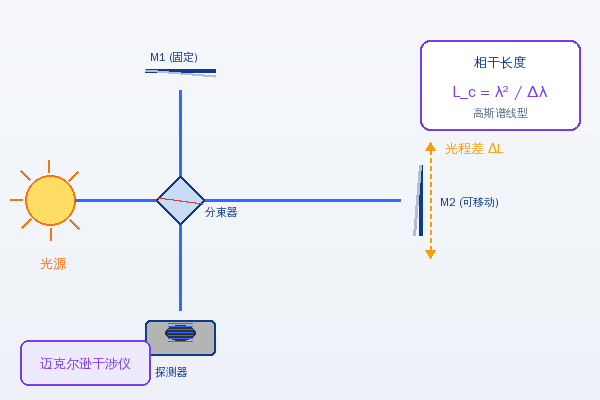
Spatial coherence descriptionThe degree of correlation of the optical field at different spatial points at the same instant, which depends on the size of the source. A point source has good spatial coherence, while an extended source has poor spatial coherence. Young’s double-slit interference mainly involves spatial coherence, whereas the Michelson interferometer mainly involves temporal coherence.
🟢 Relationship between spectral width and coherence
Spectral width and coherence time area Fourier transform pair: the narrower the linewidth, the longer the coherence time; the broader the spectral width, the shorter the coherence time. This is why white light has a coherence length of only a few micrometres, while a single-frequency laser can reach several kilometres.
⚠️ Note the difference between the two types of coherence
This calculator computestemporal coherence(longitudinal coherence). Do not confuse it with spatial coherence. Good laser coherence refers to good temporal coherence; the spatial coherence of a laser is determined by its modes — single-mode lasers have good spatial coherence, multimode lasers poor spatial coherence, but temporal coherence can be good in both.
Typical applications of coherence
From precision measurement to optical communications, coherence is everywhere
Laser interferometry
Interferometry
Requires a long coherence length
Michelson interferometers, Fabry–Pérot interferometers and laser length meters all rely on the coherence of light. The measurement range is limited by the coherence length.
Optical coherence tomography
OCT
Requires a short coherence length
OCT exploits the low coherence of a short-coherence source, obtaining depth information by locating where the optical path difference between the two arms is matched, thereby enabling tomographic imaging of biological tissue.
Coherent optical communications
Coherent Comms
Narrow-linewidth laser
Coherent communications encode information in dimensions such as the phase and polarisation of light, greatly improving spectral efficiency. This requires lasers with sufficiently narrow linewidth.
Holography
Holography
Temporal + spatial coherence
Holographic recording requires interference between the object beam and reference beam, placing high demands on both the temporal and spatial coherence of the source.
LiDAR
LiDAR
Narrow linewidth for coherent detection
Frequency-modulated continuous-wave (FMCW) LiDAR uses coherent detection, obtaining range and velocity information from the beat frequency; it requires a narrow laser linewidth and good linearity of frequency tuning.
Fibre sensing
Fiber Sensing
Brillouin/Raman scattering
Distributed fibre sensing exploits the scattering of light in the fibre to detect parameters such as temperature and strain. Different sensing mechanisms impose different requirements on source coherence.
Common misconceptions
Avoid these misunderstandings about coherence
“All lasers have long coherence lengths”
Not necessarily!Multimode lasers(such as multimode diode lasers) have coherence lengths of only millimetres to centimetres, little different from LEDs. Onlysingle-frequency (single-longitudinal-mode)lasers have very long coherence lengths (metres to kilometres). When buying a laser, check whether it is multimode or single-mode and what its linewidth is.
Coherence length is the “maximum interference distance”
Not accurate. Coherence length is not a hard threshold — it does not mean interference occurs when the path difference is below L_c and not when it is above. Interferencevisibility decreases gradually. L_c is usually defined as the path difference at which visibility falls to a specific value (such as 1/e or 1/2), and definitions may differ between references!
Gaussian and Lorentzian spectra give similar results
The difference is significant! For the same FWHM spectral width, the coherence length of a Gaussian spectrum is about1.48 timesthat of a Lorentzian spectrum. Choosing the wrong lineshape can cause nearly 50% error. Use the Lorentzian spectrum for single-frequency lasers and the Gaussian spectrum for multimode/LED/ASE sources for greater accuracy.
“Good coherence” means good monochromaticity
Good temporal coherence does indeed correspond to good monochromaticity (narrow linewidth), but “coherence” also includesspatial coherence. A multimode high-power laser may have excellent temporal coherence (narrow linewidth) but poor spatial coherence (multiple transverse modes). The sweeping statement “lasers have good coherence” can be misleading.