


Description
Product Overview
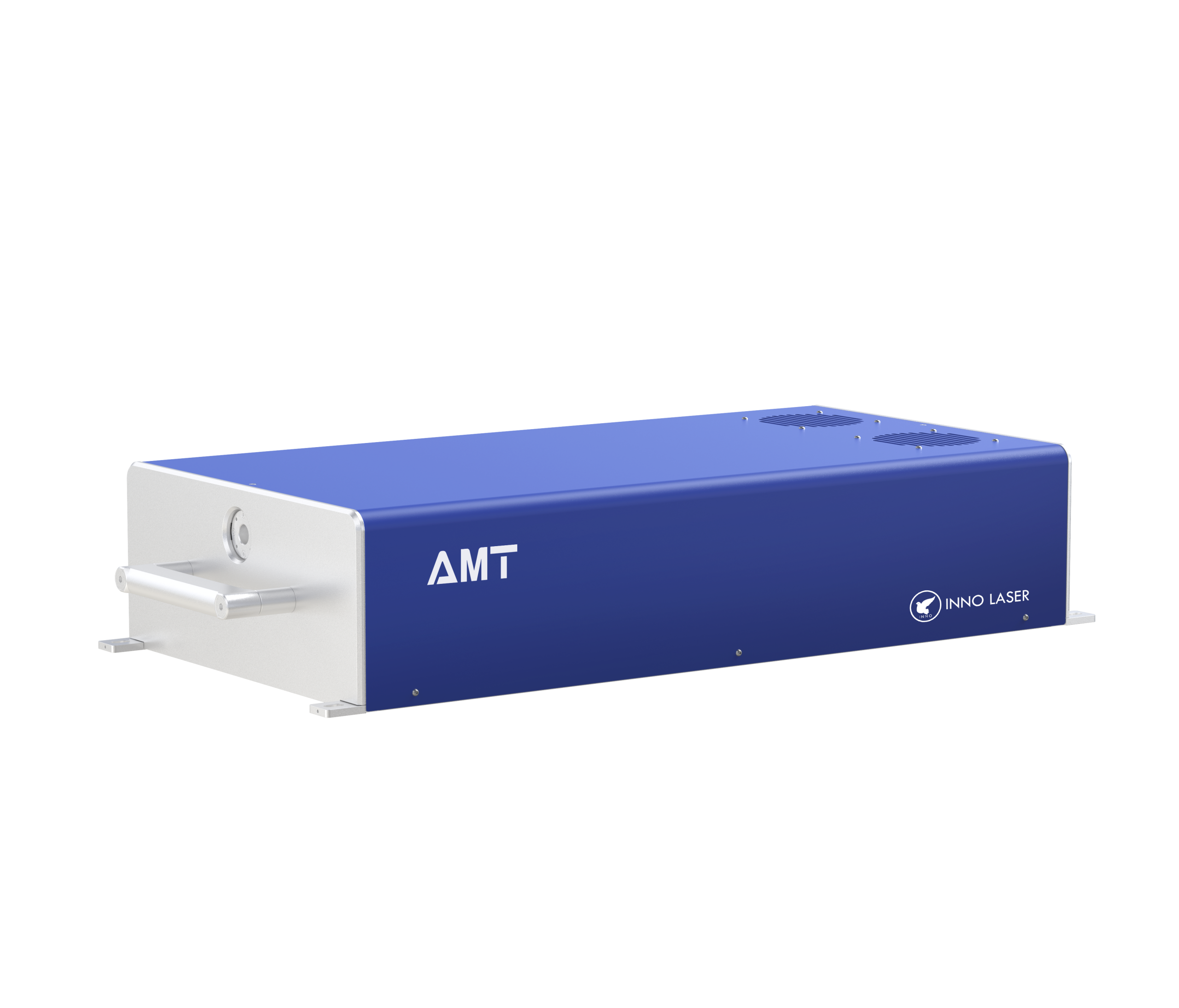
The AMT 355 15W-500K (model AMT-355-15-500-W) is a third-generation UV picosecond laser from Inno Laser’s AMT series: 355 nm wavelength, 15 W output at 500 kHz, all-in-one design with a newly upgraded control system that delivers greater stability together with multiple control functions. The laser combines a fibre seed source with a solid-state amplifier, supports Advanced POD output mode and 0-10 V external power control, and is widely used in fine laser micromachining. The specifications on this page are taken from Inno Laser’s official AMT Gen-3 User Manual (V1.0, March 2024).
Key Features
- All-in-one design: newly upgraded control system, compact footprint, stable operation and multiple control functions
- Advanced POD output mode: dual guarantee of timing and pulse-energy stability, trigger response < 1 μs, near-identical pulse energy, compatible with all market control cards offering POD (PSO) functionality
- Multiple trigger modes: TTL signal (3.5-5 V) control with rising-edge, falling-edge, high-level and low-level trigger modes
- External power control: 0-10 V DC input through the DB15 connector controls output power; 10 V corresponds to maximum power
- Complete safety design: Class 4 laser classification, with external Interlock, key switch, EMISSION indicator and audible alarm
- Rich connectivity: LAN port plus RS232 serial port, AOC Ultrafast control software included (no installation required, supports Windows 7 and later)
Technical Specifications
| Parameter | Value |
|---|---|
| Model | AMT-355-15-500-W |
| Wavelength | 355 nm (UV) |
| Output power | 15 W @ 500 kHz |
| Laser class | Class IV (GB 7247.1-2012 Class 4) |
| Supply voltage | DC 24 V |
| Power consumption | 1000 W |
| Laser weight | 44.3 kg |
| Weight with packaging | 69.3 kg |
| Outer box dimensions (with base) | 93.6 × 49.2 × 40.8 cm |
Pulse width, pulse energy, beam quality (M²), power stability and other optical parameters are subject to Inno Laser’s factory test report; contact us to request a copy. Inno AMT series picosecond lasers support crystal spot-changing (available on the 15 W and 30 W UV models); beam quality and pointing remain unchanged after spot change.
Operating Requirements
| Operating environment | |
|---|---|
| Ambient temperature | 15 °C to 35 °C |
| Relative humidity | 20 % to 80 % (non-condensing) |
| Altitude | Below 3000 m, away from vibration sources |
| Chiller requirements | |
| Cooling capacity | 1000 W |
| Temperature stability | ±0.1 °C |
| Water pressure | 18-24 psi (excessive pressure squeezes the cavity and causes power drop) |
| Water flow | 2-4 L/min |
| Water temperature setpoint | 22 °C (never adjust water temperature during operation to optimise power) |
Interface Description
| Interface | Function | Interface | Function |
|---|---|---|---|
| POWER | Power button | GATE/TRIGGER IN | Trigger signal input |
| KEY | Key switch | SYNC OUT | Sync signal output |
| 24V DC | DC-24V power supply | FLOW IN/OUT | Water inlet / outlet |
| LAN | Ethernet communication | EMISSION | Operation indicator |
| RS232 | Serial communication | INTERFACE | Interlock and external power control |
Startup and Operation Notes
- Standard startup sequence: press the power button, wait 10 s, turn the key, connect the software, Laser ON (automatic warm-up, approx. 7 min), select Low Level Gate mode, align the beam and then set the trigger mode; after 30 min of full-power warm-up the laser is ready for processing at the required power
- Standard shutdown sequence: Laser OFF (automatic shutdown, approx. 60 s), Shutter OFF, turn the key off, wait 10 s, press the power button off. Abnormal power loss may cause power degradation; contact an engineer for power optimisation
- Included accessories: 2 × water hoses, 15-pin Interlock connector, DC-24V power cable, 4 × port plug screws, 2 × keys, handle removal/installation instructions
Quick Troubleshooting (Official Manual)
| Symptom | Checks |
|---|---|
| Degraded spot quality on the workpiece | Verify that Report parameters match the factory report; check the F-theta lens, beam expander, focusing lens and mirrors for contamination or damage (do not remove window mirrors on picosecond lasers) |
| No output | Check the alarm code; in low-level mode unplug the signal cable to test; check the emission signal and supply voltage |
| Power degradation | Confirm control signal voltage, window mirror condition and all temperatures; UV and green models can optimise crystal temperature (Cry1/Cry2) via the Advanced page of the software |
Do not power off first when an alarm occurs: connect the software and click Print Report to generate a TXT report, or query the alarm code with the “?STA” command, then refer to the alarm table in Chapter 8 of the manual.
Applications
- Fine laser micromachining: cutting, drilling and dicing of brittle materials (glass, sapphire, ceramics)
- Semiconductor industry: wafer processing, mask repair
- Medical devices: stent cutting, precision tube processing
- Scientific research: ultrafast laser experimental platforms
📎 Documentation download
Inno Laser AMT Gen-3 User Manual, PDF download (V1.0, March 2024) – covers laser safety regulations, interfaces and included accessories, installation and water-cooling requirements, AOC Ultrafast control software operation, startup and shutdown procedures, Advanced POD mode details and troubleshooting.
Source: official manual of Inno Laser Technology Co., Ltd. For selection assistance contact Soar Laser at 15927220467.
Reviews
There are no reviews yet.