


Description
Product Overview
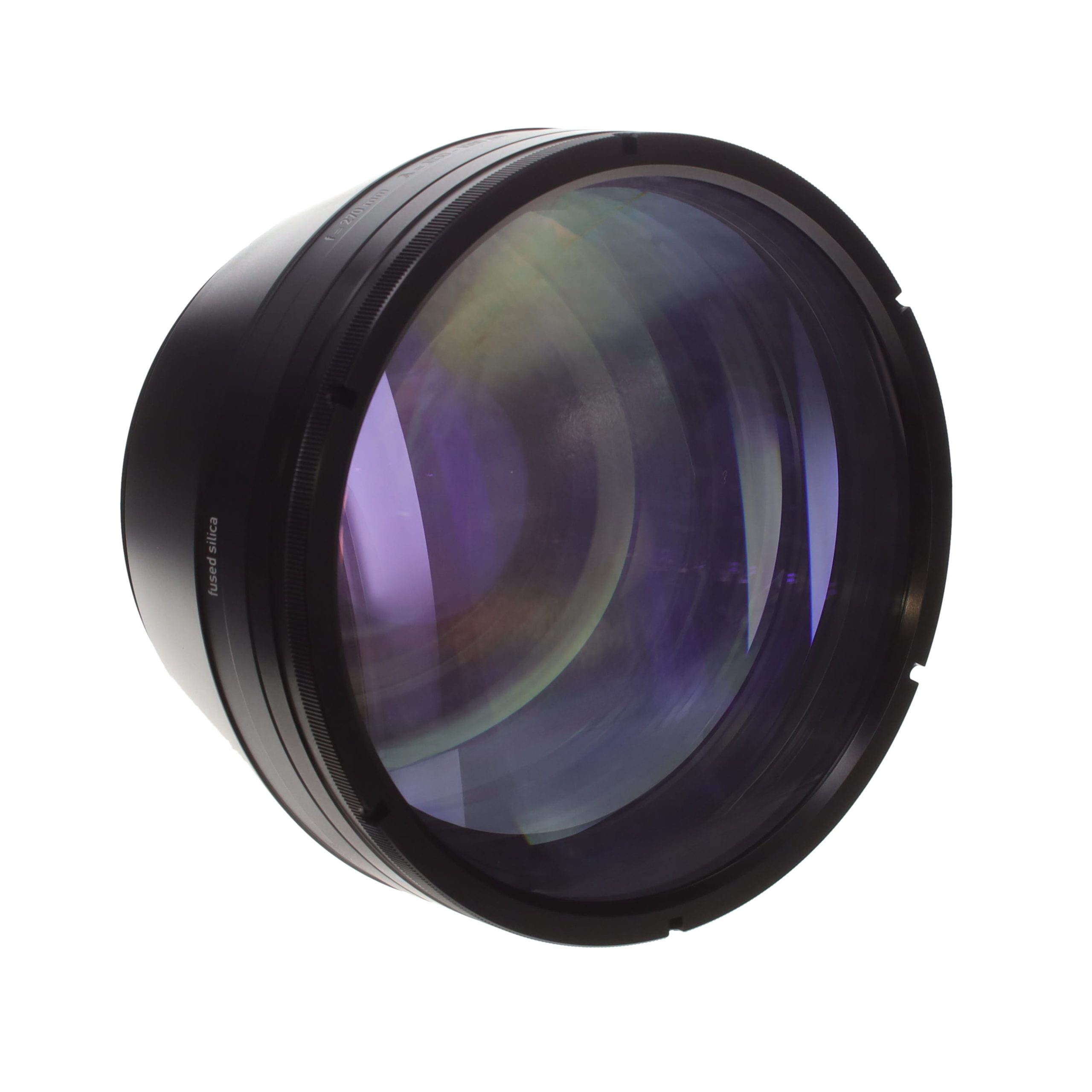
The LINOS 4401-604-000-26 is an infrared (fiber/disc) F-Theta field lens from the Excelitas Technologies (Qioptiq) F-Theta-Ronar series in Germany, designed for a 1064 nm wavelength with an effective focal length of 270.1 mm. It uses fused silica optics, offers a 158 x 158 mm scan field and produces a focused spot of about 37 μm with a 14 mm input beam. Transmission over the working band is > 96, making it a core scanning objective for laser marking, welding and precision micromachining systems.
Key Features
- Optimized for the infrared (fiber/disc) band: 1064 nm design wavelength, total transmission over the working band > 96.
- High damage threshold coating: coating LIDT 40 J/cm², suitable for high power and long-term operation.
- Fused silica body: low thermal expansion and low absorption suppress thermal lensing, while the low-absorption coating further reduces coating heating.
- Suitable for ultrashort pulses: group delay dispersion (GDD) of only 1230 fs², so picosecond and femtosecond pulses are not broadened.
- Replaceable protective window as standard: protective window PG 4401-513-006-00 isolates dust and spatter, protects the internal optics and keeps maintenance cost low.
Technical Specifications
| Parameter | Specification |
|---|---|
| Model | 4401-604-000-26 |
| Type | LINOS F-Theta-Ronar F-Theta field lens (low absorption) |
| Brand | LINOS / Excelitas Technologies (Qioptiq, Germany) |
| Design wavelength | 1064 nm |
| Effective focal length EFL | 270.1 mm |
| Back focal length BFL | 354.5 mm |
| Working distance WD | 352.0 mm |
| Flange focal length FFL | 440.5 mm |
| Maximum input beam diameter (1/e²) | 14 mm |
| Recommended scan head spacing m1 | 17 mm |
| Recommended scan head spacing m2 | 27 mm |
| Recommended scan head spacing m2 (mechanical) | 22.3 mm |
| Scan angle ±θ | 17.3 ° |
| Scan field | 158 x 158 mm |
| Focused spot diameter | 37 μm |
| Maximum telecentric error | 9.7 ° |
| Total transmission over working band | > 96 |
| Group delay dispersion GDD | 1230 fs² |
| Coating LIDT | 40 J/cm² |
| Back-reflection focus positions (from first surface) | 8.41; 16.93; 20.30; 22.86; 53.05; 53.65; mm |
| Weight | 2331 g |
| Protective window model | 4401-513-006-00 |
Applications
- Laser marking and engraving: the 158 x 158 mm field together with the roughly 37 μm spot gives crisp edges on metals, plastics and coatings, with high fidelity for small characters and 2D codes.
- Precision laser welding: a 270.1 mm effective focal length and moderate depth of focus suit galvo welding of battery cases and precision hardware with consistent seams.
- Cutting and drilling: combined with high peak power lasers it enables high-speed thin-sheet cutting and precision cutting.
- Micromachining and research: with GDD of only 1230 fs², ultrafast micromachining pulses are not stretched and spot energy stays concentrated.
Installation and selection notes: field lens performance depends on correct installation. First enter the recommended scan head spacings m1 = 17 mm and m2 = 27 mm into the scan head software, then set the distance from the lens reference plane to the workpiece using the flange focal length FFL of 440.5 mm, and finally fine-tune the Z axis for the smallest spot before production. Keep the protective window PG 4401-513-006-00 in place and check it regularly for contamination, since a contaminated window directly degrades the spot energy distribution. For other field sizes, select a different focal length in the same series in proportion (this model with f = 270 mm covers 158 x 158 mm).
FAQ
Which lasers does the 4401-604-000-26 suit?
It is designed for 1064 nm (working band as listed in the specification table) and suits nanosecond, picosecond and femtosecond industrial lasers in that band. The coating damage threshold is 40 J/cm², so please confirm suitability against your pulse duration and power when selecting.
What scan field and spot size does the 4401-604-000-26 provide?
With a 14 mm input beam the scan field is 158 x 158 mm (scan angle ±17.3°) and the focused spot diameter is about 37 μm. A larger entrance pupil or a different focal length model gives a different combination of field and spot.
Which applications suit a non-telecentric F-Theta field lens?
Non-telecentric models are more compact and lower in cost, with uniform imaging across the 158 x 158 mm field, which suits routine laser marking and engraving. If normal incidence is required (drilling, deep engraving), choose a telecentric model from the same series.


Reviews
There are no reviews yet.