



Description
Product Overview
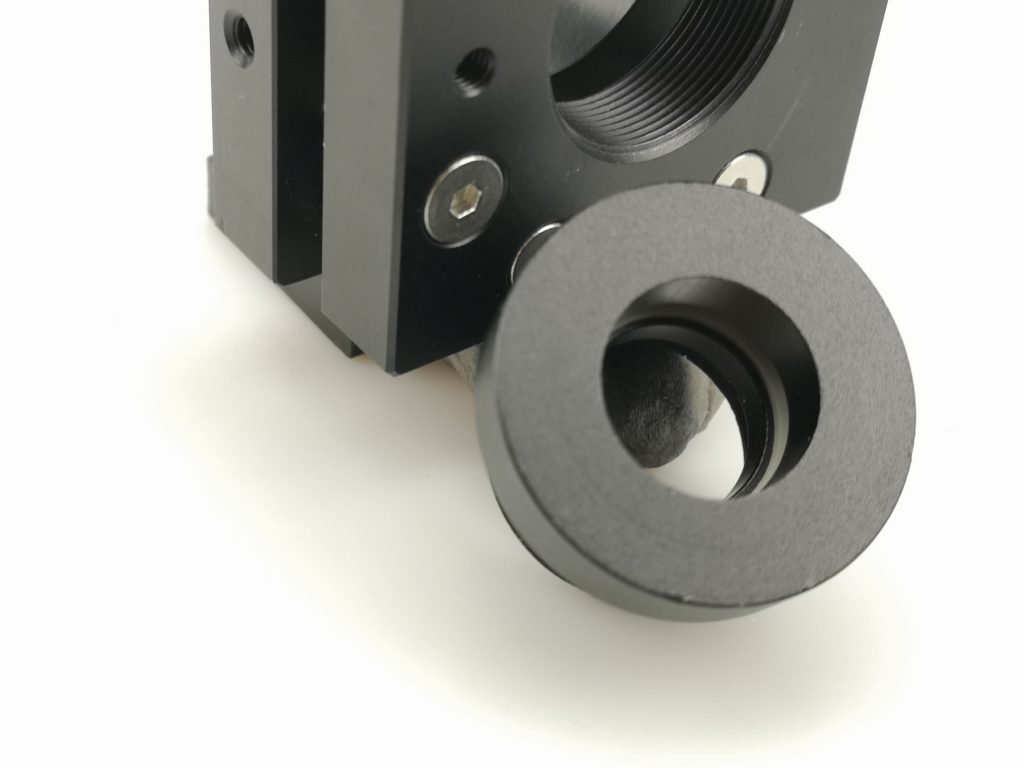
The D80C is an 80 mm precision rotary fixture (rotary chuck) used for circumferential marking of cylindrical workpieces in laser marking systems. It does not generate laser light itself; it is the motion axis of the marking machine. Once connected to the extended axis of a marking control card, the direction/pulse signals drive the built-in stepper motor to rotate the chuck while the galvo laser scans along the circumference of the workpiece. Working together, the two complete a full 360 degree wrap-around mark on the cylindrical surface: wrap-around text, circumferential logos and ring-shaped 2D codes are all easy to achieve.
The 80 mm chuck suits small-diameter cylindrical parts such as pen barrels, test tubes, small tubing and e-cigarette tubes. Compared with the D160F (160 mm large chuck), the D80C is smaller, lighter and more flexible to install, making it a good match for small and medium marking machines or workstations with limited space.
Key Features
- 80 mm precision chuck: designed for clamping and rotary marking of small-diameter cylindrical workpieces
- Stepper motor drive: accepts the direction/pulse signals of the marking card extended axis, giving controllable rotation angle and stable repeat positioning
- Compact design: small volume, light weight, flexible installation and minimal bench space
- Software linkage: works with the marking card and EzCad2 software for precise synchronization between rotation angle and laser scanning
- Batch friendly: meets the continuous rotary marking needs of volume production
Technical Specifications
| Parameter | Specification |
|---|---|
| Model | D80C |
| Product type | Rotary fixture (rotary chuck) |
| Chuck size | 80 mm |
| Drive method | Stepper motor |
| Control signal | Direction/pulse signal (connected to the extended axis of the marking card) |
| Typical workpieces | Small-diameter cylindrical parts such as pen barrels, test tubes, small tubing and e-cigarette tubes |
Note: detailed data such as rotation speed, torque and clamping range are subject to the delivered unit and its documentation. Please contact us for the full data sheet.
Model Comparison: D80C vs D160F
The key differences between the two rotary fixtures are the chuck size and the workpiece size they accept:
| Item | D80C (this page) | D160F |
|---|---|---|
| Chuck size | 80 mm | 160 mm |
| Suitable workpieces | Small-diameter cylinders: pen barrels, test tubes, small tubing, e-cigarette tubes | Larger-diameter cylinders: vacuum flasks, bottles, pipes |
| Size and weight | Compact and light, flexible installation | Larger body, higher load capacity |
| Drive method | Stepper motor | Stepper motor |
| Best matched machines | Small and medium marking machines, compact workstations | Large-workpiece marking machines, volume production lines |
Selection advice: choose the chuck size according to the outer diameter of the workpiece. For thin, small parts such as pen barrels and cigarette tubes choose the D80C; for vacuum flasks, large bottles and thick pipes choose the D160F. If you are not sure, send us the workpiece dimensions and we will match the chuck size for you.
Compatible Control Cards
The D80C connects to the extended axis of a marking card through direction/pulse signals and can be used with JCZ marking cards that have an extended axis, for example: LMCV4-FIBER, LMCV4-FIBER-M, FBLI-B-LV4A, SZLI-B-V4, LMCV4-DIGIT and PCIE-FB. Cards without an axis output (such as the FBLI-B-LV4) cannot drive a rotary fixture, so please check this when ordering a marking card.
Applications
- Pen barrel marking: circumferential logos and wrap-around text on metal pen barrels
- E-cigarette tube marking: brand and specification marks around the tube body
- Test tube and small part marking: batch numbers and scale marks on medical and laboratory ware
- Small pipe coding: ring-shaped 2D codes and serial numbers on small tubing
FAQ
Q1: Should I choose the D80C or the D160F?
A: Choose by workpiece diameter. The D80C with its 80 mm chuck suits small-diameter parts such as pen barrels, test tubes and e-cigarette tubes; the D160F with its 160 mm chuck suits large-diameter parts such as vacuum flasks, bottles and thick pipes.
Q2: How is the fixture connected to the marking card?
A: The stepper motor of the rotary fixture receives the direction/pulse signals output by the extended axis of the marking card. Please make sure your marking card has an extended axis (for example LMCV4-FIBER-M, FBLI-B-LV4A or SZLI-B-V4). Contact Soar Laser for wiring guidance.
Q3: What can be marked with rotary marking?
A: Together with the marking software you can produce wrap-around text, circumferential logos and wrap-around 2D codes or serial numbers. In the software, set the object property to rotary marking and configure the rotary axis parameters.
Q4: What should I watch out for regarding drive and wiring?
A: The D80C is driven by a stepper motor. Please confirm the power supply and driver configuration with us before ordering, and follow the delivered unit and its wiring instructions to avoid damaging the motor or the board through incorrect wiring.
Disclaimer
The technical data on this page has been compiled from official public information of JCZ (BJJCZ) and verified against the physical product, and is provided for selection reference only. Appearance, connector definitions and specifications may change slightly with production batches or firmware upgrades; the delivered unit and the latest official technical documentation prevail. Software functions depend on the version actually supplied. If you have any questions about compatibility or wiring before ordering, please contact us to confirm and avoid losses caused by unsuitable purchases.
📞 Hotline: +86 159-2722-0467 (same number on WeChat)
Soar Laser · Professional laser accessory supplier · Genuine original products · Selection consulting and wiring guidance

Reviews
There are no reviews yet.