


Description
TOPTICA DFC CORE+ Offset-Free Optical Frequency Comb
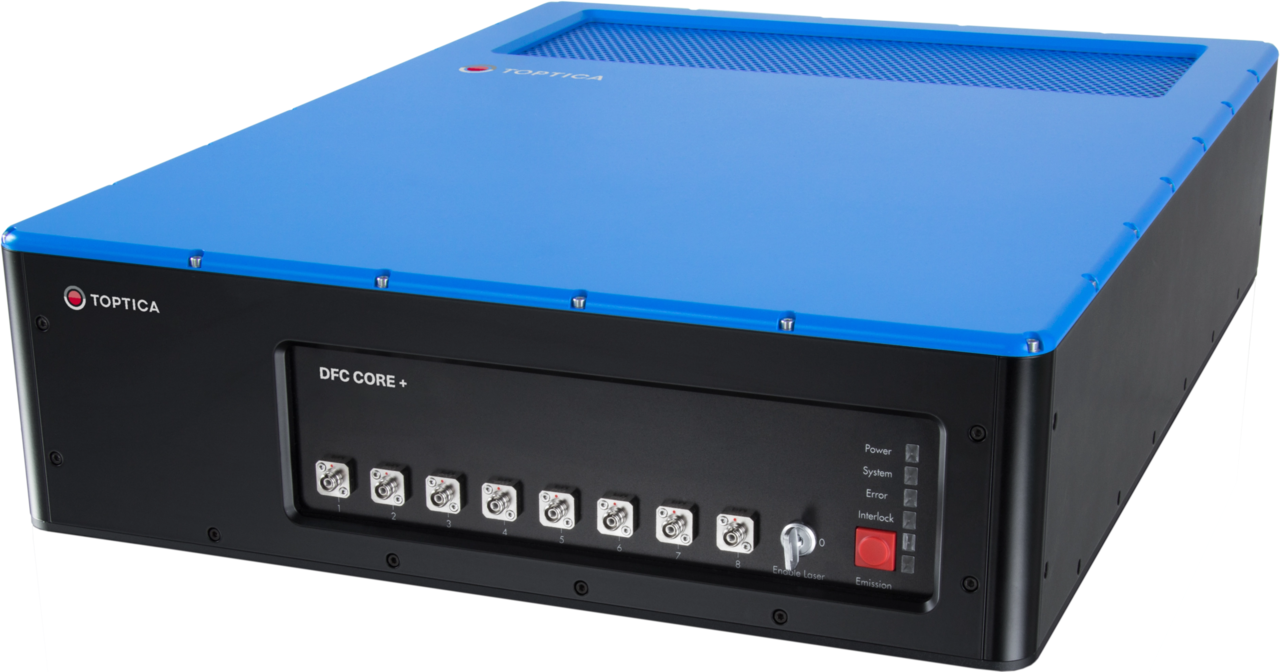
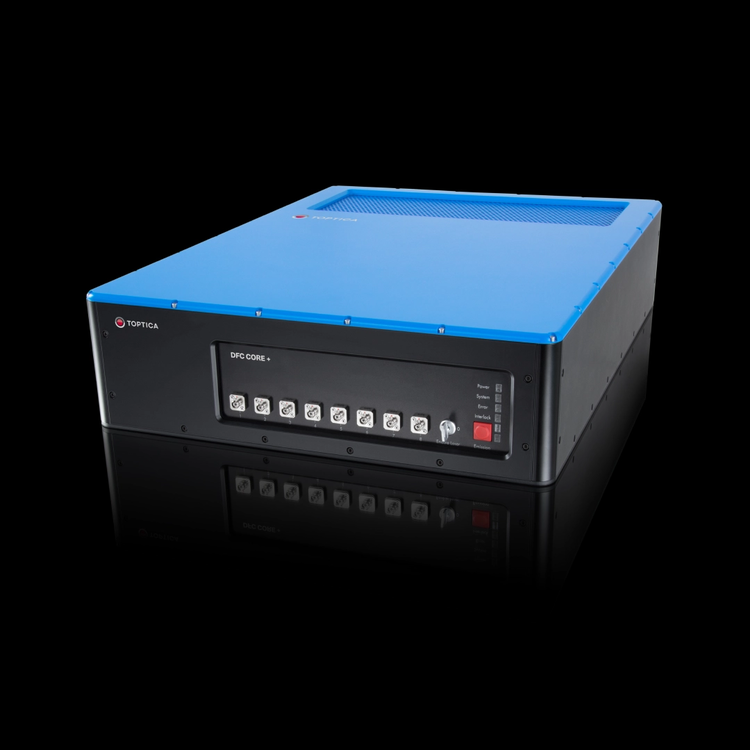
The TOPTICA DFC CORE+ is an offset-free optical frequency comb (also called a difference-frequency comb) with a centre wavelength of 1560 nm, comb spacing of 200 MHz or 80 MHz, and a standard 4 (expandable to 8) polarisation-maintaining fibre outputs at >10 mW each. It uses difference-frequency generation (DFG) to passively fix the carrier-envelope offset frequency fCEO to 0 — no f-2f detection and no CEO phase-locked loop, removing the electronic-noise channel at its source. Locked to an optical reference, the 1560 nm linewidth is <1 Hz with a stability of 5×10⁻¹⁸ @1 s; with wavelength-extension modules the coverage spans 420–2200 nm.
The bottom line for buyers: if your experiment needs a comb that locks as soon as it is switched on, runs long-term without adjustment and has extremely low phase noise — for optical clock comparison, absolute frequency locking of narrow-linewidth lasers, fibre-based frequency transfer or precision spectroscopy — the DFC CORE+ is among the lowest-maintenance commercial options. For sub-kHz optical linewidth and traceability to the SI second, pair the DFC CORE+ with the DFC PURACY upgrade package.
Key Specifications (DFC CORE+, official data dated 2026-07-22)
| Parameter | Value |
|---|---|
| Centre wavelength | 1560 nm (420–2200 nm with wavelength-extension modules) |
| Comb spacing (repetition rate) | 200 MHz or 80 MHz |
| Laser outputs | 4 (upgradeable to 8), fibre-coupled, polarisation-maintaining (PM), FC/APC |
| Bandwidth (per output) | 20 nm (FWHM, each) |
| Power (per output) | > 10 mW (each); > 36 nm range @ −10 dB |
| Offset frequency fCEO | fCEO = 0, passively stabilised by difference-frequency generation (DFG) |
| Integrated phase noise of fCEO | < 40 mrad [100 Hz – 2 MHz]; < 65 mrad [70 mHz – 20 MHz] |
| Linewidth @ 1560 nm | < 1 Hz (locked to an optical reference) |
| Lock bandwidth of frep | 600 kHz (optical reference); 10 kHz (RF reference) |
| Stability | 5×10⁻¹⁸ @1 s and 5×10⁻²⁰ @1000 s (optical reference); 1×10⁻¹³ @1 s (RF reference) |
| Accuracy | 1×10⁻¹⁸ (τ > 100 s, optical reference); 1×10⁻¹⁴ (τ > 100 s, RF reference) |
| Frequency reference | Optical reference or RF reference (both optional) |
| Reference input | 800 MHz (RF reference); 10 MHz (with DFC RF); high-bandwidth Imod, DC – 10 MHz (optical reference) |
| Dimensions (H × W × D) | 133 × 450 × 633 mm (including electronics) |
| Cooling | Air cooled — no water cooling required |
| Power consumption | < 110 W |
| Operating temperature | 21 ± 4 °C |
| Weight | < 32 kg |
| Input voltage | 100 – 240 V ~, 50/60 Hz |
| Laser class | 3B (EN 60825-1:2014+A11:2021 / IEC 60825-1:2014) |
CERO Technology: Why fCEO = 0 Is Easier Than Active Phase Locking
The conventional route for fibre-based frequency combs is: measure the carrier-envelope offset frequency fCEO with an f-2f self-referencing interferometer, then use a phase-locked loop (PLL) to lock fCEO to zero or a fixed value. This route carries three inherent burdens — it needs an octave-spanning spectrum, an f-2f optical path, and a dedicated CEO locking electronics chain — and the PLL itself injects electronic noise and can lose lock under environmental disturbance.
DFC takes a different path. TOPTICA’s CERO (Carrier Envelope Offset Reduction) technology mixes two different spectral components of an erbium (Er)-doped femtosecond fibre laser by difference-frequency generation (DFG), and the difference naturally satisfies fCEO ≡ 0. The optical waveform is therefore fixed pulse by pulse and fCEO need be neither measured nor locked. The engineering consequences are direct:
- One PLL fewer: with no CEO locking electronics there is one fewer noise-injection channel and one fewer component that can lose lock;
- Noise suppression orders of magnitude faster: the passive mechanism is not limited by loop bandwidth, whereas an active PLL’s gain falls off beyond it;
- Every comb tooth inherits the same low noise: CEP noise is shared by all comb teeth, so the whole spectrum benefits — including after wavelength extension;
- One-button automatic (re)locking: the system automatically identifies beat signals, finds the beat sensitivity and determines the optimal piezo position; if a disturbance breaks lock mid-experiment it recovers automatically in the background — no manual retuning.
System Composition and Options
| Module (option) | Description / function |
|---|---|
| DFC CORE + | Main unit: complete self-referenced offset-free comb with electronics and 4 × 1560 nm optical outputs |
| 8 outputs | Output upgrade: 4 → 8 offset-free 1560 nm outputs |
| DFC Wavelength Extensions | Wavelength extension: converts 1560 nm to any design wavelength from 420–2200 nm (see table below) |
| DFC Beat Detection | Beat detection: DFC BC / DFC BCF combiners + DFC MD detector, SNR > 50 dB |
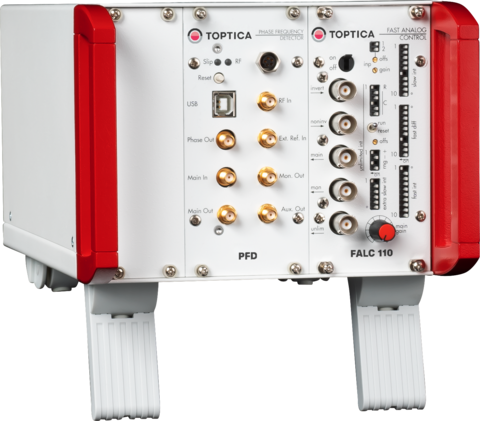
| DFC Locking Electronics | Locking electronics: FALC/FALC pro high-speed PLL modules + PFD/PFD pro phase-frequency detectors |
| DFC PURACY | Ultimate-precision upgrade: sub-kHz optical linewidth + simultaneous optical and RF reference locking, absolute frequency traceable to the SI second |
| Reference (DFC RF / DFC GPS / DFC RF TUNE / CLS) | Reference sources: from long-term-stable (RF, GPS) to tuneable (RF TUNE) to ultra-low phase noise (CLS optical reference) |
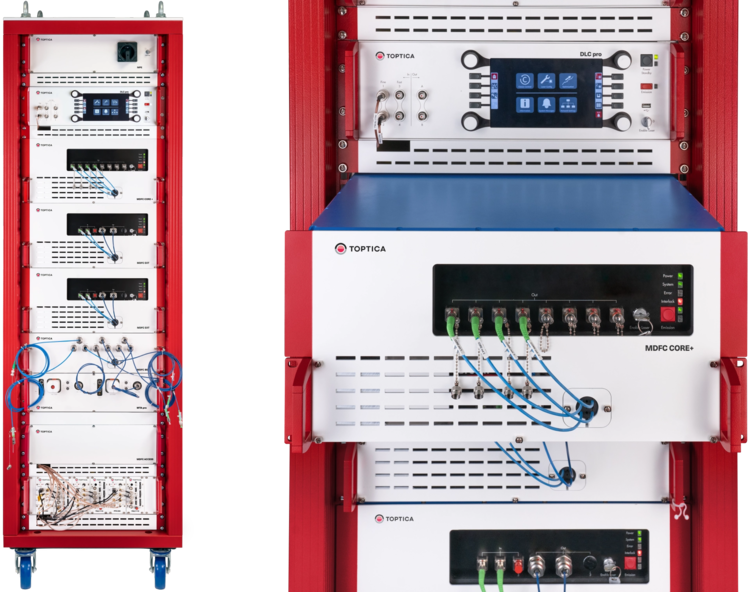
| 19″ rack integration (MDFC / T-RACK) | Rack integration: modular installation in a standard 19-inch cabinet — space-saving and easy to relocate |
Wavelength Extension Modules (DFC Wavelength Extensions)
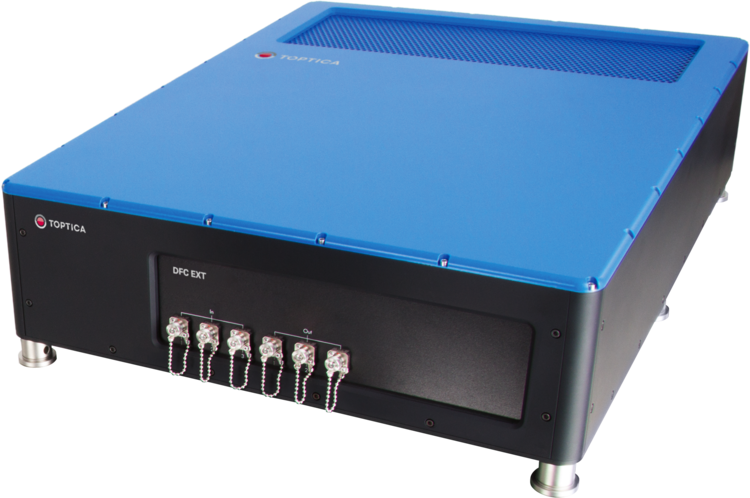
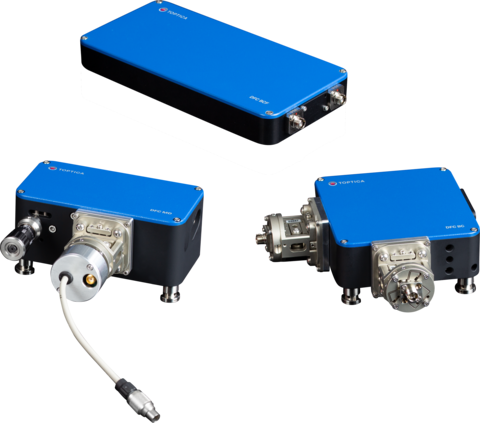
The extension modules convert the 1560 nm offset-free fundamental of the DFC CORE+ to the target band using TOPTICA’s proven femtosecond fibre-laser frequency-doubling / supercontinuum technology. The modular design supports field installation: each (M)DFC EXT chassis holds up to 3 extension modules, each independently remote-controlled.
| Model | Wavelength coverage | Typical use |
|---|---|---|
| DFC IR | 1560 nm, high-power broadband | Telecom device testing, narrow-linewidth laser locking in the 1550 nm band |
| DFC SCIR | Design wavelength 980–2200 nm | Mid-infrared spectroscopy, 2 µm laser locking |
| DFC SCNIR | Design wavelength 840–980 nm | Yb / semiconductor laser locking, quantum-dot and microresonator characterisation |
| DFC NIR | 780 nm, high-power broadband | Rb atom cooling and trapping, 780 nm narrow-linewidth laser locking |
| DFC VIS-L | Design wavelength 640–840 nm | Sr / Rb related transitions, precision spectroscopy |
| DFC VIS-S | Design wavelength 420–640 nm | Ca⁺ and Sr optical clock transitions, visible-band absolute frequency measurement |
| (M)DFC EXT | Chassis, control and power supply, up to 3 extension modules | System expansion and rack integration |
DFC PURACY Upgrade: Sub-kHz Linewidth and SI Traceability
DFC PURACY is the precision upgrade package for the DFC CORE+. Its core capability is locking an optical reference and an RF reference simultaneously: the optical reference handles short-term phase noise and linewidth, the RF reference handles long-term stability and absolute accuracy, and together the absolute frequency becomes traceable to the SI second. The locking process runs automatically via a patented control principle (DE102017131244B3, US10,931,078B2).
| Parameter | Value |
|---|---|
| Wavelength coverage | 420 / 532 / 689 / 778 / 1000 / 1162 / 1550 / 2000 nm |
| Optical linewidth * | 13 / 9 / 7 / 5 / 2 / 1.3 / 0.6 / 0.3 kHz (matched to the wavelengths above) |
| Output power | > 10 mW |
| Fractional stability | 3×10⁻¹⁵ @100 s; 5×10⁻¹⁶ @1000 s; 2×10⁻¹⁶ @10000 s |
| Typical phase noise @ 1550 nm | 23 dBc/Hz @1 Hz; 11 dBc/Hz @10 Hz; −18 dBc/Hz @100 Hz; −38 dBc/Hz @1 kHz; −58 dBc/Hz @10 kHz |
* Integration interval 100 Hz to the beta separation line. Stability figures: 3×10⁻¹⁵ @100 s, 5×10⁻¹⁶ @1000 s, 2×10⁻¹⁶ @10000 s (DFC PURACY contributions, ultimately dependent on the RF reference). Typical phase noise @1550 nm: 23 dBc/Hz @1 Hz, 11 dBc/Hz @10 Hz, −18 dBc/Hz @100 Hz, −38 dBc/Hz @1 kHz, −58 dBc/Hz @10 kHz.
Beat Detection and Locking Electronics (Locking Any CW Laser to the Comb)
Locking a narrow-linewidth continuous-wave (CW) laser to the comb relies on the beat note. The DFC series provides a two-tier solution:
- DFC BC: fibre-input beam combiner; the comb/CW splitting ratio is continuously adjustable via polarisation optics, with free-space or fibre output — suited to cases where signal strength must be optimised on site.
- DFC BCF: all-fibre combiner with three fixed splitting ratios — lower cost, lower insertion loss, better repeatability.
- DFC MD: monochromatic detector unit, fibre-coupled, with a built-in 10 GHz-bandwidth grating filter to suppress unwanted comb teeth; combined with DFC BC / BCF it yields beat signals with SNR > 50 dB, covering 420–2000 nm.
- DFC Locking Electronics: FALC/FALC pro high-speed PLL module + PFD/PFD pro phase-frequency detector, with an internal tuneable RF source (for offset-phase-frequency locking), 10 MHz reference input and beat-signal conditioning, all remote-controlled through the TOPAS DFC GUI.
A detail often overlooked: DFC BC / BCF are designed so that the CW laser light not used for beating remains available for the experiment — and this residual light contains no comb light, so it does not pollute the downstream path, and it makes comb-tooth numbering with a wavemeter straightforward.
Comparison and Selection: DFC CORE+ vs Other Combs on This Site
This site also offers the Thorlabs comb series. Choose along three lines: “wavelength band + whether f-2f active locking is acceptable + comb spacing”:
| Model | Technology | Centre wavelength / rep rate | Suited to |
|---|---|---|---|
| TOPTICA DFC CORE+ (this page) | Er fibre + DFG, fCEO passively 0, no CEO locking loop | 1560 nm, 200 / 80 MHz, extended 420–2200 nm | Lowest phase noise, longest unattended run time, several CW lasers to lock |
| Thorlabs FC1000-250 | Yb-doped fibre, f-2f self-referencing + active locking | 1030 nm, 250 MHz | Work centred on the 1 µm band with direct 1030 nm output |
| Thorlabs FC800 | Ti:sapphire femtosecond laser, f-2f self-referencing | 800 nm, 250 MHz | Broad spectrum and high repetition rate near 800 nm |
| Thorlabs SMART-COMB | Compact fibre comb | 1.5 µm, 100 MHz | Budget- and size-first teaching or engineering uses with moderate specs |
| Thorlabs MID-IR-COMB | Mid-IR difference-frequency comb | 250 MHz (typical) | Direct coverage of the mid-infrared band |
Note: the lower the comb spacing (80 MHz vs 200 MHz / 250 MHz), the denser the comb teeth and the freer the choice of CW laser wavelengths that can be locked — but the lower the power per tooth. The 80 MHz option of the DFC CORE+ exists precisely for this trade-off; if your application is “three narrow-linewidth lasers at different wavelengths, all to be locked to one comb”, the 80 MHz version is usually the better fit.
Typical Applications
- Optical frequency transfer and infrastructure (frequency distribution): remote control + automatic locking + long-term reliability — metrology networks and fibre frequency-transfer links.
- Optical quantum clocks: clock comparison and sub-Hz spectral-purity transfer (requires DFC PURACY).
- Precision spectroscopy and tests of fundamental constants: an SI-traceable absolute frequency ruler with narrow linewidth and low phase noise.
- Photonic microwave generation: extracting high-purity microwaves from comb-tooth beats, with customisable 9.6 GHz, −165 dBc/Hz-class ultra-low-phase-noise RF outputs.
- Atom cooling and trapping, quantum computing and simulation, quantum communication: one frequency reference for many lasers.
- Length metrology: SI-second traceable calibration of stabilised HeNe and similar lasers.
- Quantum dot / microresonator / photonic integrated circuit (PIC) characterisation: high absolute frequency accuracy plus broad coverage.
- Attosecond physics: a driving source with fully controlled carrier-envelope phase (CEP).
Frequently Asked Questions (FAQ)
A: It is an offset-free difference-frequency comb based on an erbium (Er)-doped femtosecond fibre laser; difference-frequency generation passively fixes fCEO to 0, with no f-2f self-referencing detection and no CEO phase-locked loop.
A: One PLL fewer means one fewer electronic-noise channel and one fewer component that can lose lock; noise suppression is not limited by loop bandwidth and is orders of magnitude faster than active locking; all comb teeth share the same low CEP noise, including after wavelength extension.
A: 80 MHz gives denser teeth and freer choice of CW laser wavelengths — suited to locking several lasers of different wavelengths simultaneously; 200 MHz gives higher power per tooth and stronger beat signals — suited to single-laser locking or high-SNR requirements.
A: The DFC CORE+ itself outputs 1560 nm (20 nm FWHM per output, >10 mW). With wavelength-extension modules the coverage is 420–2200 nm: VIS-S 420–640 nm, VIS-L 640–840 nm, NIR at 780 nm, SCNIR 840–980 nm and SCIR 980–2200 nm. Special wavelengths can be customised.
A: With the DFC CORE+ locked to an optical reference, the 1560 nm linewidth is < 1 Hz and the stability 5×10⁻¹⁸ @1 s and 5×10⁻²⁰ @1000 s; with only an RF reference the stability is 1×10⁻¹³ @1 s. For sub-kHz optical linewidth and SI-second traceability, add the DFC PURACY upgrade.
A: Yes, an RF reference (DFC RF or an external 10 MHz / 800 MHz) is enough to run, giving a stability of about 1×10⁻¹³ @1 s, adequate for most spectroscopy and laser-locking work; ultimate stability or clock comparison calls for an optical reference such as the CLS.
A: Yes. The DFC BC / BCF combiners and DFC MD detector cover 420–2000 nm and support CW lasers from other manufacturers as well as TOPTICA’s own; TOPTICA lasers lock seamlessly out of the box.
A: Air cooled, < 110 W — no water cooling. The main unit measures 133 × 450 × 633 mm, weighs < 32 kg, and can stand alone or be rack-mounted via MDFC / T-RACK in a 19-inch cabinet.
A: The pump modules use telecom-grade laser diodes (Telcordia GR-468-CORE certified) and are field-replaceable; on failure the module is replaced on site by TOPTICA or trained personnel with remote support — no full-unit return. Wavelength-extension modules can also be installed in the field.
A: All are fibre combs; the difference lies in how fCEO is handled: DFC fixes it passively to zero via DFG (no CEO locking electronics), while conventional schemes (figure-9 mode locking + f-2f self-referencing + active PLL) need a CEO loop. Choose DFC for the lowest phase noise and least maintenance; choose a Yb fibre comb for work centred on 1030 nm; choose a mid-IR model for direct mid-infrared output. For a specific setup, send us your laser list and target wavelengths for a selection review.
A: Frequency combs are quoted by configuration (comb spacing, number of outputs, extension wavelengths, reference source, locking modules and racking all affect price and lead time). Contact us with your application requirements and laser list; we will confirm with the manufacturer and provide a formal quotation and delivery time.
Official Documentation Downloads
- TOPTICA DFC CORE+ product information (product_info_TOPTICA_DFC_en.pdf)
- TOPTICA DFC PURACY product information (product-info_TOPTICA_DFC-PURACY_en.pdf)
- Manufacturer product page (TOPTICA China site)
Related Products
- Frequency Combs category (all comb models on this site)
- Thorlabs FC1000-250 Yb-doped fibre comb (250 MHz, 1030 nm)
- Thorlabs FC800 femtosecond comb (250 MHz, 800 nm)
- Thorlabs SMART-COMB compact comb (100 MHz, 1.5 µm)
- Thorlabs MID-IR-COMB mid-infrared comb (250 MHz)
Disclaimer: parameters on this page are excerpted from official TOPTICA product documentation (version dated 2026-07-22; DFC PURACY documentation 2026-02-18) for selection reference. The frequency comb is a configurable, built-to-order system; delivered specifications follow the manufacturer’s formal datasheet and contract. Items marked * depend on the chosen reference and configuration. Product photos are official TOPTICA images. Price, stock and lead time are subject to our quotation reply.
Reviews
There are no reviews yet.