



Description
Product Overview
PTZJ D1.31 puts the rotation where the seam is and leaves the optic still. It is a rotary-axis laser welding system: the workpiece is held in a rotating fixture, the welding head stays fixed, and the two motions are coordinated by a follow-up control so that a circumferential seam is produced in a single pass rather than in segments that have to be joined. Because the seam closes on itself with no start and no stop, there is no overlap where one pass ends and the next begins – the feature that shows up first on a flange weld as a slightly thicker, slightly darker patch that fails a visual standard.
The system is aimed at rotationally symmetric parts: flanges, pipe fittings, hubs and similar bodies where the joint is a circle and the part can be turned about its own axis. For that geometry a rotary axis is the simplest kinematic that can do the job. A robot can trace the same circle, but it carries six axes to describe one, and it adds programming, calibration and reach considerations that have nothing to do with the weld. Turning the part instead of moving the head keeps the optic at a constant distance and a constant angle to the joint for the entire revolution, which is precisely the condition that makes penetration uniform around the circle.
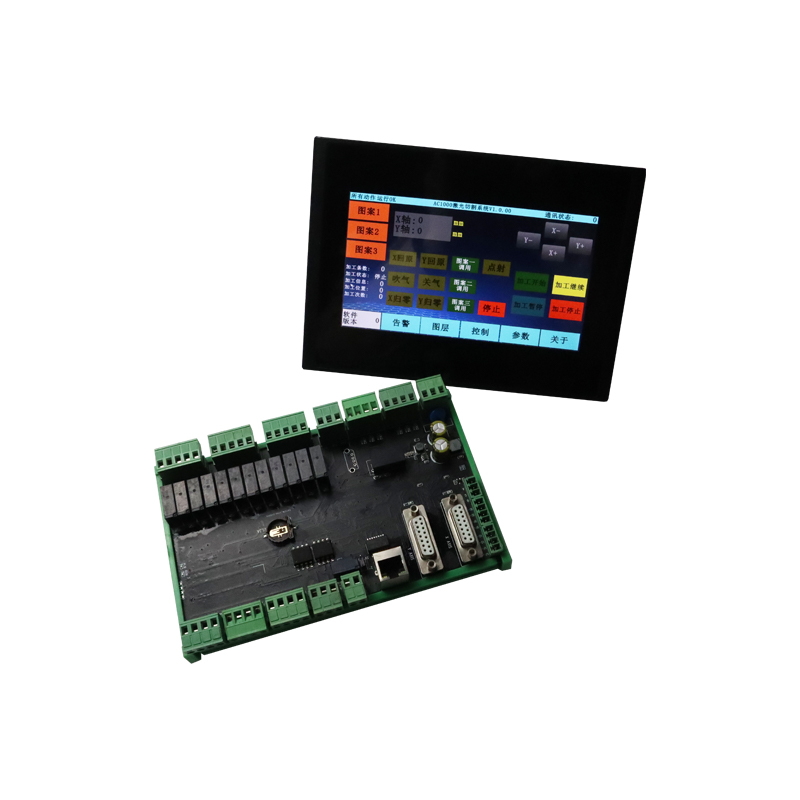
D1.31 is supplied as a system rather than as a component: rotating fixture, follow-up control and control cabinet together, and it can be bought as a set with the FQ series dedicated machines and the F series CNC systems. Installation and commissioning are supported on site by our technical team, and the system is handed over ready to run rather than as a set of parts to be integrated by the customer. The table below lists what the manufacturer publishes for this model. Workpiece diameter, weldable wall thickness and the matching laser source are set by the fixture specification and by the joint design, so they are confirmed against your part drawing rather than quoted as fixed numbers.
Key Features
- Seam closed in one revolution: 360 degrees of continuous weld with no start-stop overlap, so the seam has one consistent cross section all the way round instead of a joint that has to be dressed
- Rotation and welding coordinated: the follow-up control keeps the head at working distance while the axis turns, so focus height does not drift as the part runs out
- Built for rotationally symmetric parts: flanges, pipe fittings and hubs sit in a chuck and turn about the joint axis, which is the geometry the kinematic is designed around
- Repeatable across a batch: because the motion is a single axis at a fixed radius, part-to-part variation comes from the fixture and the joint fit rather than from the motion program
- Fixture and control as one system: chuck, tailstock and control are matched and supplied together, so the clamping reference and the rotation reference are the same reference
- Standard fibre interface: accepts mainstream QBH lasers, so the source can be chosen for wall thickness and penetration depth rather than for connector compatibility
Technical Specifications
| Brand | PTZJ |
| Model | D1.31 |
| Product type | Rotary-axis laser welding system |
| Process | Automatic circumferential seam welding |
| Workpiece type | Flange, pipe fitting, hub and other rotationally symmetric parts |
| Motion principle | Workpiece rotates, welding head fixed, follow-up control synchronised with the axis |
| Laser interface | QBH, mainstream fibre lasers |
| Fixture | Rotary chuck with tailstock, integrated with the control |
| Workpiece range | Set by the rotary fixture and chuck stroke; confirmed per part drawing |
| Laser source | Selected by wall thickness and required penetration depth, not included as a fixed rating |
| System composition | Rotary fixture, follow-up unit and control cabinet; can be ordered as a set with FQ series machines and F series CNC |
| Commissioning | On-site installation and adjustment supported by our technical team |
Applications
The system is used wherever a circular joint has to be welded at a rate that a manual station cannot hold. In practice the parts are short, the seam is short, and the cost of the operation is dominated by handling and by consistency rather than by welding speed – which is exactly where a fixed head and a turning fixture pay for themselves.
- Flange to pipe circumferential welding in pipe fittings and valve body production
- Butt welding of pipe sections and fittings where the joint is a full circle
- Hub and disc shaped parts with a circular joint on one or both faces
- Batch production of rotationally symmetric parts where the same seam is repeated hundreds of times per shift
- Rework and repair stations that need the same seam quality as the production line
Because the fixture sets the reference, the system suits a family of parts more than a single part. A shop that welds four flange sizes on one machine will normally hold one set of jaws and one parameter set per size, and change over by calling the stored program rather than by re-teaching a path.
Selection Guide
- Send the part drawing first: outside diameter, bore, flange thickness, joint preparation and the required penetration decide the fixture, the chuck stroke and the laser source. Without the drawing the specification cannot be fixed
- Buy the machine and the CNC system as a set where possible. The rotation, the follow-up and the weld program are commissioned together, and splitting the order across two suppliers moves the coordination cost onto you
- Before the first production batch, check coaxiality and run-out on a scrap part, then trial weld and cut a section. Seam offset does not appear as an alarm; it appears as penetration that varies from one side of the circle to the other
- Build a parameter archive by flange specification and reuse it. A stored program per size removes most of the changeover time, and it also removes the variation that comes from re-entering numbers at the panel
- If the part needs filler wire or a groove, say so at the quotation stage. Autogenous welding of a tight butt joint and welding with feed are different process setups
- Consider the handling path as part of the project. The cycle is short, so loading and unloading usually determine the real output of the station
Series Comparison
Three ways of putting a laser on a circular seam are offered in this range, and they are not interchangeable. The choice follows the part, not the budget.
| Option | Kinematic | Best for | Main limitation |
| PTZJ D1.31 (this page) | Rotary axis, head fixed, follow-up control | Flanges, pipe fittings, hubs and other parts that can be turned about the joint axis | The joint must be a circle on the axis of rotation |
| FQ1.0 dedicated flange machine | Dedicated flange fixture with locating tooling, supplied with CNC | Flange to pipe butt seams in batch production, one flange family | Tooling is built for a flange family, so a new family needs new tooling |
| F series CNC with a machine platform | Platform motion with the CNC as the controller | Jobs where the seam is not a simple circle and the motion has to be programmed | More programming work per part than a single-axis rotation |
The dividing question is simple: can the part be turned about the seam? If yes, D1.31 is the shortest path to a uniform seam. If the part is a flange family that will be produced in volume and the fixture can be dedicated, FQ1.0 removes even the setup step. If the seam is not a circle, none of the rotary options apply and the work moves to a programmed platform.
Usage Precautions
- Laser safety: a fibre laser at welding power is a Class 4 hazard. The station must be enclosed with interlocked guarding, the working area marked, and everyone present wearing eyewear matched to the wavelength in use. Never look into the beam or into a specular reflection while aligning the head
- Fixture maintenance: lubricate the chuck and tailstock on the schedule the manufacturer specifies, and replace worn jaws rather than adjusting around them. Worn jaws show up as run-out, and run-out shows up as a seam that is good on one side and cold on the other
- Re-datum after any fixture change: replacing jaws, a chuck or a tailstock changes the rotation reference. Check coaxiality with a dial gauge before the next production run, not after the first rejected part
- Cooling and process gas: verify chiller flow and temperature, and gas flow, at the start of each shift. A welding optic that overheats drifts its focus, and the result looks like a parameter problem rather than a cooling problem
- Electrical work: connection and service by a qualified electrician only, with lockout and tagout before any panel is opened. Servo drives are sensitive to grounding quality, so the protective earth is part of the weld quality, not just a safety formality
- Transport and storage: keep the unit dry and dust free, support the rotary table during lifting, and never lift by the chuck or the tailstock. Long storage requires the fixture surfaces to be protected against corrosion
- Fume extraction: welding produces fume and spatter. Extraction at the seam is part of the installation, not an accessory, and a blocked extraction path deposits contamination on the protective window
FAQ
What diameter can it weld?
The range is set by the rotary fixture and the chuck stroke, and by the follow-up travel. Common sizes are quoted on request against your part drawing; there is no single maximum that applies to every configuration.
Which laser should be matched to it?
The source is chosen from wall thickness and required penetration depth, and mainstream QBH fibre lasers are accepted. We normally size the source together with the joint design, because penetration is decided by the pair and not by the laser alone.
How does this compare with a robot doing circumferential welding?
For a circular joint the rotary axis is structurally simpler and lower in cost, and it holds a constant angle and distance to the seam for the whole revolution. A robot earns its cost when the seam is not a circle or when several different seams are reached in one clamping.
Is filler wire needed?
Not for a tight butt joint without a groove, which can be welded autogenously. Where the fit-up leaves a gap, or where the joint design calls for reinforcement, a feed arrangement is added and the process setup changes accordingly.
Can it weld a seam that is not a full circle?
No. The kinematic is a single rotation, so the seam has to close on itself about the axis. Partial arcs are possible by programming start and end angles, but a seam that is not circular belongs on a platform or robot system.
Disclaimer
Specifications on this page are compiled from the manufacturer’s published material and from existing documentation, and are provided as a selection reference. The delivered configuration is defined by the order confirmation, the factory test report and the current manufacturer specification; fixture size, chuck stroke and laser source are project-specific and are fixed in the technical agreement. Appearance and configuration may change between batches, so confirm the details with us before ordering. Reproduction of this page without written permission is not permitted.
Selection enquiries: Changsha Soar Laser Equipment Co., Ltd., hotline +86 159 2722 0467, www.soar-laser.cn, email 859818709@qq.com.


Reviews
There are no reviews yet.