


Pulse Laser Parameter Calculator
Quickly calculate the relationships between average power, peak power, single-pulse energy, pulse width, repetition rate and duty cycle, with multi-unit switching to help you understand pulse laser characteristics in depth.
🔬 Pulse Laser Parameter Calculator
Enter the known parameters and the remaining ones are calculated automatically (pulse width is required for peak power calculation).
💡 Hint: enter at least2 known parameters + pulse width, then click the “Calculate” button
Pulse Parameters Explained
Understand the seven core parameters of a pulse laser and their physical meaning.
Average power
Pavg
The total energy output by the laser per unit time, averaged over a long period.
Unit: watts (W)
Meaning:Determines the overall heat input and processing efficiency in laser materials processing; the first parameter to consider when selecting a laser.
Peak power
Ppeak
The maximum power reached by a single pulse — the instantaneous power peak of the pulse.
Unit: W / kW / MW
Meaning:Determines the intensity of laser–matter interaction. Nanosecond lasers can reach peak powers tens of thousands of times their average power; femtosecond lasers can reach millions of times.
Single-pulse energy
E
The total energy carried by a single pulse — the work done by one pulse.
Unit: J / mJ / μJ
Meaning:Determines the total energy delivered to the material by one pulse, affecting drilling depth, marking depth and material removal.
Repetition rate
frep
The number of pulses emitted per second — the rate at which pulses repeat.
Unit: Hz / kHz / MHz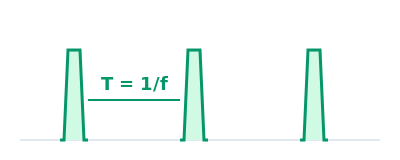
Meaning:Affects processing speed and pulse overlap. A higher rate means more pulses per unit time and higher processing efficiency, but lower energy per pulse.
Pulse width
τ (tau)
The duration of a single pulse, normally defined by the full width at half maximum (FWHM).
Unit: s / ms / μs / ns / ps / fs
Meaning:Determines peak power and the size of the heat-affected zone. A narrower pulse width gives higher peak power and less thermal effect, enabling ‘cold processing’.
Pulse period
Δt = T
The time interval between two consecutive pulses — the reciprocal of the repetition rate.
Unit: s / ms / μs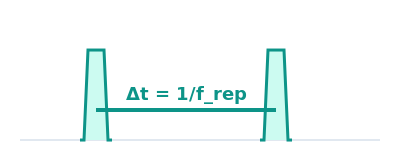
Meaning:Understanding the period helps in understanding repetition rate. f_rep = 80 MHz means one pulse every 12.5 ns.
Duty cycle
D = τ / Δt
The fraction of total time the pulse is ‘on’, reflecting the operating duty cycle of the laser.
Unit: percentage (%)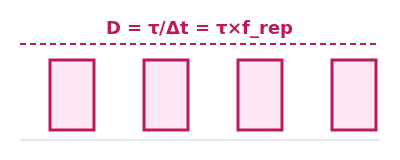
Meaning:Understanding duty cycle is key to understanding pulse lasers. Nanosecond lasers typically have a duty cycle below 0.1%, meaning they are ‘off’ 99.9% of the time.
Parameter Relationship Diagram
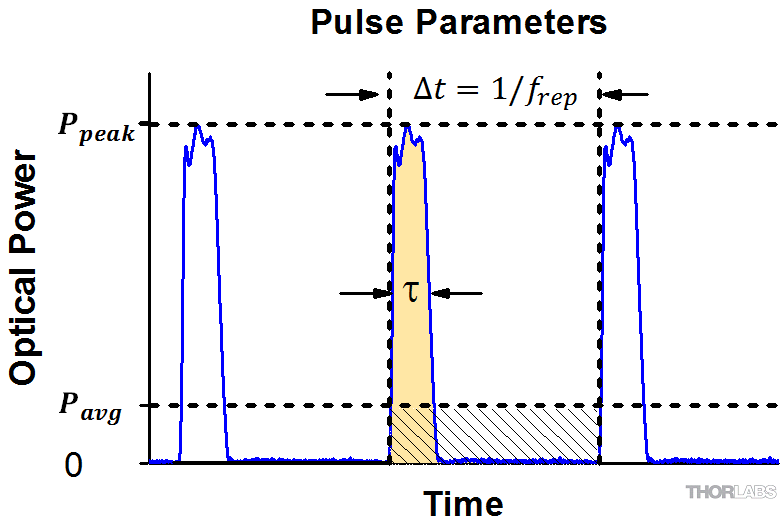
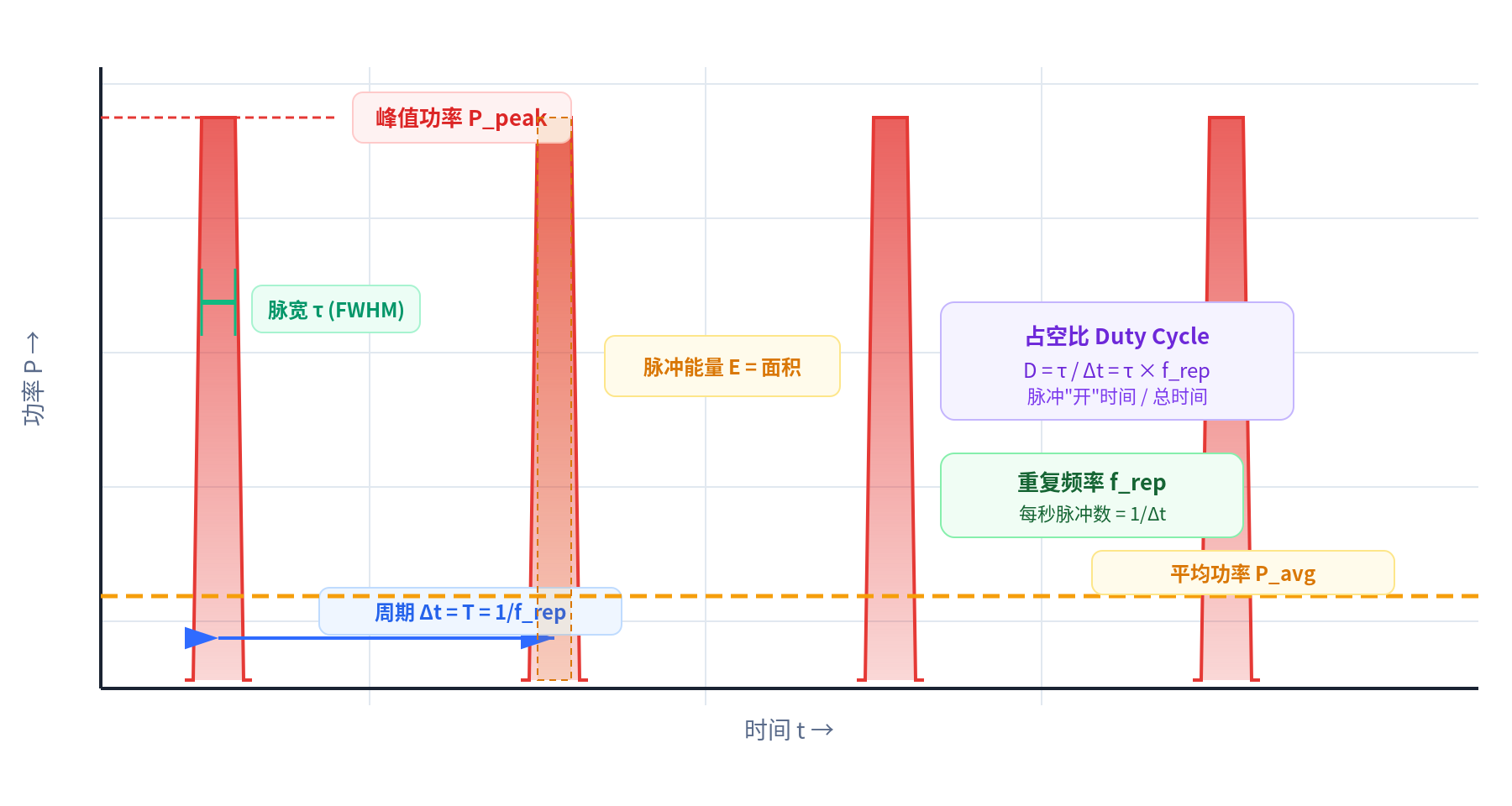
See at a glance how the parameters of a pulse laser relate to one another
▲ Animated diagram of pulse laser waveform parameters (reference: Thorlabs official tutorial)
Core Formula Summary
Master these 6 formulae to convert between all pulse laser parameters with ease
frep = 1 / Δt
Use:Period and repetition rate can be converted into each other. A higher frequency means a shorter period.
= Pavg · Δt
Use:Given average power and repetition rate (or period), find the single-pulse energy.
= E · frep
Use:Given single-pulse energy and period (or repetition rate), find the average power.
Use:Given pulse energy and pulse width, estimate the peak power. This is an approximation; the actual value depends on pulse shape.
Pavg = Ppeak · f · τ
Use:Direct conversion between peak power and average power without first finding pulse energy.
Ppeak = Pavg / D
Use:Duty cycle is the fraction of time the pulse is ‘on’. Peak power = average power / duty cycle.
Parameter Influence Relationships
How do pulse width and repetition rate affect average power? See at a glance
⏱️Effect of pulse width on average power (peak power fixed)
Conclusion:With peak power fixed, average power isdirectly proportional。
to pulse width.
Narrower pulse width → less energy per pulse → lower average power.
📊(Example conditions: P_peak = 50 mW, f = 1 MHz)
Conclusion:Conclusion:directly proportional。
directly proportional
to repetition rate.
Higher frequency → more pulses per unit time → higher average power.
P_avg = P_peak × f_rep × τ(Example conditions: P_peak = 50 mW, τ = 20 ns)
Key Conclusions
— Average power is directly proportional to peak power, repetition rate and pulse width alike.
There are three ways to increase average power: raise the peak power, raise the repetition rate, or increase the pulse width. However, these three parameters affect the processing result in completely different ways and cannot be treated as equivalent.
Parameter Derivation Diagram
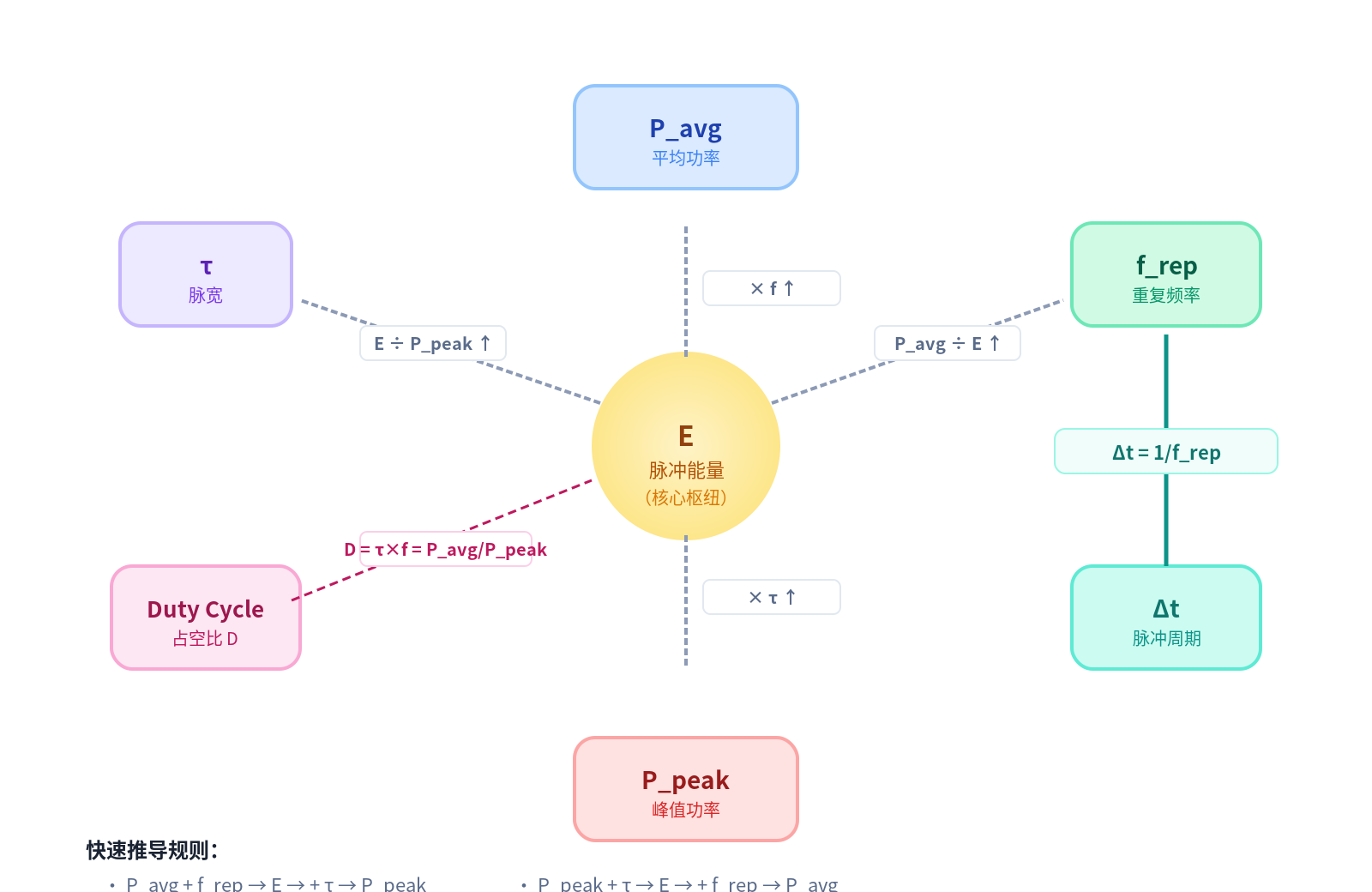
Which two known parameters determine all the others? See the derivation chain at a glance
Common Misconceptions
Avoid these misunderstandings to truly grasp pulse laser parameters‘Low pulse energy means safe’ — completely wrong!A pulse energy of only a few picojoules may look safe, but if the pulse width is just 10 femtoseconds, peak power can reach the kilowatt level! When selecting a detector you
must consider both pulse energy and peak power
— neither may exceed the detector damage threshold.Average power ≠ peak powerUnder nanosecond pulses, peak power can be tens of thousands of times the average power; under femtosecond pulses, millions of times.
Average power cannot be used to judge laser processing intensity
— it is peak power that determines the material removal mechanism.Narrower pulse width means higher peak powerWith pulse energy fixed, a shorter pulse width gives higher peak power. This is why femtosecond lasers, despite modest average power, can achieve ‘cold processing’ —
the extremely high peak power density vaporises material directly
with a minimal heat-affected zone.Energy ≠ power。
Energy is a quantity (joules, J); power is a rate (watts, W = J/s). Single-pulse energy is the total energy of one pulse, while peak power is the instantaneous power during the pulse.
The two are entirely different concepts with different unitsRaising repetition rate ≠ raising peak powerRaising the repetition rate only increases average power (P_avg = E × f); it does not increase peak power. If the gain medium’s stored energy is unchanged,
a higher repetition rate actually means lower energy per pulse
and peak power may fall.Duty cycle is the key to understanding pulse lasers。
D = τ × f = P_avg / P_peak. Nanosecond lasers typically have a duty cycle below 0.1%, meaning the laser is ‘off’ 99.9% of the time.
Understand duty cycle and you understand the essential difference between pulsed and continuous-wave lasers
| Laser Detector Selection Guide | Different detector types suit very different applications; the wrong choice can give inaccurate readings or even burn out the detector | Sensor type | Recommended use |
|---|---|---|---|
|
What it measures |
Important cautions Photodiode |
Low-power CW lasers; low pulse power and energy measurement |
Power (CW);average power (pulsed)
⚠️ Fastest response(ns-level response time), suitable for high-speed pulse detection. |
|
Take special care of peak-power damage! |
Pulse laser peak power can be 5–6 orders of magnitude above average power, easily exceeding a photodiode’s damage threshold. Thermopile |
Average power | CW and pulsed lasersAverage power
Slowest response(seconds-level response time), very accurate for average power.Converts all pulse energy into heat, so it is |
|
not affected by peak power |
as long as average power is within limits. Suitable for high-power pulsed lasers. Pyroelectric |
For pulsed lasers only | Single-pulse energy measurementPulse energyResponds only to pulse changes,
specifically for measuring single-pulse energy |
and cannot measure CW lasers.
1. What it measuresThree Principles of Detector SelectionPhotodiode: fastest response, but requires
2. Take special care of peak-power damage!— low pulse energy does not mean safe!Thermopile: most accurate and safest for average power, but
3. not affected by peak power, unsuitable for rapidly changing measurements.Pyroelectric: the first choice for pulsed laser energy measurement, but
only measures pulsesand cannot measure CW light.4. Under pulsed lasers, excessive average power can also cause
thermal damage
(pulse pile-up); both thresholds must be checked.
Calculation Examples
⚠️ Warning case: femtosecond laser detector safety assessmentBackgroundAn attenuated Ti:sapphire femtosecond laser has an
average power of only 1 mW
, which looks very low.Given: repetition rate 85 MHz, pulse width 10 fs.The detector’s
- maximum peak input power is 75 mW
E = P_avg / f_rep = 1 mW / 85 MHz = 1×10⁻³ W / 85×10⁶ Hz ≈ 11.8 pJ
, so is direct measurement safe? - First calculate the single-pulse energy (looks tiny):
P_peak = E / τ = 11.8×10⁻¹² J / 10×10⁻¹⁵ s = 1.18 kW
11.8 picojoules! Extremely low energy — looks safe? - Now calculate the peak power (the surprising truth):
D = τ × f = 10×10⁻¹⁵ × 85×10⁶ = 8.5×10⁻⁷ = 0.000085%
1.18 kilowatts! Six orders of magnitude above the average power! - Duty cycle calculation:
The laser is ‘off’ 99.9999% of the time, but the instant it is ‘on’ the power is astoundingSafety assessment conclusion:
Detector limit 75 mW vs actual peak power 1180 W =
Unsafe!
- Repetition rate
E = P_avg / f = 20 W / 20,000 Hz = 0.001 J = 1 mJ - Pulse width
P_peak = E / τ = 0.001 J / 100×10⁻⁹ s = 10,000 W = 10 kW - Calculate single-pulse energy:
Δt = 1/f = 50 μs;D = τ/Δt = 100 ns / 50 μs = 0.002 = 0.2% - Calculate peak power:Calculate period and duty cycle:
Duty cycle
- Pulse width
P_avg = E × f = 50×10⁻⁶ J × 50,000 Hz = 2.5 W - Pulse width
P_peak = E / τ = 50×10⁻⁶ J / 15×10⁻⁹ s ≈ 3.33 kW - Calculate average power:
D = τ × f = 15×10⁻⁹ × 50,000 = 0.00075 = 0.075% - Calculate peak power:Calculate duty cycle:
Duty cycle
- Repetition rate
E = P_avg / f = 10 W / 200,000 Hz = 50 μJ - Pulse width
P_peak = E / τ = 50×10⁻⁶ J / 10×10⁻¹² s = 5,000,000 W = 5 MW - Calculate average power:
D = τ × f = 10×10⁻¹² × 200,000 = 2×10⁻⁶ = 0.0002% - Calculate peak power:Calculate duty cycle:
Peak-to-average ratio
- Scenario C:
P_avg(A) = 50mW × 1MHz × 39ns = 50×10⁻³ × 10⁶ × 39×10⁻⁹ = 1.95 mW
P_avg(B) = 50mW × 1MHz × 12ns = 0.6 mW
Scenario D:Effect of changing pulse width (repetition rate fixed at 1 MHz): - Pulse width reduced from 39 ns to 12 ns (×0.31); average power falls proportionally from 1.95 mW to 0.6 mW →
P_avg(C) = 50mW × 5MHz × 20ns = 5 mW
P_avg(D) = 50mW × 10MHz × 20ns = 10 mW
directly proportionalEffect of changing pulse width (repetition rate fixed at 1 MHz):