


Optical Resolution Calculator
Calculate Rayleigh criterion resolution, the Abbe diffraction limit and Airy disc diameter, and gain a deeper understanding of the physical limits of an optical system’s resolving power
🔬 Optical Resolution Calculator
Enter the wavelength and optical system parameters to calculate the Rayleigh criterion resolution, Abbe limit and Airy disc size
NA
💡 Tip: resolution is the smallest separation an optical system can distinguish; it is limited by the diffraction limit and cannot be overcome by ‘infinite magnification’
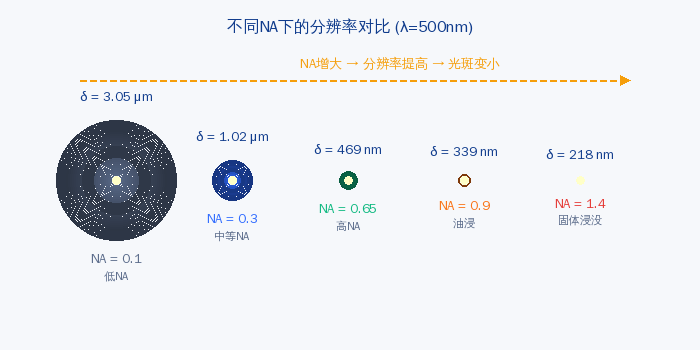
Resolution comparison at different numerical apertures
The larger the NA, the higher the resolution and the smaller the Airy disc
Core Resolution Formulas
Three important resolution criteria, each suited to different applications
The Physical Nature of Diffraction and Resolution
Why do optical systems have a resolution limit?
🔵 Diffraction: an inevitable consequence of wave optics
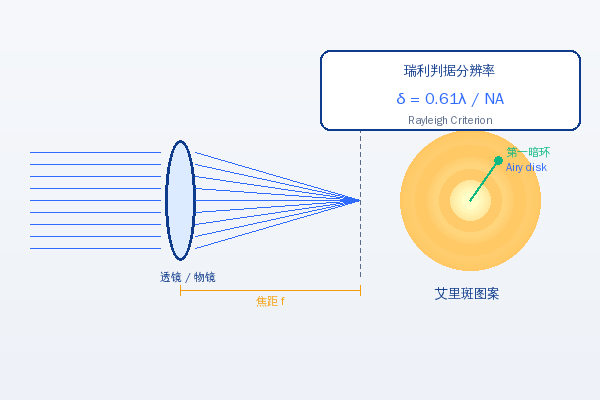
As an electromagnetic wave, light undergoesdiffractionwhen passing through an aperture of finite size. After passing through a lens, a perfect point source does not form a point in the image plane but a diffraction spot (Airy disc). This is dictated by the nature of waves and is independent of lens manufacturing quality — no matter how perfect the lens, it cannot produce a spot smaller than the diffraction limit.
💜 Resolution vs Magnification
Magnification is not resolution!Many people assume that ‘higher magnification reveals finer detail’, which is wrong. Resolution is determined by NA and wavelength (the diffraction limit); magnification beyond the diffraction limit is ’empty magnification’ — the image becomes larger but no finer detail appears. The ‘useful magnification’ range of a microscope is roughly 500NA to 1000NA.
🟢 Ways to Improve Resolution
From the formula δ = 0.61λ/NA, there are two ways to improve resolution:
1. Reduce the wavelength λ: for example from visible light → ultraviolet → X-rays, which is why lithography machines use EUV (13.5 nm).
2. Increase the NA: use a lens with a larger aperture, or a high-refractive-index medium (such as water-immersion or oil-immersion objectives).
⚠️ Super-resolution techniques
Conventional optical microscopy is diffraction-limited (~200 nm), butsuper-resolution microscopy(such as STED, PALM and STORM) can break the diffraction limit and achieve resolutions of a few tens of nanometres. These techniques exploit the switching behaviour of fluorescent molecules and are not ‘optical resolution’ in the traditional sense — they are achieved through computational reconstruction.
Airy Disc and Diffraction Rings
Characteristics of the intensity distribution of circular-aperture diffraction
Central bright spot (Airy disc)
Airy Disk
Energy fraction: 83.8%
The central bright disc of a point source’s diffraction pattern, with radius r = 0.61λ/NA and diameter d = 1.22λ/NA. Most of the light energy is concentrated in this region.
First bright ring
1st Bright Ring
Energy fraction: 7.2%
The first annular bright band outside the Airy disc, whose peak intensity is only 1.75% of the central peak. Its position is about 1.64λ/NA (radius).
First dark ring
1st Dark Ring
Radius: 0.61λ/NA
The dark ring between the central bright spot and the first bright ring, where the intensity is zero. The Rayleigh criterion is based on the definition that ‘one spot’s centre lies at the other’s first dark ring’.
Common Misconceptions
Avoid these misunderstandings about resolution
‘More pixels means higher resolution’
The pixel count of a camera determinessampling density, not optical resolution. If an optical system’s resolution limit is 1 μm, cameras with 0.5 μm and 0.2 μm pixels perform the same (after Nyquist sampling). Optical resolution is determined by NA and wavelength; pixels merely digitise the optical image.
‘Infinite magnification reveals finer detail’
Completely wrong! Magnification beyond the diffraction limit is called’empty magnification’ — it merely enlarges and blurs the spot without adding any detail. It is like enlarging a low-resolution image; it does not become sharper. The useful magnification of a microscope is roughly 500NA to 1000NA.
Is resolution proportional to the F-number?
Airy disc diameter d = 2.44λ·(f/#). The larger the F-number (smaller aperture), the more severe the diffraction and the resolutiongets worse. In photography, to obtain maximum resolution one normally avoids the smallest aperture (diffraction effect) and instead uses the lens’s ‘sweet spot’ (typically f/5.6–f/8).
‘The larger the NA, the better the lens’
A large NA gives high resolution, but at a cost:short working distance(an NA 0.9 objective may have a working distance of only 0.2 mm),small field of view、extremely shallow depth of field, and high cost. Real selection must be balanced according to the application; a larger NA is not always better.
Calculation Examples
Understand resolution calculation through practical examples
Resolution of a 100× oil-immersion objective
Numerical apertureNA = 1.4
MediumImmersion oil (n=1.518)
- Rayleigh criterion resolution:δ = 0.61×550nm / 1.4 = 239.6 nm ≈ 0.24 μm
- Abbe limit:δ_Abbe = 550nm / (2×1.4) = 196.4 nm ≈ 0.20 μm
- Airy disc diameter:d_Airy = 1.22×550nm / 1.4 = 479.3 nm ≈ 0.48 μm
- Useful magnification range:500×1.4 ~ 1000×1.4 = 700× ~ 1400×
Estimating the focused spot size of a laser marker
Focusing lens focal lengthf = 160 mm
Incident beam diameterD = 10 mm
- F-number:f/# = f/D = 160/10 = 16
- Numerical aperture (approximate):NA ≈ 1/(2·f/#) = 1/32 ≈ 0.03125 (approximately valid for small apertures)
- Diffraction-limited spot diameter:d = 2.44λ·f/# = 2.44×1064nm×16 = 41.5 μm
- Actual spot:Taking the M² factor into account (M²=1.2), d_real = 41.5×1.2 ≈ 50 μm