



Description
Product Overview
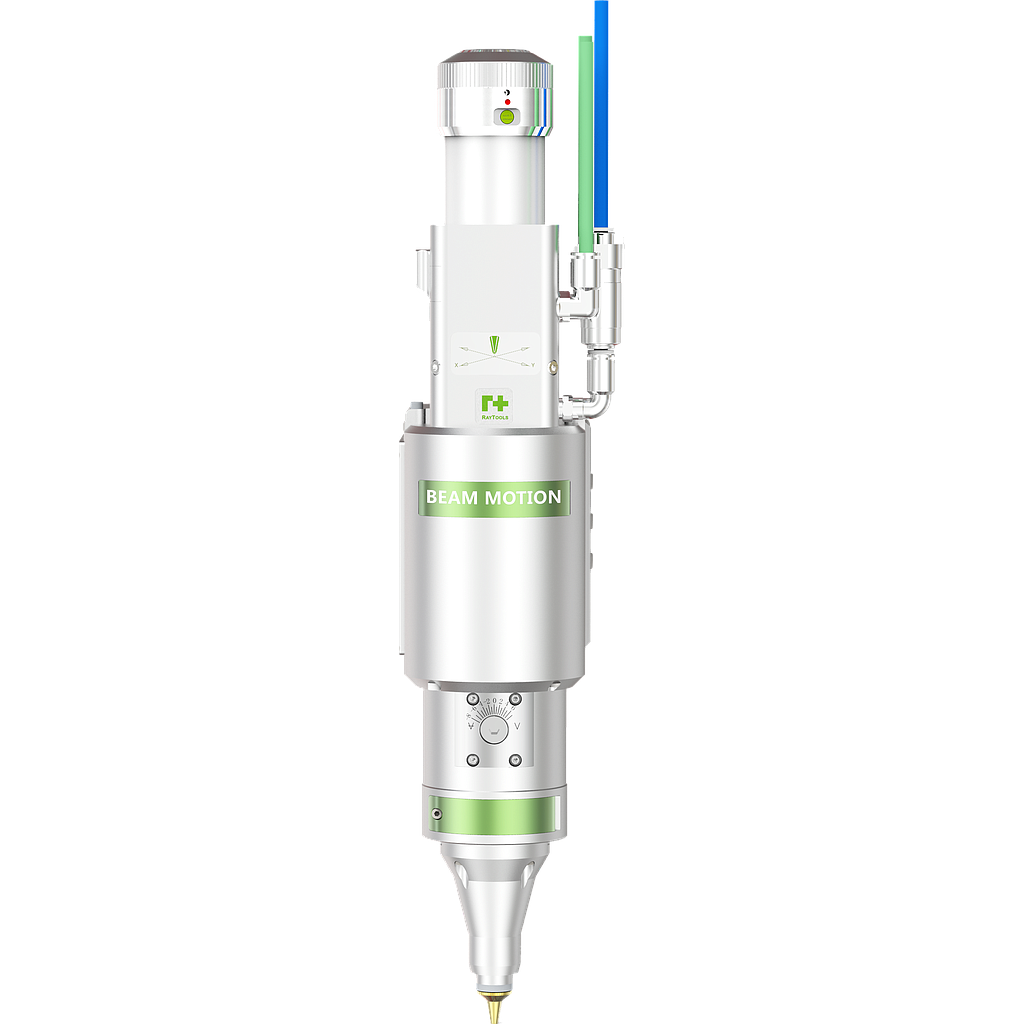
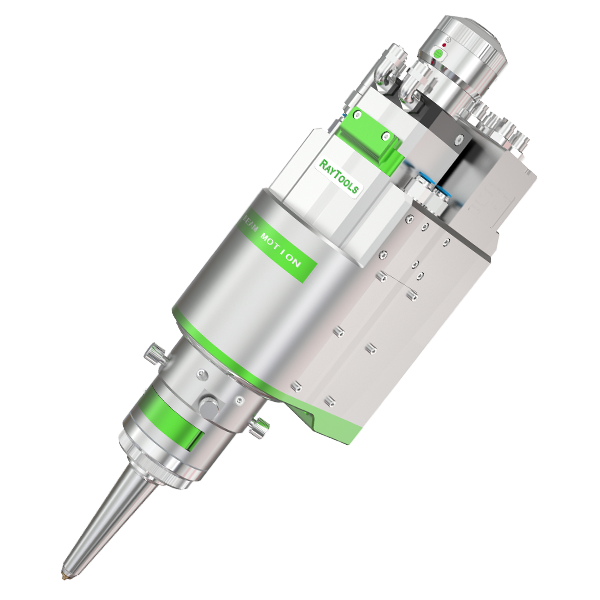
The GF101 is an integrated robot cutting head: the optics, the focusing follower module and its motor drive sit in one slim body that mounts directly on the robot flange, with the Z axis built in. A built-in motor drives the focusing follower module through a linear mechanism, so the module repositions itself over a 20 mm range without any external slide, air cylinder or counterweight on the wrist. Because the Z travel is inside the head, the robot does not have to generate the follow-up motion itself, which is what makes the unit usable on mid-to-low power 3D work where the arm is already busy holding the contour. The optical train is optimised for the 3D duty, the gas path is annular, and the body weighs about 3.5 kg.
Focus position is set by hand at the head over a -9 mm to +7 mm range, with 0.05 mm accuracy; the built-in Z axis is the follow-up axis that holds stand-off on a curved surface, not a motorised focus drive. If the process needs the focal point to change automatically between layers, the GF101F is the autofocus member of the same family.
Key Features
- Built-in Z axis: the follow-up unit is inside the head with a 20 mm stroke, so no external slide has to be mounted on the robot wrist
- Integrated single body: optics, follower module and drive in one housing, which shortens the flange stack and simplifies cabling on the arm
- Lightweight: about 3.5 kg, which leaves payload margin for the robot to accelerate along the contour
- High sealing: robust sealing plus a slim modular nozzle that resists spatter
- High dust protection: a drawer-type protective lens sits above the collimating lens, so dust is stopped before the optics
- Focal length options: 75 mm or 100 mm collimating, 125 mm or 150 mm focusing, to trade spot size against working distance
Technical Specifications
| Parameter | Specification |
|---|---|
| Power class | mid to low power |
| Focus range | -9 mm to +7 mm |
| Follow-up stroke (built-in Z axis) | 20 mm |
| Accuracy | 0.05 mm |
| Fiber interface | QBH, QD |
| Clear aperture | 28 mm |
| Numerical aperture | 0.14 |
| Collimating focal length | 75 mm, 100 mm |
| Focusing focal length | 125 mm, 150 mm |
| Collimating protective lens | 24.9 mm dia. x 1.5 mm |
| Focusing protective lens | 27.9 mm dia. x 4.1 mm |
| Nozzle type | single layer |
| Assist gas pressure | up to 25 bar |
| Weight | approx. 3.5 kg |
| Brand | Empower / RayTools |
Two numbers are often confused on this head. The 20 mm figure is the follow-up stroke of the built-in Z axis, which is what keeps the nozzle at working distance while the surface curves. The -9 mm to +7 mm figure is the focus range, set manually at the head. They are separate adjustments and neither one substitutes for the other.
Series Comparison
| Model | Feature | Z axis | Weight |
|---|---|---|---|
| GF101 | manual focus | built-in Z axis | approx. 3.5 kg |
| GF101F | autofocus, 4 kW class | built-in Z axis | approx. 6.5 kg |
| GF501 | 5-axis, 3 kW, DD motor full closed loop | built-in, 5-axis | approx. 25.0 kg |
The GF101 is the light member: manual focus, built-in Z follow-up, 3.5 kg. The GF101F keeps the same built-in Z axis but adds a motorised focus drive and moves to the 4 kW class, at roughly twice the mass. The GF501 is a different machine altogether, a 5-axis head on direct-drive motors for full contouring, and it belongs on a robot only when the payload and the budget allow 25 kg at the flange.
Applications
3D laser cutting of automotive parts, stamped and formed sheet components, and similar robot-held workpieces in the mid-to-low power range, where the contour is curved in two directions and stand-off has to be held without programming the robot to follow the surface.
Selection Guide
Choose the GF101 when the focal point stays the same through the job and payload or reach matters: the 3.5 kg body and the built-in 20 mm follow-up do the work that would otherwise need an external slide. Move to the GF101F when the process needs the focus changed automatically between layers or between materials, and accept the extra mass. Go to the GF501 only when the geometry genuinely needs five simultaneous axes. Check the robot payload at the flange with cable pack and gas hose included, not just the head mass.
FAQ
Is the focus automatic on this head? No. Focus is set by hand at the head over the -9 mm to +7 mm range. What is automatic is the built-in Z follow-up, which holds stand-off over the 20 mm stroke. For autofocus, take the GF101F.
Why build the Z axis into the head instead of using a slide? An external slide adds mass and stack height at the flange and needs its own cable run. Putting a 20 mm follower inside the head keeps the assembly short and light, which is the point on a robot doing 3D contours.
What gas pressure can the nozzle take? Up to 25 bar assist gas with the single-layer nozzle. Above that, check the nozzle and the sealing set with us before running the process.
Disclaimer
Specifications are taken from the manufacturer data current at the time of publication and are subject to change without notice. Focal length combinations, protective lens sizes and gas pressure limits must be confirmed for the exact configuration ordered. Actual cutting results depend on the laser source, the process gas, the material grade, the robot path accuracy and the nesting strategy.
Contact Us
Changsha Soar Laser Equipment Co., Ltd. supplies this unit with a configuration check against your laser source, your cutting head and your controller. Hotline +86 159-2722-0467, e-mail 859818709@qq.com, www.soar-laser.cn.

Reviews
There are no reviews yet.