



Description
Product Overview
FQ1.0 is built around one joint geometry and refuses to be general. It is a dedicated laser welding machine for the butt seam between a flange and a pipe: the flange locates on a machined plate, the pipe enters from the opposite side, and the tooling holds both parts on a common axis before the head is brought to the joint. That single decision – locating from the joint instead of from the outside of the part – is what makes the seam uniform, because the weld sees the same gap and the same edge preparation through the whole revolution instead of a fit that closes on one side and opens on the other.
The machine exists because flange-to-pipe welding is a volume operation with a short cycle, and short cycles are where handling dominates cost. Clamping is quick, the tooling is open enough to load from the front, and the cycle is repeatable from the first part of a batch to the last. Tooling holes are cut to the customer’s flange drawing, so the locating plate is a part-specific item rather than a universal fixture with adjustable stops. A different flange diameter is normally a tooling change plus a stored program, not a re-teach of the path.
The welding package is a QBH fibre laser with a follow-up system that maintains working distance as the joint runs. FQ1.0 is delivered together with the PTZJ F3.2 CNC system, including on-site installation, adjustment and operator training, and the machine is released to production after a first-article trial weld has been accepted. Where the process is not yet fixed, we can supply parameter recommendations for the joint and run sample parts before the order is placed, which is usually cheaper than discovering the fit-up problem during acceptance.
Key Features
- Dedicated to the flange butt seam: the tooling, the head approach and the rotation are all arranged for one joint, which is why the seam is consistent instead of merely acceptable
- Coaxiality held by tooling: flange and pipe locate on a common axis from a machined plate, so the gap at the joint does not change as the part turns
- Fast clamping: the fixture opens from the loading side and the part drops into position, which keeps the handling part of the cycle short enough for batch work
- Stable cycle time: because the path and the parameters are stored per flange size, the machine repeats rather than re-settles after each changeover
- QBH fibre interface: accepts mainstream fibre lasers, so the source is selected for wall thickness and penetration rather than for connector compatibility
- Tooling cut to your drawing: locating holes and plate geometry are made to the flange drawing, so the fixture is not a compromise that has to be shimmed on site
- Delivered as a working station: machine, tooling, CNC system, on-site commissioning and operator training arrive as one package
Technical Specifications
| Model | FQ1.0 |
| Product type | Dedicated flange laser welding machine |
| Process | Flange to pipe butt circumferential seam welding |
| Fibre interface | QBH |
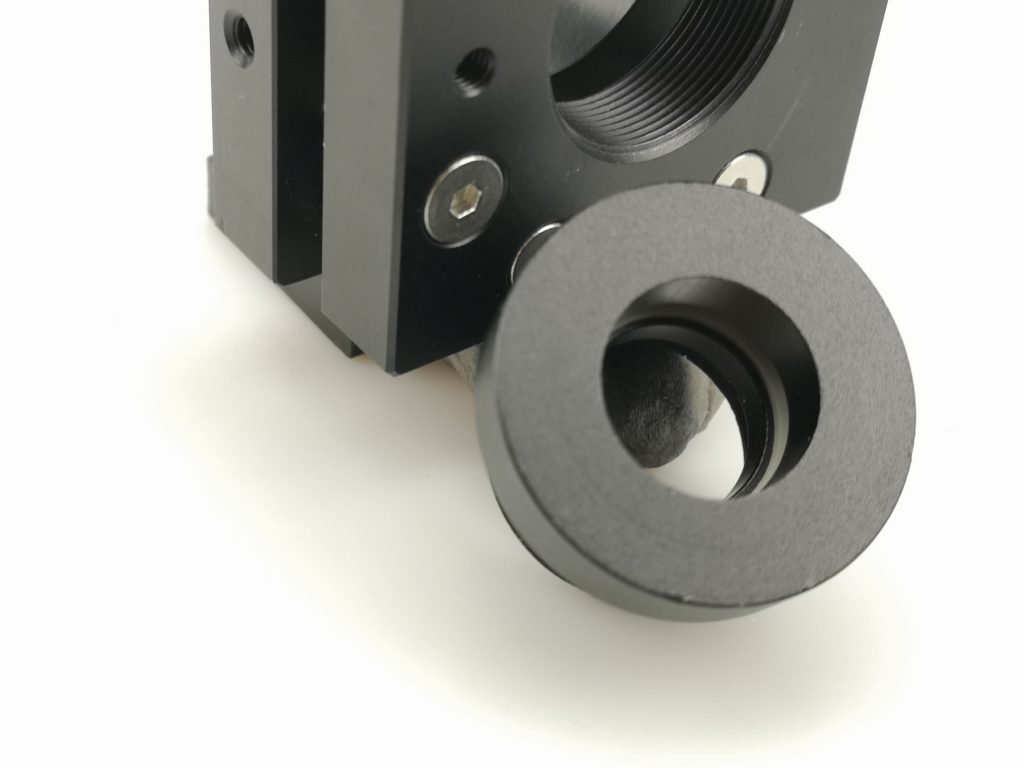
| Tooling | Machined locating plate, hole pattern cut to the customer flange drawing |
| Changeover | Tooling change plus stored program for a different flange diameter |
| Control | Supplied together with the PTZJ F3.2 CNC system |
| Welding head | Fixed head with follow-up height control |
| Workpiece range | Set by the tooling and fixture; confirmed against the flange drawing |
| Delivery scope | Machine, tooling, CNC system, on-site installation and adjustment, operator training, first-article trial weld |
| Process support | Parameter recommendations and sample welding available before order |
Applications
The machine is used where a flange is joined to a pipe or a tube end and the joint has to hold pressure or pass a visual and section standard at a rate that hand welding cannot sustain. The parts are small enough to handle by hand, the seam is short, and the value of the station lies in doing the same short seam identically several hundred times per shift.
- Batch welding of flanges to pipe sections in pipe fitting production
- Flange to tube joints on valve bodies and manifold blocks before final assembly
- Pipe spool fabrication where both ends carry a flange and both seams are welded on the same station
- Water and gas fitting manufacture, where a leak path at the flange root is the failure mode that matters
- Rework of flanges that were tacked by hand and need a full penetration finish pass
Because the tooling is part-specific, the practical unit of work is a flange family rather than a single drawing. A customer running four sizes will usually hold four locating plates and four stored programs, and treat the plate as a consumable that is replaced when the locating bore wears.
Selection Guide
- Send the flange drawing and the pipe drawing together: outside diameter, locating bore, flange thickness, pipe wall, joint preparation and the required penetration decide the tooling and the laser source. One drawing without the other cannot be quoted properly
- State the fit-up tolerance you can actually hold in production, not the tolerance on the drawing. A dedicated machine welds what it is given, and a joint that varies in gap will vary in penetration no matter how good the motion is
- Order the machine with its CNC system. FQ1.0 is commissioned with the PTZJ F3.2 control as a pair, and separating them moves the integration work onto your floor
- Plan one locating plate per flange size, and treat the plate as a wear item. The bore is what holds coaxiality, and a worn bore is the most common reason a previously good seam starts to drift
- Ask for a sample weld before the order if the material or the coating is unusual. Galvanised, plated or dissimilar joints behave differently from bare carbon steel, and the difference is cheaper to find on a sample
- Consider the handling and the fume path as part of the station layout. The weld cycle is short, so loading, unloading and extraction set the real output
Series Comparison
Two ways of welding a circular seam are offered in this range, and the choice is about how much of the setup you want built into the machine.
| Option | Approach | Best for | Trade-off |
| FQ1.0 dedicated flange machine (this page) | Flange-specific locating tooling, quick clamp, fixed head, supplied with CNC | One flange family produced in volume, where changeover is rare and cycle time decides cost | A new flange family needs new tooling, so variety costs money |
| PTZJ D1.31 rotary-axis system | General rotary fixture with chuck and tailstock, follow-up control | Mixed rotationally symmetric parts – flanges, fittings, hubs – on one machine | Setup per part is longer than on a dedicated fixture, so very high volume favours the dedicated machine |
The dividing question is how often the part changes. If the same flange runs for weeks, FQ1.0 removes setup from the cycle entirely and the tooling cost is recovered quickly. If four sizes run in a week, a general rotary fixture is the better purchase because the setup moves to a stored program instead of a new plate.
Usage Precautions
- Laser safety: welding power fibre lasers are a Class 4 hazard. The station needs interlocked guarding, a marked working area, and eyewear matched to the wavelength for everyone present. Alignment is done with the beam off and the interlock proven, never by looking along the joint
- Tooling wear: the locating bore and the plate face are what hold coaxiality. Check them on a schedule, and replace the plate when the bore opens up. A worn plate shows as a seam that is sound on one side and undercut on the other, and it is often misdiagnosed as a parameter fault
- Clamping force: enough to close the joint, not enough to distort the flange. A flange pulled out of flat by over-clamping springs back after welding and takes the seam with it
- Cooling and gas: confirm chiller flow, chiller temperature and shielding gas flow at the start of each shift. An optic that is running hot drifts focus gradually, which reads as a slow loss of penetration rather than as a fault
- Electrical work: connection and service by a qualified electrician only, with lockout and tagout before opening a panel, and a verified protective earth. Servo drives and the welding source both depend on grounding quality
- First article per batch: weld and section the first part of every batch, and after any tooling change. The check is fast and it is the only reliable way to see penetration before a batch has been run
- Transport: the locating plate is a precision item. Ship it fixed or separately, and never use it as a lifting point or a lever when moving the machine
FAQ
How many seams can be welded in one clamping?
The fixture is arranged for sequential welding, so a part with more than one seam can be processed without reclamping if the tooling gives access to each joint. The number is set by the part and by the tooling design, and it is fixed at the quotation stage.
What flange sizes can it take?
The range follows the tooling and the fixture, not a single machine limit. Common sizes are quoted on request against the flange drawing, and each size normally has its own locating plate.
Does the seam need filler wire?
A tight butt joint without a groove can be welded autogenously. Where the fit-up leaves a gap, or where the joint design calls for reinforcement, a feed arrangement is added and the process setup changes with it.
How long does a changeover take?
A change of flange size is a tooling change plus a stored program, so it is measured in minutes rather than in a re-teach. The first part after a change is treated as a first article and sectioned.
Is this a machine or a control system?
A machine. FQ1.0 is a complete welding station with tooling, head and fixture, and it is delivered together with the PTZJ F3.2 CNC system that runs it. The control is part of the package, not the product.
Disclaimer
Specifications on this page are compiled from the manufacturer’s published material and from existing documentation, and are provided as a selection reference. The delivered configuration is defined by the order confirmation, the tooling drawings approved by the customer, the factory test report and the current manufacturer specification. Flange size range, weldable wall thickness and laser source are project-specific. Appearance and configuration may change between batches, so confirm the details with us before ordering. Reproduction of this page without written permission is not permitted.
Selection enquiries: Changsha Soar Laser Equipment Co., Ltd., hotline +86 159 2722 0467, www.soar-laser.cn, email 859818709@qq.com.



Reviews
There are no reviews yet.