


Description
Product Overview
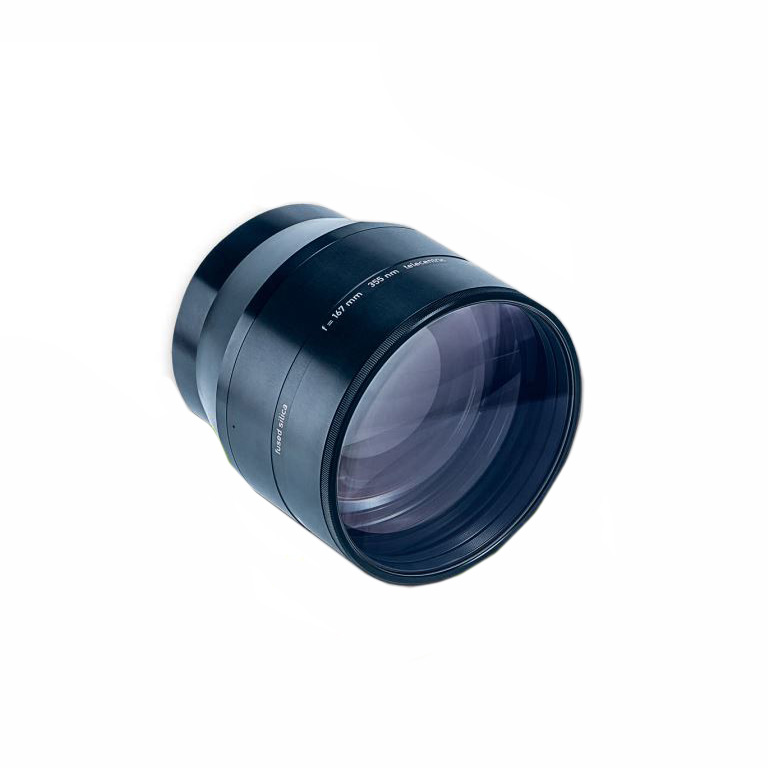
One of the first choices among green-wavelength F-Theta scanning lenses: the LINOS 4401-605-000-26, from the Excelitas Technologies (Qioptiq, Germany) F-Theta-Ronar product line. Design wavelength 532 nm, focal length 265.1 mm, fused silica lens body, spot diameter about 18 μm over a 150 × 150 mm scan field, transmittance > 96. It delivers stable and consistent focusing performance for laser marking, engraving and micromachining.
Key Features
- Optimized for the green band: design wavelength 532 nm, total transmittance over the working band > 96.
- High damage threshold coating: coating LIDT 20 J/cm², withstanding high power over long operating periods.
- Fused silica lens body: low thermal expansion coefficient and low absorption suppress thermal lensing; the low-absorption coating further reduces coating heating.
- Suitable for ultrashort pulses: group delay dispersion (GDD) of only 4902 fs², so picosecond and femtosecond processing is free of pulse broadening concerns.
- Replaceable protective window as standard: protective window PG 4401-517-006-00 isolates dust and spatter, protects the internal lenses and keeps maintenance cost low.
Technical Specifications
| Parameter | Specification |
|---|---|
| Model | 4401-605-000-26 |
| Type | LINOS F-Theta-Ronar F-Theta field lens (low absorption) |
| Brand | LINOS / Excelitas Technologies (Qioptiq, Germany) |
| Design wavelength | 532 nm |
| Effective focal length EFL | 265.1 mm |
| Back focal length BFL | 349.4 mm |
| Working distance WD | 346.9 mm |
| Flange focal length FFL | 435.4 mm |
| Maximum input beam diameter (1/e²) | 14.0 mm |
| Recommended galvo spacing m1 | 17.0 mm |
| Recommended galvo spacing m2 | 27.0 mm |
| Recommended galvo spacing m2 (mechanical) | 22.3 mm |
| Scan angle ±θ | 16.7 ° |
| Scan field | 150 x 150 mm |
| Focused spot diameter | 18 μm |
| Maximum telecentric error | 9.3 ° |
| Total transmittance over working band | > 96 |
| Group delay dispersion GDD | 4902 fs² |
| Coating LIDT | 20 J/cm² |
| Back-reflection focal positions (from first surface) | 10.35; 17.12; 20.72; 21.73; 51.23; 51.81; mm |
| Weight | 2331 g |
| Protective window model | 4401-517-006-00 |
Applications
- Micromachining and research: with a GDD of 4902 fs², ultrashort micromachining pulses are not broadened and spot energy stays concentrated.
- Cutting and drilling: combined with high peak power lasers for high-speed and precision cutting of thin sheets.
- Precision laser welding: effective focal length 265.1 mm gives a moderate depth of focus; with a scan head it welds battery cases and precision hardware with consistent seams.
- Laser marking and engraving: a 150 × 150 mm field with an approximately 18 μm spot produces clean edges on metal, plastic and coated surfaces, with high fidelity for small characters and 2D codes.
Installation and selection notes: lens performance depends on correct installation. First enter the recommended galvo spacings m1 = 17.0 mm and m2 = 27.0 mm into the scan head software, then set the distance from the lens reference plane to the workpiece according to the flange focal length FFL of 435.4 mm, and finally fine-tune the Z axis for the smallest spot before starting production. Keep the protective window PG 4401-517-006-00 in place and check it regularly for contamination, since contamination directly degrades the spot energy distribution. For other field sizes, select a model of the same series with a different focal length in proportion (this model, f = 265 mm, corresponds to a 150 × 150 mm field).
FAQ
What is the mounting interface of the 4401-605-000-26?
This model has a flange focal length FFL of 435.4 mm and connects to mainstream scan heads through a mounting thread. The recommended galvo spacings are m1 = 17.0 mm and m2 = 27.0 mm; simply provide these two dimensions to the scan head supplier when selecting.
In which industries is the 4401-605-000-26 used?
Typical applications include green laser marking, laser engraving, precision laser welding, and micromachining of wafers, glass and thin films. It can be used directly with a scan head system as a drop-in upgrade.
How does the 4401-605-000-26 perform with ultrashort pulses?
The group delay dispersion GDD is 4902 fs², so picosecond and femtosecond pulses pass through with almost no broadening. Combined with the low-absorption lens body, focus drift stays small during long high-power operation.


Reviews
There are no reviews yet.