


Description
Product Overview
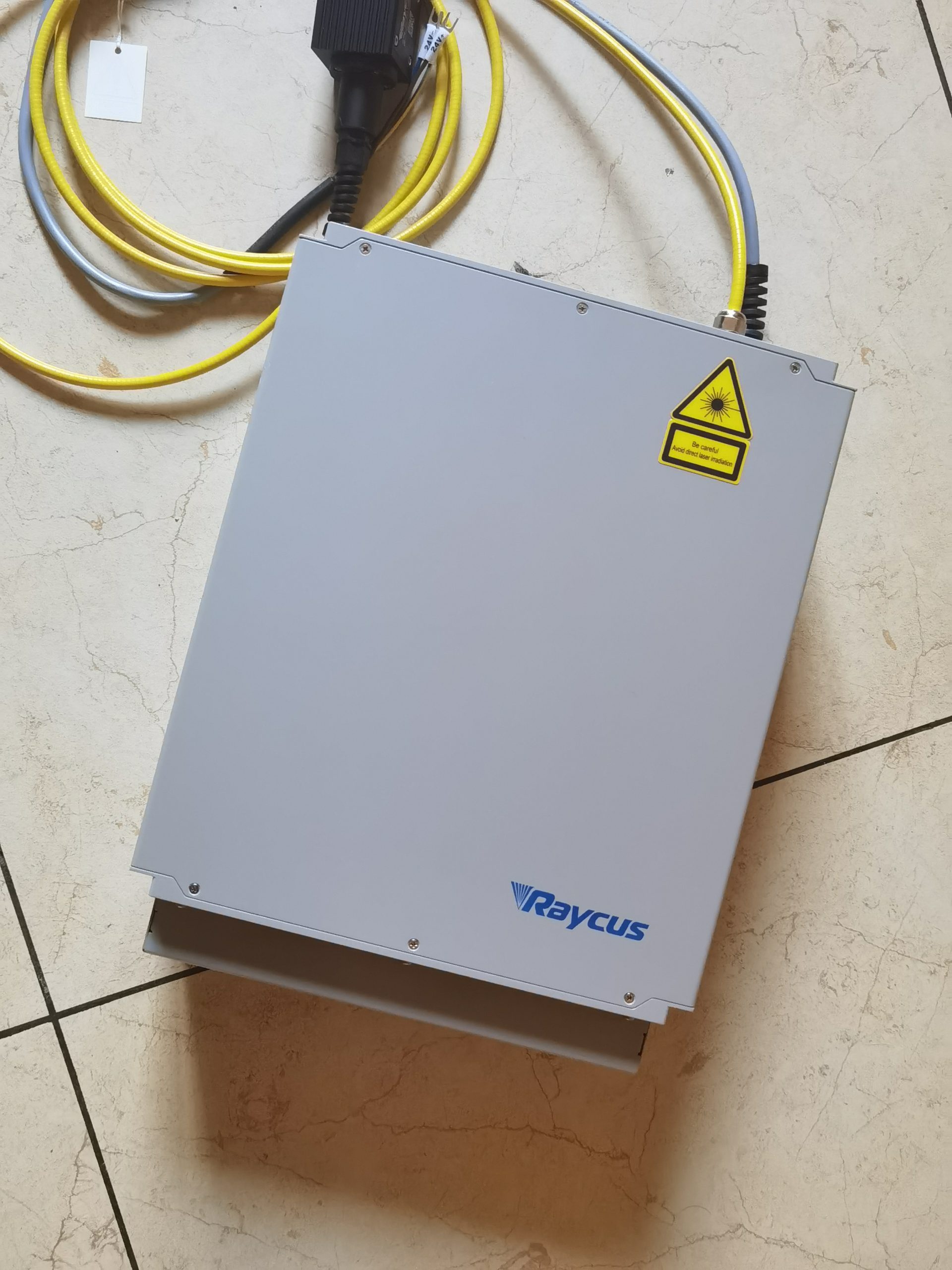
The Raycus RFL-P100MX is a 100 W MOPA pulsed fiber laser from the Raycus MX series. Unlike Q-switched pulsed lasers, the MOPA (Master Oscillator Power Amplifier) architecture separates pulse generation from power amplification, so pulse width and repetition rate can be adjusted independently, giving users an unprecedented level of process flexibility.
The RFL-P100MX offers a choice of pulse widths from 2 to 500 ns, a very wide adjustable repetition rate of 1-2000 kHz, first-pulse availability and on-line editing of the pulse width. These features make it hard to replace in processes that demand fine pulse control, such as black marking on anodized aluminum, color marking on stainless steel, precision thin-film cutting and surface cleaning. It is an ideal laser source for high-end industrial applications in solar photovoltaics, 3C electronics and precision manufacturing.
Key Features
- Extremely wide pulse width range: a choice of pulse widths from 2 to 500 ns (including 10, 20, 30, 60, 100, 200, 250 and 350 ns settings), with on-line editing of the pulse width so process parameters can be switched without stopping production. One laser covers everything from fine marking to deep engraving.
- Ultra-wide repetition rate range: 20-1000 kHz spans low-frequency, high-energy deep engraving through to high-frequency fine marking, so one laser meets many process requirements without changing equipment.
- First-pulse availability: this function guarantees stable energy in every pulse, including the very first pulse of a job. It eliminates the start-of-line defects caused by unstable first-pulse energy in conventional Q-switched lasers and improves process consistency.
- High beam quality: a beam quality factor M² below 1.6 keeps the focused spot small and round with uniform energy distribution, enabling high-precision fine marking and micromachining, with particularly strong results in black marking on anodized aluminum and color marking on stainless steel.
- Universal control interface: a unified industrial standard control interface is fully compatible with mainstream marking cards and software for easy system integration, and supports both analog and digital control with 0-100% power adjustment.
- Efficient air-cooled thermal design: an optimized air-cooling scheme removes the need for a water chiller, reducing system complexity and maintenance cost. The module measures 360×390×123 mm and is compact enough to integrate into many types of laser processing equipment.
- All-fiber, high reliability: an all-fiber integrated structure with core components developed in-house by Raycus. The sealed design protects the internal optical path from contamination, operation is maintenance-free, and MTBF exceeds 100,000 hours for excellent long-term stability.
Technical Specifications
| Optical Characteristics | |
|---|---|
| Rated output power | 100 W |
| Central wavelength | 1064±5 nm |
| Repetition rate range | 20-1000 kHz |
| Output power stability | <5% |
| Output Characteristics | |
| Output beam diameter | 6.5±1 mm |
| Beam quality M² | <1.6 |
| Pulse width | 10-350 (customizable) ns |
| Max single-pulse energy | 1 mJ |
| Polarization | Random |
| Output fiber length | 3 (customizable) m |
| Optical isolator | Standard |
| Electrical Characteristics | |
| Input power supply | 24 VDC |
| Power adjustment range | 0-100% |
| Power consumption | ≤450 W |
| Other Characteristics | |
| Cooling method | Air-cooled |
| Dimensions (W×H×D) | 360×390×123 mm |
| Operating temperature | 0-40 ℃ |
| Storage temperature | -20 to 60 °C |
| Storage humidity | ≤80% |
Operating Principle
The RFL-P100MX produces pulsed output using a MOPA (Master Oscillator Power Amplifier) architecture. Unlike Q-switching, the MOPA architecture divides pulse generation and power amplification into two independent stages. The master oscillator (seed source) generates a seed pulse train with a defined pulse width and repetition rate, and both parameters can be adjusted independently and flexibly. The seed pulses then enter several power amplifier stages, where they are amplified in ytterbium-doped fiber and delivered as high-power pulsed output. The key advantage of this architecture is the decoupled control of pulse width and repetition rate – changing the pulse width does not affect the repetition rate and vice versa – so users can precisely match the optimum pulse parameters for each material and process. This is decisive in processes that are highly sensitive to pulse parameters, such as black marking on anodized aluminum and color marking on stainless steel.
Applications
- Black marking on anodized aluminum: precise control of pulse parameters produces uniform, high-contrast black marks on anodized aluminum surfaces, widely used for branding on phone housings, laptops and other 3C products
- Color marking on stainless steel: combining different pulse widths and repetition rates generates oxide layers of different colors on stainless steel for premium color logos, 2D codes and similar marks
- Fine marking: excellent beam quality and flexible pulse parameters enable micron-level marking for electronic components, medical devices and other high-precision applications
- Thin-film cutting: the short-pulse, high-repetition-rate mode suits precision cutting of flexible materials such as FPC coverlay and PET film, with smooth, burr-free edges
- Precision cleaning: with suitable parameters it removes oxide layers, coatings and weld spatter from metal surfaces without damaging the substrate
- Surface texturing and oxide removal: high peak power pulses texture metal surfaces or break through oxide layers to improve surface properties
- Scribing for solar photovoltaics: the short pulse width and high repetition rate suit precision scribing of photovoltaic cells
Selection Guide
As a 100 W MOPA pulsed laser, the RFL-P100MX is the flagship power level of the MOPA range and suits demanding, high-throughput work such as anodizing color marking, deep marking, thin-film cutting and precision cleaning. Compared with the Q-switched P100QA at the same power, the MX series adds adjustable pulse width and a wider repetition rate range for greater process flexibility. If you only need conventional marking, the P100QA is sufficient and more cost-effective; for special processes such as oxide coloring, the P100MX is the best choice.
MOPA Series Model Comparison
| Parameter | P20MX | P30MX | P60MX | P70MX | P100MX |
|---|---|---|---|---|---|
| Power (W) | 20 | 30 | 60 | 70 | 100 |
| Frequency (kHz) | 1-2000 | 1-2000 | 1-2000 | 20-1000 | 20-1000 |
| Pulse width (ns) | 2-500 | 2-500 | 10-350 | 10-350 | 10-350 |
| M² | <1.5 | <1.5 | <1.5 | <1.6 | <1.6 |
| Pulse energy (mJ) | 0.71 | 1 | 1.5 | 1 | 1 |
| Power consumption (W) | 170 | 240 | 350 | 350 | 450 |
| First-pulse available | ✓ | ✓ | ✓ | ✓ | ✓ |
| Reference price | On request | On request | On request | On request | On request |
About the Brand
Wuhan Raycus Fiber Laser Technologies Co., Ltd. (Raycus) is the leading company in China’s fiber laser industry and the first domestic high-tech enterprise to develop and mass-produce fiber lasers independently. Founded in 2007 and listed on the Shenzhen Stock Exchange in 2018 (ticker 300747), it is headquartered in Optics Valley, Wuhan. Raycus masters in-house technology across the entire chain of core components, from pump sources and gain fiber to fiber Bragg gratings. Its pulsed fiber laser portfolio covers the 10-250 W Q-switched series and the 20-250 W MOPA series, widely used for marking, cutting, welding and cleaning in industrial processing. The company holds a leading domestic market share and exports to more than 50 countries and regions.
Contact Us
For more product information, a quotation or technical advice, please contact Soar Laser:
- Sales hotline: +86 159-2722-0467
- Website: www.soar-laser.cn
- Brand website: www.raycuslaser.com
We provide professional selection guidance, on-site technical support and comprehensive after-sales service to match you with the best laser solution.



Reviews
There are no reviews yet.