


Description
Product Overview
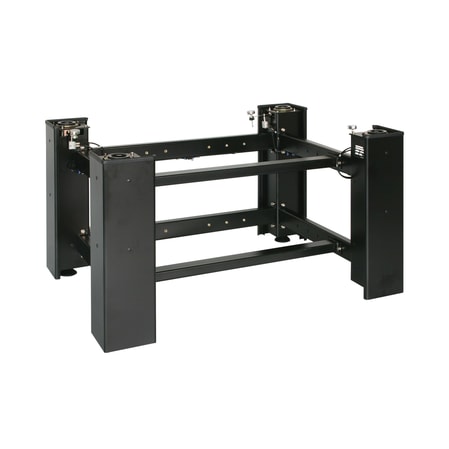
PFA51508 is an active isolation breadboard support frame for a 750 x 1200 mm (30 in x 48 in) breadboard. It is 700 mm (27.5 in) high, rated to 700 kg (1,545 lbs), and stands on four independent, air mounted, active vibration isolators with pneumatic self-leveling that repeats to ±0.25 mm (0.010 in). The vertical resonant frequency is below 1.6 Hz and the horizontal resonant frequency is below 1.2 Hz. The frame is all steel, the leveling pads give ±9.5 mm (±0.375 in) and the leveling feet give ±5 mm (±0.2 in), the PWA061 caster set is available as an option, and a continuous supply of pressurised air is required.
The outline is a 1 to 1.6 rectangle. That ratio is not an accident of the catalogue: it is the shape you get when a table is designed around beam path rather than around floor area. A square bench of the same area would measure 949 x 949 mm and would have a clear span of about 849 mm. This frame has 1100 mm of clear span on the long axis for the same 0.90 m² of surface. The difference between 849 mm and 1100 mm of span is the difference between five runs and four runs on a 4 m path, and that difference is the entire reason the long narrow bench exists.
So the value of this frame is not the area. It is the fold count. Folding a beam is how a table of finite size accommodates a path of arbitrary length, and every fold is a cost: about 3 percent of throughput at normal incidence with a standard dielectric mirror, a two-axis alignment that drifts, a surface that scatters, and a return path for light travelling backwards. On a 4 m path this frame needs four runs and three folds, which leaves 91.3 percent of the light. The same path on a 750 x 750 mm bench needs seven runs and six folds and leaves 83.3 percent. Same payload, same isolation, eight percentage points of light.
There is a second, less obvious reason that ultrafast and amplifier systems gravitate toward long narrow tables, and it is not about throughput at all. A folded geometry sends the beam back in the direction it came from. After an amplifier, a fold that reflects even a fraction of a percent of the amplified beam back down the chain is a route to feedback into the oscillator, to mode instability, or to damage at an earlier component. The standard remedies are Faraday isolators and angled folds, both of which cost money and add loss. A layout that runs mostly in one direction along a long table reduces the number of near-normal-incidence folds in the high-power section, and a reduction in fold count is a reduction in the number of places where that problem can start.
What the frame does not change is the isolation. The isolators, the 700 kg rating, the 700 mm height and the 1.6 Hz and 1.2 Hz resonant frequencies are shared across the whole PFA range, so a long bench is not better isolated than a short one. It is the same isolation over a shape that lets the beam run further before it has to turn. The vertical element is a dual chamber damped pneumatic spring with a rolling diaphragm and orifice damping; the horizontal element is a trifilar suspension system with an oil-free damper; the leveling is pneumatic and self-acting.
The pages for the other sizes in this range make different arguments, because different sizes solve different problems. This page is about the geometry of a beam path on a narrow, long surface, and about when paying for length is better value than paying for width.
Key Features
- 750 x 1200 mm (30 in x 48 in) outline, a 1 to 1.6 rectangle with about 1100 mm of clear span along the long axis. For the same 0.90 m² of surface, a square bench would give about 849 mm of span, so the shape buys roughly 250 mm of run length per pass.
- Fewer folds per metre of beam path than any other outline of comparable area. A 4 m path needs four runs and three folds here, against seven runs and six folds on a 750 x 750 mm bench.
- Lower cumulative reflection loss as a direct consequence. Three folds leave 91.3 percent of the light on a 4 m path, where six folds leave 83.3 percent. The difference is worth more than most coating upgrades.
- A geometry that favours unidirectional propagation, which matters on amplified beams. Fewer near-normal-incidence folds in the high-power section means fewer surfaces that can return light into the oscillator, so fewer isolators and fewer angled-fold workarounds.
- Four independent, air mounted, active vibration isolators, each carrying 175 kg (386 lbs) at the 700 kg rating. Independent mounting means a single fault shows as a tilt rather than as a silent loss of isolation.
- Vertical resonant frequency below 1.6 Hz and horizontal resonant frequency below 1.2 Hz, the same as every other size in the range. The isolated band starts just above those corners and covers footfall, door closure, pump rotation and building services.
- Dual chamber damped pneumatic spring for the vertical direction. Air pressure supports the tabletop, a rolling rubber diaphragm seals the piston to the upper chamber and allows near frictionless vertical travel while blocking horizontal motion, and air forced through a high damping orifice between the chambers damps the oscillation and shortens settling time. The chamber volume ratio is chosen for low resonant frequency and usable damping together.
- Trifilar suspension system for the horizontal direction. The vertical isolators sit on a three-wire pendulum, gravity provides the restoring force, and an oil-free damper between each isolator base and the outer housing suppresses oscillation at the horizontal resonant frequency. There is no hydraulic fluid in the frame.
- Pneumatic self-leveling with ±0.25 mm (0.010 in) repeatability. The three-way valve adjusts chamber pressure until the tabletop returns to its set point and compensates automatically for a changed load distribution, which on a long bench matters because adding a delay line at one end is a large moment.
- Sturdy all-steel construction, giving the frame the mass to anchor the pendulum and the dimensional stability to keep a 1200 mm mounting plane flat while the room temperature moves.
- Height adjustment of ±9.5 mm (±0.375 in) on the pads and ±5 mm (±0.2 in) on the feet, with the 700 mm (27.5 in) frame height suited to seated work and an 800 mm (31.5 in) version available for standing work.
- Optional PWA061 caster set and a continuous air requirement. Without air the tabletop settles onto its supports and the frame behaves as a rigid steel structure.
- A horizontal corner below 1.2 Hz with -34 dB at 10 Hz in that axis, which is the pairing that controls rocking on a long outline. A 1200 mm top on four points has a rocking mode that a purely vertical specification would never describe, and the horizontal column is where that mode is answered.
- Below 8 dB horizontal transmissibility at resonance, so the rocking mode is bounded as well as placed low. A long bench that is quiet vertically and lively horizontally will still lose a folded beam, because a fold converts a small rotation into a large lateral shift at the far end of the run.
- 87.5 percent isolation at 5 Hz and 98 percent at 10 Hz, both axes, which is the same isolator set used on every size in the range. Choosing the long outline therefore costs nothing in isolation performance; it only changes the shape of the top the isolators carry.
Technical Specifications
The manufacturer data below applies to this model. The isolation figures are properties of the isolator design and are therefore common to every outline in the range; the outline-specific values are the breadboard size, the aspect ratio and the clear span.
| Parameter | Value |
|---|---|
| Model | PFA51508 |
| Product class | Active isolation breadboard support frame |
| Breadboard size accepted | 750 x 1200 mm (30 in x 48 in) |
| Aspect ratio of the outline | 1 to 1.6, long axis 1200 mm |
| Frame height | 700 mm (27.5 in), with an 800 mm (31.5 in) version available |
| Load capacity | 700 kg (1,545 lbs) total |
| Load per isolator at rating | 175 kg (386 lbs) |
| Isolators | Four, independent, air mounted, active |
| Leveling | Pneumatic self-leveling, three-way valve |
| Leveling repeatability | ±0.25 mm (0.010 in) |
| Vertical resonant frequency | below 1.6 Hz |
| Horizontal resonant frequency | below 1.2 Hz |
| Vertical transmissibility at the resonant peak | below 13 dB |
| Horizontal transmissibility at the resonant peak | below 8 dB |
| Vertical transmissibility at 5 Hz | -18 dB (87.5%) |
| Horizontal transmissibility at 5 Hz | -18 dB (87.5%) |
| Vertical transmissibility at 10 Hz | -34 dB (98%) |
| Horizontal transmissibility at 10 Hz | -34 dB (98%) |
| Vertical isolation element | Dual chamber, damped pneumatic spring, rolling diaphragm |
| Horizontal isolation element | Trifilar suspension system, oil-free damper |
| Construction | All-steel |
| Finish | Black Paint |
| Height adjustment, leveling pads | ±9.5 mm (±0.375 in) |
| Height adjustment, leveling feet | ±5 mm (±0.2 in) |
| Height adjustment range, isolators | ±6 mm (0.25 in) |
| Height adjustment range, legs | ±10 mm (0.4 in) |
| Total breadboard height adjustment | 26 mm (1.02 in) |
| Optional mobility | PWA061 caster set |
| Air supply | Continuous, clean, dry, regulated |
| Air pressure required, maximum | 690 kPa (100 psi) maximum |
| Behaviour without air | Tabletop settles onto its supports |
| Largest breadboard in the family | 1200 x 1800 mm (48 in x 72 in) |
Two readings to keep apart in this table. The bracketed percentages are attenuation: -34 dB passes about 2.0 percent of the floor motion, so 98 percent is removed, and -18 dB passes about 12.6 percent, which the datasheet rounds to 87.5 percent. The leveling pads at ±9.5 mm and leveling feet at ±5 mm named in the Features list are static adjusters, distinct from the ±6 mm isolator and ±10 mm leg travel rows above; the table governs selection. 26 mm is the total breadboard height range of the system, and the quoted corners are limits, below 1.6 Hz and below 1.2 Hz.
The derived tables that follow are the reason to choose this shape, so they deserve more attention than the specification table. The first compares the fold count for four common path lengths against a square bench of similar area. The second converts fold count into throughput. Both assume a 100 mm margin at each end of the long axis for mounts and beam clearance, which gives the 1100 mm clear span used throughout, and a 97 percent reflectivity per fold mirror at normal incidence.
| Total Beam Path | 750 x 1200 mm (1100 mm Span) | 750 x 750 mm (650 mm Span) | Folds Avoided by the Long Outline |
|---|---|---|---|
| 3.0 m | 3 runs, 2 folds | 5 runs, 4 folds | Two folds saved |
| 4.0 m | 4 runs, 3 folds | 7 runs, 6 folds | Three folds saved |
| 5.0 m | 5 runs, 4 folds | 8 runs, 7 folds | Three folds saved |
| 6.0 m | 6 runs, 5 folds | 10 runs, 9 folds | Four folds saved |
The saving grows with path length, which is the opposite of what happens when you compare outlines by area. On a 3 m path the long bench saves two folds; on a 6 m path it saves four. That is because the number of runs scales with path length divided by span, so a span that is 450 mm longer removes a fixed fraction of the runs, and a fixed fraction of a larger number is a larger number.
| Fold Count | Cumulative Transmission | Reading |
|---|---|---|
| 2 folds | 94.1 percent | Comfortable on this outline for paths up to 3 m |
| 3 folds | 91.3 percent | The normal case for a 4 m path here |
| 4 folds | 88.5 percent | 5 m path, or 4 m on a 750 x 900 mm bench |
| 5 folds | 85.9 percent | Layout starting to fight the tabletop |
| 6 folds | 83.3 percent | 4 m path on a 750 x 750 mm bench |
| 7 folds | 80.8 percent | 5 m path on a 750 x 750 mm bench |
| 9 folds | 76.0 percent | 6 m path on a 750 x 750 mm bench |
Two limits belong with that table. The 97 percent figure is representative for a good dielectric mirror at normal incidence and at the design wavelength; ultrafast coatings are often lower and a mirror optimised for 800 nm will not behave the same at 400 nm. And reflection loss is not the only cost of a fold: each mirror adds group delay dispersion, which enters the chirp budget of a short pulse, and each fold adds a pointing degree of freedom whose drift shows up as beam walk at the far end of the path.
Applications
The applications below are the ones where the length of this frame does real work. In each case the deciding factor is the number of folds the layout would otherwise need, not the amount of equipment on the bench.
- Regenerative and multipass amplifiers. A regenerative cavity or a multipass cell needs a long folded path by construction, and the fold count is set by the design rather than by the table. Putting that design on a 1100 mm span keeps the external folds few, so the total path stays inside a sensible transmission budget.
- Long-path interferometry. Where a reference arm has to be metres long to match a measurement arm, the arm can run along the table instead of being folded back on itself. A long narrow bench gives the arm room to be straight, which removes the wavefront distortion that a folded reference arm introduces.
- Ultrafast systems that need a unidirectional layout. Amplified beams that must not return to the oscillator are laid out to propagate mostly in one direction. That is a length-driven requirement, and a 1200 mm long bench accommodates it without adding isolators.
- Optical parametric amplification chains. A seed, a pump and an idler arm, each with its own delay, need to coexist without crossing repeatedly. The long axis lets the three arms run in parallel rather than being folded over each other.
- Beam transport between two positions in a room. Where an experiment needs light delivered from a source bench to a distant point, the launch optics can be laid out along the long axis with a single fold, which keeps pointing stability better than a compact zig-zag.
- A narrow bay or a bench along a wall. The 750 mm depth fits where a wider bench would block a walkway, and the 1200 mm length uses the wall. This is a practical constraint that often decides the choice before the optics do.
Selection Guide
This frame is chosen for its length, so the selection procedure is about how much run length the layout needs and whether a longer bench is worth more than a wider one. The steps below produce that comparison.
- Measure the total beam path first. Sum every segment from source to detector, including passes through delay lines, multipass cells and diagnostic taps. Do this before listing equipment, because equipment count does not predict path length and path length is what this frame is for.
- Compute the runs and folds on this outline. Divide the total by 1100 mm, round up, subtract one. A 4 m path gives four runs and three folds. A 5 m path gives five runs and four folds. If the result is three folds or fewer, the bench is adequately sized for the path.
- Compare with the next outline down and up. The 750 x 900 mm frame has an 800 mm span and will need one more fold on a 4 m path; the 900 x 1200 mm frame has the same 1100 mm span and will need the same fold count, so the step up buys width rather than length. If the limitation is folds, this model is the right answer and the wider one is not.
- Check the fold pitch against the mounts. Four runs across a 750 mm width put the parallel beam lines 187.5 mm apart, which is comfortable for 25 mm mirrors in standard mounts. Five runs reduce the pitch to 150 mm and six runs to 125 mm, at which point adjacent mounts and their cable exits begin to interfere. If the layout needs six or more parallel lines, a wider frame is the better answer even though it does not reduce the fold count.
- Test the transmission budget. Three folds leave 91.3 percent and four leave 88.5 percent. If the experiment is photon-starved, the difference between three folds here and six folds on a small square bench is worth more than most other upgrades available at the same cost.
- Estimate the mass and the moment. A long bench invites loading one end. Add the breadboard, both ends, the cabling and a 20 to 30 percent growth margin, then compare with a working budget of 490 kg to 560 kg. Then check the distribution: a heavy item at one end of a 1200 mm bench is a larger moment than the same item at the edge of a 750 mm bench, and the leveling valve will correct the tilt but the static load difference remains.
- Decide the frame height and the casters. 700 mm (27.5 in) for seated work, 800 mm (31.5 in) for standing. Order the PWA061 set if the bench will be repositioned, and remember that casters are for moving, not for measuring.
- Confirm air, floor and access. Continuous clean dry air at the installation position, 175 kg (386 lbs) per corner at rating against the floor rating, and an access route that takes a 1200 mm long all-steel frame through the doors and corners on the way in.
Series Comparison
The six outlines in the PFA range differ in shape as well as size, and the shape decides the fold count. The table below keeps the span column next to the area column so that the two effects can be separated.
| Model | Breadboard Size | Area (m²) | Clear Span | 4 m Path Needs | Shape |
|---|---|---|---|---|---|
| PFA51509 | 750 x 750 mm | 0.5625 | 650 mm | 5 runs, 4 folds | Square, smallest |
| PFA51505 | 750 x 900 mm | 0.6750 | 800 mm | 5 runs, 4 folds | Short rectangle |
| PFA51508 | 750 x 1200 mm | 0.9000 | 1100 mm | 4 runs, 3 folds | Long rectangle, fewest folds per area |
| PFA51507 | 900 x 1200 mm | 1.0800 | 1100 mm | 4 runs, 3 folds | Wider, for two stations |
| PFA51502 | 900 x 1500 mm | 1.3500 | 1400 mm | 3 runs, 2 folds | Long and wide |
| PFA51504 | 1200 x 1500 mm | 1.8000 | 1400 mm | 3 runs, 2 folds | Largest, room-scale |
Two rows in that table carry the point of this page. PFA51508 and PFA51507 have the same 1100 mm span and therefore the same fold count on any path, but they differ by 0.18 m² of area. If the layout is limited by fold count, the narrower frame delivers the same optical result for 20 percent less surface and less floor. PFA51505, by contrast, has 0.225 m² less area than this frame but also 300 mm less span, which costs one extra fold on a 4 m path. Length, not area, is what moves the fold count.
The comparison also explains why a long narrow bench is not simply a cheap large bench. It is a specialised shape for a specific problem: a beam path that is long in one direction and narrow in the other. Where the layout is naturally two-dimensional, with several parallel arms that each need depth, the wider frames are the better tool and the fold count argument does not apply.
FAQ
Why is a 750 x 1200 mm bench better than a square bench of the same area?
Because span, not area, sets the fold count. A square bench of 0.90 m² would measure about 949 x 949 mm and give roughly 849 mm of clear span; this frame gives 1100 mm on the long axis for the same area. On a 4 m path that is the difference between five runs and four, and between 88.5 percent and 91.3 percent of the light reaching the experiment.
How many folds does a 4 m path need on this frame?
Four runs and three folds, assuming 100 mm at each end is reserved for mounts and beam clearance, which leaves 1100 mm of usable run. Three folds at 97 percent each leave 91.3 percent of the light. The same path on a 750 x 750 mm bench needs seven runs and six folds and leaves 83.3 percent.
Is the narrow width a problem for the optics?
Only if the layout needs many parallel beam lines. Four runs across 750 mm gives 187.5 mm of pitch, which is comfortable for 25 mm mirrors in standard mounts with room for cable exits. Five runs gives 150 mm and six runs 125 mm, at which point mounts begin to interfere. If the layout needs more than five parallel lines, a wider frame is the right answer and the fold count advantage of this one becomes secondary.
Why do ultrafast systems prefer long narrow benches?
Two reasons. The first is throughput: fewer folds means less reflection loss and less dispersion from mirror coatings. The second is feedback: a folded geometry sends light back toward the source, and after an amplifier even a small back-reflection can destabilise the oscillator or damage an earlier component. A layout that propagates mostly in one direction along a long table reduces the number of near-normal-incidence folds in the high-power section, which reduces the number of places where that problem can begin.
Can this frame be used for a two-station layout?
It can, but it is not the natural choice. At 750 mm width there is no middle to place a shared optical lane: a 150 mm lane leaves 300 mm on each side, which is four rows of 75 mm modules, and the lane has to run near one edge. For a genuine two-station layout with a centre lane, the 900 x 1200 mm frame is the better fit. This frame is for one long path, not two parallel ones.
What is the load capacity, and does a long bench need more?
700 kg (1,545 lbs), or 175 kg (386 lbs) per isolator at rating, identical to every other size in the range. A long bench does not need more capacity; it needs attention to distribution. Loading one end heavily creates a moment that a short bench would not see, and while the leveling valve corrects the resulting tilt within ±0.25 mm, the static difference in load between the near and far isolator pairs remains.
How does the leveling handle a heavy item placed at one end?
The tabletop dips at that end, the three-way valve senses the change in height, and chamber pressure is adjusted until the tabletop returns to its set point, repeatably within ±0.25 mm (0.010 in). The valve also compensates for the change in load distribution, so the bench does not stay permanently tilted. What it cannot do is remove the static load difference: the isolators nearer the mass carry more, and the margin on the far pair is correspondingly smaller.
What happens to the beam if air pressure is lost?
The tabletop settles onto its supports and the frame becomes a rigid steel structure. Alignment is preserved if the descent is gentle, but isolation stops, and on a long path a small tilt at the table translates into a large displacement at the far end of the beam. That is the reason to fit a pressure gauge where the operator can see it and to treat air pressure as a run condition.
Does the 700 mm height work with a long path?
Height and length are independent. 700 mm (27.5 in) puts the breadboard top at a height that suits a seated operator, and the beam runs horizontally at whatever height the mounts set. A 1200 mm long path at seated height is comfortable to align because the operator can move along the bench without changing eye level. An 800 mm (31.5 in) version is available if standing work is preferred.
Is a long frame harder to keep flat?
It is harder in principle, which is why the all-steel construction matters. A 1200 mm span has to hold its mounting plane flat as the room temperature moves, and steel gives the stiffness and thermal mass to do that. The pneumatic isolators also help, because each corner is individually supported and the leveling valve trims any residual tilt rather than relying on the frame being perfectly rigid.
Can the frame carry a breadboard of a different outline?
The frame is dimensioned for a 750 x 1200 mm breadboard, and a smaller breadboard can be mounted if the load stays over the four support points and inside the 700 kg rating. A larger breadboard is not appropriate: an overhanging plate moves the centre of gravity outward as well as upward, and the frame family supports breadboards up to 1200 x 1800 mm only on the largest model.
Usage Precautions
A long narrow bench has its own failure modes, most of them arising from the length rather than from the isolation. The precautions below are written for a layout that runs 1200 mm in one direction.
- Lay the path out along the long axis before drilling. The whole advantage of this frame disappears if the beam zig-zags across the 750 mm width instead of running along the 1200 mm length. Draw the path at full scale, count the folds, and check the pitch between parallel lines before any hole is drilled.
- Keep the number of near-normal-incidence folds low in the amplified section. A fold at normal incidence returns light along the incoming path. After an amplifier that is a feedback route, so use angled folds or an isolator in the high-power section, and prefer layouts that propagate in one direction.
- Watch the moment when loading one end. A long bench invites putting everything at one end because that is where the source is. Distribute mass along the length where the layout allows, keep the heaviest items near the centre, and add ballast low if one end is much heavier than the other.
- Provide clean, dry, regulated air and a visible gauge. On a long path a small tilt at the table becomes a large displacement at the far end, so a pressure loss is an alignment event rather than just a loss of isolation. Fit a filter-regulator, drain it regularly, and take the required pressure and flow from the installation manual for the exact model.
- Level mechanically before pressurising. Set the frame roughly level on its pads and feet, then bring up pressure and let the valve finish. Starting from a badly out-of-level frame uses the ±9.5 mm pad travel and the ±5 mm foot travel against a bias the valve then has to fight.
- Do not measure on casters. If the PWA061 set is fitted, lower the frame onto pads or feet and let the leveling settle before taking data. Casters add compliance and the leveling system has no defined set point while the frame is rolling.
- Support long cable and fibre runs. A 1200 mm bench collects long runs of cable, coolant hose and fibre, and an unsupported loop hanging off the end is a load on the breadboard edge and a snag hazard. Route services along the underside or the frame, and strain-relieve at the table edge.
- Check the access route for a 1200 mm long object. The frame is narrow enough for most doors but long enough that corridor corners and lift dimensions become the constraint. Measure the route before ordering.
- Confirm the floor point loading. Each corner carries 175 kg (386 lbs) at rating. On a raised access floor, check the panel rating and use spreader plates where the point load is marginal.
- Allow settling time after any change. Adding mass at one end of a long bench moves the whole tabletop. Give the valve time to settle and the breadboard time to stop ringing before recording data at the other end of the path.
Disclaimer
The specifications on this page are reproduced from Thorlabs published product information for the PFA series and are provided for selection and planning. Where the current official datasheet, drawing or installation manual differs from this summary, the official document takes precedence, and the manufacturer may revise specifications without notice.
The fold-count and transmission tables are calculations, not manufacturer data. They assume a 100 mm margin at each end of the long axis for mounts and beam clearance, a 97 percent reflectivity per fold mirror at normal incidence, and straight-line segments between folds. Real layouts lose additional length to mirror footprints, beam samplers and delay stages, and real ultrafast coatings often reflect less than 97 percent at the wavelength in use. Use the tables to compare outlines, not to predict absolute throughput.
Load capacity, resonant frequencies and leveling repeatability are quoted for the conditions defined by the manufacturer and will vary with the payload installed, its distribution along the bench, the floor and the quality of the air supply. No transmission curve for the isolation system is reproduced here; where a project requires a specific isolation performance at a specific frequency, request current performance data for the exact configuration.
No price is stated on this page. Availability, lead time and price are confirmed at the time of enquiry and may change with stock and currency. Nothing on this page constitutes a warranty, and the terms of sale are those agreed at the time of order.
Contact Us
For a quotation on PFA51508, or for help deciding whether the 1100 mm clear span removes enough folds from a particular layout, send the total beam path length, the number of parallel runs you expect, the deepest module on the bench, the estimated total mass and how it is distributed along the length, and confirmation that a continuous air supply is available. Those five items decide both the fold count and the loading question.
For a project comparing this frame with the 900 x 1200 mm model, say so and include the layout sketch. The two have the same clear span and therefore the same fold count, so the choice turns on whether the layout needs a centre lane and on how much floor area is available, not on optical performance.
Reviews
There are no reviews yet.