


Description
Product Overview
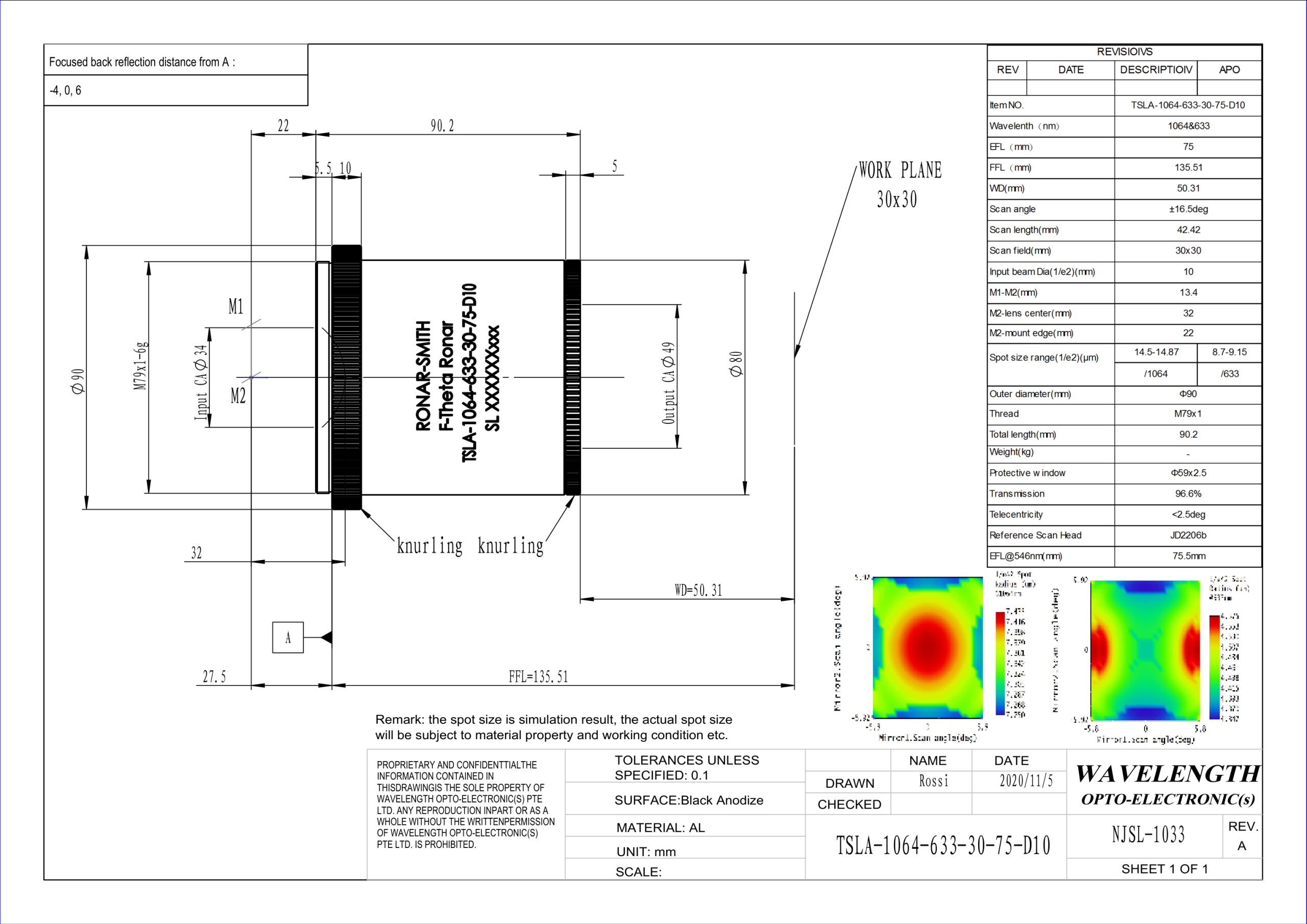
Wavelength TSLA-1064-633-30-75-D10 is a telecentric achromatic F-Theta scan lens (manufacturer drawing NJSL-1033, REV marked APO) for galvo-scanned precision laser processing. It combines a telecentric design (telecentricity < 2.5°) with an achromatic design that is confocal at 1064 nm and 633 nm: the focused beam meets the workpiece almost perpendicularly across the entire field, and the red aiming beam shares the same focal plane as the infrared process beam. The focal length is 75 mm, the standard field is 30 × 30 mm, and the 1064 nm spot is approximately 14.5–14.87 µm. It suits marking, micro-drilling and fine cutting where hole-wall verticality, depth consistency and alignment accuracy matter.
Key Specifications
| Model / drawing number | TSLA-1064-633-30-75-D10 / NJSL-1033 |
| Design wavelengths | 1064 nm & 633 nm (two-wavelength confocal; drawing REV marked APO) |
| Focal length (EFL) | 75 mm (EFL at 546 nm = 75.5 mm) |
| Back focal length (FFL) | 135.51 mm |
| Working distance (WD) | 50.31 mm |
| Maximum scan angle | ±16.5° |
| Scan length / standard field | 42.42 mm / 30 × 30 mm |
| Input beam diameter (1/e²) | 10 mm |
| Focused spot (1/e²) at 1064 nm | 14.5–14.87 µm (manufacturer simulation) |
| Focused spot (1/e²) at 633 nm | 8.7–9.15 µm (manufacturer simulation) |
| Telecentricity | < 2.5° |
| Transmission | 96.6% |
| Barrel diameter / mounting thread | Ø90 mm / M79 × 1 |
| Overall length | 90.2 mm |
| Protective window | Ø59 × 2.5 mm |
| Input / output clear aperture | Ø34 mm / Ø49 mm |
| Reference scan head | JD2206b |
| Housing material / finish | Aluminium alloy / black anodised |
| Mounting dimensions M1–M2 / M2–lens centre / M2–mounting flange | 13.4 mm / 32 mm / 22 mm |
Source: Wavelength Opto-Electronic (Singapore) outline drawing NJSL-1033 (REV APO, 5 November 2020). The manufacturer’s released specification sheet and the delivered part take precedence.
Telecentricity first: why processing needs a normal angle of incidence
Beyond chromatic aberration, a field lens has a second, easily overlooked error source: the angle of incidence at the edge of the field. To keep spot position linear with scan angle across the field, an ordinary F-Theta lens delivers the marginal field as a converging cone striking the workpiece at an angle. Oblique incidence causes three problems: drilled holes come out tapered and cut faces are bevelled; etching at the same nominal depth differs between centre and edge; and any small height variation on the workpiece surface is amplified into focus error.
A telecentric design solves exactly this. This lens is specified at < 2.5° telecentricity, which means the chief ray of the focused cone is close to perpendicular to the work plane across the whole 30 × 30 mm field. Four practical benefits follow:
- Straighter hole walls, less taper. Micro-hole arrays, precision drilling and kerfs keep a vertical cross-section, which matters for subsequent assembly or lamination.
- Better depth consistency. Centre and edge see similar energy-incidence conditions, so marking depth, etch depth and cut quality are more uniform.
- Larger defocus tolerance. Slight surface waviness or uneven clamping is less critical, so you do not have to refocus at every height change.
- More stable spot quality. The spot at the field edge is not stretched or distorted; roundness and energy distribution hold across the full field.
Achromatic design: why the red beam must be confocal with the process beam
Optical glass refracts differently at different wavelengths — that is chromatic aberration. With a lens optimised for one wavelength only, the 633 nm red aiming beam and the 1064 nm process beam do not focus in the same plane. The operator then sees a red spot that is not where the laser actually processes, and has to compensate by experience: slow setup, difficult alignment.
This lens is designed to be confocal at 1064 nm and 633 nm. The drawing is REV marked APO and quotes EFL at 546 nm = 75.5 mm with a 1064 nm focal length of 75 mm, holding the visible and process foci in one focal plane. The practical value of the achromatic design:
- What you see is what you machine. The red preview, teach and alignment position is the actual processing position, so trial cuts and compensation are reduced.
- One lens for alignment and processing. 633 nm visible light for indication and vision alignment, 1064 nm for processing, sharing one focus — a simpler optical layout.
- More accurate vision alignment. When a visible camera is used for positioning or in-line inspection, the imaging focus and the process focus coincide, avoiding “it looked centred but it marked off-centre”.
- No refocusing when switching wavelength. Moving between indication and processing on the same system costs no extra downtime for focus adjustment.
Telecentric and achromatic together: 1 + 1 > 2
Telecentricity addresses angle of incidence and depth consistency across the field; achromatism addresses focus consistency between wavelengths. The two error dimensions are independent, and neither substitutes for the other: telecentric but not achromatic still misplaces the red beam; achromatic but not telecentric still gives inconsistent hole walls and depth across the field. With both, the system gains processing that is “vertical, uniform and repeatable” plus alignment accuracy that is “what you see is what you machine”.
- Precision marking and micro-drilling: vertical hole walls, consistent depth and accurate position for dense micro-hole arrays and fine patterns.
- Vision-assisted processing: red indication, camera alignment and 1064 nm processing all share one focus, so automated lines are quicker to set up.
- Lower trial-and-error cost: fewer test cuts, focus adjustments and compensation parameters for oblique incidence and chromatic aberration, giving more consistent yield.
Typical Applications
Galvo-scanned precision marking, micro-drilling and hole arrays, fine cutting and scribing, marking of semiconductor and electronic components, and automated laser processing stations that need visible-beam alignment or vision positioning.
Selection and Integration Notes
The barrel is Ø90 mm with an M79 × 1 mounting thread, 90.2 mm overall length, a Ø59 × 2.5 mm protective window and a 50.31 mm working distance; the drawing references scan head JD2206b. Before ordering, confirm the galvo model, input beam diameter, laser wavelength and power, target field size and available mounting space. For telecentric achromatic field lenses in other focal lengths or field sizes, contact a Soar Laser engineer for selection support.
Frequently Asked Questions
What kind of field lens is the TSLA-1064-633-30-75-D10?
It is a telecentric achromatic F-Theta scan lens from Wavelength Opto-Electronic in Singapore (drawing NJSL-1033, REV marked APO). Design wavelengths 1064 nm and 633 nm are confocal, focal length 75 mm, standard field 30 × 30 mm, maximum scan angle ±16.5°, telecentricity < 2.5°. It is intended for galvo-scanned laser marking, micro-drilling and fine cutting.
What does a telecentric field lens do better than an ordinary F-Theta lens?
An ordinary F-Theta lens delivers the marginal field obliquely to the workpiece, whereas a telecentric design (here < 2.5°) keeps the chief ray of the focused cone close to normal across the whole field. The direct benefits are threefold: straighter hole walls and kerfs with less taper; more consistent depth between centre and edge; and lower sensitivity to small surface height variations, with a larger defocus tolerance and more uniform spot roundness and energy distribution.
What is the practical benefit of an achromatic (two-wavelength confocal) field lens?
Lens materials refract differently at different wavelengths, so a single-wavelength lens separates the focus of the 633 nm red beam from that of the 1064 nm process beam. This lens is designed confocal at 1064 nm and 633 nm — the drawing quotes EFL at 546 nm = 75.5 mm and a 1064 nm focal length of 75 mm — holding the visible indication beam and the process beam in one plane. The red preview, alignment and teach positions are therefore the real processing positions, with no separate focusing for the two wavelengths, and visible light can be used for vision alignment.
Why does it matter that the lens is both telecentric and achromatic?
They address different error dimensions: telecentricity handles angle of incidence and depth consistency across the field, achromatism handles focus consistency between wavelengths. Together, the system gets vertical, uniform, repeatable processing over the full field and coincident red-indication and infrared process foci for accurate alignment. For precision marking, micro-hole arrays, fine cutting and vision-assisted processing that means fewer trial cuts, higher positional accuracy and more consistent yield.
What are the scan field and spot size of this lens?
Standard field 30 × 30 mm, scan length 42.42 mm, maximum scan angle ±16.5°, input beam diameter (1/e²) 10 mm. The focused spot (1/e²) is 14.5–14.87 µm at 1064 nm and 8.7–9.15 µm at 633 nm. Note that the manufacturer drawing states these spot values are simulation results; the actual spot depends on material properties, beam quality and operating conditions.
What should I check about the mounting interface and accessories?
Barrel Ø90 mm, mounting thread M79 × 1, overall length 90.2 mm, protective window Ø59 × 2.5 mm, working distance 50.31 mm, reference scan head JD2206b, black anodised aluminium housing. Before ordering, provide the galvo model, laser wavelength and power and target field size so a Soar Laser engineer can verify interface and optical-path compatibility.
Disclaimer
All values on this page are taken from the Wavelength Opto-Electronic (Singapore) outline drawing NJSL-1033 (REV APO, 5 November 2020). The drawing states explicitly that the focused spot values are simulation results and that the actual spot depends on material properties, beam quality and operating conditions; measured values prevail. Images are the manufacturer’s outline drawing; product appearance, interface thread, protective window and final technical data are subject to the manufacturer’s latest specification sheet and the delivered part. Soar Laser is the distributor and technical support contact; please provide full operating conditions for compatibility confirmation before selection.


Reviews
There are no reviews yet.