


Description
Product Overview
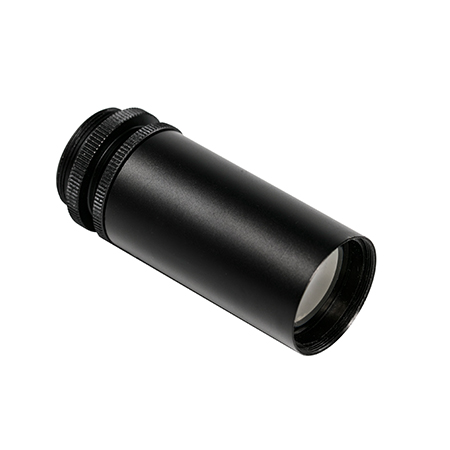
The Type A fixed-magnification beam expander is a high-performance optical assembly designed for high-power laser systems, covering the three mainstream solid-state laser wavelengths of 355 nm (UV), 532 nm (green) and 1064 nm (IR), plus the 9.3 μm and 10.6 μm CO₂ laser wavelengths. The series uses the classic Galilean optical design, consisting of a negative (concave) lens and a positive (convex) lens; the absence of an internal focal point fundamentally eliminates the risk of air breakdown when high-power laser light is focused, ensuring safe and stable operation of the laser system.
In a laser processing system the beam expander plays a critical role. By optical principle the product of beam diameter and divergence angle is constant — when the expander increases the beam diameter by a factor of N, the divergence angle shrinks by the same factor N. A smaller divergence angle yields a smaller focal spot diameter and higher power density after focusing by the field lens, while the depth of focus also increases, significantly improving processing quality and efficiency. The Type A fixed-magnification beam expander is built on exactly this principle, providing precise beam shaping for laser marking, cutting and welding.
Different wavelength ranges use two premium optical materials: UV fused silica for 355/532/1064 nm and zinc selenide (ZnSe) for 9.3/10.6 μm, combined with high laser damage threshold anti-reflection coatings to ensure long-term reliability in demanding high-power applications. The standard M22 × 0.75 threaded interface is compatible with mainstream lasers and optical systems for quick integration.
Key Features
1. Galilean focal-point-free design
The Galilean layout of concave and convex lenses means light never converges to a focus inside the expander, effectively avoiding air breakdown and optical damage at high power density. Compared with a Keplerian design, the Galilean layout has shorter lens spacing, a more compact body and lower spherical aberration, making it the preferred solution for high-power beam expansion.
2. Full multi-wavelength coverage
The product line covers the three solid-state laser wavelengths of 355 nm UV, 532 nm green and 1064 nm IR as well as the 9.3 μm and 10.6 μm CO₂ wavelengths, meeting laser application needs from UV to mid- and far-IR. Each wavelength has a dedicated anti-reflection coating for optimum transmittance at the working wavelength (above 96% for solid-state wavelengths, above 97% for CO₂).
3. High-quality optical materials
The 355/532/1064 nm range uses UV-grade fused silica, which offers an extremely low thermal expansion coefficient, excellent UV transmission and a very high laser damage threshold, maintaining stable optical performance under high average and high peak power. The 9.3/10.6 μm range uses high-purity zinc selenide (ZnSe), which has very high transmittance and very low absorption at CO₂ wavelengths — the ideal choice for mid- and far-IR laser optics.
4. Multiple magnifications
Fixed magnifications of 2X, 3X, 4X, 5X, 6X, 8X and 10X are available, allowing users to choose according to the laser’s output beam diameter, the field lens entrance aperture and the required processing result. Higher magnification gives a smaller output divergence angle, a smaller focal spot and a larger depth of focus, but the maximum input beam diameter decreases accordingly.
5. Standard interface for easy integration
All versions feature a standard M22 × 0.75 mounting thread, fully compatible with mainstream laser output heads, optical assemblies and mounting brackets. Precision machining ensures coaxiality and pointing stability (< 1 mrad), so a high-quality output beam is obtained without complex adjustment after installation.
6. High laser damage threshold coatings
Every lens surface carries a high damage threshold anti-reflection coating that withstands high-power irradiation while maintaining high transmittance. Reflectance is R < 0.5% per surface in the solid-state bands and R < 0.2% per surface in the CO₂ band, minimising reflection loss and thermal effects.
Technical Specifications
355 nm UV beam expander
| Magnification | Max. input beam (1/e²) | Clear aperture | Barrel length (mm) | Barrel OD (mm) | Thread |
|---|---|---|---|---|---|
| 2X | 6 mm | 12 mm | 46.5 | 27 | M22×0.75 |
| 3X | 6 mm | 18 mm | 52 | 27 | M22×0.75 |
| 4X | 6 mm | 21.6 mm | 70.5 | 27 | M22×0.75 |
| 5X | 4 mm | 20 mm | 76 | 27 | M22×0.75 |
| 6X | 3 mm | 18 mm | 62 | 27 | M22×0.75 |
| 8X | 3 mm | 21.6 mm | 64.5 | 27 | M22×0.75 |
| 10X | 3 mm | 21.6 mm | 66 | 27 | M22×0.75 |
532 nm green beam expander
| Magnification | Max. input beam (1/e²) | Clear aperture | Barrel length (mm) | Barrel OD (mm) | Thread |
|---|---|---|---|---|---|
| 2X | 8 mm | 16 mm | 46.5 | 27 | M22×0.75 |
| 3X | 8 mm | 21.6 mm | 66.5 | 27 | M22×0.75 |
| 4X | 6 mm | 21.6 mm | 74 | 27 | M22×0.75 |
| 5X | 6 mm | 21.6 mm | 70.5 | 27 | M22×0.75 |
| 6X | 4 mm | 21.6 mm | 72 | 27 | M22×0.75 |
| 8X | 4 mm | 21.6 mm | 66 | 27 | M22×0.75 |
| 10X | 3 mm | 21.6 mm | 68 | 27 | M22×0.75 |
1064 nm IR beam expander
| Magnification | Max. input beam (1/e²) | Clear aperture | Barrel length (mm) | Barrel OD (mm) | Thread |
|---|---|---|---|---|---|
| 2X | 8 mm | 16 mm | 48 | 27 | M22×0.75 |
| 3X | 8 mm | 21.6 mm | 68 | 27 | M22×0.75 |
| 4X | 6 mm | 21.6 mm | 76 | 27 | M22×0.75 |
| 5X | 6 mm | 21.6 mm | 72 | 27 | M22×0.75 |
| 6X | 4 mm | 21.6 mm | 74 | 27 | M22×0.75 |
| 8X | 3 mm | 21.6 mm | 68 | 27 | M22×0.75 |
| 10X | 3 mm | 21.6 mm | 71.5 | 27 | M22×0.75 |
9.3 μm / 10.6 μm CO₂ beam expander
| Magnification | Max. input beam (1/e²) | Clear aperture | Barrel length (mm) | Barrel OD (mm) | Thread |
|---|---|---|---|---|---|
| 2X | 10 mm | 20 mm | 48.1 | 36 | M22×0.75 |
| 3X | 10 mm | 28 mm | 60 | 36 | M22×0.75 |
| 4X | 8 mm | 28 mm | 67.3 | 36 | M22×0.75 |
| 5X | 4 mm | 23 mm | 70 | 30 | M22×0.75 |
General Specifications
| Parameter | 355/532/1064nm | 9.3/10.6μm |
|---|---|---|
| Optical material | UV fused silica | Zinc selenide (ZnSe) |
| Housing material | 6061-T6 aluminium alloy | 6061-T6 aluminium alloy |
| Surface quality | 40/20 (scratch/dig) | 80/50 (scratch/dig) |
| Transmittance | >96% | >97% |
| Pointing stability | <1 mrad | <1 mrad |
| Wavefront error | <λ/4 | <λ/4 |
| Laser damage threshold | 5 J/cm² @1064nm, 10ns, 10Hz | 500 W CW |
| Mounting thread | M22×0.75 | M22×0.75 |
Applications
Laser marking and engraving
In laser marking systems the beam expander is a core element of the optical path. Selecting the right magnification expands the laser’s relatively small output beam to a size matched to the field lens entrance aperture, effectively reducing the focal spot and improving line-width definition and energy density. The 355 nm UV expander suits fine marking (electronic components, glass), the 532 nm green expander suits wafer and metal marking, the 1064 nm IR expander suits general metal marking, and the CO₂ expander suits non-metals (wood, acrylic, leather, etc.).
Laser cutting and micromachining
In precision laser cutting the expander markedly improves beam quality and reduces divergence, producing a smaller focal spot and a larger depth of focus. A larger depth of focus maintains more uniform energy density through the material thickness, improving kerf quality and reducing the heat-affected zone. The UV band is particularly suited to precision cutting of flexible printed circuits (FPC), sapphire and ceramics.
Laser welding and 3D printing
In laser welding and additive manufacturing (3D printing) the expander adjusts the input beam diameter to match the galvo scanner and field lens system, ensuring uniform spot size and energy density across the working area. High-magnification expanders increase depth of focus for welding thicker materials, while low-magnification expanders suit precision welding that requires higher energy density.
Selection Guide
Choosing the right beam expander requires considering the following key factors:
1. Wavelength matching
Anti-reflection coatings are optimised for a specific wavelength and must strictly match the laser output. A 355 nm expander cannot be used with a 532 nm laser, and vice versa. For CO₂ lasers, note the difference between 9.3 μm and 10.6 μm — the two are not interchangeable.
2. Magnification
Magnification depends on matching the laser output beam diameter to the field lens entrance aperture. As a general rule the expanded beam should reach 60-80% of the field lens entrance aperture, making full use of the clear aperture while avoiding truncation. Common references: a galvo system with a 10 mm beam usually needs no expander, a 14-15 mm system pairs with a 2X expander, and systems of 20 mm and above use a 3X-5X expander.
3. Input beam limit
Each magnification has a maximum input beam diameter; exceeding it truncates the beam or degrades wavefront quality. High-magnification expanders usually have a smaller maximum input diameter, so confirm that the laser output beam diameter is within the permitted range.
4. Type A vs Type BC
Type A is the most widely used fixed-magnification expander with a simple, compact structure. Type BC adds adjustable divergence (a rotating adjustment ring fine-tunes output collimation) on top of the Type A design, suited to applications requiring fine adjustment of the focal position.
📞 Hotline: +86 159-2722-0467 | Website: www.soar-laser.cn
Soar Laser — your professional supplier of laser optical accessories, offering selection guidance, technical support and custom solutions


Reviews
There are no reviews yet.