


Q-switching is an important concept in laser technology—understanding its principles, key parameters and applications is essential for correct component selection and system design. This article explains it clearly, from principles and key parameters to main types and typical applications.
Table of Contents
- 1. What Is Q-Switching? Understanding the Core Concepts
- 2. Working Principle: How Does Q-Switching Work?
- 3. Key Parameters: Understanding Q-Switching Performance Indicators
- 4. Main Types: What Kinds of Q-Switches Exist?
- 5. Applications: Where Is Q-Switching Relevant?
- 6. Common Misconceptions: Pitfalls to Avoid
1. Core Concepts: What Is Q-Switching?
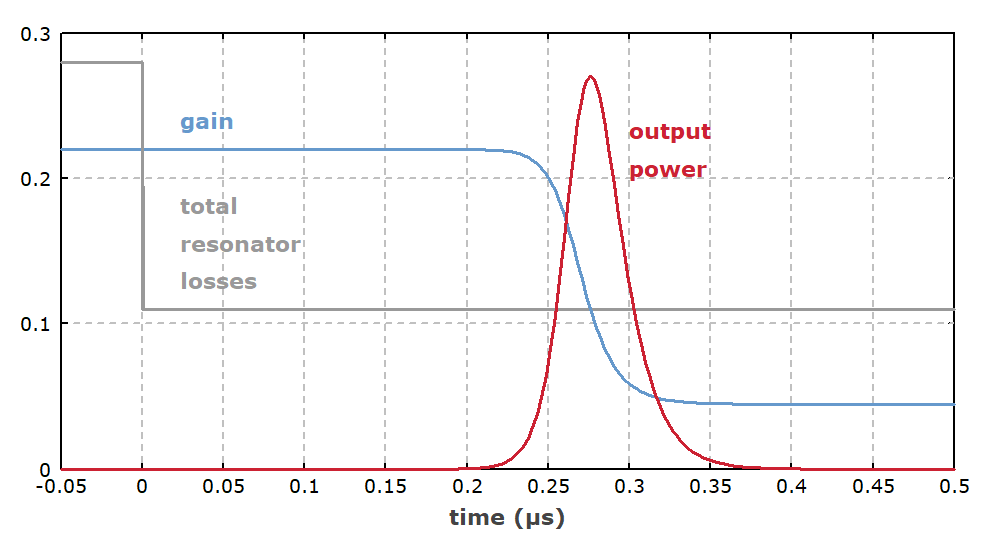
< Q-switching is a technique that generates high-energy short pulses by modulating the quality factor (Q value) of a laser resonator, based on the idea of “store energy first, release it later.” The cavity is first held at high loss (low Q) to prevent lasing, so pump energy is stored as population inversion; when the stored energy peaks, the loss is rapidly dropped and the energy is released as an intense light pulse in an extremely short time. Pulse widths are typically in the nanosecond range, with peak power reaching kilowatt to megawatt levels.
A Q-switch is a component that periodically changes the loss inside a laser cavity—it first stores energy in the gain medium, then releases it instantaneously to produce nanosecond giant pulses, a common means of obtaining high pulse energy.
2. Working Principle: How Does Q-Switching Work?
Understanding how Q-switching works can be broken down into several key steps or mechanisms. Let us look at them one by one:
Q-switching operates in two stages. The first is the energy-storage phase: pumping continuously injects energy, but cavity loss is high so lasing cannot start and the upper-level population keeps accumulating. The second is the giant-pulse phase: the Q-switch opens suddenly, laser oscillation builds rapidly from noise and the intracavity intensity grows exponentially; once the intensity saturates the gain, the gain begins to fall, and when gain drops below loss the pulse peaks and decays quickly.
3. Key Parameters: Understanding Q-Switching Performance Indicators
| Parameter Name | Meaning | Why It Matters |
|---|---|---|
| Pulse Width | From a few nanoseconds to hundreds of nanoseconds, depending on cavity length, gain and switching speed. | Determines peak power and the size of the heat-affected zone; nanosecond widths suit marking and drilling, and a narrower width means higher peak power. |
| Pulse Energy | Tens of microjoules to a few millijoules in small lasers; flashlamp-pumped systems can reach the joule level. | Directly determines the single-pulse machining capability, affecting drilling depth, marking depth and the detection range of laser rangefinders. |
| Peak Power | The pulse energy divided by the width, from kilowatts to megawatts. | Determines the conversion efficiency of nonlinear optical effects (such as second-harmonic generation and stimulated Raman scattering) and the material-removal threshold. |
| Repetition Rate | Active Q-switching can reach tens of kilohertz; passive Q-switching is usually lower. | Affects machining speed and average power; high repetition suits fast scanning, low repetition suits high-peak-power needs. |
| Pulse Contrast | The power ratio of the main pulse to the pre-pulse/ASE pedestal. | The intensity ratio of the main pulse to pre-pulses/ASE, directly affecting the purity of the main pulse in precision machining and strong-field physics experiments. |
These parameters are not isolated; they are interrelated and mutually constrained. In Q-switched lasers there is a trade-off among pulse energy, repetition rate and width: raising single-pulse energy usually lowers the repetition rate, requiring a choice based on the application.
If you are not familiar with these parameters, that is fine—Soar Laser’s product pages have detailed descriptions, and you can also consult our technical engineers directly to help you select.
4. Main Types: What Kinds of Q-Switches Exist?
Q-switches can be classified in several ways, and different dimensions help us understand them from different angles. The common classification methods are introduced below:
By Type
Active Q-Switching
An externally electrically controlled modulator. Acousto-optic Q-switches (AOM) are most common, using RF-driven acoustic diffraction to control loss—low cost, long lifetime, the industrial mainstream. Electro-optic Q-switches (EOM) use the Pockels effect for faster switching but need high drive voltage. Active Q-switching offers precisely controllable repetition rate and good pulse stability.
Passive Q-Switching
Uses a saturable absorber that “bleaches” when intensity is high enough, automatically raising Q. Simple in structure and needing no electronics, but timing cannot be precisely controlled.
Different types of Q-switches have their own advantages and disadvantages; there is no absolute “best,” only “most suitable.” Selection should consider your specific application, power requirements, budget and other factors. For example, for high-power industrial applications fibre lasers may be more suitable; for research with ultrashort-pulse needs, Ti:sapphire may be preferable.
5. Applications: Where Is Q-Switching Relevant?
Q-switching has a very wide range of applications, from industrial manufacturing to healthcare, from communication networks to scientific research—almost anywhere lasers are used. A few fields are briefly described below:
- Q-switched lasers are the workhorses of industrial laser processing. In materials processing they are used for laser marking, drilling, cutting, welding and surface treatment, especially on metals and hard materials. In ranging and remote sensing they are the core light source for LiDAR and laser rangefinders. In medicine they are used for ophthalmic surgery and skin treatments (tattoo and spot removal).
Typical Application Scenarios in Detail
Scenario 1: Q-switched lasers are the workhorses of industrial laser processing—used in marking, drilling, cutting, welding and surface treatment, as the core source for LiDAR and rangefinders, and in ophthalmic surgery and skin treatments
these applications all rely on nanosecond, high-energy pulses: the peak power is sufficient to vaporize or ablate material, while the relatively low repetition rate lets each pulse carry more energy, especially suited to single-pulse-energy-sensitive tasks such as marking and drilling.
👉 Want to learn more about practical applications of Q-switching? Please visit Soar Laser’s application-case page, or contact our technical team directly for professional advice.
6. Common Misconceptions
Many people have somewhat plausible but mistaken notions about Q-switching. See whether you fall into any of the following:
Misconception 1: ‘Q-switching and mode locking work on similar principles.’
the mechanisms are completely different: Q-switching is a store-and-release mode producing nanosecond, high-energy pulses; mode locking is a circulating-cavity-pulse mode producing picosecond/femtosecond, low-energy, high-repetition-rate pulses
Misconception 2: ‘Passive Q-switching and mode locking use the same absorber.’
the requirements differ: Q-switching needs a higher unsaturated absorption and larger modulation depth, while mode locking uses smaller modulation depth and stricter recovery-time requirements
Misconception 3: ‘The higher the repetition rate, the higher the single-pulse energy.’
at a given average power, a higher repetition rate means lower single-pulse energy
Misconception 4: ‘A Q-switched laser can replace a mode-locked laser for femtosecond processing.’
Q-switching produces nanosecond pulses whose peak power and duration differ fundamentally from femtosecond pulses, so it cannot deliver cold-ablation processing; the two have clear application boundaries and are not interchangeable
Of course, there are far more misconceptions about Q-switching than these. Laser technology develops rapidly, with new materials and processes constantly emerging, so some previous “common knowledge” may already be outdated. If you have other questions, please leave a comment and we will answer them one by one.
Leave a Reply