


html
Wedged Window (Wedge Window) Encyclopedia:
Back-Reflection Control, Three Window Types Compared and Laser Selection Guide
One function (isolate the environment, protect the optical path), one core problem (what to do with reflections off the window surfaces), and three solutions — parallel, wedged and Brewster windows — compared and selected side by side.
1. Definition of Terms and Basic Concepts
A wedged window (Wedged Optical Window) is an optical window whose two transmitting planes are not strictly parallel but meet at a small wedge angle (typically a few arcminutes to a few degrees). Externally it is still a flat glass plate, but the normals of its two faces enclose a small angle — and it is precisely this seemingly ‘imperfect’ geometry that solves a frequent engineering problem in laser systems.
The window’s job and its core conflict: the basic function of a window is to isolate the environment (keep out dust and moisture, maintain vacuum, withstand pressure differences) and protect the internal optical path, requiring ‘transmit everything that should pass and block nothing that shouldn’t’. But every glass–air interface has Fresnel reflection: uncoated ordinary optical glass (n≈1.5) reflects about 4% per surface at normal incidence, about 8% for both surfaces; even with a good anti-reflection coating (AR coating), about 0.2%–1% remains at each surface. A window has at least two transmitting surfaces, giving rise to the core problem: where do these reflections go? A parallel window’s answer — ‘straight back along the path’ — is the source of disaster in highly coherent laser systems; wedged and Brewster windows give two other answers.
Around ‘what to do with surface reflections’, three mainstream solutions have formed in industry:
| Solution | Surface shape / placement | Where the reflection goes | Polarisation | One-line positioning |
|---|---|---|---|---|
| Parallel window | Two faces strictly parallel, normal/near-normal incidence | Front and rear reflections both return along the original path | Insensitive | Simplest structure, lowest cost, relies on AR coating to suppress reflection |
| Wedged window | Face normals enclose a small wedge angle, normal incidence | Second-surface reflection geometrically deflected out of the path | Insensitive | Cuts back-reflection geometrically; mainstay for high-coherence/high-power scenarios, the focus of this article |
| Brewster window | Faces parallel but the whole plate tilted at Brewster’s angle | p-polarisation zero reflection, s-polarisation mostly reflected | Strongly dependent | Uses polarisation for ‘zero reflection’, classic solution for gas-laser cavities |
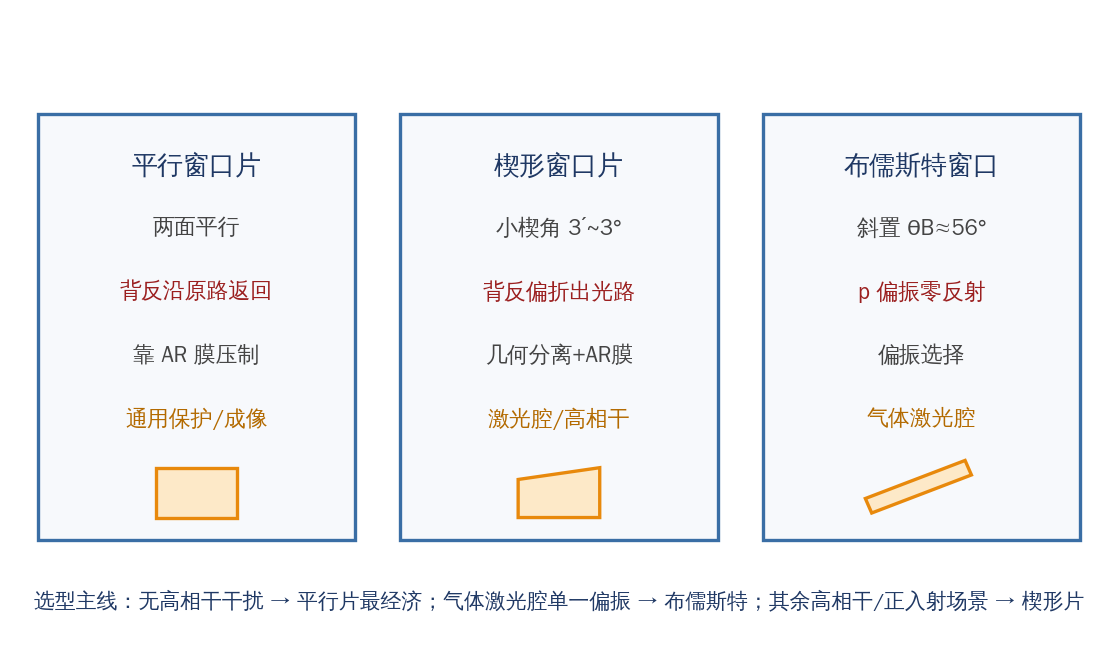
Comparison of three optical-window solutions: parallel window (back-reflection returns along the path), wedged window (back-reflection deflected out of path), Brewster window (p-polarisation zero reflection)
Source: drawn by Soar Laser
Related and similar terms distinguished:
| Term | Meaning | Relationship to a wedged window |
|---|---|---|
| Wedge prism (optical wedge) | A prism that deflects or steers a beam or fine-tunes alignment, with wedge angles often several to a dozen degrees | Looks similar but serves a different purpose: a wedge prism is meant to ‘deflect’, a wedged window to ‘transmit without deflecting’; wedge angles differ by an order of magnitude, and catalogues list them under ‘prisms’ versus ‘optical windows’ |
| Wedge compensator | An element using a known wedge angle to compensate optical path or pointing | Same geometry, different purpose — not interchangeable |
| Bevelled mirror / wedge mirror | A reflective element whose reflecting surface carries a wedge angle | Works in reflection, unrelated to a transmitting window |
| Protective window | A window named by its use; protective windows in laser heads are traditionally parallel plates with double-sided AR | ‘Protective’ names the use, ‘wedged/parallel’ names the geometry; upgrade to a wedged protective window only when return-light interference appears |
Division of labour with the AR coating: wedged geometry ‘shows the reflection out of the path’, AR coating ‘makes the reflection smaller’ — one manages direction, the other intensity, complementary rather than either/or. The standard engineering combination is ‘wedge geometry + double-sided AR’: geometry removes the return path, coating minimises residual reflection. AR alone can still let residual reflection form an etalon; wedge alone leaves 4% (higher for IR materials) reflection from the uncoated face which, even deflected out of the path, can form ghost spots and heat inside the optomechanics. In high-power systems both are indispensable.
2. Working Principle
2.1 The etalon effect in a parallel window: the root of the problem
Magnitude of Fresnel reflection. At normal incidence the single-surface reflectance is given by the Fresnel formula:
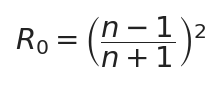
Fresnel reflectance (normal incidence): R₀ is single-surface reflectance, n the material index. Ordinary optical glass n≈1.5 reflects about 4% per surface; fused silica n≈1.46 about 3.4%; ZnSe n≈2.4 about 17%; germanium n≈4.0 over 30%. With AR coating the single-surface residual is typically reduced to 0.2%–1% (good narrowband coatings below 0.25%), but never to zero, and with three prerequisites: design wavelength, design angle and uncontaminated coating
Formation of the etalon effect. A parallel window’s two strictly parallel faces form exactly a low-finesse Fabry–Pérot etalon — a parasitic etalon. Light bounces repeatedly between the two parallel reflecting faces with multiple-beam interference, and transmission and reflectance are modulated periodically with wavelength in a comb pattern; the spacing of adjacent transmission peaks is the free spectral range (FSR):
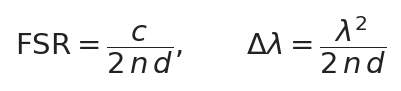
Free spectral range of a parallel window’s parasitic etalon: FSR is the frequency spacing (Hz), Δλ the wavelength spacing, c the speed of light in vacuum, n the refractive index, d the window thickness and λ the wavelength. Order of magnitude: a 3 mm fused-silica plate (n≈1.46) has FSR≈34 GHz at 1064 nm, corresponding to about 0.13 nm — exactly the order of a typical solid-state laser’s longitudinal-mode spacing, so the modulation really sweeps across the laser wavelength
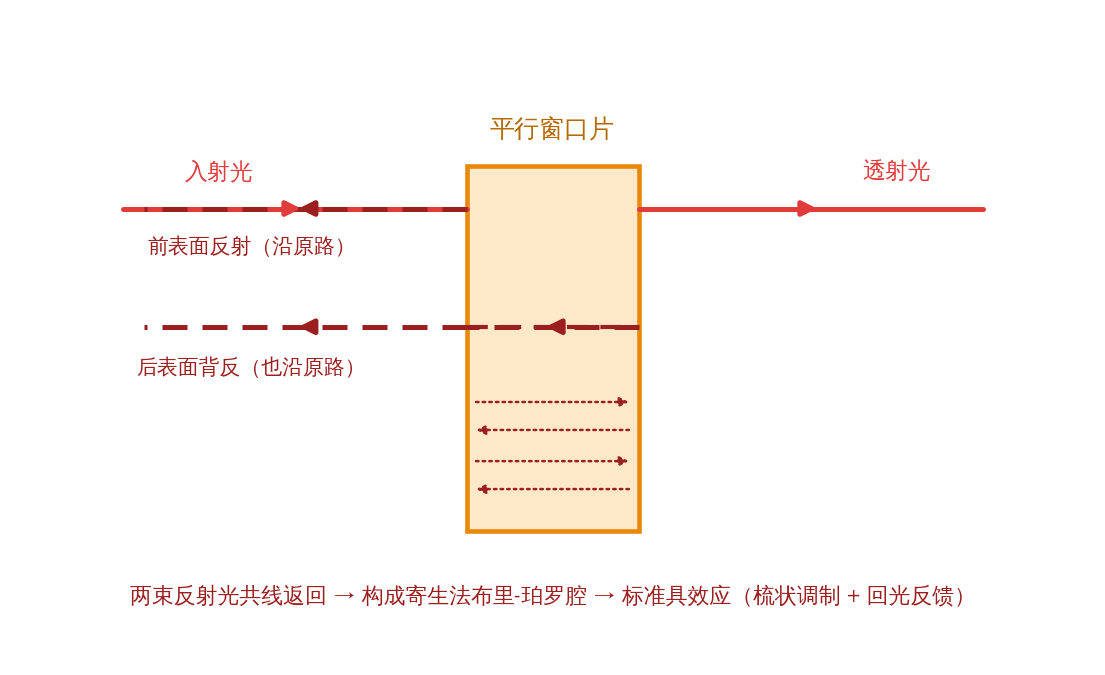
Etalon effect in a parallel window: front- and back-surface reflections return collinearly along the path; the two parallel faces form a parasitic Fabry–Pérot cavity producing comb-like transmission modulation and return-light feedback
Source: drawn by Soar Laser
The amplitude is also considerable: an uncoated parallel plate can have a transmission peak-to-valley difference on the order of 15%; even with double-sided AR reducing residual reflection to 0.5%, transmission ripple is still about 2% (a typical estimate for low-finesse interference).
Four specific harms to laser systems:
- Cavity feedback: the back-surface reflection returns along the original path into the laser cavity and couples with the intracavity field, effectively adding an extra feedback cavity and causing longitudinal-mode competition and mode hopping, power fluctuation, frequency pulling and feedback noise; especially fatal for diode lasers, external-cavity diode lasers (ECDLs) and narrow-linewidth fibre lasers, where return light on the order of 0.1% can markedly destroy frequency stability.
- Fringing: with a highly coherent source (laser illumination, coherent imaging, holography, interferometry) passing a parallel window, reflections from the two surfaces interfere with the main beam, superimposing bright/dark fringes or Newton rings on the detector/camera, directly contaminating the measurement signal and drowning low-contrast defects.
- Transmittance drift: when a narrow-linewidth laser’s wavelength falls on a steep flank of the interference comb, temperature changes shift the optical thickness nd (thermal expansion + thermo-optic effect) and mechanical vibration changes the tilt, sweeping the interference peak across the laser line and changing transmission — a common hidden cause of slow ‘passive-noise’ drift in precision measurement systems.
- Parasitic oscillation and ghost hot spots: in high-gain amplifiers, window reflections combined with other optical surfaces can form parasitic lasing, consuming gain; at high power, off-axis ghost reflections converge on the barrel wall or adjacent components, causing local absorption and heating, thermal distortion or even component burnout.
Why AR coating cannot eradicate the problem: residual reflection is nonzero (0.2%–1% is already enough in highly coherent, high-gain systems), bandwidth is limited (broadband coatings have higher residual than narrowband, and dual/triple-wavelength systems are hard to cover), angle is limited (oblique incidence raises residual and changes polarisation response), and at high power there are damage-threshold and contamination sensitivities (contamination → absorption and heating → coating damage → reflectance rises → worse heating, a vicious cycle). Coating makes the problem smaller; geometry sends it away.
2.2 Wedged windows: how the wedge angle eliminates back-reflection (core)
Geometric derivation of wedge deflection. Let the angle between the normals of the two surfaces (the wedge angle) be α. Light at normal incidence on the first face keeps its direction, enters the glass and reaches the second face; since the face normals differ by α, the incidence angle at the second face is about α. By the law of reflection, the reflected ray makes angle α with the second-face normal too, so inside the glass this back-reflection is deflected by 2α relative to the original direction — no longer returning along the path. On reaching the front face it refracts again (glass→air, angle magnified by n in the small-angle approximation), and on emerging into air the deflection relative to the original return path is about 2nα (about 3α for n≈1.5):
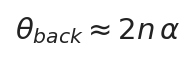
Emergent deflection angle of the second-surface back-reflection: α is the wedge angle (radians), n the refractive index. Inside the glass the deflection is 2α; after refraction out of the window it is about 2nα in air (about 3α for n≈1.5). This is the standard basis for measuring window wedge angle in optical testing (back-reflection spot separation ∝ 2nα), and ghost-beam deflection analysis uses the same formula
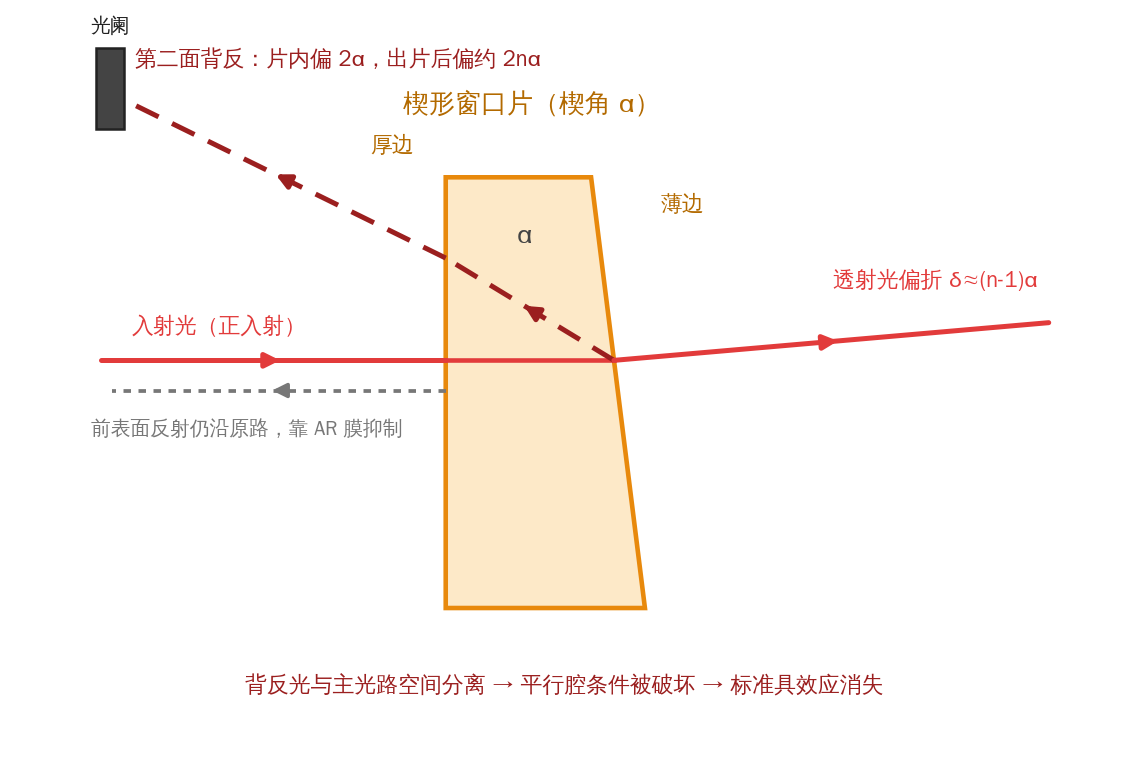
Back-reflection deflection geometry of a wedged window: the incident beam enters the first face normally, the back-reflection from the second face deflects 2α inside the glass and about 2nα after emerging, where it is collected by a stop; the transmitted main beam deflects slightly δ≈(n−1)α towards the thin edge; the front-surface reflection still returns along the original path and is suppressed by the AR coating
Source: drawn by Soar Laser
Thus the two reflected beams separate in space: the first-face reflection still returns along the original path, but it is only a single-surface residual (≤0.2%–1% after AR), low in intensity and not forming a round-trip cavity between two parallel faces; the most harmful second-face ‘back-reflection’ is thoroughly deflected out of the path. The round-trip beams no longer overlap, the geometric condition of the Fabry–Pérot parallel cavity is dismantled, and multiple-beam interference loses its basis — the full meaning of ‘a wedged window eliminates the etalon effect geometrically’: it does not depend on a perfect coating; as long as the faces are not parallel, the etalon cannot form. Viewed through interference fringes, a parallel plate produces equal-inclination fringes (concentric rings), a wedged plate equal-thickness fringes (parallel straight lines), with spacing inversely proportional to wedge angle; a large enough wedge makes fringes too dense for the detector to resolve, so macroscopically interference disappears.
Order-of-magnitude example: take a mainstream commercial 30 arcmin (0.5°) wedge with N-BK7 (n≈1.52): the back-reflection from the second face emerges at about 2nα≈1.5° from the original path, enough to be blocked by a stop or separated from the main reflection after a short distance; with a 1° wedge and n≈1.5 the back-reflection deflects about 3°.
The price of the emergent beam — a small deflection. The main beam transmitted through the window is also deflected by the wedge; in the thin-prism (small-angle) approximation the emergent deflection is:
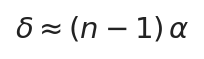
Emergent deflection of the transmitted main beam of a wedged window: α is the wedge angle (radians), n the refractive index, deflection directed towards the thin edge. OptoSigma gives quantitative factors: about 0.52 times the wedge angle for N-BK7 and 0.46 for fused silica (visible light, normal incidence), i.e. a 1° wedge deflects the emergent beam about 0.5°
This fixed small deflection can be compensated once at alignment (adjusting the mount, using a downstream mirror to recover the axis), but precision imaging and long-distance collimation are sensitive to it — in a focusing path with 100 mm focal length, a 0.5° deflection causes about 0.87 mm lateral focus shift:

Lateral focus shift from emergent deflection: f is the focusing-lens focal length, δ the emergent deflection angle. At f=100 mm, δ≈0.5°, Δs≈0.87 mm. This is the fundamental reason a window’s wedge must be very small while an optical wedge’s can be large: a window’s primary task is ‘transmit while changing the beam direction as little as possible’; large-angle deflection is the job of a wedge prism
Wedge orientation matters. Wedge angle is a directional geometric quantity — which way the thick and thin edges point decides where the deflected reflection flies. Alignment principle: direct the deflected reflection towards a safe direction outside the path (a light trap, beam stop or absorbing surface), not into reflective areas of the barrel wall, adjacent lenses or back into the system. High-power scenarios must calculate the power density at the reflection’s landing point and provide absorbing structures — the reflection has merely ‘changed direction’, not disappeared; a reversed wedge at best sends the reflection to the wrong place, at worst a high-power reflection burns the barrel or adjacent lenses. Wedged windows therefore usually carry thick/thin-edge marks or arrows, which must be checked before installation.
Typical wedge magnitudes. Commercial wedged windows commonly range from 3 arcmin (3′) to 3°; mainstream standard products from Thorlabs, Edmund Optics and others widely use 30 arcmin (0.5°) ±10 arcmin, with 1° and 2° options. Selection logic: a larger wedge separates reflections more thoroughly and is less sensitive to alignment error, but emergent deflection (n−1)α also grows. Very small wedges (a few arcmin–0.5°) serve intracavity reference paths, precision imaging and collimation; standard wedges (0.5°–2°) are the mainstream laser window; larger wedges (2°–3°) handle high reflected energy that must be kept well away from the path, with collection structures required.
Single wedge and double wedge. Single-wedge (one face wedged): one face flat, the other wedged — simple to make, lower cost, the mainstream standard product; emergent deflection (n−1)α is set solely by the wedged face and the first-face reflection still returns along the path at normal incidence. Double-wedge (both faces wedged): both faces carry wedge angles, which can be designed symmetrically so emergent deflections cancel (net deflection near zero), and both surfaces’ reflections are deflected — more thorough for cases ‘not wanting even the first-face residual to return along the path’ (such as narrow-linewidth seed-source exits); the price is greater manufacturing and testing difficulty and higher cost, usually custom products.
2.3 Brewster windows: the polarisation zero-reflection approach
Brewster’s law: when light is incident at the Brewster angle θB on an interface between two media, the reflectance of p-polarisation (electric field parallel to the plane of incidence) is zero:
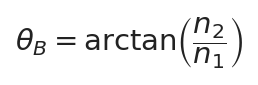
Brewster’s law: θB is the Brewster angle, n₁ and n₂ the indices on either side. Air to ordinary glass (n≈1.5) gives θB≈56.3° (fused silica about 55.5°), at which s-polarisation still has about 15% single-surface reflection; CO₂ lasers commonly use ZnSe (n≈2.4) with θB≈67.4° and s reflectance about 50% per surface — the higher the index, the harder the Brewster approach suppresses s-polarisation
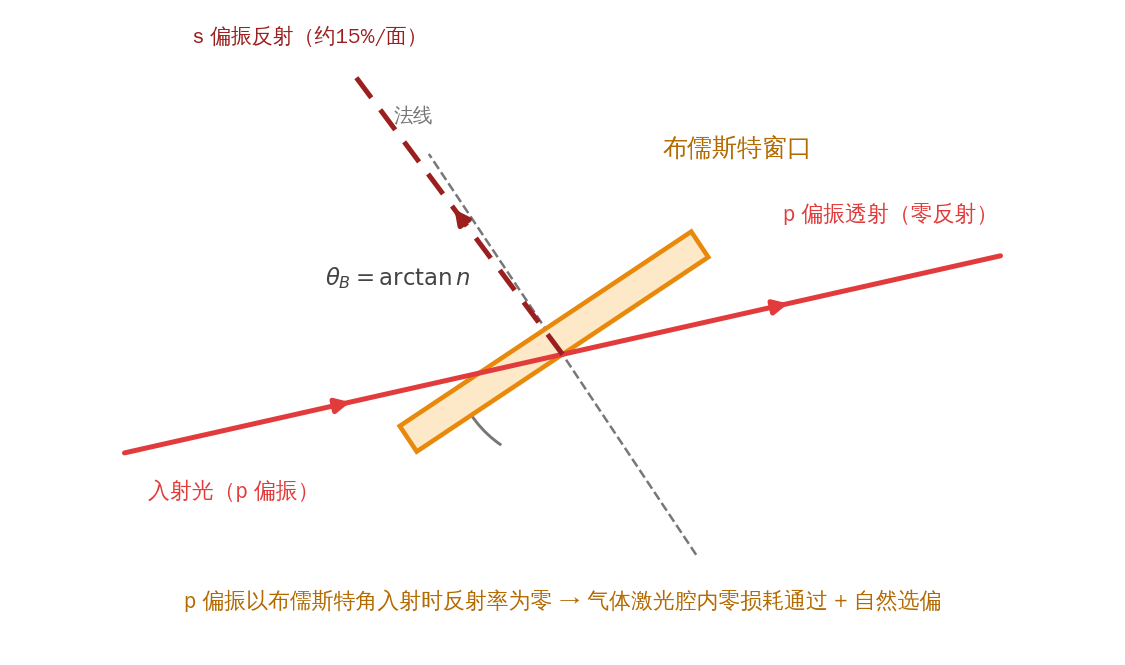
Brewster window principle: the window is tilted at the Brewster angle, p-polarisation passes with zero reflectance and no loss, s-polarisation is mostly reflected; gas lasers use this to achieve both a sealed window and intracavity polarisation
Source: drawn by Soar Laser
Brewster windows in gas lasers. At both ends of the resonant cavities of CO₂, He-Ne, argon-ion and other gas lasers, sealing windows are tilted at the Brewster angle: p-polarised light passes each round trip with zero reflection loss, while s-polarisation suffers about 15% (glass) loss per interface, so over intracavity round trips the total loss for s far exceeds p and gain competition naturally ‘polarises’ the laser into a linearly polarised p output. The Brewster window serves two roles at once: sealed window + intracavity polariser, achieving zero p reflection without coating and immune to coating damage and contamination — especially important for ZnSe high-power CO₂ lasers where coating at 10.6 μm is difficult and damage-risky, and the reason this scheme has endured for decades.
Positioning difference from wedged plates. A Brewster window has zero reflection only for a single polarisation (p); unpolarised or s-polarised light suffers heavy loss; it must be tilted about 56°–67°, taking space and giving a long path inside the plate; an obliquely inserted flat introduces astigmatism and lateral shift in converging paths and is sensitive to angular misalignment (p reflectance rises markedly a few degrees off θB). A wedged window is polarisation-independent, used at normal incidence and compact, but the first-face reflection still needs AR suppression. Solid/fibre laser external paths have uncontrolled polarisation and limited space, making wedged plates more practical; in gas-laser cavities the Brewster window remains the classic standard.
3. Structure and Classification
Typical structure of a wedged window: a circular or rectangular optical substrate + two transmitting faces enclosing a small wedge angle + double-sided AR coating + protective edge chamfer + wedge-orientation marking (different thick/thin-edge chamfers, engraving or arrows — alignment direction depends entirely on it). High-power versions also add a wedge retaining ring (keeping the wedge orientation fixed and preventing rotation), a reflected-light collection groove or barrel-wall absorbing structure, and water-cooling/heat-sinking design.
A parallel window has the simplest structure: two strictly parallel faces (parallelism usually <1 arcmin), double-sided AR, no orientation requirement, free rotation on installation. A Brewster window has parallel faces but is tilted at the Brewster angle in a dedicated mount, with the p direction aligned to the plane of incidence, and is usually uncoated (low loss via polarisation, not coating).
By wedge angle:
| Category | Wedge-angle range | Emergent deflection (n≈1.5) | Typical use |
|---|---|---|---|
| Very small wedge | A few arcmin – 0.5° | < 0.25° | Intracavity reference paths, precision imaging, collimation |
| Standard wedge | 0.5°–2° (30′ the mainstream standard) | 0.25° ~ 1° | General laser windows, high-coherence measurement, spectrometers |
| Larger wedge | 2° ~ 3° | 1° ~ 1.5° | High-power reflection separation, ghost management |
By wedging method: single wedge (one flat face, one wedged, the mainstream standard) and double wedge (both faces wedged, emergent deflection can be designed to cancel, mostly custom).
By material:
| Material | Transmission band (typical nominal) | Refractive index (typical wavelength) | Features and suitable scenarios |
|---|---|---|---|
| Fused silica (e.g. JGS1, Corning 7980 grade) | About 0.18–2.5 μm (premium grade to 3.5 μm) | 1.46 @ 633 nm | Mainstay from UV to near-IR; low expansion (≈0.55×10⁻⁶/K), high LIDT; first choice for high-power fibre-laser windows |
| N-BK7 / H-K9L glass | About 0.35–2 μm | 1.52 @ 633 nm | Economical visible to near-IR; good homogeneity, higher expansion (≈7×10⁻⁶/K), unsuitable for high power |
| Calcium fluoride (CaF₂) | About 0.17–7 μm (to 8 μm) | 1.43 @ 633 nm | Broad UV to mid-IR transmission; common at 193/248 nm excimer and mid-IR; low index gives lower Fresnel reflection, soft material |
| Magnesium fluoride (MgF₂) | About 0.15–6 μm | 1.38 @ 633 nm | Excellent deep-UV transmission; birefringent crystal, must be cut by crystal orientation |
| Sapphire | About 0.15–5 μm | 1.77 @ 633 nm | Mohs hardness 9, high conductivity (≈30 W/m·K); high-power, high-pressure, harsh-environment windows; mind birefringence |
| Zinc selenide (ZnSe) | About 0.6–16 μm (to 21 μm) | 2.40 @ 10.6 μm | First choice for CO₂ lasers (10.6 μm); uncoated single-surface reflection about 17%, coating mandatory; soft, toxic dust |
| Germanium (Ge) | About 2–14 μm | 4.00 @ 10.6 μm | Mid-IR high index (uncoated >30% per surface), opaque to visible; absorption rises with temperature, for low-power IR |
| Silicon (Si) | About 1.2–7 μm | 3.42 @ 3 μm | Near to mid-IR, high conductivity, for moderately high-power IR |
By use:
- Laser cavity window: at cavity or amplifier outputs, before/after isolators, seed-injection ends, suppressing back-reflection into the gain medium;
- Protective window: outermost in laser heads, isolating spatter and fumes; generally parallel plate + double-sided AR, with wedged protective plates for highly reflective material processing or high-coherence systems;
- Vacuum / pressure window: vacuum chambers, pressure vessels, environmental test chambers, balancing pressure sealing with fringe removal, thickness designed mechanically for the pressure difference;
- Imaging / measurement window (fringing-free window): eliminating interference fringes under highly coherent sources, for machine vision, holography and interferometry;
- Special IR/UV windows: ZnSe for CO₂ lasers, Ge/Si/CaF₂ for IR thermal imaging and spectroscopy, CaF₂ or high-purity fused silica for UV excimer.
Quick comparison of three window structures:
| Item | Parallel window | Wedged window | Brewster window |
|---|---|---|---|
| Face relationship | Two faces strictly parallel (<1 arcmin) | Normals enclose a small wedge angle (3′–3°) | Faces parallel, whole plate tilted |
| Incidence | Normal / near-normal | Normal incidence (on first face) | Brewster-angle oblique incidence (about 56°–67°) |
| Reflection destination | Returns along the original path | Second-face reflection deflects 2α in glass, about 2nα emergent | p zero reflection, s mostly reflected |
| Polarisation sensitivity | No | No | Yes (only p has zero reflection) |
| Emergent deflection | None | About (n−1)α | Lateral shift and astigmatism |
| Mounting orientation requirement | None | Yes (wedge orientation mark) | Yes (angle + polarisation direction) |
| Typical scenario | General protection, imaging, low-coherence paths | Laser cavity windows, fringe-free measurement windows | Gas-laser cavities |
4. Key Parameters
| Parameter | Meaning and typical value | Selection significance |
|---|---|---|
| Wedge angle α | Angle between the normals of the two faces, typically 3′–3°; mainstream standard 30′±10′, with 1° and 2° options | Larger wedge separates reflections more thoroughly but increases emergent deflection; choose by the path’s deflection tolerance and reflection-separation need |
| Emergent deflection angle δ | ≈ (n−1)·α (BK7 about 0.52α, fused silica about 0.46α); 1° wedge about 0.5° | Directly affects downstream alignment and focus position; precision systems must calculate it, choose a very small wedge or cancel with a double wedge |
| Back-reflection deflection angle | About 2α inside glass, about 2nα in air (about 3α for n≈1.5) | Sets how fast the reflection separates from the path; use the emergent angle when sizing stops/collectors |
| Surface figure | Usually λ/4–λ/10 @633 nm (PV), high-precision λ/20 | Windows demand less figure accuracy than lenses, but figure error introduces wavefront distortion affecting focus and beam quality |
| Surface quality (scratch-dig) | Commonly 20-10, 40-20; high-power grade 10-5 | Scratches and digs become absorption sources and damage initiation sites at high power |
| Parallelism / wedge tolerance | Parallel plates <1 arcmin; wedged plates typically ±a few arcmin to ±0.1° (standard 30′±10′) | Wedge tolerance directly sets the determinacy of reflection deflection; excessive tolerance may under-separate or deviate in direction |
| Material and transmission band | Fused silica 0.18–2.5 μm; BK7 0.35–2 μm; CaF₂ 0.17–7 μm; ZnSe 0.6–16 μm | Material must match the laser wavelength; a mismatch causes at best absorption and heating, at worst opacity or cracking |
| AR band and residual reflection | Single-surface residual R<0.25% (narrowband), R<0.5% (broadband) typical; dual/triple-wavelength AR available | Lower residual means less etalon remnant; the coating band must cover all operating wavelengths |
| LIDT | Pulsed: fused-silica dielectric coating typically 5–15 J/cm² (1064 nm, 10 ns, per maker’s specification); CW: order of kW/cm² | At high power check both peak power density (pulsed) and average power density (CW), leaving a 2–3 times margin |
| Clear aperture / outer diameter / thickness | Clear aperture usually 80%–90% of outer diameter; thickness 1–10 mm common | Aperture must exceed beam diameter with margin; thickness affects pressure resistance and FSR (thicker = smaller FSR, denser fringes) |
| Transmitted wavefront error (TWE) | Typically λ/4–λ/2 @633 nm, high precision λ/10 | Characterises wavefront distortion after transmission, essential for high beam-quality (M²) systems |
| Operating temperature and thermal-shock resistance | Fused silica and sapphire resist shock well; BK7 poorer; ZnSe must avoid rapid temperature changes | At high power window absorption creates a thermal lens; material expansion/conductivity sets thermal distortion magnitude |
| Pressure resistance | Vacuum/high-pressure window thickness calculated from pressure difference and aperture (uniform load on a circular plate) | Wedging does not affect strength calculation, but thickness must meet mechanical requirements; high-pressure windows are usually much thicker than optical ones |
5. Characteristics: Advantages and Disadvantages
Wedged window. Advantages: ① thoroughly separates back-reflection geometrically — relying not on ‘reflection being zero’ but on ‘reflection not coming back’, a robust mechanism that greatly weakens the etalon even uncoated; ② polarisation-independent, suitable for any polarisation state; ③ used at normal incidence, compact, a direct replacement for a parallel window of the same specification; ④ geometry itself imposes no wavelength limit — effective over any band the material transmits; ⑤ complementary to AR coating, with double protection from geometric separation plus coating reduction. Limitations: ① small emergent deflection δ≈(n−1)α needs compensation in precision imaging/collimation, or a very small wedge or double wedge; ② a reversed wedge sends the reflection to a dangerous spot and can burn components at high power; ③ more expensive than a parallel plate of the same specification; ④ figure and coating uniformity are harder to control when both faces are wedged; ⑤ the first-face reflection still returns along the path and must be suppressed by AR coating.
Parallel window. Advantages: zero emergent deflection, friendly to imaging and alignment; simplest structure, most mature manufacturing, lowest price; no orientation requirement and easy to replace; parallelism gives good coating consistency. Limitations: the etalon effect can only be suppressed, never eradicated, by AR coating — in high-coherence/intracavity scenarios 0.2%–1% residual is enough for observable interference; at high power coating risk concentrates, with reflectance rising rapidly after contamination or damage.
Brewster window. Advantages: theoretical zero reflection for p-polarisation without relying on coating — immune to coating damage and contamination, the reason it is irreplaceable in high-power gas lasers; also gives intracavity polarisation, killing two birds with one stone. Limitations: effective only for p-polarisation, with s-polarisation loss about 15% (glass)–50% (ZnSe) per surface and heavy loss for unpolarised light; must be tilted, taking space and constraining optomechanics; the tilted interface introduces astigmatism and lateral shift; sensitive to angular misalignment.
Overall comparison of three window types:
| Comparison dimension | Parallel window | Wedged window | Brewster window |
|---|---|---|---|
| Reflection-suppression principle | AR coating reduces reflection amplitude (geometrically reflection still returns along path) | Geometric deflection separates reflection + AR coating | Polarisation selection, p zero reflection |
| Polarisation dependence | No | No | Strong (only p has zero reflection) |
| Emergent deflection | None | Small deflection ≈(n−1)α | Lateral shift + astigmatism |
| Etalon effect | Present (AR only suppresses; tilting cannot eliminate) | Essentially eliminated geometrically | Essentially eliminated (tilt + polarisation) |
| Reflection-suppression bandwidth | Limited by AR coating band | Limited only by material transmission | Coating-independent, broad (at a single angle) |
| Power handling | Limited by AR coating LIDT | Coating + geometry, better | Very high (no coating, no damage risk for p) |
| Installation complexity | Lowest | Medium (wedge direction must be aligned) | Highest (angle + polarisation direction) |
| Cost | Lowest | Medium | Medium-high (including dedicated mount) |
| Typical use | General protection, imaging, low-coherence paths | Laser cavity windows, fringe-free measurement windows, wedged protective plates | Gas-laser cavities |
6. Typical Applications and Selection Guidance
Typical application scenarios:
- High-power/narrow-linewidth laser cavity and external windows (the wedged plate’s main battlefield). Before/after output isolators of fibre and solid-state lasers, amplifier outputs and seed-source injection ends — anywhere back-reflection may return to the gain medium, use a wedged window: return light into the cavity causes mode hopping, power fluctuation and linewidth broadening, and even parasitic oscillation in high-gain amplifiers. A wedged plate geometrically ensures the second-face reflection does not return to the path, forming double protection with an optical isolator; in narrow-linewidth lasers (MHz-linewidth ECDLs, etc.) a wedged window is standard. Gas-laser cavities with a single polarisation use Brewster windows.
- Protective windows in laser heads. Cutting/welding heads are harsh environments with frequent window replacement, and the general solution is a parallel protective plate + double-sided AR (prioritising economy and replaceability). But when processing highly reflective materials (copper, aluminium, brass, gold) with workpiece reflection returning into the head, or when kW-class systems show return-light interference and power jitter, a wedged protective plate deflects the plate’s own back-reflection and returning light out of the path, protecting the fibre output end — a clear upgrade path. Note the wedged plate’s emergent deflection slightly shifts the focus, so recalibration is needed after replacement.
- Interferometry, holography, coherent imaging, machine vision. Under laser or highly coherent LED illumination, reflections from a parallel window’s two surfaces interfere with the main beam, forming Newton rings or parallel fringes on the CCD superimposed on the image under test — especially visible with telecentric lenses, collimated illumination and low-NA systems. Switching to a wedged window (fringing-free window, commonly 30′–1° wedge) deflects the reflection out of the imaging path (lens field angles are usually below 1°), and the fringe geometry disappears.
- Spectrometers, wavemeters, reference paths, external-cavity lasers. A parallel window’s etalon comb modulation superimposes noise on measured spectra, reducing wavelength resolution; in an ECDL external feedback path any parallel surface can compete with the grating in mode selection. Such spots where ‘a parallel plate is a free etalon’ should all use wedged plates.
- Observation windows for vacuum chambers, environmental test chambers and pressure vessels. A dual need: mechanically withstand pressure differences (thickness designed for mechanics, usually thick) and optically produce no interference fringes — while a thick parallel plate has smaller FSR, denser fringes and is harder to fix. A wedged design removes fringes without changing thickness or strength; sapphire or thick fused silica is common at high pressure.
- IR/CO₂ lasers and UV excimer windows. CO₂ systems (10.6 μm) use ZnSe wedged windows: uncoated ZnSe reflects about 17% per surface, and even AR-coated residual exceeds visible-band windows, so geometrically deflecting the strong reflection out of the path is standard practice for high-power CO₂; external beam-delivery paths use wedged ZnSe plates. UV excimer (193/248 nm) uses CaF₂ or high-purity fused silica wedged plates — UV AR coating is difficult with higher residual, making the wedge structure equally necessary.
- Brewster windows for gas lasers. The classic solution for the end windows of CO₂, He-Ne and argon-ion laser cavities: a ZnSe window tilted at the Brewster angle (about 67°) passes p-polarisation with zero reflection and no coating, while s losses lock the laser to linearly polarised output — solving polarisation, loss and coating risk at once.
Selection decision tree (ask in order):
- Any high-coherence reflection interference? Is there a laser/narrow-linewidth source in the path? Can reflections return to the cavity or gain medium? Do fringes appear on the detector? Is output power jittering irregularly? — all no: a parallel window + good AR coating suffices, most economical.
- Interference present — is a Brewster window suitable? Is the path single p-polarisation? Is there room for oblique mounting (about 56°–67°)? Is it a gas-laser cavity? — yes: Brewster window.
- Interference present, normal incidence, arbitrary polarisation, compact space? — a wedged window (the mainstream choice for the vast majority of modern solid-state/fibre laser systems).
- How large a wedge? Precision imaging/collimation fear deflection: a very small wedge (a few arcmin–0.5°) with deflection calculated; general laser windows insensitive to deflection: standard wedge (0.5°–2°, 30′ standard); high reflected energy needing to be far from the path: 2°–3° with a reflection collection structure.
- Choose material by wavelength. Visible–near-IR (400–2000 nm): fused silica (high power) or N-BK7/H-K9L (economical); UV (180–400 nm): fused silica or CaF₂; deep UV (<200 nm): CaF₂ or MgF₂; mid-IR (2–7 μm): CaF₂ or sapphire; CO₂ laser (10.6 μm): ZnSe; high-power harsh/high-pressure environments: sapphire.
- Power and reliability checks. Compute peak power density (pulsed) and average power density (CW) at the working surface, comparing with material and coating LIDT with a 2–3 times margin; high-power CW also needs thermal-lens assessment and a plan for the deflected reflection’s landing point and absorbing structure; vacuum/pressure scenarios verify thickness mechanically.
Selection examples:
- Example 1: Why a kilowatt fibre laser output window uses a wedged silica plate? A 1064 nm fibre laser outputs 1 kW with a beam diameter around 10 mm, power density about 1.3 kW/cm². With a parallel silica window, even 0.25% double-sided AR residual leaves about 2.5 W reflected per surface; that 2.5 W returning to the fibre output head can create feedback at the fibre end face or in the gain fibre, causing power instability or even end-face damage. Switching to a 1° wedge fused-silica window: the second-face back-reflection emerges deflected about 3°, completely outside the fibre’s acceptance angle (usually a few degrees) and unable to return; the first-face 2.5 W is reduced to milliwatts by the AR coating. The emergent deflection of about 0.5° is compensated once with the mount in the downstream collimation/focusing path; fused silica’s high LIDT and low expansion ensure no significant thermal lens at 1 kW CW.
- Example 2: How to solve fringe interference in front of a vision-inspection lens? A machine-vision station uses 660 nm line-laser illumination, and a parallel quartz protective window in front of the lens produces concentric ring fringes on the CCD, affecting defect detection. The cause is interference between the parallel window’s two-surface reflections and the main beam, forming Newton rings. Solution: swap in a 30′ (0.5°) wedged window of the same material and AR coating — the back-reflection deflects about 1.5°, out of the lens imaging path, and the fringes disappear; emergent deflection about 0.25° gives about 0.87 mm image shift at 200 mm object distance, absorbed by recalibrating the pixel-to-coordinate mapping.
- Example 3: Why a CO₂ laser cavity window is a Brewster tilt rather than a wedged plate? A 500 W, 10.6 μm CO₂ laser needs windows at both cavity ends. ZnSe (n≈2.4) reflects about 17% per surface uncoated, with high coating-damage risk at high power and relatively high residual even coated. With a wedged ZnSe plate, although the second-face reflection is deflected, the first-face reflection still returns along the path into the cavity (17% or coated residual), and the intracavity loss is unacceptable. A Brewster window tilted about 67° passes p-polarisation with zero reflection and no coating, avoiding coating-damage issues while making the laser naturally output linear polarisation — the industry-standard CO₂ solution for decades. Windows in the external beam-delivery path use wedged ZnSe plates to remove back-reflection.
7. Common Misconceptions and Pitfalls
| No. | Misconception | Correct understanding / consequence |
|---|---|---|
| 1 | AR coating means no reflection interference | AR leaves 0.2%–1% single-surface residual, enough to form an etalon in highly coherent/high-gain systems; coatings also have bandwidth, angle and contamination limits, suppressing but never removing the parallel-cavity condition |
| 2 | A wedged window is a ‘defective parallel plate’ | The wedge angle is a deliberately designed functional parameter with tight angular tolerance (e.g. 30′±10′) and orientation marking, manufactured to no lower precision than a parallel plate and usually costing more |
| 3 | Using a wedged window as a wedge prism to deflect a beam | A window’s wedge is small (usually <3°) and designed to transmit with minimal deflection; for large deflection choose a wedge prism (0.5°–15° deflection grades) |
| 4 | Ignoring wedge orientation, fitting it backwards or wrongly | Wrong thick/thin-edge direction sends the deflected reflection into the barrel wall or adjacent lenses, causing local overheating or burnout at high power; check the edge marks before installation |
| 5 | The larger the wedge the better | Emergent deflection (n−1)α grows linearly with wedge angle; too large misdirects the beam, shifts the focus and distorts imaging; a 1° wedge already gives about 0.87 mm focus shift at 100 mm focal length |
| 6 | Using a large-wedge plate freely in imaging systems | A large wedge introduces astigmatism, chromatic aberration (index varies with wavelength) and pointing deflection; precision measurement should use a very small wedge (a few arcmin–0.5°) or evaluate and compensate deflection |
| 7 | Not handling the deflected reflection’s landing point at high power | The reflection has only changed direction and remains inside the optomechanics; it must point to a stop/absorbing surface, or it may reflect off the barrel wall back into the path or create a new hot spot |
| 8 | Choosing material without regard to wavelength | BK7 absorbs significantly in UV (<350 nm) and mid-IR (>2 μm), heating or even cracking there; CO₂ lasers must use IR materials such as ZnSe — silica is completely opaque at 10.6 μm |
| 9 | Looking only at transmittance, ignoring LIDT and coating bandwidth | At high power coating damage is the main failure mode — check both peak/average power density; dual/triple-wavelength lasers must confirm the AR coating covers all operating wavelengths |
| 10 | Treating a Brewster window as a general-purpose window | Zero reflection only for p-polarisation, with s loss about 15% (glass)–50% (ZnSe) per surface; must be tilted with polarisation aligned to the plane of incidence, cannot be used at normal incidence |
| 11 | Calculating vacuum/high-pressure windows only optically, not mechanically | Thickness needs mechanical-strength calculation for pressure difference and aperture; wedging does not affect strength but thickness must be adequate; under high pressure window deformation also affects optical figure |
| 12 | Continuing high-power use after the window is contaminated | Contamination absorbs → local heating → coating damage → reflectance rises → more absorbed heat; this vicious cycle can crack the window within seconds — inspect, clean and replace regularly |
| 13 | Focusing only on both-surface figure, ignoring wedge tolerance | Wedge tolerance directly sets the actual reflection-deflection angle and batch consistency; excessive tolerance may under-separate (too little deflection) or deviate from the design direction — check nominal wedge and tolerance when purchasing |
| 14 | Confusing the selection scenarios of ‘protective window’ and ‘wedged window’ | Head protection prioritises economy, replaceability and contamination resistance, defaulting to a parallel plate; upgrade to wedged only when return-light interference, fringes or power jitter are confirmed |
| 15 | Thinking a wedged plate completely removes all reflections | A wedge only deflects the second-face reflection; the first-face reflection still returns along the path and needs AR reduction; to deflect even the first-face residual, choose a double-wedge design |
| 16 | Thinking tilting a parallel window removes fringes | Tilting only changes interference-fringe spacing and position (etalon tilt tuning); the parallel-cavity condition remains and fringes do not vanish — eliminating interference requires the two faces to stop being parallel (wedging) |
8. References and Further Reading
- RP Photonics Encyclopedia, Optical Windows: https://www.rp-photonics.com/optical_windows.html
- RP Photonics Encyclopedia, Etalons (etalon principle and free spectral range): https://www.rp-photonics.com/etalons.html
- RP Photonics Encyclopedia, Output Couplers (wedged substrates eliminating back-surface reflection etalon effect): https://www.rp-photonics.com/output_couplers.html
- RP Photonics Encyclopedia, Fresnel Reflections (interface reflectance and polarisation): https://www.rp-photonics.com/fresnel_reflections.html
- RP Photonics Encyclopedia, Brewster Angle (Brewster’s law and laser applications): https://www.rp-photonics.com/brewster_angle.html
- RP Photonics Encyclopedia, Anti-Reflection Coatings: https://www.rp-photonics.com/anti_reflection_coatings.html
- Thorlabs, Wedged Laser Windows / UV Fused Silica Wedged Windows (30 arcmin wedge, non-collinear back-reflection): thorlabs.com
- Edmund Optics, N-BK7 Wedged Windows (wedged design eliminates etalon effect, avoids cavity feedback): edmundoptics.com
- OptoSigma, Wedged Substrates (emergent deflection δ≈(n−1)α, factor 0.52 for BK7 and 0.46 for fused silica): optosigma.com
- Abridged Optics, Beam Splitters – Ghost Reflections and Wedge Angle (ghost-beam angular separation about 2nα): abridgedoptics.com
- Wyant J. C. et al., Testing an Optical Window of a Small Wedge Angle: Effect of Multiple Reflections (large wedge makes fringes too dense to resolve), University of Arizona
- E. Hecht, Optics — chapters on Fresnel formulae, Brewster angle and multiple-beam interference
- Zhou Bingkun et al., Principles of Lasers (7th ed.), National Defence Industry Press — chapters on etalon effect and laser mode stability
📖 Further reading
- Laser protective window encyclopedia: materials, coatings and high-power protection explained — the protective window is the largest use of windows named by application; parallel plates + double-sided AR selection and failure analysis
- Dichroic mirror encyclopedia: splitting principle, film design and laser application selection — another flat optic relying on thin-film polarisation/wavelength selectivity
- Polarisation rotator encyclopedia: Faraday rotation and optical isolation principles — a return-light protection means alongside the wedged window, core of the optical isolator
- Beam combiner encyclopedia: laser combining technology and wavelength-combining mirror selection
🔧 Related product recommendations
Soar Laser supplies Thorlabs-specification optical windows and laser optics, including wedged laser windows (30 arcmin / 1° / 2° wedges, N-BK7 and UV fused-silica substrates, AR coatings at common laser wavelengths), parallel protective windows, Brewster windows and optical wedges/wedge prisms, covering 1064 nm, 532 nm, 355 nm and CO₂ 10.6 μm bands. For selection calculations by wavelength, power density and wedge orientation, or for a combined window + isolator return-light protection scheme, contact Soar Laser technical support.
Hotline: 15927220467 | Email: 859818709@qq.com
Disclaimer: This article is technical education in laser optics; formulae and figures are engineering approximations under typical conditions. For specific component specifications, damage thresholds and installation requirements, refer to the manufacturer’s official technical documents.
Leave a Reply