


What Is Pumping? How to “Fuel” a Laser
If a laser were a car, the gain medium would be the engine and pumping would be the act of “refueling” — without pumping, a laser is just a pile of non-luminous material. The method, efficiency and matching of pumping directly determine laser performance. From the earliest flash-lamp pumping to today’s laser-diode pumping, every advance in pumping technology has driven a leap in laser technology. Based on authoritative content from the RP Photonics Encyclopedia, this article systematically explains the physics of optical pumping, pump sources, pumping schemes and key techniques.
Table of Contents
- I. What Is Pumping? — “Injecting Energy” into the Laser
- II. Core Physics: Two-, Three- or Four-Level Systems?
- III. Types of Pump Sources: From Flash Lamps to Laser Diodes
- IV. Pumping Geometry: End Pumping vs. Side Pumping
- V. Advanced Pumping Techniques: In-Band Pumping, Tandem Pumping, etc.
- VI. Typical Applications
- VII. Common Misconceptions: 6 Ideas You May Have Got Wrong
- VIII. Recommended Reading
I. What Is Pumping? — “Injecting Energy” into the Laser
Pumping is the process of injecting energy into the laser gain medium, exciting particles from lower to higher energy levels to achieve population inversion. Only when population inversion is achieved (upper-level population > lower-level population) can stimulated emission exceed stimulated absorption and light be amplified — this is the prerequisite for laser operation [(RP Photonics)](https://www.rp-photonics.com/optical_pumping.html).
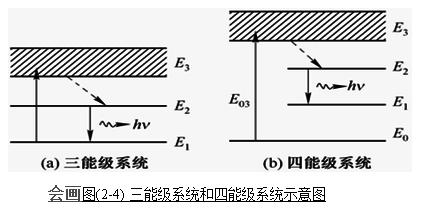
Figure 1: Comparison of energy-level structure and transitions in a three-level system (left) and a four-level system (right)
The word “pumping” may sound odd; it comes from the English “pump,” both transliterated and translated — just as a water pump draws water from a low place to a high place, pumping “draws” particles from lower to higher energy levels. According to the form of injected energy, pumping falls into two broad categories:
- Optical pumping: using photon energy to excite particles — solid-state lasers, fibre lasers, dye lasers and alkali-vapor lasers all belong to this category. The pump source can be a flash lamp, a laser diode (LD), or even another laser.
- Electrical pumping: using electrical energy to excite particles directly — semiconductor lasers (current injection) and gas lasers (discharge excitation) belong to this category.
- Chemical pumping: using the energy released by chemical reactions to achieve population inversion — typically chemical lasers (HF/DF chemical lasers, chemical oxygen-iodine lasers), which need no external power supply but involve hazardous chemicals.
- Other pumping methods: special types also include nuclear pumping (nuclear-pumped lasers) and gas-dynamic pumping (gas-dynamic lasers).
This article focuses on optical pumping, because solid-state and fibre lasers (the two most important types in industry and research today) are both optically pumped. The process of optical pumping is usually described by a rate-equation model, but this ignores some quantum coherence aspects of atom-photon interaction (such as Rabi oscillations) — though in most practical lasers, rate equations are sufficiently accurate [(RP Photonics)](https://www.rp-photonics.com/optical_pumping.html).
Key understanding: The essence of pumping is the means of energy injection that achieves population inversion — “feeding” energy to the gain medium so that more atoms are in excited states. “Refueling” is only a colloquial analogy; pumping is not fuel combustion but energy transfer (light → excited state, electricity → excited state, chemical energy → excited state, etc.). Without pumping, the gain medium is just a collection of atoms in the ground state, unable to produce laser light.
II. Core Physics: Two-, Three- or Four-Level Systems?
Why Can’t a Two-Level System Produce Laser Light?
Many beginners ask: if you shine light on a material to excite particles from the ground state to an excited state, doesn’t that achieve population inversion? The answer is no. The reason is that when you use light to excite particles, that same light can not only “pump” particles up from the lower level (stimulated absorption) but also “knock” particles down from the upper level (stimulated emission). When the upper and lower level populations are equal (N₁ = N₂), absorption and stimulated emission proceed at the same rate, reaching dynamic equilibrium — the so-called “transparency” state, with zero net gain. You can never achieve population inversion in a simple two-level system by purely optical means [(RP Photonics)](https://www.rp-photonics.com/optical_pumping.html).
Key insight
A two-level system can at most reach N₁ = N₂ (saturation), because the transition cross sections for stimulated absorption and stimulated emission are equal. To achieve inversion, a third (or more) level must participate — which is why real lasers are three-level or four-level systems.
Three-Level Systems
In a three-level system, particles are pumped from the ground state (E₁, level 1) to a high energy level (E₃, level 3), then relax rapidly and non-radiatively to a metastable state (E₂, level 2). The laser transition occurs between E₂ and E₁. A typical three-level system: the ruby laser (Cr³⁺:Al₂O₃, laser transition from ²E to ⁴A₂).
The problem with a three-level system is that the lower laser level is the ground state, which already holds almost all the particles. To achieve inversion, more than half the particles must be excited to the upper level — requiring a very high pump threshold. Therefore three-level lasers are usually less efficient
From an energy-utilisation standpoint, in a three-level system the lower laser level is the ground state, and the gap between pump-photon and laser-photon energy (the quantum defect) can actually be smaller — in other words, the fraction of pump-photon energy carried by the laser photon can be higher (smaller quantum defect). Its core problem is not absolutely low energy efficiency, but a high threshold pump power (needing to excite more than half the particles out of the ground state). Under high-power pumping, three-level systems can also have very high quantum efficiency [(RP Photonics · Optical Pumping)](https://www.rp-photonics.com/optical_pumping.html).
[(RP Photonics)](https://www.rp-photonics.com/optical_pumping.html).
Four-Level Systems
A four-level system adds a lower laser level (E₁) on top of the three-level arrangement, and this lower level has a very short lifetime, so particles quickly relax back to the ground state (E₀). Thus the population of the lower laser level E₁ is nearly zero — as soon as a few particles are excited to the upper level E₂, population inversion is achieved!
A typical four-level system: the Nd:YAG laser (neodymium ions transition from ⁴F₃/₂ to ⁴I₁₁/₂, with the lower level rapidly relaxing to the ground state ⁴I₉/₂). Four-level systems have a low pump threshold and high efficiency, and are the working scheme of the vast majority of efficient lasers [(RP Photonics)](https://www.rp-photonics.com/optical_pumping.html).
Quasi-Three-Level Systems and In-Band Pumping
In practice, many gain media are “quasi-three-level” (quasi-three-level) — because of Stark-level splitting, some sublevels of the lower level lie within the ground-state manifold and have a certain thermal population at room temperature, causing reabsorption. Typical examples: Yb:YAG, Er-doped fibre, etc. For such media, in-band pumping is an efficient pumping approach — pumping particles directly into the upper-level manifold rather than to an even higher level, giving a small quantum defect, less heat and higher efficiency [(RP Photonics)](https://www.rp-photonics.com/in_band_pumping.html).
III. Types of Pump Sources: From Flash Lamps to Laser Diodes
| Pump Source | Working Method | Electro-Optic Efficiency | Main Advantages | Main Disadvantages |
|---|---|---|---|---|
| Flash lamps (xenon/krypton) | Gas-discharge light emission, pulsed/continuous | ~2-5% | High peak power, inexpensive, broad spectrum | Low efficiency, short lifetime, strong thermal effects |
| Laser diodes (LD) | Electroluminescence, continuous/quasi-CW | ~50-70% | Very high efficiency, long lifetime, good wavelength matching | Low brightness at high power, relatively high cost |
| Other lasers | Using one laser to pump another | Depends on the pump source | Good beam quality, high brightness, precise wavelength | Complex system, high cost |
| LED | Light-emitting diodes, continuous | Rather low | Low cost, long lifetime | Too low brightness, low coupling efficiency |
Lamp Pumping: Classic and Still in Use
The earliest solid-state laser (the ruby laser) was pumped by a flash lamp. Lamp pumping can produce very high peak power (a flash lamp can release a large amount of electrical energy in a very short time), and the equipment is relatively inexpensive. But its fatal drawback is extremely low efficiency — a flash lamp emits broad-spectrum white light, of which only a small fraction of wavelengths can be absorbed by the gain medium, with most converted to heat. Moreover, the lamp lasts only a few hundred hours and needs frequent replacement [(RP Photonics)](https://www.rp-photonics.com/lamp_pumped_lasers.html).
Nevertheless, in applications needing extremely high pulse energy (hundreds or even thousands of joules), lamp pumping remains irreplaceable — because single laser diodes have limited power and are expensive. The giant neodymium-glass lasers in inertial-confinement fusion (ICF) facilities are pumped by thousands of flash lamps.
Laser-Diode Pumping: The Modern Mainstream
Diode pumping is today’s mainstream technology. Laser diodes have several major advantages:
- High electro-optic efficiency — over 50% electrical-to-optical conversion efficiency, greatly reducing energy consumption and heat load
- Good wavelength matching — diodes can be selected whose emission wavelength precisely matches the gain medium’s absorption peak, reducing quantum-defect heating
- Long lifetime — tens of thousands of hours, virtually maintenance-free
- Controllable beam quality — low-power diodes can be diffraction-limited, suited to high-quality end-pumped lasers
Diode pumping also comes in different power classes: low-power edge-emitting diodes (mW level), broad-area diodes (a few W), diode bars (tens of W and above), and diode stacks (kW level). The higher the power, the poorer the beam quality and the lower the brightness — which is why high-power lasers often use side pumping or cladding pumping (which do not require very high pump brightness) [(RP Photonics)](https://www.rp-photonics.com/diode_pumped_lasers.html).
IV. Pumping Geometry: End Pumping vs. Side Pumping
End Pumping
End pumping injects pump light from the end face of the gain medium (along the laser axis). The pump light is focused by a lens into the crystal, overlapping well with the laser mode volume spatially — meaning the gain is precisely “placed” where the laser mode needs it, giving good mode matching and high beam quality. End pumping is the preferred scheme for obtaining diffraction-limited beam quality [(RP Photonics)](https://www.rp-photonics.com/optical_pumping.html).
But the limitation of end pumping is that the pump light must have sufficiently high brightness (because it must be focused into a very small spot), so only laser diodes with good beam quality can be used. The injection power ceiling is usually tens to hundreds of watts — beyond that, thermal load and damage at the end face become problems.
Side Pumping
Side pumping injects pump light from the side of the gain medium (perpendicular to the laser axis). The pump light enters the crystal rod from the side and propagates radially. The advantage of side pumping is that a very large pump power can be injected (because there is no need to focus the light into a small spot), suiting high-power, high-energy lasers [(RP Photonics)](https://www.rp-photonics.com/optical_pumping.html).
But in side pumping the overlap between pump light and laser mode volume is not as good as in end pumping, so beam quality is usually somewhat poorer. The pump distribution may also be non-uniform, making thermal effects more complex. Lamp-pumped lasers are almost all side-pumped, and high-power diode-pumped lasers also commonly use side-pumping schemes.
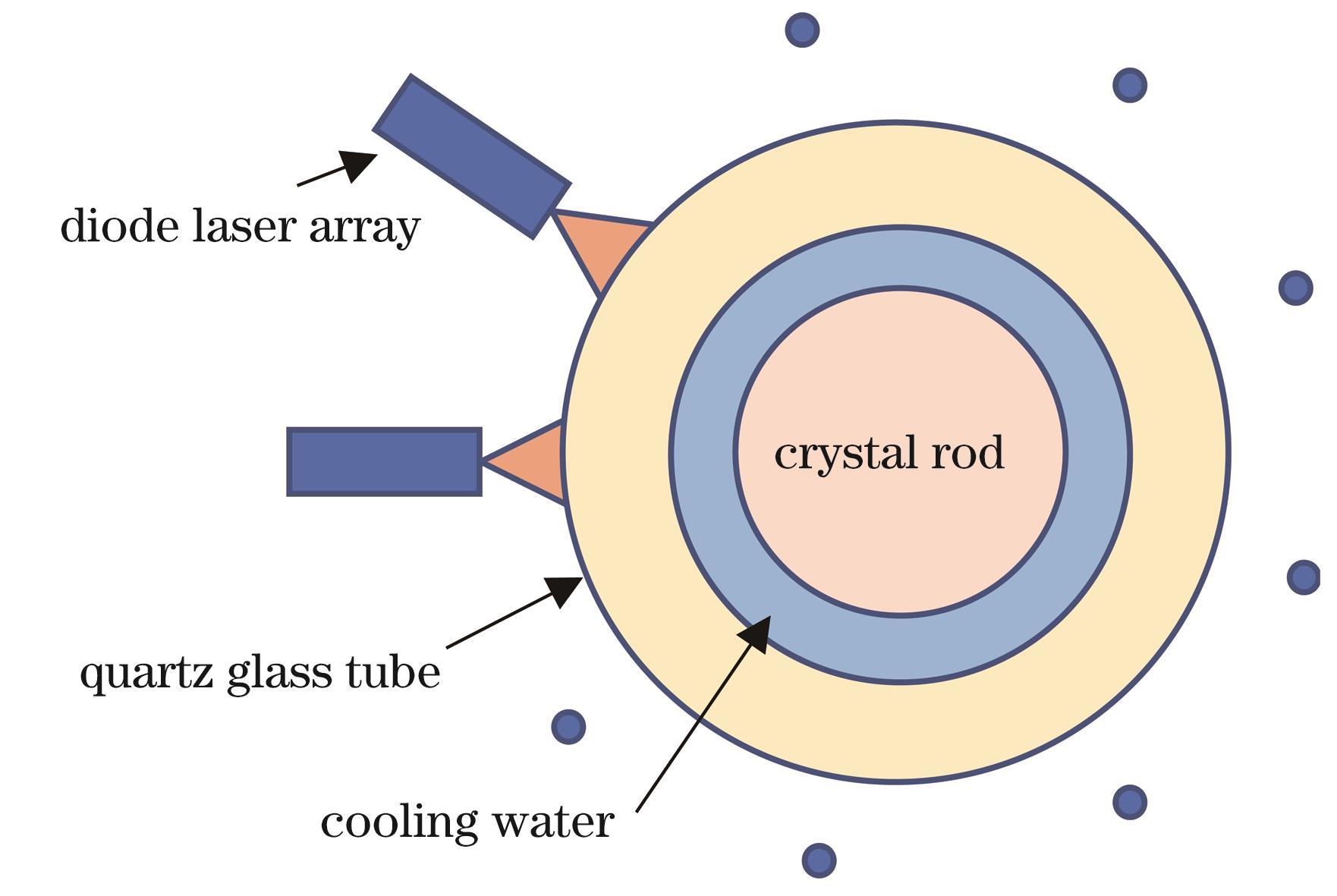
Figure 2: Schematic of a side-pumped laser crystal structure — diode lasers emit pump light from the side, illuminating the central crystal rod through a quartz glass sleeve and cooling-water layer
V. Advanced Pumping Techniques
1. In-Band Pumping
In-band pumping pumps particles directly into the Stark-level manifold containing the upper laser level, rather than into a higher pump band. Because the pump wavelength is relatively close to the laser wavelength, the quantum defect is small — that is, the difference between pump-photon and laser-photon energy is small, less energy is converted to heat, and efficiency is higher. Yb:YAG and Er-doped fibre are both commonly pumped in-band [(RP Photonics)](https://www.rp-photonics.com/in_band_pumping.html).
The disadvantage of in-band pumping is that, because the lower level has a thermal population (quasi-three-level behaviour), there is reabsorption, and the pump light also induces stimulated emission, limiting the maximum achievable excitation.
2. Tandem Pumping
Tandem pumping is an upgraded version of “using one laser to pump another” — first a laser (usually also a fibre laser) produces an intermediate wavelength, then that intermediate wavelength pumps the final fibre laser. The benefit is that the quantum defect of each stage is small and generates little heat, so overall efficiency is higher and higher powers can be reached.
For example, in a high-power Yb fibre laser, 9xx-nm diodes first pump a 1020-nm first-stage fibre laser, then the 1020 nm pumps a 1080-nm second-stage fibre laser. The quantum defect of each stage is only a few percent, far less than pumping directly from 9xx to 1080 nm [(RP Photonics)](https://www.rp-photonics.com/optical_pumping.html).
3. Intracavity Pumping
Placing one laser’s gain medium inside another laser’s resonator, using the high power inside the cavity for pumping. Very high pump intensities can be obtained.
4. Synchronous Pumping
The pump pulses are synchronised with the intracavity pulses, used for pumping mode-locked lasers — ensuring the gain reaches its maximum exactly when a pulse arrives.
VI. Typical Applications
1. The Energy Source of Industrial Lasers
The core pump source of industrial fibre and solid-state lasers is the high-power laser-diode array. Pumping technology directly determines a laser’s power, efficiency, lifetime and cost — the pump source accounts for a considerable share of industrial laser cost.
2. EDFAs in Optical Communication
The erbium-doped fibre amplifier (EDFA) is the “repeater station” of fibre-optic communication; its pump source is a 980 nm or 1480 nm semiconductor pump laser. Key EDFA performance such as noise figure and gain flatness is closely related to the pumping scheme.
3. Research Lasers
Titanium-sapphire femtosecond lasers are usually pumped by a green (532 nm) solid-state laser; optical parametric oscillators/amplifiers (OPO/OPA) are pumped by nanosecond or femtosecond lasers; Raman lasers are also a special kind of optically pumped laser.
4. Medical Lasers
The pump source of the various solid-state and fibre lasers used in medicine is the laser diode. The choice of pumping scheme directly affects the size, reliability and operating cost of medical equipment.
VII. Common Misconceptions: 6 Ideas You May Have Got Wrong
Misconception 1: The higher the pump power, the more laser output power necessarily grows linearly
Correction: Only in the region above threshold and far from saturation effects is output power approximately linear with pump power (slope efficiency). At very high pump power, gain saturation, thermal effects, upconversion and other nonlinear effects reduce efficiency. Moreover, different pumping schemes (end vs. side, core vs. cladding pumping) have different power ceilings [(RP Photonics)](https://www.rp-photonics.com/optical_pumping.html).
Misconception 2: Shorter pump wavelength and higher energy are always more effective
Correction: Not so. The pump wavelength does need to match the gain medium’s absorption peak, but a shorter wavelength means a larger quantum defect — more pump energy becomes heat rather than laser light. Ideal pumping is “just right” — a longer wavelength (small quantum defect) that still excites effectively. In-band pumping exploits this principle to improve efficiency [(RP Photonics)](https://www.rp-photonics.com/optical_pumping.html).
Misconception 3: All solid-state lasers are optically pumped
Correction: Strictly speaking, only doped-insulator lasers (crystals, glass, fibre) are necessarily optically pumped — because the host is an insulator and cannot conduct current. But semiconductor lasers, though also solid-state, are electrically injected and are not optically pumped. In addition, optical pumping is not exclusive to solid-state lasers — alkali-vapor lasers (DPALs) are a typical optically pumped gas laser [(RP Photonics)](https://www.rp-photonics.com/optical_pumping.html).
Misconception 4: Four-level systems are always better than three-level systems
Correction: Four-level systems have a low threshold and high efficiency — that is true. But three-level systems also have advantages — for example they can produce shorter-wavelength output (because the lower level is the ground state, so the laser energy equals the level difference, which can be large). And many “quasi-three-level” systems (such as Yb:YAG), despite reabsorption, have a small quantum defect and low heat load, giving them unique advantages in the high-power field. Each has its suitable applications; you cannot simply say which is better [(RP Photonics)](https://www.rp-photonics.com/optical_pumping.html).
Misconception 5: The pump wavelength is the laser output wavelength
Correction: They are completely different. The pump light’s wavelength is usually shorter than the laser output wavelength (higher photon energy); the laser photon energy is always less than the pump photon energy, the difference being the quantum defect (dissipated as heat). This wavelength difference is also called the Stokes shift. For example, an Nd:YAG laser is pumped by 808 nm light and outputs 1064 nm; erbium-doped fibre is pumped at 980 nm and outputs 1550 nm. Only in special cases such as in-band pumping is the pump wavelength relatively close to the output wavelength.
Misconception 6: The higher the pump power, the more output power increases linearly
Correction: It is not a linear relationship, much less unlimited growth. First there is a pump threshold — below threshold there is only spontaneous emission (fluorescence) and no laser output; above threshold, output power grows approximately linearly with pump power (the growth rate set by slope efficiency). But when pump power is too high, thermal effects, gain saturation and optical damage occur, output power saturates or even falls, and in severe cases the gain medium or optics can be damaged. Therefore every laser has a rated power range; output cannot be raised by endlessly increasing pump power.
VIII. Recommended Reading
- What Is a Gain Medium? The Core Amplification Material in a Laser — the target of pumping; understand the gain medium to understand pumping
- What Is a Solid-State Laser? Classic and Timeless Laser Technology — the main application of optical pumping technology
- RP Photonics Encyclopedia: Optical Pumping — the main reference for this article, the world’s most authoritative laser encyclopedia
Leave a Reply