


What Is a Photodetector? How Light Signals Become Electrical Signals
Photodetectors convert incident light into electrical signals — they are core devices in laser measurement, fibre-optic communication and light-detection systems. This article explains them clearly, from principles and key parameters to main types and typical applications.
Table of Contents
- I. What Is a Photodetector? — Core Concepts
- II. How It Works: How a Photodetector Is Realised
- III. Key Parameters: Understanding Performance Metrics
- IV. Main Types: What Kinds Exist?
- V. Applications: Where Are They Used?
- VI. Common Misconceptions: Pitfalls to Avoid
I. Core Concept: What Is a Photodetector?
When it comes to photodetectors, many people’s first reaction may be “that sounds very specialised.” But if you know something about lasers, you know the photodetector is a very central, very fundamental concept in the laser field. A photodetector is a class of device that converts incident optical signals into electrical signals, and is one of the most fundamental and widely used core components in optoelectronics. Its essence is to convert light energy into measurable changes in current or voltage through the interaction of photons with matter, thereby achieving “sensing” of light.
Quite simply, a photodetector is the “eye” of light — from signal reception in fibre-optic communication to pixels in a phone camera, all depend on photodetectors. In the laser industry, photodetectors are the core sensing elements in power measurement, beam analysis, spectral detection and other instruments.
Some may ask, why dedicate a whole article to photodetectors? Why is precise photodetector selection needed? Because selection is one of the direct determinants of laser application results — if the spot shape is wrong, cutting quality suffers; if power is measured inaccurately, the process is unstable; if signal detection is insensitive, communication distance is short. Understanding the principles, parameters and selection methods of photodetectors is the first step to using lasers well.
II. How It Works: How a Photodetector Is Realised
To understand how a photodetector works, it can be broken down into several key steps or mechanisms. Many people find laser principles mysterious, but if you follow this line of thinking, it is not difficult at all. Let’s go step by step:
The core physical mechanism of a photodetector is the photoelectric effect — when photons strike a specific material, they excite charge carriers (electrons and holes) in the material, generating a detectable electrical signal. Depending on the working principle, there are mainly the following mechanisms:
1. Internal photoelectric effect (semiconductor type): after photons are absorbed by a semiconductor material, electron-hole pairs are generated in the depletion region. Under an applied electric field, these carriers move directionally, forming a photocurrent. Photodiodes and avalanche photodiodes belong to this category. This is currently the most widely used detection mechanism.
2. External photoelectric effect (vacuum type): photons strike a photocathode surface, “knocking” electrons out into a vacuum; these electrons are collected to form a current. Photomultiplier tubes (PMTs) use this principle, achieving electron multiplication through multiple dynodes.
3. Superconducting effect: superconducting nanowire single-photon detectors (SNSPDs) use an extremely thin superconducting nanowire that momentarily loses superconductivity locally upon absorbing a single photon, producing a voltage pulse. Such detectors have extremely high sensitivity and can detect single photons.
4. Photoconductive effect: the conductivity of certain semiconductor materials changes under illumination; light intensity is detected by measuring the resistance change. Such devices respond more slowly but can operate at longer infrared wavelengths.
III. Key Parameters: Understanding Performance Metrics
To understand photodetectors, knowing concepts and principles is not enough — you must also understand their key parameters. Many people, when selecting a laser, stare at a table of parameters without knowing where to start. There is no need to worry; the table below organises the core parameters clearly:
| Parameter | Meaning | Why It Matters |
|---|---|---|
| Responsivity | The photocurrent produced per unit incident optical power, in A/W. It measures how efficiently the detector converts light into an electrical signal and is closely wavelength-dependent. Higher responsivity means a stronger signal for the same optical input. | Measures the efficiency of converting light into an electrical signal. Higher responsivity means a stronger output signal at the same optical power and lower demands on subsequent amplification. Responsivity varies with wavelength and must be evaluated at the operating wavelength. |
| Quantum Efficiency (QE) | The fraction of incident photons that actually generate photoelectrons, expressed as a percentage. This is the fundamental metric of a detector’s ability to “capture photons.” Detectors with high quantum efficiency perform better in low light. | Measures the fundamental ability to “capture photons.” QE directly affects detection sensitivity and signal-to-noise ratio, and is one of the most core parameters in low-light detection; electronic amplification cannot compensate for insufficient quantum efficiency. |
| Detectivity / Noise-Equivalent Power (NEP) | Describes the smallest optical signal a detector can detect. A smaller NEP (higher detectivity) means a more sensitive detector. Note that electronic amplification can raise signal amplitude but cannot truly improve detectivity — because noise is amplified too. | Describes the lower limit of detection sensitivity. A smaller NEP (higher detectivity) means weaker optical signals can be detected. This is the ultimate metric of a detector’s low-light capability; electronic amplification cannot improve detectivity. |
| Bandwidth / Response Speed | The ability to track changes in light intensity, determining whether it can be used for high-speed optical communication or ultrashort pulse measurement. Bandwidth varies enormously between detector types, from a few kilohertz to over a hundred gigahertz. | Determines the ability to track fast optical signals, directly affecting communication rate and pulse-measurement accuracy. High speed and high sensitivity are often contradictory and require trade-offs. |
| Spectral Response Range | Which wavelengths the detector is sensitive to. This is mainly determined by the bandgap of the photosensitive material — for example, silicon-based detectors cover UV to about 1100 nm, and InGaAs covers to about 1700 nm. | Determined by the bandgap of the photosensitive material, it decides which wavelengths the detector is sensitive to. Selection must ensure the operating wavelength lies within the response range, otherwise responsivity drops sharply or even to zero. |
| Dynamic Range | The range of light intensities over which the detector responds linearly, from the lowest detectable power to the maximum before saturation or damage. Usually expressed in decibels (dB). | The range of light intensities over which the detector responds linearly, from the noise floor to the saturation point. A wide dynamic range means one instrument can cover more measurement scenarios without frequently changing ranges. |
IV. Main Types: What Kinds of Photodetectors Exist?
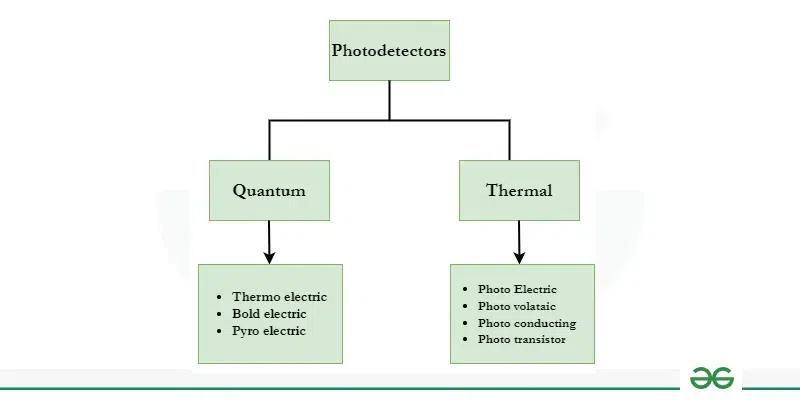
Photodetectors can be classified in many ways; different dimensions help us understand their characteristics from different angles. The following introduces them by common classification approaches:
I. Semiconductor Photodetectors
Photodiode
The most basic and most common semiconductor detector, based on p-n or p-i-n junctions. Small, fast and linear, it is the mainstay device for optical communication and power measurement.
Avalanche Photodiode (APD)
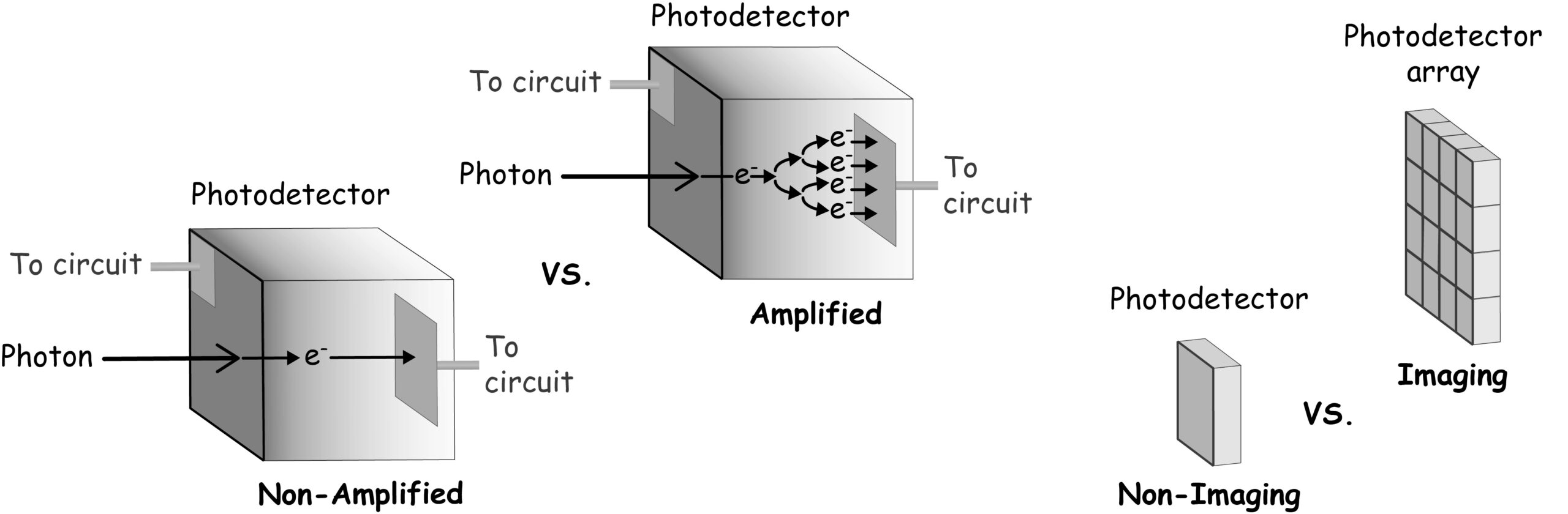
A special form of photodiode that achieves internal gain through impact ionization under high reverse bias, giving higher sensitivity but also more noise.
Phototransistor
Combines photodetection with transistor amplification, giving relatively high gain but slow speed and high noise, so it is less commonly used.
Metal-Semiconductor-Metal (MSM) Detector
Has no p-n junction, operating via two Schottky contacts; extremely fast (up to hundreds of GHz), suited to ultrahigh-speed applications.
Photoconductive Detector
Uses the photoconductive effect, made from materials such as CdS and PbS; can be used for long-wave infrared, but with poorer speed and linearity.
II. Vacuum-Electronic Detectors
Phototube
An early device using the external photoelectric effect, now essentially obsolete.
Photomultiplier Tube (PMT)
Achieves enormous electron gain through multiple dynodes, with extremely high sensitivity and fast response, remaining irreplaceable in extremely low-light detection.
III. Superconducting Photodetectors
Superconducting Nanowire Single-Photon Detector (SNSPD)
Single-photon-level sensitivity and picosecond-level timing accuracy, a key device in quantum optics and quantum communication.
Transition-Edge Sensor (TES)
Can resolve the number of photons in a pulse, with relatively slow response.
IV. Emerging Nanomaterial Detectors
Detectors made from new materials such as graphene and carbon nanotubes offer ultra-broad spectral response and ultrafast speed, and are currently in the research and development stage.
Detectors made from new materials such as graphene and carbon nanotubes offer ultra-broad spectral response and ultrafast speed, and are currently in the research and development stage.
Different photodetector types have their own strengths and weaknesses — there is no absolute “best,” only “most suitable.” Selection should consider your specific application, power needs, budget and other factors comprehensively. For example, industrial applications with high power requirements may favor fibre lasers; research applications needing ultrashort pulses may favor titanium-sapphire.
V. Applications: Where Are Photodetectors Used?
Photodetectors have a very broad range of applications, from industrial manufacturing to healthcare, from communication networks to scientific research — almost anywhere lasers are used, photodetectors are indispensable. A few fields are briefly described below:
- Photodetectors penetrate almost every light-related field and are especially important in the laser and optoelectronics industries:
- Optical Communication and Data Transmission: the receiving end of fibre-optic communication systems, converting optical signals into electrical signals — the “last mile” of information transmission. High-speed photodiodes and APDs are the core devices.
- Optical Measurement and Metrology: the core sensing elements of power meters, laser energy meters, wavelength meters, spectrometers and other optical instruments; without them quantitative measurement would be impossible.
- Laser Processing and Manufacturing: used for laser power monitoring, beam-quality detection and closed-loop process control, ensuring consistency and stability of laser processing.
- Scientific Research and Analytical Instruments: widely used in spectrometers, fluorescence detection, Raman spectroscopy, particle detection and other research equipment; especially in extremely low-light detection, PMTs and single-photon detectors play an irreplaceable role.
- Imaging and Vision: CCD/CMOS image sensors in digital cameras, phone cameras and industrial vision inspection are essentially large-scale 2D photodetector arrays.
- Quantum Optics and Quantum Communication: single-photon detectors are key enabling devices in cutting-edge fields such as quantum key distribution and quantum computing.
- Medicine and Bio-detection: photodetectors are indispensable in flow cytometers, PCR machines and medical imaging equipment.
🔧 Engineering selection tips
• Choose device type by light intensity: for strong light (mW and above) a PIN photodiode suffices; for weak light (μW–nW) use an APD for internal gain; for extremely weak light/single photons (below pW) use a PMT or SPAD.
• Balance speed and sensitivity: high-bandwidth detectors usually have small active areas and low capacitance, but receive less optical power and have higher noise. Within bandwidth requirements, choose the largest-area detector possible.
• Don’t look only at responsivity: high responsivity does not mean high sensitivity; noise level matters too. What truly measures detection capability is NEP or detectivity D*.
• Watch the optical power density: consider not just total power but spot size — focused intensity can far exceed the damage threshold, causing permanent damage.
VI. Common Misconceptions
Many people have plausible-sounding but wrong ideas about photodetectors. See if any of these misconceptions catch you out:
Misconception 1: The higher the responsivity, the better the detector
Responsivity only measures how much current is produced per unit optical power; high responsivity can be achieved by electronic amplification. What truly determines the detection floor is quantum efficiency and noise level (i.e. NEP/detectivity). A detector with low responsivity but high quantum efficiency and low noise may be more “sensitive” than one with high responsivity but high noise. Amplifying the signal also amplifies noise and does not improve the true detection limit.
Misconception 2: Higher-bandwidth detectors are also more sensitive
Bandwidth and sensitivity are often contradictory. High-bandwidth detectors usually have small junction capacitance and small active area, receiving less total optical power, with noise characteristics harder to optimise. Generally, the higher the bandwidth, the higher the minimum detectable optical power (the lower the sensitivity). Selection requires balancing speed and sensitivity for the actual application.
Misconception 3: Photodetectors only measure visible light
The spectral range of a photodetector is set by the photosensitive material, covering a very broad span from deep UV to far IR. Different materials correspond to different bands: silicon (190–1100 nm), InGaAs (900–1700 nm), germanium (800–1800 nm), HgCdTe (up to tens of micrometres), etc. Selection must ensure the response band covers the laser wavelength being measured.
Misconception 4: A detector’s power ceiling is the maximum power it can withstand
A detector’s power limit is not a single number but is closely tied to spot size. The same total power, if focused into a very small spot area, can produce local intensity (irradiance) far exceeding the damage threshold, causing permanent damage. So selection must consider not only power but also the maximum allowable intensity or energy density (W/cm² or J/cm²).
Leave a Reply