


What Is the M² Factor? How to Judge Laser Beam Quality
The M² factor summarises the collimation and focusing capability of a laser beam in a single number, and it is the internationally accepted way to judge beam quality.
Table of contents
- 1. What is the M² factor? Getting the core concept straight
- 2. Working principle: how the M² factor is determined
- 3. Key parameters: reading the specifications of the M² factor
- 4. Main categories: what kinds of M² figure there are
- 5. Applications: where is the M² factor used
- 6. Common misconceptions: pitfalls to avoid
1. Core concept: what is the M² factor?
Whether a laser beam can be focused to a small spot depends on its beam quality. Beam quality is the core metric for judging a laser beam “good or bad”, describing how well a beam preserves collimation and focusability as it propagates. Simply put, the better the beam quality, the more easily the laser can be focused to a smaller spot and the less it diverges.
Among all the parameters used to judge beam quality, the M² factor (also called the beam quality factor or beam propagation ratio) is the most authoritative and standardised measure at a given wavelength. An ideal fundamental-mode Gaussian beam has M² = 1, the perfect theoretical value. The M² of a real laser is always greater than or equal to 1, and the larger it is the worse the beam quality. For laser processing, LiDAR and fibre coupling, beam quality directly determines the processing accuracy, the working range and the coupling efficiency — it is one of the central parameters in the specification of a laser.
It is reasonable to ask why the M² factor deserves an article of its own, and why an accurate M² measurement matters. M² measurement is one of the direct determinants of how well a laser application performs: if the spot profile is wrong the cut quality suffers, if the power is measured inaccurately the process is unstable, and if the signal is detected insufficiently the communication distance falls short. Understanding the principle, the parameters and the selection method of M² measurement is the first step toward using a laser well.
For more on the measurement principle of the M² factor, the sources of error and the details of the ISO standard, read: M² factor in depth: the international standard way to judge beam quality
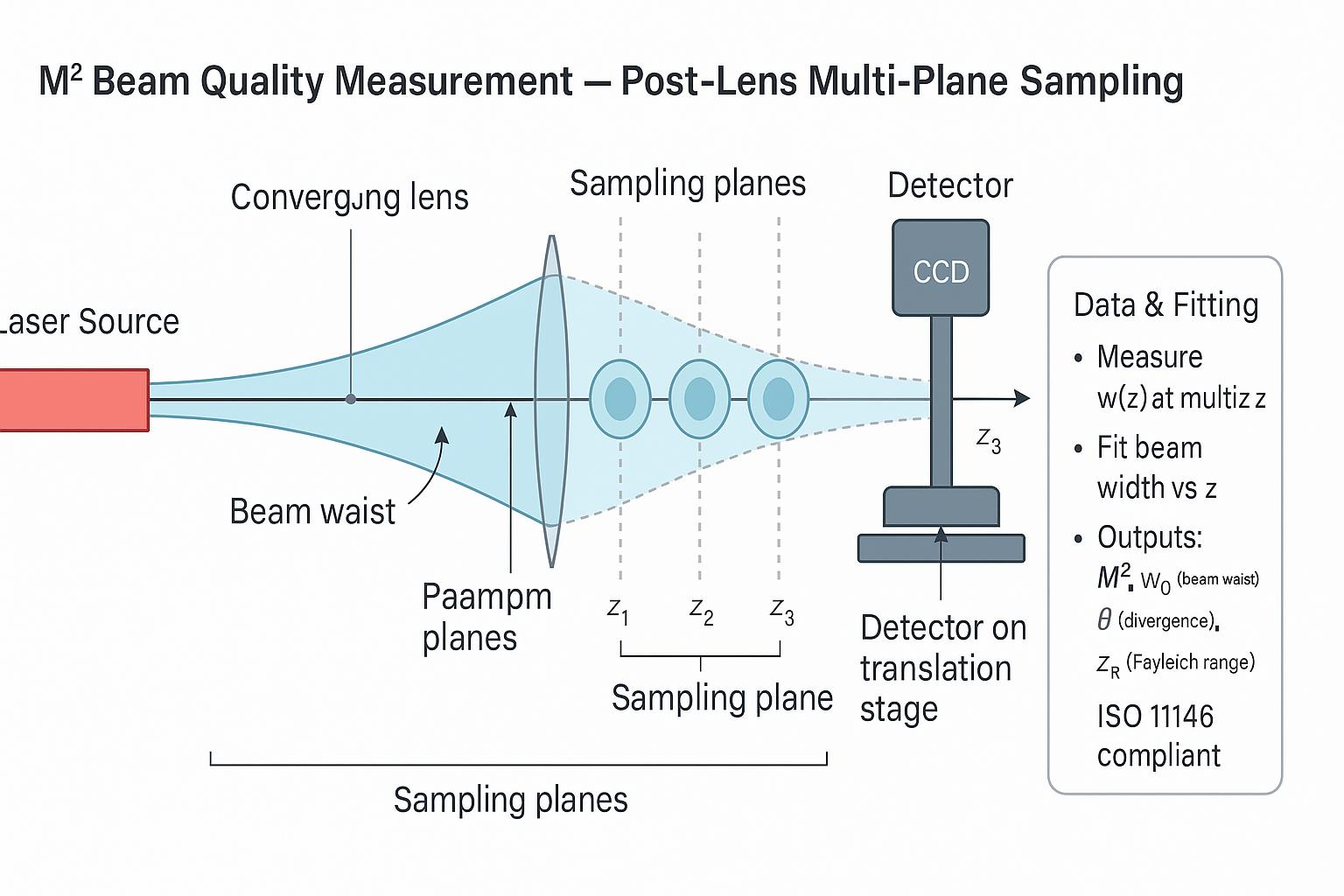
2. Working principle: how is the M² factor determined?
The way the M² factor is determined can be broken down into a few key steps or mechanisms. Laser physics has the reputation of being obscure, but following this line of reasoning it is not difficult at all. Let us go through it step by step:
To understand beam quality, one has to start from how a laser beam propagates:
### Gaussian beams and the physical meaning of M²
An ideal fundamental-mode Gaussian beam (TEM₀₀ mode) has the best possible beam quality. Its propagation follows a strict mathematical law:
The beam width of an ideal fundamental-mode Gaussian beam varies with propagation distance according to the following formula:
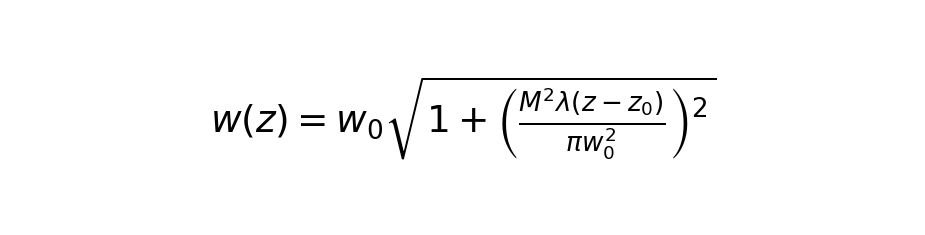
where w0 is the beam waist radius, λ is the wavelength, z0 is the waist position and M² is the beam quality factor. For an ideal Gaussian beam M² = 1.
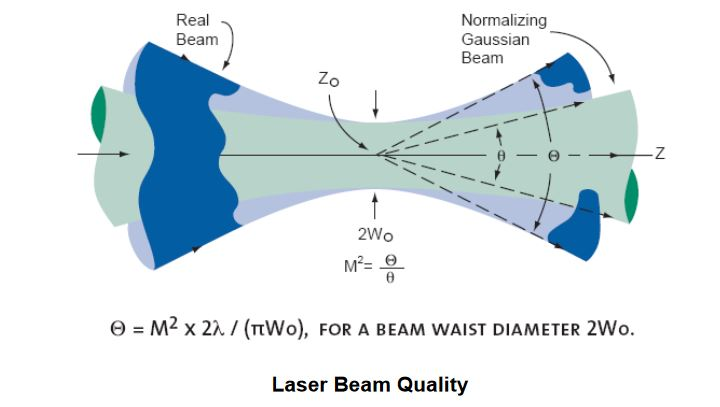
For a real laser, the M² factor was introduced to quantify how far it departs from an ideal Gaussian beam:
> M² = actual beam waist radius × actual far-field divergence / (ideal Gaussian beam waist radius × ideal Gaussian beam far-field divergence)
In other words, M² is the ratio of the beam parameter product (BPP, waist radius × divergence) of the real beam to the beam parameter product of an ideal Gaussian beam.

The larger the M², the further the beam “departs” from an ideal Gaussian beam.
The physical meaning of the M² factor can be understood as follows:
### How the M² factor is measured (ISO 11146)
The international standard ISO 11146 specifies the standard method for measuring M². The core of it is measuring how the beam width varies along the propagation direction (the caustic, also called the waist trajectory) and then computing M² from a fit:
1. Measure the beam width at several positions along the propagation direction (at least 10 points, five on each side of the waist)
2. Fit these data points with a hyperbola to obtain the beam width as a function of propagation distance
3. Extract the waist radius, the far-field divergence and other parameters from the fitted curve
4. Compute the M² factor and the beam parameter product (BPP)
Measuring the beam width must use the D4σ method (also called the second-moment method), which computes the beam width from the second moments of the intensity distribution. This is what the international standard prescribes; it applies to any beam shape and is more rigorous and reliable than the simple 1/e² width or the full width at half maximum (FWHM).
3. Key parameters: reading the specifications of the M² factor
Knowing the concept and the principle is not enough to evaluate the M² factor; you also need to understand its key parameters. When people choose a laser they are often faced with a wall of spec sheets and do not know where to start. There is no need to worry: the table below sorts out the core parameters.
| Parameter | Meaning | Why it matters |
|---|---|---|
| M² factor (Beam Propagation Ratio) | The central beam quality metric, with a value of ≥1 where closer to 1 is better. A single-mode fibre laser typically has M² < 1.1, while a multimode laser may sit anywhere between 1.5 and several tens or even hundreds. | It is the gold standard for beam quality and directly determines the focusing capability and far-field divergence of the laser. The smaller the M², the smaller the focal spot under identical conditions and the more concentrated the energy. |
| Beam parameter product (Beam Parameter Product, BPP) | The product of the waist radius (in mm or mrad) and the far-field divergence (in rad or mrad), usually in mm·mrad. The BPP directly reflects the “brightness” quality of the beam: the smaller the value the better the beam quality. For an ideal Gaussian beam at wavelength λ, BPP = λ/π. | It combines the waist size and the divergence into one product, which is a more rigorous measure of beam quality than either alone and is directly tied to the brightness of the laser. |
| Far-field divergence (Far-field Divergence) | The half-angle by which the beam diverges in the far field, usually expressed in mrad. The smaller the divergence the more collimated the beam. But the divergence alone cannot represent beam quality, because a lens can change it at will; it is meaningful only when read together with the waist size. | It determines how far the beam stays collimated, and directly affects the range of LiDAR and the link distance of free-space optical communication. On its own, however, it does not represent beam quality. |
| Beam waist radius (Beam Waist Radius) | The radius of the spot at the narrowest point of the beam. A smaller waist means the laser can be focused more tightly — but that also depends on the focal length of the focusing optic. The intrinsic beam quality parameters are M² and the BPP. | It determines how small a spot the laser can be focused to and directly affects processing accuracy and coupling efficiency. But the waist can be changed with a lens, so it is not an intrinsic beam quality parameter. |
| Strehl ratio (Strehl Ratio) | The ratio of the peak intensity of the actual focal spot to that of the ideal Airy pattern. It is another way of judging beam quality, used mostly in optical imaging and large-aperture beam systems. | It measures the actual peak focal intensity against the ideal diffraction limit, an important metric for optical imaging and wavefront quality, especially in large-aperture beam systems. |
| Brightness (Brightness) | The beam power divided by a quantity related to the beam parameter product, which combines power and beam quality. The higher the brightness, the more the laser is both “strong and accurate”, and the better it suits deep welding, long-distance transmission and similar applications. | It combines power and beam quality into a single figure and determines how concentrated the energy is in processing and transmission applications. The higher the brightness, the more the laser is both strong and accurate. |
4. Main categories: what kinds of M² figure there are
The M² factor can be classified in many ways, and each dimension reveals different aspects of the beam. The common ones are introduced below:
By practical M² value
Diffraction-limited beams (M² ≈ 1)
M² between 1.0 and 1.2, close to an ideal Gaussian beam. Typical examples: single-mode fibre lasers, single-longitudinal-mode solid-state lasers and He-Ne lasers. They suit precision machining, scientific research and coherent applications where beam quality requirements are extreme.
Near diffraction-limited beams (M² ≈ 1.2-2)
Good beam quality: not perfectly single mode, but the focusing capability is still strong. Typical examples: some high-power single-mode fibre lasers and low-order-mode solid-state lasers.
Medium beam quality (M² ≈ 2-10)
Multimode output: the beam contains several transverse modes, so the focal spot is larger, but the power is usually higher. Typical examples: medium- and high-power multimode fibre lasers and semiconductor lasers. They suit cutting and welding, where the spot size requirement is not extreme.
Poor beam quality (M² > 10)
High-power multimode lasers or incoherent sources, whose beams diverge quickly and produce large focal spots. Typical examples: high-power CO₂ lasers, high-power semiconductor laser arrays and flashlamps. They suit heat treatment and surface cladding, where fine focusing is not needed.
By evaluation method
The M² factor method
The most standard and general method, prescribed by ISO 11146.
The BPP (beam parameter product) method
Expressed directly as waist radius × divergence, which reflects the practical capability more intuitively.
The Strehl ratio method
Used mainly in optical imaging and astronomical optical systems.
Power in the bucket (Power in the Bucket, PIB)
Measures the fraction of power contained within a given angular range, used commonly with high-power lasers and military applications.
The encircled energy method
Similar to PIB, but measures in the spatial domain the fraction of energy contained within a given radius.
Points to note when selecting instruments related to the M² factor: ① For basic beam profiling, choose a camera-based or scanning beam profiler and match the wavelength and beam size to the application; ② If M² has to be measured frequently, pick an integrated M² measurement system with a motorized translation stage and ISO 11146-certified software; ③ Measuring high-power lasers needs a suitable attenuator or sampler to avoid damaging the sensor; ④ Keep the distinction between the M² factor (dimensionless, wavelength dependent) and the BPP (mm·mrad, an absolute quantity) in mind — lasers at different wavelengths cannot be compared by M² alone.
5. Applications: where is the M² factor used?
The M² factor is used very widely, from industrial manufacturing to healthcare, from communication networks to scientific research; hardly any application of a laser works without it. A few areas are worth listing:
- Beam quality is one of the most important parameters in selecting a laser, and it directly affects the result of every kind of application:
- Laser cutting and welding: a laser with good beam quality focuses to a smaller spot and reaches a higher power density, which gives a faster cutting speed, a narrower kerf and a deeper weld. The reason high-power, high-beam-quality fibre lasers displaced traditional CO₂ lasers is precisely that their beam quality is good.
- Laser marking and micro-machining: fine marking and micro-structuring need extremely small focal spots and therefore a high-beam-quality laser.
- LiDAR and ranging: a laser with good beam quality has a small divergence, travels further while keeping a small spot, and improves both range and accuracy.
- Fibre coupling: when coupling a laser into a fibre, the beam quality must match the numerical aperture and the core diameter. The larger the M², the harder it is to couple into a small-core fibre. Single-mode coupling requires an M² close to 1.
- Scientific research: advanced work in nonlinear optics, quantum optics and atomic cooling almost always calls for diffraction-limited beam quality.
- Medical lasers: delicate eye surgery, skin resurfacing and similar procedures need a precise energy distribution and focusing capability, so they place high demands on beam quality.
- Free-space optical communication: beam quality determines the spot size and energy concentration after long-distance propagation, and directly affects the link distance and the signal-to-noise ratio.
🔧 Engineering selection notes
• Choose a camera-based M² system for laboratory work: when precise measurement and a wide range of analysis functions are needed, an integrated CCD/CMOS camera plus motorized translation stage provides full-featured software.
• Choose a portable unit for production lines: for fast quality checks on a production line, a portable or USB beam profiler is preferable — simple to operate and quick.
• Use a scanning system for high power: at very high power (kilowatt levels and above) camera sensors are easily damaged, so a scanning slit system with a sampler is safer.
• Mind the wavelength: when comparing the beam quality of lasers at different wavelengths, use the BPP (mm·mrad) rather than the M² factor, because M² is a ratio relative to the diffraction limit at the same wavelength.
6. Common misconceptions
Many beliefs about the M² factor are plausible but wrong. Check whether any of the following misconceptions apply to you:
Misconception 1: a small divergence means good beam quality
The divergence alone cannot represent beam quality. A telescope can squeeze the divergence down without improving the beam quality at all — it only changes the ratio between the beam size and its divergence. The real beam quality is set by the product of the waist size and the divergence (the BPP), and that product is an intrinsic property of the beam which a lens system cannot change. Judge beam quality by the M² factor or the BPP, not by the divergence or the spot size on their own.
Misconception 2: a laser with M² = 1.5 produces a focal spot 1.5 times the size of the ideal Gaussian one
Under the same focusing conditions (same lens, same incident beam diameter) the focal spot diameter is indeed roughly proportional to M². But the statement has a precondition — the comparison must be made with the same optical system and the same input. With a different focal length or a different input beam size, the result is different. And because M² is a ratio of second-moment beam widths, the “size” of a non-Gaussian spot also depends on how the energy is distributed, so a single factor cannot summarise all of it.
Misconception 3: the more powerful the laser, the worse the beam quality
This is a common but inaccurate rule of thumb. It is true that many lasers lose beam quality as their power rises (semiconductor lasers and multimode solid-state lasers, for instance), because raising the power usually needs a larger pump area, which excites more high-order transverse modes. But it is not inevitable: single-mode fibre lasers keep a near diffraction-limited beam quality (M² < 1.2) at several kilowatts and even at ten kilowatts, because their waveguide structure limits the modes naturally. Beam quality is governed mainly by the cavity design and the properties of the gain medium, not by the power level alone.
Misconception 4: with a beam quality meter in hand, the measured M² must be accurate
The accuracy of an M² measurement depends on many factors. First, ISO 11146 has to be followed strictly: enough measurement positions, the correct D4σ beam width definition, and sufficient coverage on both sides of the waist. Second, the quality of the attenuation optics, the alignment of the beam and the background noise all affect the result. If the beam shape is very irregular (severe multimode distortion, for example), the beam width computed by the D4σ method can differ greatly from what the “effective spot” feels like. Measuring M² demands professional technique and judgement about the quality of the data; the instrument reading should not be taken on faith.
Leave a Reply