
QQ: 859818709

Beam Deviation Calculator

Beam Deviation Calculator

🔬 Beam Deviation Calculator

Beam Deviation Calculator

Calculate the lateral displacement of a beam after it passes through a plane-parallel plate (glass window), with the derivation of the formula and an explanation of its physical meaning, helping you understand the effect of plate refraction on the optical path.
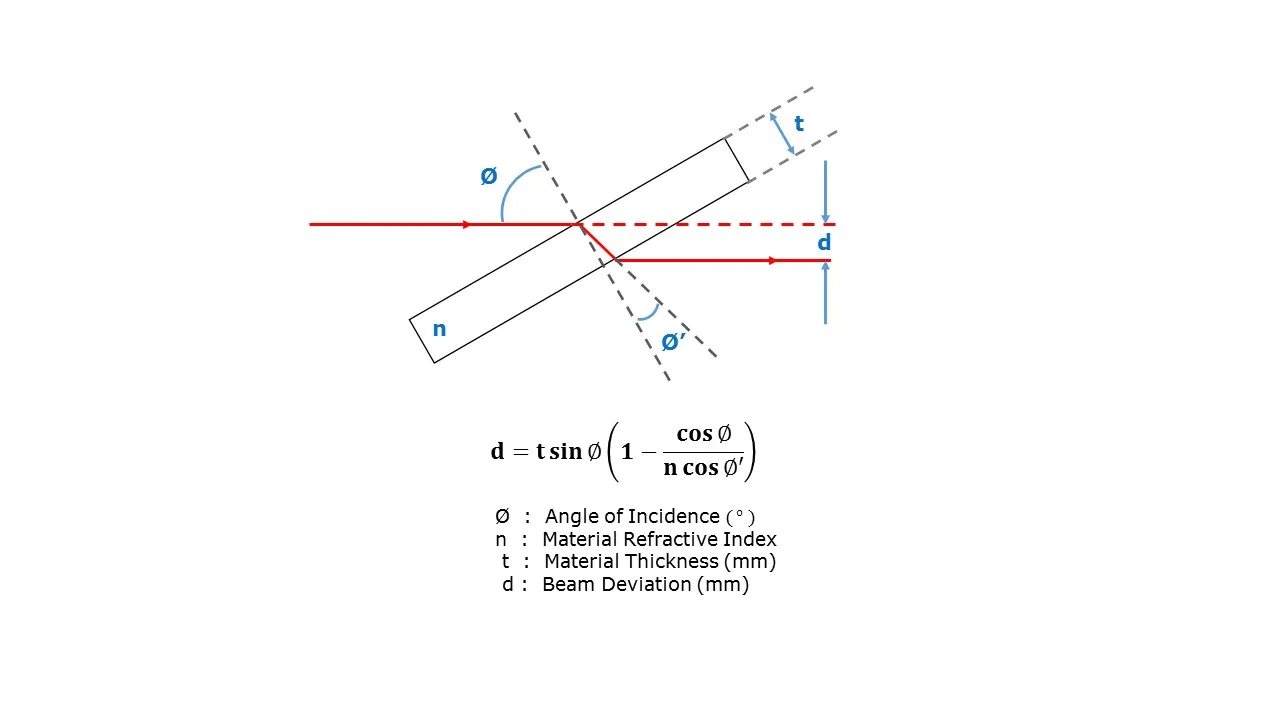
Schematic of lateral beam shift through a plane-parallel plate, d = t sinθ(1−cosθ/n cosθ′)

↔️ Beam Deviation Calculator

Enter the refractive index, plate thickness and angle of incidence to automatically calculate the lateral beam displacement and refraction angle

BK7 ≈ 1.517, fused silica ≈ 1.458, ZnSe ≈ 2.4


mm

Thickness of the plane-parallel plate along the optical axis


°

Angle between the incident beam and the normal; 0° is normal incidence


📊 Calculation results
↔️ Lateral displacement d
0.0000
mm
📐 Refraction angle inside the plate θᵣ
0.0000
°

Formula details

A plane-parallel plate refracts the beam twice; the emergent beam is parallel to the incident beam but laterally displaced

① Lateral beam displacement formula
d = t·sin θi · ( 1 − cos θi / (n·cos θr) )
d: lateral displacement (mm);t: plate thickness (mm);θi: angle of incidence;θr: refraction angle inside the plate;n: refractive index of the material.
② Refraction angle (Snell’s law)
θr = arcsin ( sin θi / n )
When a beam passes from air (n₁=1) into a medium of refractive index n, the refraction angle satisfies n₁·sin θi = n·sin θr。
③ Equivalent square-root form
d = t·sin θi · ( 1 − cos θi / √(n² − sin²θi) )
From n·cos θr = √(n² − sin²θi) the formula can be written in terms of the angle of incidence alone, fully equivalent to equation ①; this calculator uses this form.
④ Physical meaning
The emergent beam and the incident beamare parallel in direction, with only a lateral translation. The larger the angle of incidence, the thicker the plate and the lower the refractive index, the greater the displacement; at normal incidence (θi=0) the displacement is zero.
⑤ Derivation
From Snell’s law, the refraction angle θr. The beam propagates inside the plate along the refracted direction, and its horizontal displacement component within the plate is t·tan θr; if the beam were not deflected, the corresponding horizontal displacement would be t·tan θi. Projecting the difference between the two onto the direction perpendicular to the incident beam and simplifying gives:
d = t·sin θi·(1 − cos θi / (n·cos θr))

Parameter details

How the three input parameters affect the displacement

📏

Plate thickness t

  • The displacement is directly proportional to the thickness
  • Typical window thicknesses: 1, 2, 5, 10 mm
  • For high-power lasers, note that thermal effects can cause changes in thickness
📐

Angle of incidence θᵢ

  • At 0° normal incidence, the displacement is zero
  • The larger the angle, the greater the displacement
  • It must be smaller than the critical angle for total internal reflection, arcsin(1/n)
🔬

Refractive index n

  • BK7 optical glass: ≈ 1.517 (587.6 nm)
  • Fused silica: ≈ 1.458
  • ZnSe (infrared): ≈ 2.4
  • The higher the refractive index, the smaller the displacement at the same angle

⚠️ Common pitfalls and notes

Six of the most common mistakes when using the displacement formula

Is the displacement equal to the optical path difference?

The lateral displacement d is a geometrical distance, not an optical path difference. The optical path difference also depends on the refractive index n; do not confuse the two.

Is there displacement at normal incidence?

At an angle of incidence of 0°, sin(0)=0 and the displacement is zero. The beam passes straight through the plate, producing only an optical path delay.

Does the direction of the emergent beam change?

For a plane-parallel plate, the emergent beam is always parallel to the incident beam (provided no total internal reflection occurs); there is only a lateral displacement and the direction of propagation is unchanged.

Can wavelength dispersion be ignored?

The refractive index varies with wavelength, so the displacement differs slightly for different wavelengths. The effect is negligible for narrowband lasers, but dispersion must be considered for broadband sources.

Is there no limit on large-angle incidence?

The angle of incidence must be smaller than the critical angle arcsin(1/n); otherwise total internal reflection occurs inside the plate and the ray cannot emerge in its original direction.

Is the displacement the same for all plates?

The displacement depends strongly on thickness, angle of incidence and refractive index. A thick plate gives a larger displacement than a thin one, and a low-index material gives a larger displacement than a high-index material.

💡 Common applications

🔬
Optical path alignment
After inserting a window into an optical system, the beam displacement must be calculated precisely to align the optical path and ensure the beam still hits the intended detector.
🪟
Window design
When selecting a laser protective window, the effects of thickness and mounting angle on beam position must be evaluated; precision measurement systems are particularly sensitive.
🖥️
Beam splitting
When splitting a beam using reflections from the front and rear surfaces of a plate, the displacement of the transmitted beam must be calculated to determine the downstream optical layout.

📋 Frequently asked questions

Q: Why is the displacement zero at normal incidence?
At normal incidence, θi=0°, sin(0°)=0; substituting into the formula gives d=0. The beam passes straight through the plate, producing only an optical path delay and no lateral displacement.
Q: Does the direction of the emergent beam change?
No. The front and rear surfaces of a plane-parallel plate are parallel, so the angles of the two refractions cancel each other; the emergent beam is parallel to the incident beam and undergoes only a lateral translation.
Q: Does wavelength affect the displacement?
Yes, through material dispersion. The refractive index varies with wavelength, so the displacement differs slightly for different wavelengths; the effect is negligible for narrowband lasers, but must be assessed for supercontinuum sources.
Q: How can beam displacement be reduced?
① Reduce the plate thickness; ② reduce the angle of incidence (approaching normal incidence); ③ choose a higher-refractive-index material. High-precision systems can use a wedged window for compensation.

中文EN