


Beam Divergence Angle and Waist Converter
Bidirectional conversion between Gaussian beam waist diameter and far-field divergence angle, calculate the spot size at any position, and quickly understand laser beam propagation characteristics
📐 Beam Divergence Angle and Waist Converter
Enter the known parameters to automatically convert all Gaussian beam parameters and calculate the spot size at a specified distance
M²
📍 Extra: calculate the spot diameter at a specified distance
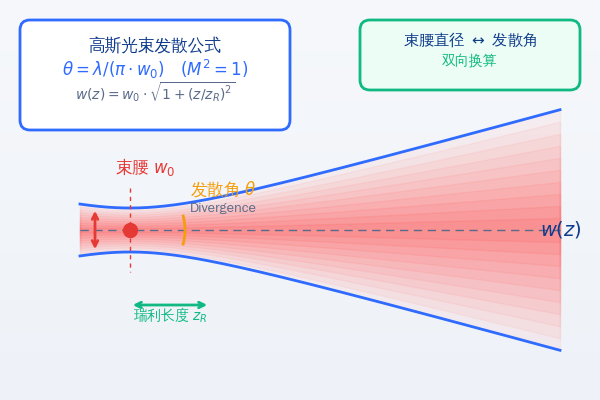
💡 Tip: θ = λM²/(πw₀). The smaller the waist, the larger the divergence angle — the two are inversely proportional
Core Gaussian beam formulas
Understand the conversion relationship between waist and divergence angle
The three regions of beam propagation
Beam characteristics differ markedly between propagation regions
Near-field region (z < 0.5 z_R)
Near Field
Beam approximately collimated
Within half the Rayleigh range, the beam radius increases by no more than 15%, so the beam can be considered approximately collimated. In this region the wavefront is close to planar.
Transition region (0.5 z_R ~ 2 z_R)
Transition Region
Beam begins to diverge
The transition region from collimation to divergence. At z = z_R, the beam radius grows to √2 times the waist (about 41%), which is the definition of the Rayleigh range.
Far-field region (z >> z_R)
Far Field
Beam diverges linearly
The beam radius is proportional to the propagation distance, w(z) ≈ θ·z. In this region the beam expands conically and the divergence angle fully determines the spot size.
Common misconceptions
Avoid these misunderstandings about beam divergence angle
“The smaller the divergence angle, the better the laser”
Not necessarily. A small divergence angle means a large waist and hence a large focused spot — this is determined by theuncertainty relation. If you need small-spot processing (such as precision marking), a small focused spot inevitably has a large divergence angle (short depth of focus). Collimation and focusing are a trade-off — choose according to your needs.
Confusing “full angle” and “half angle”
The θ in the formula θ = λM²/(πw₀) is thehalf-angle(the angle from the optical axis to the beam edge). However, the divergence angle quoted in many laser datasheets is the “full angle” (2θ) — a factor of two difference! Always confirm the definition before use. A typical fibre laser has a full-angle divergence of about 6–7 mrad, corresponding to a half-angle of 3–3.5 mrad.
Using “collimated” to describe zero divergence
There is no such thing as a beam with zero divergence! Even perfectly parallel light diverges through diffraction. “Collimated” is only an approximation for a very small divergence angle. A 1064 nm beam of 2 mm diameter has a divergence of about 0.34 mrad; after propagating 100 metres the spot expands to about 34 mm — already a “well-collimated” beam.
Confused definitions of “beam diameter”
Beam diameter has several definitions: 1/e², FWHM, D4σ, 90% energy enclosed, etc. The most commonly used is the1/e² diameter(the width where the intensity falls to 1/e² of its maximum). FWHM diameter = 0.5887 × 1/e² diameter. Under different definitions the “diameter” of the same beam can differ by nearly a factor of two!
Calculation examples
Learn divergence angle and waist conversion through practical examples
How far can a laser pointer reach?
Output apertureØ = 1 mm
M² ≈ 1.1
- Beam waist radius:w₀ = 0.5 mm = 500 μm
- Far-field divergence angle (half-angle):θ = 532×10⁻⁹ × 1.1 / (π × 500×10⁻⁶) = 0.372 mrad
- Full-angle divergence:2θ = 0.744 mrad
- Rayleigh range:z_R = π × (500×10⁻⁶)² / (532×10⁻⁹/1.1) = 1.62 m
- Spot diameter at 100 metres:w(100m) ≈ 2θ·z = 0.744×10⁻³ × 100 = 74.4 mm
Inferring the fibre laser waist from its divergence angle
Full-angle divergence2θ = 6 mrad
M² = 1.2
- Half-angle divergence:θ = 6/2 = 3 mrad = 0.003 rad
- Beam waist radius:w₀ = λM²/(πθ) = 1064×10⁻⁹ × 1.2 / (π × 0.003) = 135 μm
- Beam waist diameter:2w₀ = 270 μm = 0.27 mm
- Rayleigh range:z_R = π × (135×10⁻⁶)² × 1.2 / 1064×10⁻⁹ = 64.6 mm