



Description
Product Overview
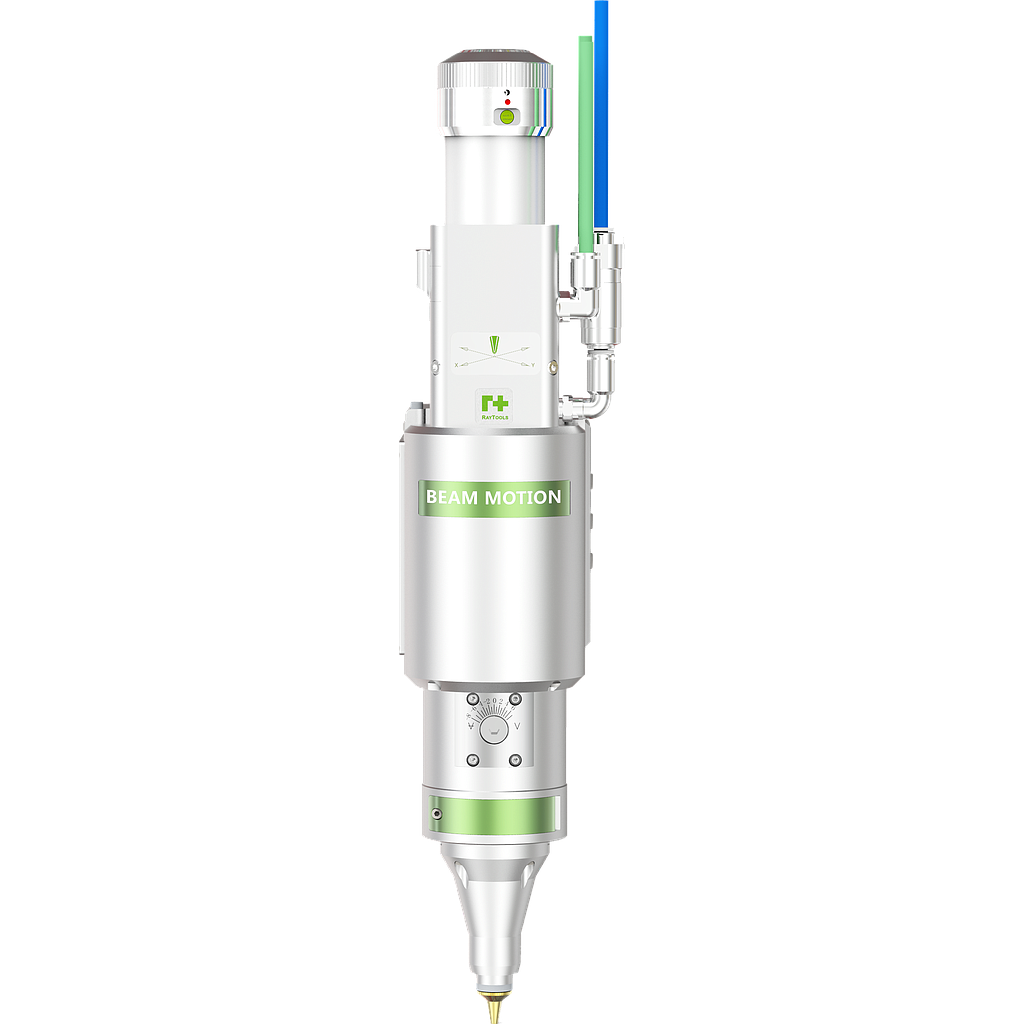
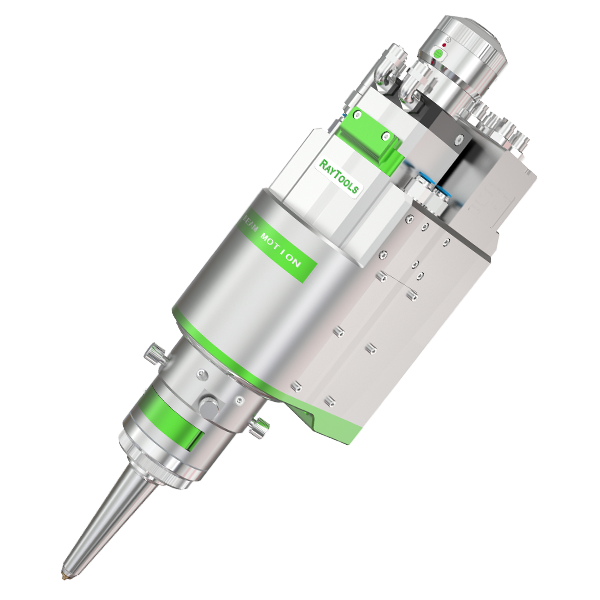
The GF402 is the four-axis tube cutting head in the RayTools range, offered across multiple power segments matched to the laser source. Four axes change what a tube head can do: instead of holding the beam square to the axis and relying on the chuck to present the seam, the head combines tube rotation with head motion, so the beam can follow an intersecting line, drop a hole in the side wall, or run an angled cut on the same machine. That is the difference between cutting tube to length and making a part out of tube.
Two details make the four-axis work practical. The first is the follow-up unit, which is built into the head rather than bolted on as an external slide: it adjusts position automatically as the surface moves under the nozzle, so standoff is held over a tube that is out of round or slightly bent, which is the normal condition of structural stock. The second is the protective lens, which sits in a drawer-type carrier: the carrier slides out and the lens is changed without disturbing the optical train, and the drawer itself is part of the dust protection. The body is a lightweight integrated design, which keeps the moving mass on the machine’s carriage down and improves dynamic accuracy, and focus is automatic for fast piercing.
This page documents the standard four-axis tube cutting configuration of the GF402: four-axis linkage, the built-in follow-up unit, the drawer-type protective lens, the lightweight integrated structure, automatic focus and the high-seal modular body, with power offered in multiple segments and fixed per laser source. The GF402 family also includes a bevel-cutting configuration, which is a different build for shops whose work is dominated by bevel and chamfer seams; that configuration is documented on its own page. Aperture, weight, focal lengths and axis travel are confirmed per configuration rather than published as fixed figures.
Key Features
- Four interpolated axes: tube rotation and head motion are controlled together, which is what makes intersecting-line cutting, hole patterns and angled cuts possible in one set-up
- Built-in follow-up unit: the follow-up is inside the head rather than an external slide, so nozzle standoff is held automatically over tube that is out of round or bent
- Drawer-type protective lens: the lens sits in a carrier that slides out for replacement, so a change does not disturb the optical train – and the drawer design itself is part of the dust defence
- Lightweight integrated body: reducing the moving mass on the carriage lowers machine load and improves the dynamic accuracy of the axes, which is what four-axis work depends on
- Automatic focus: focal position is set by the head, which shortens piercing and lets the machine move to the next part without a manual re-datum
- High-seal modular structure: modular assemblies with tight sealing keep the optical cavity clean and shorten the stoppage when a wear part is replaced
- Power matched per source: offered in multiple power segments, so the head is configured to the laser behind it rather than derated or over-specified
Technical Specifications
| Brand | Empower / RayTools |
| Model | GF402, standard four-axis tube cutting configuration |
| Type | Four-axis tube cutting head |
| Axes | Four-axis linkage: tube rotation combined with cutting head motion |
| Follow-Up | Follow-up unit built into the head, automatic position adjustment |
| Focus Adjustment | Automatic |
| Protective Lens | Drawer-type protective lens carrier |
| Structure | Lightweight integrated design, reduced moving mass on the machine carriage |
| Sealing | High-seal modular body |
| Laser Power | Multiple power segments – the exact segment is fixed with the laser source |
| Clear Aperture, Focal Lengths, Axis Travel, Weight | Configuration-dependent, not published as fixed figures for this head – confirmed per laser source and process |
Applications
The GF402 is specified where tube has to become a finished part rather than a cut length. That means intersecting-line cutting, where one tube meets another and the seam is a three-dimensional curve; multi-hole cutting, where a pattern of holes has to sit at defined positions around the section; angled and bevel cuts; and complex tube parts where several of those features appear on the same workpiece. The common thread is that the seam is no longer square to the axis, which is exactly where a two-axis tube head runs out of capability.
Typical industries are those that build structures out of tube: construction steel structures, where intersecting joints have to fit without gaps before welding, and fitness equipment, where frames combine angled members, holes and bends on the same part. The same capability serves general tube fabrication where the drawing calls for a shaped end rather than a square cut. If the job is square cuts on straight tube, the automatic-focus BD08K is the simpler and cheaper head; if the seam is dominated by bevel and chamfer work, ask about the GF402 bevel-cutting configuration. Send us the tube sizes, the wall thickness and a drawing of the seam and we will confirm which configuration fits.
Selection Guide
- Start from the seam, not from the model name: if the drawing shows an intersecting line, a hole pattern or an angled cut, four axes are required. If every cut is square to the axis, a two-axis tube head does the job for less.
- Confirm the configuration before the price: the GF402 is built in more than one configuration, and this page covers the standard four-axis tube cutting build. Bevel-dominated work belongs to the bevel-cutting configuration, which is quoted separately.
- Fix the power segment with the source: the head is offered across multiple power segments, and the segment is decided by the laser and the wall thickness, not by the tube diameter.
- Plan for the follow-up, not around it: because the follow-up unit is inside the head, the machine does not need an external slide for it – but the carriage still has to carry the head’s mass through the interpolation, so the lightweight body is part of the accuracy budget.
- Budget the drawer lens as a consumable: the drawer carrier makes the change quick, which only helps if spares are on the shelf. In four-axis work the lens sees spatter from angled cuts as well as from piercing.
- Send the drawing with the enquiry: tube size, wall thickness, material and a sketch of the seam are what decide the configuration, the optics and the axis travel.
Series Comparison
| Model | GF402 (this page) | BD08K | BS04K |
| Head Class | 4-axis tube cutting head | Auto-focus tube cutting head | All-in-one cutting head |
| Axes | Four-axis linkage, tube rotation with head motion | Tube cutting duty, no four-axis linkage | Flat-sheet cutting duty |
| Seam Capability | Intersecting-line, multi-hole and angled seams | Cuts square to the tube axis | Flat-sheet contours |
| Laser Power Range | Multiple power segments, fixed per laser source | 1-8 kW | 1-4 kW |
| Follow-Up Unit | Built-in follow-up unit with automatic position adjustment | Not part of this configuration | Not part of this configuration |
| Protective Lens | Drawer-type carrier | Multi-stage stack | Multi-stage stack |
| Focus Adjustment | Automatic | Automatic | Automatic |
| Structure | Lightweight integrated design | Sealed modular body | Integrated collimation and focusing |
| Configuration Variants | Standard four-axis tube cutting build (this page); bevel-cutting build documented separately | Standard auto-focus tube head; 90-degree 3D and robot slide variants documented separately | International edition with CE conformity |
Usage Precautions
- Never look into the beam or into specular reflections while the laser is running. On four-axis work the beam leaves the nozzle at an angle, so screens and guarding have to cover the angled path as well as the vertical one.
- Use purified or deionised water in the cooling circuit and change it on schedule. If temperature or flow alarms, stop the machine, find the cause and only then restart.
- Electrical wiring and servicing must be carried out by a licensed electrician, with lock-out and tag-out after isolation. The equipment must be reliably earthed to prevent leakage and interference.
- Protect the head from moisture and dust in transport and storage; before a long shutdown drain the water circuit, disconnect power and cover the unit.
- Check the follow-up unit’s free travel and its collision protection before a batch. On angled cuts the head approaches the tube obliquely, and a follow-up that is stuck will drive the nozzle into the workpiece.
- Change the drawer-type protective lens on condition, not only on failure: remove the carrier, inspect, and replace a marked lens rather than cleaning and reusing it.
- Prove the interpolation on a scrap length of the same tube before running the batch. A chuck that is not gripping concentrically produces a seam that varies around the section, which is easy to misread as an optics or programming fault.
- On receipt, check the model nameplate and the configuration against the order and the packing list, because the GF402 is built in more than one configuration. For help with installation and commissioning, contact Soar Laser technical support in Changsha (hotline +86 159-2722-0467).
FAQ
What advantage does a four-axis head have over a two-axis head?
A four-axis head controls tube rotation and head motion at the same time, so it can produce angled cuts, holes and bevels – the complex processes a two-axis head cannot do, since a two-axis head is limited to straight cuts.
Which tube processing jobs is the GF402 used for?
Intersecting-line cutting, multi-hole cutting, angled cutting and complex tube parts. It is commonly used in construction steel structures and in fitness equipment.
Is this the same as the GF402 bevel cutting head?
No. This page documents the standard four-axis tube cutting configuration. The GF402 family also includes a bevel-cutting configuration, built for shops whose work is dominated by bevel and chamfer seams, and that configuration is listed separately. Tell us the seam types on your drawing and we will point you to the right build.
What laser power does the head take?
The GF402 is offered across multiple power segments and the segment is fixed with the laser source. Send the source model and the wall thickness range and we will confirm the matching segment.
Does the machine need an external follow-up slide?
The follow-up unit is built into the head and adjusts position automatically, so a separate external slide is not part of this configuration. The machine still has to provide the interpolation and carry the head’s mass, which is why the body is a lightweight integrated design.
What information is needed to quote a GF402?
The laser source and power, the tube sizes and material, the wall thickness, and a drawing or sketch of the seam geometry. Those four items decide the configuration, the optics and the axis travel.
Disclaimer
The specifications on this page are compiled from the manufacturer’s public information and existing documents and are for selection reference only. Product specifications are subject to the actual product, the factory inspection report and the manufacturer’s latest datasheet; appearance and configuration may change with production batches, so please confirm with us before ordering. Reproduction of this page’s content without written permission is prohibited.
Selection advice: Soar Laser Equipment Co., Ltd., Changsha – hotline +86 159-2722-0467, www.soar-laser.cn, email 859818709@qq.com.
For configuration-specific data, contact our engineering team with your laser source and workpiece details.

Reviews
There are no reviews yet.