



Description
Product Overview
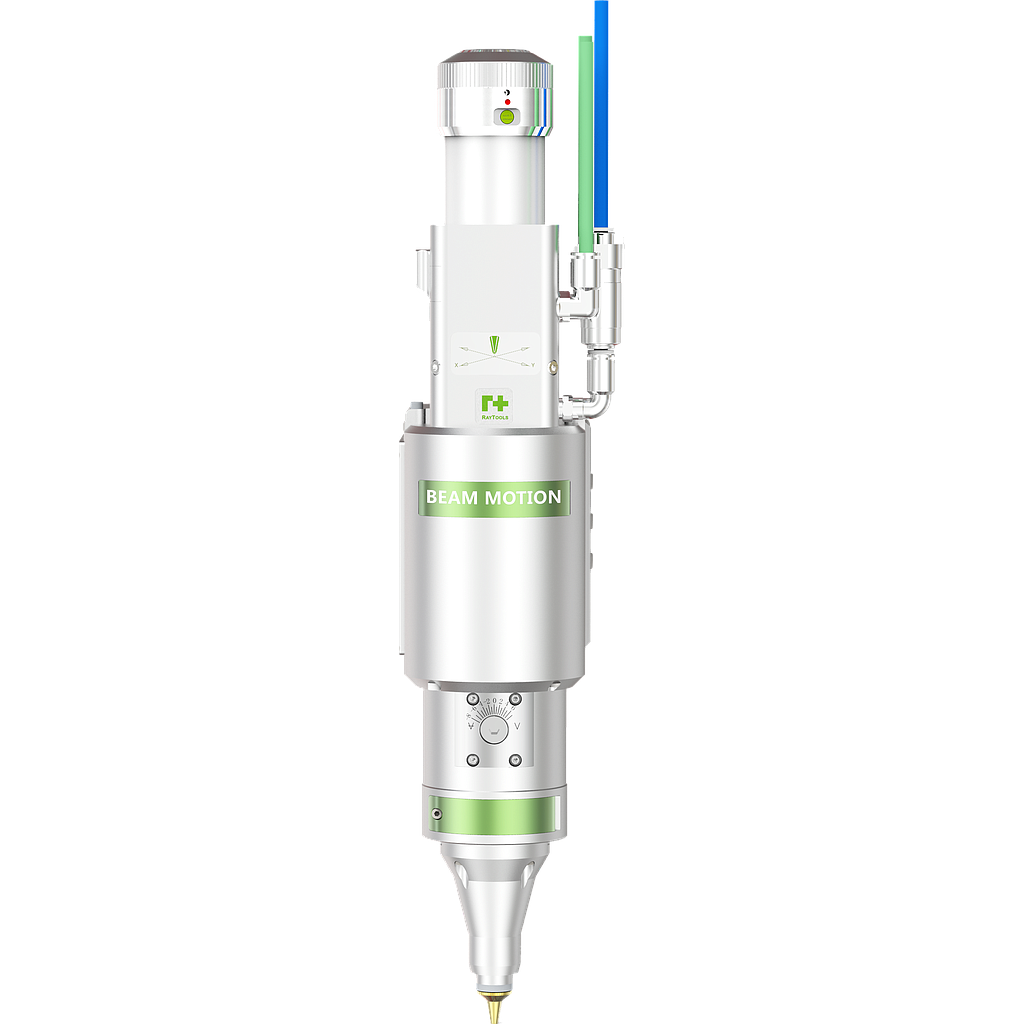
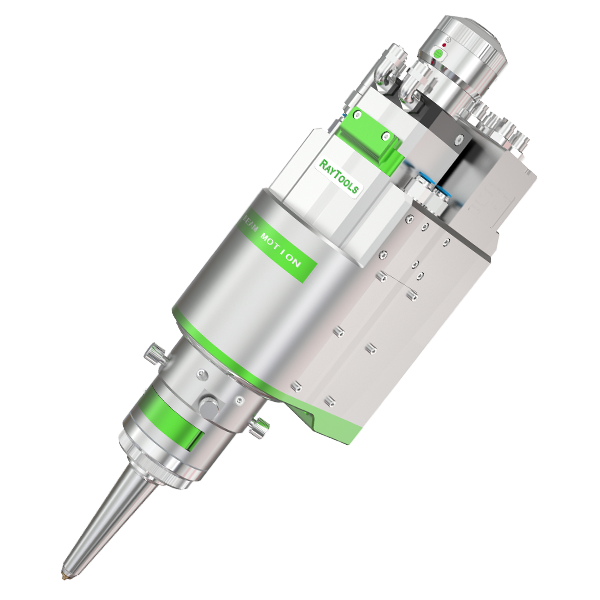
The GF501 is a five-axis three-dimensional laser cutting head rated 3 kW with a 4 kW maximum. Both the A axis and the C axis are driven by DD (direct drive) torque motors with no gearbox, belt or worm between motor and axis, and a Renishaw circular grating closes the position loop, so the head reports 0.006 degrees positioning accuracy and 0.005 degrees repeatability at 1.5 revolutions per second. Travel is ±135 degrees on A and ±540 degrees on C, with a built-in H-axis follow-up stroke of ±18.5 mm. Focus is set by an AO adaptive mirror whose curvature is changed by gas pressure, giving ±9 mm of adjustment without translating a lens group, and an automatic A-axis brake holds the head attitude if power is interrupted. The body is water cooled at the collimating lens, the focusing lens and both motors, and weighs approximately 25.0 kg.
Key Features
- DD motor direct drive: A and C axes are driven directly by DD torque motors, with no intermediate transmission, so there is no backlash to compensate and the response is immediate
- Full closed-loop control: a Renishaw circular grating measures the actual axis angle, so the loop is closed on position rather than on motor commutation
- AO adaptive mirror focusing: gas pressure changes the curvature of the AO mirror to move the focal point, giving ±9 mm of adjustment
- TRA anti-collision protection: an accidental collision stops the machine, and the assembly re-zeroes to high accuracy afterwards
- Automatic A-axis brake: the A axis is braked automatically, so an unexpected power loss cannot let the head swing into the workpiece
- H-axis follow-up: a built-in follow-up lift system with ±18.5 mm stroke maintains standoff on curved surfaces
- Focus X-Y centering: a focusing X-Y centering unit allows the spot to be centered on the nozzle axis in both directions
- Full-loop water cooling: collimating lens, focusing lens and both axis motors are cooled directly in a closed loop
Technical Specifications
| Parameter | Specification |
|---|---|
| Power rating | 3 kW (4 kW maximum) |
| Clear aperture | 36 mm |
| A-axis travel | ±135° |
| C-axis travel | ±540° |
| H-axis travel | ±18.5 mm |
| A/C axis speed | 1.5 rev/s |
| A/C positioning accuracy | 0.006° |
| A/C repeatability | 0.005° |
| Collimating focal length | 100 mm |
| Focusing focal length | 150 mm |
| Fiber interface | QBH |
| Upper protective lens | Φ38.1 mm x 1.6 mm |
| Lower protective lens | Φ37 mm x 7 mm |
| Weight | approx. 25.0 kg |
| Brand | Empower / RayTools |
Series Comparison
| Model | Power / focus type | Axis configuration | Key feature | Weight |
|---|---|---|---|---|
| GF501 | 3 kW (4 kW max), AO mirror focus | ±135° / ±540°, five-axis | DD motors with full closed loop | approx. 25.0 kg |
| GF101 | manual focus | 3D cutting | follow-up 20 mm | approx. 3.5 kg |
| GF101F | 4 kW, autofocus | 3D cutting with automatic focus | follow-up 15 mm | approx. 6.5 kg |
The three heads answer different questions. The GF101 is the light manual-focus 3D head at about 3.5 kg, chosen where the robot is small and the geometry is simple. The GF101F adds automatic focusing and 4 kW at about 6.5 kg with a 15 mm follow-up stroke. The GF501 is the only one of the three with two driven rotary axes: it carries the full 25.0 kg mass of a five-axis assembly, and in exchange it can present the nozzle at any attitude on the part instead of relying on the robot wrist alone. On a six-axis robot the head axes and the robot axes add together, which is how undercuts, deeply recessed flanges and near-parallel walls get cut.
Operating Principle
The optical path carries no translating lens carriage: the beam leaves the fiber through a QBH connector, is collimated by the 100 mm lens, is deflected by the AO adaptive mirror, and is focused by the 150 mm lens through the nozzle. The AO mirror is the focusing element: gas pressure on its back face changes its curvature, and therefore the focal length, across a ±9 mm range. Because the mirror is the only moving optical element, focus changes do not require a lens carriage to travel, which keeps the mass at the front of the head low.
The A axis rotates the cutting assembly about the horizontal axis and the C axis rotates it about the beam axis, so together they set the nozzle attitude. The H axis then lifts or lowers the nozzle to hold standoff. A Renishaw circular grating on each rotary axis feeds the actual angle back to the controller, and the DD motor is commanded from that feedback, which is what produces the 0.006 degree positioning figure without a reduction gear.
Applications
Robot three-dimensional laser cutting of automotive parts, stamped and hydroformed components, aerospace brackets and ducting, and three-dimensional sheet metal parts where the cut line runs across a curved surface or turns an undercut. Typical work includes trimming, hole cutting and edge preparation on parts that cannot be presented to a flat-bed machine, and where the attitude of the nozzle relative to the surface has to be controlled continuously along the path.
Selection Guide
Choose the GF501 when the part needs genuine five-axis attitude control and the accuracy of a closed-loop rotary axis, and when the robot or gantry can carry approximately 25.0 kg at the wrist with the cable package. Choose the GF101F instead if automatic focusing and 4 kW are enough and the geometry can be reached by the robot alone; choose the GF101 if manual focus is acceptable and payload is the limiting factor. The GF501 is the heaviest of the three and should not be specified on a robot that cannot carry it with margin.
Technical Notes
Direct drive removes the reduction stage entirely. With a DD motor the rotor is the axis, so there is no gear tooth clearance, no belt stretch and no worm wear to compensate in the controller, and there is nothing to re-tension over the life of the head. The trade-off is that the motor must be sized for the inertia it drives, which is why the head is water cooled at both motors.
The A-axis brake is a safety function rather than a process function. If power is lost, an unbraked five-axis head can swing under gravity into the workpiece or the fixture; the brake holds the attitude until the controller is back. The TRA anti-collision unit is separate: it releases on impact so the nozzle assembly absorbs the hit, and it re-zeroes to high accuracy so production can resume without re-datuming the head.
Disclaimer
Specifications are taken from the manufacturer data current at the time of publication and are subject to change without notice. The 3 kW rating is the nominal class and 4 kW is the maximum permitted, so the source and the duty cycle must be checked against that limit. Achievable accuracy on a robot installation also depends on the robot repeatability and on the calibration of the head-to-robot transform, not on the head alone. Confirm the fiber interface, the cooling circuit and the mounting flange against your machine before ordering.
Contact Us
Changsha Soar Laser Equipment Co., Ltd. supplies this cutting head with configuration checks against your laser source, robot or CNC, and your process gas supply. Hotline +86 159-2722-0467, e-mail 859818709@qq.com, www.soar-laser.cn.

Reviews
There are no reviews yet.