


What Is NOHD? How Far from a Laser Is Safe?
What Is NOHD? How Far from a Laser Is Safe? – this article systematically introduces the core concepts, working principles, key parameters, main types, application scenarios and common misconceptions of NOHD, helping you fully understand this important topic in laser safety.
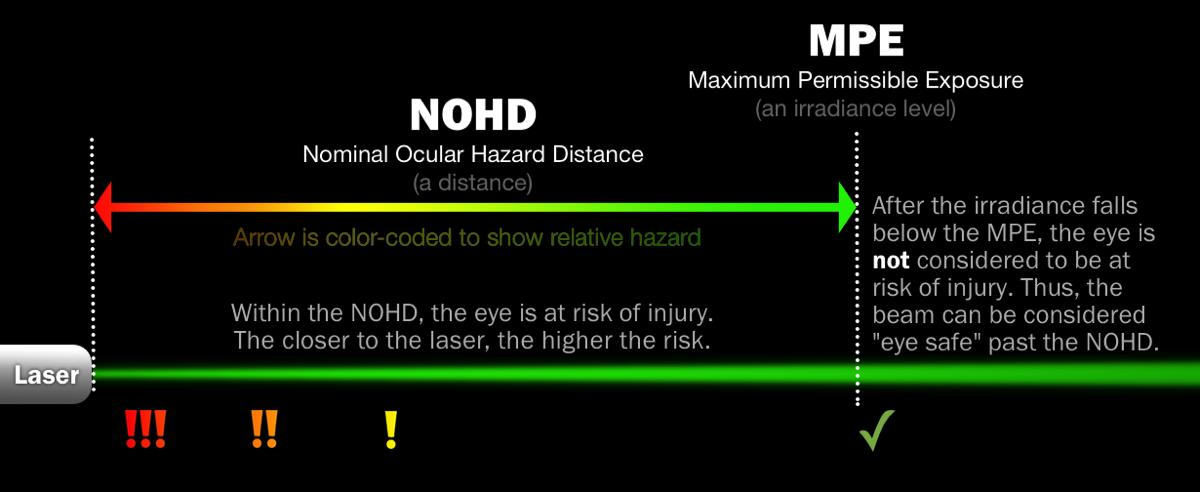
Table of Contents
- I. What Is NOHD? Clarifying the Core Concept
- II. How Is NOHD Determined?
- III. Key Parameters and Metrics
- IV. Main Types: What Kinds of NOHD Exist?
- V. Application Scenarios: Where Is NOHD Used?
- VI. Common Misconceptions: Pitfalls to Avoid
I. Core Concept: What Is NOHD?
The Nominal Ocular Hazard Distance (NOHD) is the distance from the laser aperture to the point where the beam’s irradiance or radiant exposure just falls below the MPE (Maximum Permissible Exposure). Simply put: “within this distance, looking directly at the laser with the naked eye may be unsafe; beyond it, it is safe.” For lasers used outdoors (such as laser rangefinders, LiDAR and laser displays), NOHD is an extremely important safety parameter – customers need to know how far the beam remains hazardous in order to decide whether a safety permit is needed and whether it poses a threat to the public.
II. How Is NOHD Determined?
To understand how NOHD works, it can be broken down into several key steps or mechanisms. Its core mechanism can be understood at the following levels:
The calculation of NOHD is based on the Gaussian beam propagation model: after exiting the aperture, the laser beam gradually diverges with distance, its cross-sectional area grows, and the power per unit area (irradiance) decreases. When irradiance exactly equals the MPE, the corresponding distance is the NOHD. The formula can be simplified as: NOHD ≈ (1/divergence angle) × √(4×power / (π×MPE)). From the formula three influencing factors are apparent: higher power means longer NOHD; smaller divergence angle (more collimated beam) means longer NOHD; lower MPE (more hazardous wavelength) means longer NOHD. That is why a well-collimated low-power laser can have a longer NOHD than a high-power laser with large divergence.
III. Key Parameters and Metrics
To understand NOHD, knowing concepts and principles is not enough – you must also understand its key parameters. The following are the core parameters and their significance:
| Parameter name | Meaning | Why it matters |
|---|---|---|
| Laser power | Directly determines total energy; power increases linearly, NOHD grows with the square root | Higher power means longer NOHD, growing with the square root |
| Beam divergence angle | Has the greatest effect – halving divergence doubles NOHD | Has the greatest impact on NOHD; halving divergence doubles NOHD |
| MPE value | Determined by wavelength and exposure time; the retinal hazard region (400-1400 nm) has low MPE and thus long NOHD | Determined by wavelength and exposure time; lower MPE means longer NOHD |
IV. Core Points in Detail
NOHD has two important extended concepts. Extended NOHD (ENOHD) accounts for observation through optical instruments (such as telescopes and binoculars). Optical instruments increase entrance pupil area and gather more light, multiplying the effective NOHD several-fold to ten-fold – especially important for outdoor laser applications aimed at the public. Nominal Hazard Zone (NHZ) is a broader concept, covering not only the direct beam but also the entire spatial region where reflected and scattered light may exceed the MPE. There are also corresponding Nominal Skin Hazard Distance (NSHD) and Nominal Skin Hazard Area (NSHA), but because skin MPE is generally higher, eye hazard is the limiting factor in most cases.
V. Application Scenarios: Where Is NOHD Used?
- NOHD has high sales value in outdoor laser applications. Automotive LiDAR: customers need to know whether NOHD is within safe limits and complies with road-safety regulations, often a key threshold for whether a product can be deployed on roads. Laser rangefinders / telescopes: both military and civilian rangefinders need a clear NOHD to ensure the safety of operators and third parties. Laser shows / landmark lasers: city landmark lasers must calculate NOHD to ensure beam height is safe and will not shine into residential windows or aircraft flight paths. Security lasers: the NOHD of perimeter-security laser beams determines installation height and angle. Sales can offer NOHD calculation as a value-added service, helping customers with safety assessment and compliance arguments – often a plus or even decisive factor in competitive bidding.
👉 Want to learn more about real-world NOHD applications? Visit Soar Laser’s application case page, or contact our technical team directly for professional advice.
VI. Common Misconceptions
Many people have fuzzy ideas about NOHD. See if you fall into any of these traps:
Myth 1: “One glance within the NOHD will blind you”
Wrong. NOHD is a “nominal” distance based on MPE that already includes a safety factor. Within the NOHD it means “may exceed MPE,” not “certain injury.” But safety management must treat NOHD as the boundary – no complacency.
Myth 2: “Higher power always means longer NOHD”
Not necessarily. Divergence has a greater effect than power. A 100 mW collimated laser with small divergence may have a longer NOHD than a 10 W laser with large divergence.
Myth 3: “1550 nm is eye-safe, so it has no NOHD”
Wrong. “Eye-safe wavelength” only means higher MPE and shorter NOHD, not no NOHD. At sufficient power, a 1550 nm laser still has a NOHD and can damage the cornea at close range.
Reference source:RP Photonics Encyclopedia
Leave a Reply