


What Are Laser Hazard Classes? The Difference Between Class 1 and Class 4
What Are Laser Hazard Classes? The Difference Between Class 1 and Class 4 – this article systematically introduces the core concepts, working principles, key parameters, main types, application scenarios and common misconceptions of laser hazard classes, helping you fully understand this important topic in laser safety.
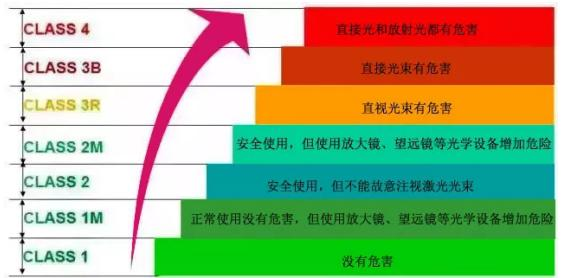
Table of Contents
- I. What Are Laser Hazard Classes? Clarifying the Core Concept
- II. How Does Laser Hazard Classification Work?
- III. Key Parameters and Metrics
- IV. Main Types: What Kinds of Laser Hazard Classes Exist?
- V. Application Scenarios: Where Are Laser Hazard Classes Relevant?
- VI. Common Misconceptions: Pitfalls to Avoid
I. Core Concept: What Are Laser Hazard Classes?
Laser classification is a grading system based on the potential hazard a laser product poses to the human body, and the cornerstone of laser safety management. The internationally accepted IEC 60825-1 standard divides laser products into seven classes – 1, 1M, 2, 2M, 3R, 3B and 4 – with higher numbers indicating greater danger. For sales, laser class is one of the most frequently asked questions – “what class is your laser?” Accurately interpreting the class meaning and explaining the corresponding protection requirements is the first step to building professional trust. Class not only concerns safety compliance but directly affects the customer’s purchasing decision, site modification and operating costs.
II. How Does Laser Hazard Classification Work?
To understand how laser hazard classification works, it can be broken down into several key steps or mechanisms. Its core mechanism can be understood at the following levels:
The underlying logic of laser classification is based on the Accessible Emission Limit (AEL) – the maximum radiation a person might be exposed to under worst-case conditions – compared with the Maximum Permissible Exposure (MPE). Classification considers worst-case assumptions: distance from person to aperture, exposure duration, whether optical instruments (magnifiers, telescopes, etc.) are used. For example, the “M” in Class 1M stands for “Magnification” – safe for the naked eye, but potentially exceeding limits when viewed through optical instruments. Classification is usually the manufacturer’s responsibility, but if a user modifies the equipment (e.g. removes a protective enclosure) the class changes, and the user then bears responsibility for reclassification.
III. Key Parameters and Metrics
To understand laser hazard classes, knowing concepts and principles is not enough – you must also understand its key parameters. The following are the core parameters and their significance:
| Parameter name | Meaning | Why it matters |
|---|---|---|
| Output power / pulse energy | The most intuitive metric, but not the only one | The main basis for laser classification, directly determining which safety class a product belongs to |
| Wavelength | Determines whether light can reach the retina, thus affecting the MPE threshold | Affects the eye’s transmission and absorption characteristics of laser light, thus affecting MPE threshold and class determination |
| Beam divergence and beam quality | Affects radiation intensity at long distance; beams with large divergence are safer | Determines radiation intensity at long distance; larger divergence generally means a lower class |
| Accessibility | Even a kilowatt-class laser, if fully sealed in an enclosure with no leakage risk, can still be Class 1 | Reflects the radiation a person can actually access; a fully enclosed high-power laser can still be Class 1 |
IV. Main Types: What Kinds of Laser Hazard Classes Exist?
The IEC 60825-1 standard divides laser products into seven classes, with higher numbers indicating greater danger. The characteristics of each class are as follows:
Class 1: no hazard under normal use; accessible radiation is below the damage threshold. Many Class 1 products contain higher-power lasers inside but are fully sealed in an enclosure. Common examples: laser printers, optical disc drives.
Class 1M: safe for naked-eye viewing, but potentially dangerous when viewed through telescopes, microscopes or other optical instruments. The beam has a large diameter or divergence, and optical instruments gather more energy.
Class 2: visible band (400-700 nm), power ≤1 mW, relying on the blink reflex (0.25 s) for protection. Common examples: most laser pointers, barcode scanners. Deliberately staring at the beam can still cause injury.
Class 2M: same visible-light blink protection as Class 2, but with a larger beam diameter; viewing through optical instruments is prohibited. Common examples: construction level tools, alignment tools.
Class 3R: has some danger, up to 5 mW visible (5 times Class 2). Directly viewing the beam may harm the eye, but the risk is lower than Class 3B. Requires careful handling and avoiding direct viewing.
Class 3B: both direct beam viewing and specular reflection pose eye-injury risk; diffuse reflection is usually safe. Visible power range 5 mW-500 mW. Laser safety goggles, engineering controls and administrative measures are required during operation.
Class 4: the highest hazard class. Both direct and diffuse reflection can injure the eye, can burn skin and start fires. Full protection is mandatory: area isolation, interlock systems, goggles, training and certification, etc.
V. Application Scenarios: Where Are Laser Hazard Classes Relevant?
- Different classes correspond to completely different use scenarios and sales pitches. Class 1/2 suits consumer electronics and teaching demonstrations, with the sales focus on “ready out of the box, no special protection needed”
- Class 3R/3B is common in research experiments and small medical devices, emphasising the basic protection scheme of “training + goggles + operating procedures”
- Class 4 is used in industrial cutting and welding, medical surgery, military and other high-power scenarios, where sales must provide a complete safety solution – area isolation, interlock systems, active safety protection, personnel training and certification, etc. – a high-value-added service entry point. When selling to Class 4 customers, the value of a safety compliance solution may far exceed the laser itself.
👉 Want to learn more about real-world laser hazard class cases? Visit Soar Laser’s application case page, or contact our technical team directly for professional advice.
VI. Common Misconceptions
Many people have fuzzy ideas about laser hazard classes. See if you fall into any of these traps:
Myth 1: “A Class 1 laser is low-power”
Wrong. Class 1 means “accessible radiation is safe,” not “low power.” A 10-kilowatt industrial laser is Class 1 as long as it is fully sealed with no light leakage.
Myth 2: “Class 2 laser pointers are safe to use freely”
Class 2 safety relies on the blink reflex, but if you deliberately stare (out of curiosity, for example), exceeding 0.25 s can cause injury – especially dangerous for children.
Myth 3: “The higher the class, the better the quality”
Class only reflects hazard, not performance quality. What customers need is “the lowest safety class that meets the application need”; a higher class means higher usage cost and barriers.
Reference source:RP Photonics Encyclopedia
Leave a Reply