


Self-phase modulation is an important concept in laser technology—understanding its principles, key parameters and applications is essential for correct component selection and system design. This article explains it clearly, from principles and key parameters to main types and typical applications.
Table of Contents
- 1. What Is Self-Phase Modulation? Understanding the Core Concepts
- 2. Working Principle: How Does Self-Phase Modulation Work?
- 3. Key Parameters: Understanding SPM Performance Indicators
- 4. Main Types: What Kinds of Self-Phase Modulation Exist?
- 5. Applications: Where Is Self-Phase Modulation Relevant?
- 6. Common Misconceptions: Pitfalls to Avoid
1. Core Concepts: What Is Self-Phase Modulation?
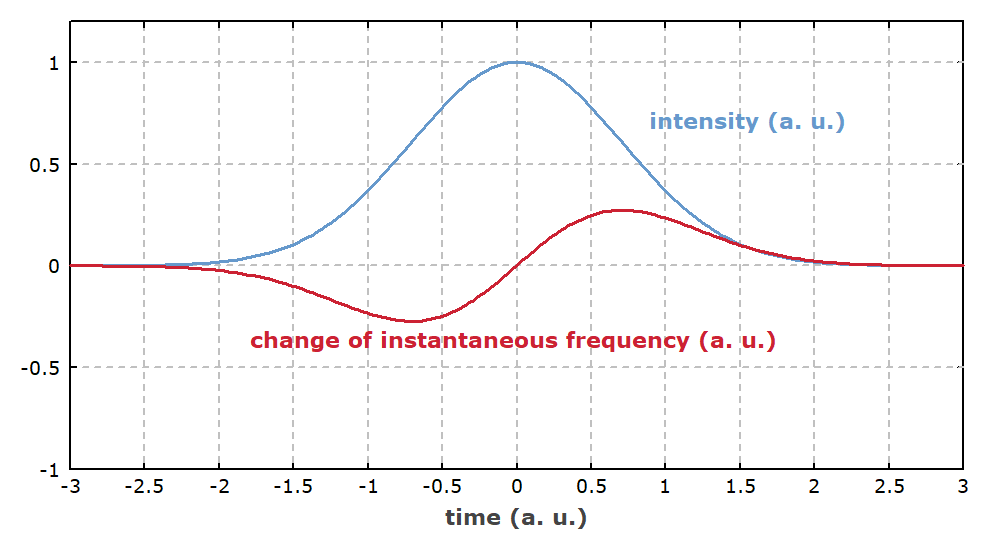
< Self-phase modulation is a nonlinear optical effect in which an intense optical pulse propagating in a medium changes its own refractive index through the Kerr effect, thereby phase-modulating itself. In simple terms, the pulse “modulates its own phase”—the pulse is intense at the centre and weak at the edges, so the induced refractive-index change also varies with time, leading to different phase shifts at different moments and thus producing a chirp. SPM is both a “troublemaker” to be controlled in pulse propagation and the physical foundation of techniques such as soliton formation and supercontinuum generation.
Self-phase modulation is a nonlinear effect: as an intense pulse propagates in a medium, its own intensity change causes a refractive-index change, which in turn changes its own phase and broadens the spectrum—it is not a component, but a phenomenon of light–matter interaction.
2. Working Principle: How Does Self-Phase Modulation Work?
Understanding how self-phase modulation works can be broken down into several key steps or mechanisms. Let us look at them one by one:
The root of SPM is the optical Kerr effect: a medium’s refractive index n varies with light intensity I. As the pulse propagates, the intensity is highest at the peak, where the refractive index rises most and the phase delay is largest; at the wings the intensity is lower and the phase delay smaller. The pulse thus acquires a time-varying phase shift—the leading edge changes slowly and the trailing edge quickly, producing an up-chirp. Pure SPM (without dispersion) barely changes the pulse width, but new frequency components are created in the frequency domain and the spectrum broadens significantly. The SPM effect is especially pronounced in optical fibres.
3. Key Parameters: Understanding SPM Performance Indicators
| Parameter Name | Meaning | Why It Matters |
|---|---|---|
| Nonlinear Phase Shift | Measures the strength of SPM, proportional to the nonlinear coefficient, power and length. | The strength of the SPM effect is determined directly by it; a larger phase shift means more significant spectral broadening, making it the core parameter for gauging nonlinear-effect strength. |
| Nonlinear Coefficient γ | In rad/(W·m), measures the phase shift per unit power and length. | A quantitative measure of a fibre’s or medium’s nonlinear capability, determining the nonlinear phase shift produced at a given power. |
| Nonlinear Refractive Index n₂ | An intrinsic material property, in m²/W. | The material’s inherent nonlinear property, the physical origin of Kerr effects such as self-phase modulation. |
| Effective Mode Area A_eff | The smaller it is, the more concentrated the intensity and the stronger the nonlinearity. | The area over which the optical field is confined in the medium; a smaller area means higher power density and stronger nonlinear effects. |
| Spectral Broadening Factor | Can reach several to tens of times under strong SPM. | The ratio of the post-SPM spectral width to the input spectral width, directly reflecting the strength and usability of the SPM effect. |
These parameters are not isolated; they are interrelated and mutually constrained. There is a trade-off between the spectral broadening from SPM and pulse quality: moderate SPM favors spectral broadening and compression, but excessive SPM leads to spectral distortion and instability.
If you are not familiar with these parameters, that is fine—Soar Laser’s product pages have detailed descriptions, and you can also consult our technical engineers directly to help you select.
4. Main Types: What Kinds of Self-Phase Modulation Exist?
Self-phase modulation can be classified in several ways, and different dimensions help us understand it from different angles. The common classification methods are introduced below:
By Type
Temporal SPM
Phase modulation caused by the pulse’s temporal profile, the most common form.
Spatial SPM
Phase modulation caused by the beam’s transverse profile, producing self-focusing.
By Mechanism
Kerr-effect SPM (instantaneous electronic response, the main mechanism for femtosecond pulses); carrier-dynamics SPM (in semiconductors, slower response).
Combined with Dispersion
Normal dispersion + SPM forms parabolic pulses; anomalous dispersion + SPM balances to form optical solitons.
Different types of self-phase modulation have their own advantages and disadvantages; there is no absolute “best,” only “most suitable.” Selection should consider your specific application, power requirements, budget and other factors. For example, for high-power industrial applications fibre lasers may be more suitable; for research with ultrashort-pulse needs, Ti:sapphire may be preferable.
5. Applications: Where Is Self-Phase Modulation Relevant?
Self-phase modulation has a very wide range of applications, from industrial manufacturing to healthcare, from communication networks to scientific research—almost anywhere lasers are used. A few fields are briefly described below:
- SPM is widely used in ultrafast optics. The most direct application is nonlinear pulse compression: first use SPM to broaden the spectrum, then dispersive compression to remove the chirp, yielding pulses much shorter than the input—an important route to few-cycle pulses. Supercontinuum generation is another key application—when a femtosecond pulse is coupled into a photonic crystal fibre, the spectrum can broaden to span the entire visible and near-infrared range. In mode-locked fibre lasers, the balance between SPM and dispersion is the physical basis of soliton mode locking.
Typical Application Scenarios in Detail
Scenario 1: SPM is widely used in ultrafast optics; the most direct application is nonlinear pulse compression
first use SPM to broaden the spectrum, then dispersive compression to remove the chirp, yielding pulses much shorter than the input—an important route to few-cycle pulses. Supercontinuum generation is another key application—when a femtosecond pulse is coupled into a photonic crystal fibre, the spectrum can broaden to span the entire visible and near-infrared range. In mode-locked fibre lasers, the balance between SPM and dispersion is the physical basis of soliton mode locking.
👉 Want to learn more about practical applications of self-phase modulation? Please visit Soar Laser’s application-case page, or contact our technical team directly for professional advice.
6. Common Misconceptions
Many people have somewhat plausible but mistaken notions about self-phase modulation. See whether you fall into any of the following:
Misconception 1: ‘SPM broadens the pulse.’
pure SPM (without dispersion) changes only the phase and spectrum, not the temporal width; pulse broadening results from the combined action of dispersion and SPM
Misconception 2: ‘SPM spectral broadening is symmetric.’
in frequency coordinates the ideal SPM spectrum is symmetric, but when displayed in wavelength coordinates the nonlinear frequency-to-wavelength conversion makes the spectrum appear shifted toward shorter wavelengths
Misconception 3: ‘SPM in fibre depends only on power.’
besides power, it also depends on the effective mode area (smaller means stronger), fibre length and n₂; photonic crystal fibres are strongly nonlinear mainly because of their small mode area
Misconception 4: ‘SPM spectral broadening can be read directly as pulse compression.’
SPM imposes a nearly linear chirp that becomes a short pulse only when dispersion is precisely compensated; judging compression by spectral width alone ignores phase information and fails to reach the target duration
Of course, there are far more misconceptions about self-phase modulation than these. Laser technology develops rapidly, with new materials and processes constantly emerging, so some previous “common knowledge” may already be outdated. If you have other questions, please leave a comment and we will answer them one by one.
Leave a Reply