


Group delay dispersion is an important concept in laser technology—understanding its principles, key parameters and applications is essential for correct component selection and system design. This article explains it clearly, from principles and key parameters to main types and typical applications.
Table of Contents
- 1. What Is Group Delay Dispersion? Understanding the Core Concepts
- 2. Working Principle: How Does Group Delay Dispersion Work?
- 3. Key Parameters: Understanding GDD Performance Indicators
- 4. Main Types: What Kinds of Group Delay Dispersion Exist?
- 5. Applications: Where Is Group Delay Dispersion Relevant?
- 6. Common Misconceptions: Pitfalls to Avoid
1. Core Concepts: What Is Group Delay Dispersion?
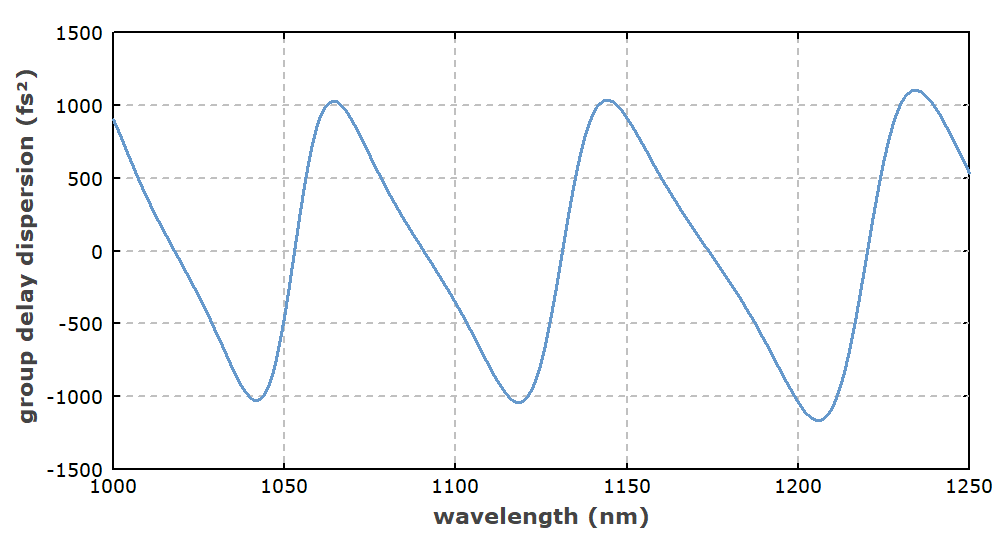
< Group delay dispersion is the core parameter that quantifies dispersion, describing how quickly group delay changes with optical frequency. If light of different frequencies is compared to a group of runners, group delay is the time each one takes to finish the course, and GDD is the “spread in their speeds”—the larger the GDD, the bigger the time gap between fast and slow runners, and the longer the pulse is stretched. GDD is the total dispersion of an entire optical component, measured in fs² or ps².
Group delay dispersion describes the phenomenon in which different frequency components travel at different speeds in a medium, broadening the pulse—it results from light interacting with material rather than being an active device, and is a parameter that must be managed in ultrafast laser systems.
2. Working Principle: How Does Group Delay Dispersion Work?
Understanding how group delay dispersion works can be broken down into several key steps or mechanisms. Let us look at them one by one:
Mathematically, GDD is the first derivative of group delay with respect to frequency, i.e. the second derivative of spectral phase with respect to frequency. It can be understood through a Taylor expansion: the total phase acquired by a propagating pulse varies with frequency; expanded around the centre frequency, the zeroth-order term is a constant phase (no effect on shape), the first-order term corresponds to group delay (an overall shift), and the second-order term is GDD—the lowest-order and usually most important dispersion term that changes the pulse shape. When an unchirped Gaussian pulse passes through a positive-GDD element, its duration increases and it acquires an up-chirp.
3. Key Parameters: Understanding GDD Performance Indicators
| Parameter Name | Meaning | Why It Matters |
|---|---|---|
| Magnitude | The absolute value determines dispersion strength. The fs² scale suits femtosecond systems; the ps² scale is used in strongly stretching systems. | The absolute value determines how much a pulse broadens—the larger the GDD, the more a pulse of a given width broadens, making it the basis for designing the compensation amount. |
| Sign | Positive GDD (normal dispersion) produces an up-chirp; negative GDD (anomalous dispersion) produces a down-chirp. | Positive dispersion (GDD > 0) makes longer wavelengths travel faster and shorter ones slower, forming a positive chirp; negative dispersion does the opposite—this determines the direction of dispersion compensation. |
| Spectral Dependence | The variation of GDD with wavelength is the source of third-order dispersion (TOD). | The rate at which GDD changes with wavelength is third-order dispersion, which has an important effect on the shape and contrast of ultrashort pulses. |
| Unit Conversion | 1 ps² = 10⁶ fs² = 10⁻²⁴ s². | Accurate conversion between units (fs², ps², fs/nm, etc.) is the basis for designing and tuning dispersion-compensation systems. |
These parameters are not isolated; they are interrelated and mutually constrained. There is a trade-off between the amount of GDD compensation and the operating bandwidth: a flat dispersion compensation over a broad band is difficult, and optimisation is usually possible only within a specific band.
If you are not familiar with these parameters, that is fine—Soar Laser’s product pages have detailed descriptions, and you can also consult our technical engineers directly to help you select.
4. Main Types: What Kinds of Group Delay Dispersion Exist?
Group delay dispersion can be classified in several ways, and different dimensions help us understand it from different angles. The common classification methods are introduced below:
By Type
Positive GDD (normal dispersion)
Group delay increases with frequency; most optical materials have positive GDD in the visible and near-infrared bands.
Negative GDD (anomalous dispersion)
Group delay decreases with frequency; grating-pair compressors provide negative GDD.
By Component
Material GDD (crystals, windows); prism-pair GDD (continuously tunable, common for intracavity compensation); grating-pair GDD (large dispersion, core of CPA); chirped-mirror GDD (reflective, high-precision compensation); fibre GDD (determined jointly by length and GVD).
Different types of group delay dispersion have their own advantages and disadvantages; there is no absolute “best,” only “most suitable.” Selection should consider your specific application, power requirements, budget and other factors. For example, for high-power industrial applications fibre lasers may be more suitable; for research with ultrashort-pulse needs, Ti:sapphire may be preferable.
5. Applications: Where Is Group Delay Dispersion Relevant?
Group delay dispersion has a very wide range of applications, from industrial manufacturing to healthcare, from communication networks to scientific research—almost anywhere lasers are used. A few fields are briefly described below:
- GDD is a central parameter in ultrafast optics system design. In mode-locked lasers, precise control of the total intracavity GDD is key to stable soliton mode locking—the net GDD is usually kept slightly negative, in the anomalous-dispersion regime. In CPA systems, the stretcher needs large positive GDD and the compressor equal negative GDD, and the matching accuracy directly determines pulse quality. In fibre communications, GDD accumulated over long distances is corrected with dispersion-compensating fibre.
Typical Application Scenarios in Detail
Scenario 1: GDD is a central parameter in ultrafast optics system design; in mode-locked lasers, precise control of the total intracavity GDD is key to stable soliton mode locking
the net GDD is usually kept slightly negative, in the anomalous-dispersion regime. In CPA systems, the stretcher needs large positive GDD and the compressor equal negative GDD, and the matching accuracy directly determines pulse quality. In fibre communications, GDD accumulated over long distances is corrected with dispersion-compensating fibre.
👉 Want to learn more about practical applications of group delay dispersion? Please visit Soar Laser’s application-case page, or contact our technical team directly for professional advice.
6. Common Misconceptions
Many people have somewhat plausible but mistaken notions about group delay dispersion. See whether you fall into any of the following:
Misconception 1: ‘GDD and GVD are the same thing.’
GVD is dispersion per unit length (s²/m), an intrinsic material property; GDD is the total dispersion of a component (s²), equal to GVD times length—like the relationship between density and mass
Misconception 2: ‘Negative GDD exists only in special fibres.’
negative GDD is more often obtained with spatial optics such as grating pairs, prism pairs and chirped mirrors; the negative dispersion in the vast majority of femtosecond systems comes from these elements
Misconception 3: ‘Compensate the GDD well and the pulse is perfect.’
GDD is only second-order dispersion; in broadband femtosecond pulses third-order and higher dispersion matter just as much, and compensating GDD alone causes trailing edges, pedestals and other distortions
Misconception 4: ‘Negative-GDD optics can be stacked without limit.’
grating pairs and chirped mirrors provide negative GDD along with higher-order dispersion and loss; excessive stacking introduces third-order distortion and reduces throughput, so matching the required amount matters more than using more
Of course, there are far more misconceptions about group delay dispersion than these. Laser technology develops rapidly, with new materials and processes constantly emerging, so some previous “common knowledge” may already be outdated. If you have other questions, please leave a comment and we will answer them one by one.
Leave a Reply