


Mode locking is an important concept in laser technology—understanding its principles, key parameters and applications is essential for correct component selection and system design. This article explains it clearly, from principles and key parameters to main types and typical applications.
Table of Contents
- 1. What Is Mode Locking? Understanding the Core Concepts
- 2. Working Principle: How Does Mode Locking Work?
- 3. Key Parameters: Understanding Mode-Locking Performance Indicators
- 4. Main Types: What Kinds of Mode Locking Exist?
- 5. Applications: Where Is Mode Locking Relevant?
- 6. Common Misconceptions: Pitfalls to Avoid
1. Core Concepts: What Is Mode Locking?
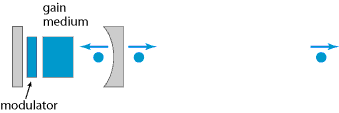
< Mode locking is the core technique by which a laser generates ultrashort pulses. By introducing a modulation mechanism inside the laser resonator, a fixed phase relationship is established among a large number of longitudinal modes, synthesizing an extremely short optical pulse in the time domain that circulates in the cavity. Mode-locked pulse widths are typically in the femtosecond-to-picosecond range, and peak power can be orders of magnitude higher than average power.
Mode locking is a technique that makes multiple longitudinal modes in a laser cavity oscillate with a fixed phase relationship—it superposes these modes in the time domain into a periodic train of ultrashort pulses, the core method for producing femtosecond and picosecond lasers.
2. Working Principle: How Does Mode Locking Work?
Understanding how mode locking works can be broken down into several key steps or mechanisms. Let us look at them one by one:
The essence of mode locking is to precisely balance gain, loss, nonlinearity and dispersion in the cavity after each round trip so that pulse parameters remain stable. Active mode locking uses an electro-optic or acousto-optic modulator to modulate loss synchronously at the cavity round-trip frequency, “clipping” the pulse wings and shortening it. Passive mode locking uses a saturable absorber—intense light saturates the absorption and automatically lowers the loss; because its response is far faster than electronic modulators, it can produce shorter femtosecond pulses.
3. Key Parameters: Understanding Mode-Locking Performance Indicators
| Parameter Name | Meaning | Why It Matters |
|---|---|---|
| Repetition Rate | Set by the inverse of the cavity round-trip time, typically tens to hundreds of megahertz. | Determines pulse spacing and the number of pulses per unit time, directly affecting time-resolved measurement precision and the choice of machining efficiency and nonlinear frequency-conversion efficiency. |
| Pulse Width | Picosecond for active mode locking, femtosecond for passive mode locking. | Determines peak power and time resolution—the most central metric of an ultrafast laser, directly affecting micromachining precision, spectral broadening capability and nonlinear-effect strength. |
| Pulse Energy | Usually nanojoule to picojoule because of the high repetition rate. | Determines the upper energy a single pulse can carry, relating to machining depth, nonlinear conversion efficiency and the design requirements of amplifier stages. |
| Peak Power | 33 With extremely short width, peak power is far above average power. | The ratio of pulse energy to width, directly determining the conversion efficiency of nonlinear effects (such as second-harmonic generation and parametric amplification) and the strength of light–matter interaction. |
| Time-Bandwidth Product | Measures how close a pulse is to the Fourier transform limit. | Reflects how close a pulse is to the Fourier transform limit; a smaller value means higher pulse quality and more complete dispersion compensation, crucial for subsequent compression and applications. |
These parameters are not isolated; they are interrelated and mutually constrained. In mode-locked lasers there is a trade-off among pulse width, spectral width and repetition rate: a broader spectrum supports a shorter pulse, but the cavity design must balance dispersion against gain bandwidth.
If you are not familiar with these parameters, that is fine—Soar Laser’s product pages have detailed descriptions, and you can also consult our technical engineers directly to help you select.
4. Main Types: What Kinds of Mode Locking Exist?
Mode locking can be classified in several ways, and different dimensions help us understand it from different angles. The common classification methods are introduced below:
By Type
Active Mode Locking
Uses acousto-optic/electro-optic modulators, with precisely controllable repetition rate and picosecond pulse width.
Passive Mode Locking
Uses saturable absorbers (SESAM), Kerr lens mode locking (KLM), etc., producing femtosecond pulses—the mainstream approach.
Hybrid Mode Locking
Combines active and passive, balancing controllable frequency with short pulse width.
Harmonic Mode Locking
Multiple equally spaced pulses circulate in the cavity, raising the repetition rate.
Different types of mode locking have their own advantages and disadvantages; there is no absolute “best,” only “most suitable.” Selection should consider your specific application, power requirements, budget and other factors. For example, for high-power industrial applications fibre lasers may be more suitable; for research with ultrashort-pulse needs, Ti:sapphire may be preferable.
5. Applications: Where Is Mode Locking Relevant?
Mode locking has a very wide range of applications, from industrial manufacturing to healthcare, from communication networks to scientific research—almost anywhere lasers are used. A few fields are briefly described below:
- Mode-locked lasers are the foundation of ultrafast optics. Industrially they are used for precision micromachining—drilling medical devices, dicing semiconductor wafers, internal engraving of transparent materials and other “cold ablation” scenarios. In research they are indispensable light sources for time-resolved spectroscopy and pump-probe experiments. Frequency-comb technology is based on the equally spaced spectral lines of a mode-locked laser. They also serve as seed sources for chirped pulse amplification (CPA) systems.
Typical Application Scenarios in Detail
Scenario 1: mode-locked lasers are the foundation of ultrafast optics, used industrially for precision micromachining
drilling medical devices, dicing semiconductor wafers, internal engraving of transparent materials and other “cold ablation” scenarios; in research they are indispensable for time-resolved spectroscopy and pump-probe experiments; frequency-comb technology is based on the equally spaced spectral lines of a mode-locked laser, and they also seed chirped pulse amplification (CPA) systems.
👉 Want to learn more about practical applications of mode locking? Please visit Soar Laser’s application-case page, or contact our technical team directly for professional advice.
6. Common Misconceptions
Many people have somewhat plausible but mistaken notions about mode locking. See whether you fall into any of the following:
Misconception 1: ‘Mode locking means locking a single mode.’
in fact mode locking makes many longitudinal modes oscillate simultaneously with a fixed phase, rather than locking a single mode
Misconception 2: ‘Passive mode locking is always better.’
passive mode locking gives shorter pulses but suffers from self-starting difficulties and Q-switching instability; active mode locking offers controllable repetition rate and reliable startup
Misconception 3: ‘The shorter the pulse, the higher the energy.’
quite the opposite: mode-locked pulse energy is limited by the high repetition rate, typically only nanojoule to microjoule level
Misconception 4: ‘Shorter pulses from a mode-locked laser are always better.’
narrower pulses mean broader spectra and stricter demands on intracavity dispersion and nonlinear management; selection should follow the application’s required time resolution and average power rather than chasing an extreme pulse width
Of course, there are far more misconceptions about mode locking than these. Laser technology develops rapidly, with new materials and processes constantly emerging, so some previous “common knowledge” may already be outdated. If you have other questions, please leave a comment and we will answer them one by one.
Leave a Reply