


Chirped pulse amplification is an important concept in laser technology—understanding its principles, key parameters and applications is essential for correct component selection and system design. This article explains it clearly, from principles and key parameters to main types and typical applications.
Table of Contents
- 1. What Is Chirped Pulse Amplification? Understanding the Core Concepts
- 2. Working Principle: How Does Chirped Pulse Amplification Work?
- 3. Key Parameters: Understanding CPA Performance Indicators
- 4. Main Types: What Kinds of Chirped Pulse Amplification Exist?
- 5. Applications: Where Is Chirped Pulse Amplification Relevant?
- 6. Common Misconceptions: Pitfalls to Avoid
1. Core Concepts: What Is Chirped Pulse Amplification?
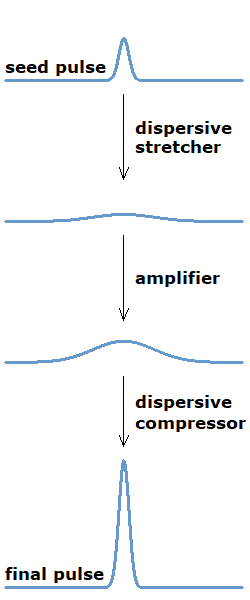
< Chirped pulse amplification is a technique for amplifying ultrashort pulses to extremely high energies, built on “stretch first, amplify, then compress.” Proposed by Mourou and Strickland in 1985, it won the 2018 Nobel Prize in Physics. Before CPA, ultrashort-pulse amplification was limited by nonlinear effects in the gain medium—high peak power caused self-focusing, distortion and even damage. CPA stretches the pulse several thousand- to tens of thousands-fold before amplification to drastically lower peak power, then recompresses it after amplification to near its original width, delivering terawatt or even petawatt peak power.
Chirped pulse amplification (CPA) is a technique that stretches, amplifies and then recompresses an ultrashort pulse—it avoids the damage that direct amplification of ultrashort pulses would cause to the amplifier, allowing femtosecond pulses to be amplified to the joule level, a milestone in ultrafast lasers.
2. Working Principle: How Does Chirped Pulse Amplification Work?
Understanding how chirped pulse amplification works can be broken down into several key steps or mechanisms. Let us look at them one by one:
A CPA system has three parts: a pulse stretcher, an amplifier and a pulse compressor. First, the low-energy femtosecond pulse from the oscillator passes through the stretcher, which introduces strong positive dispersion, separating the frequency components in time and stretching the pulse to the nanosecond scale, dropping its peak power by several orders of magnitude. Second, the stretched low-power pulse enters the amplifier, where its energy is boosted by more than a million times. Third, the amplified high-energy pulse passes through the compressor, whose dispersion is opposite to the stretcher’s, realigning the different frequencies and compressing the pulse back to near its original width.
3. Key Parameters: Understanding CPA Performance Indicators
| Parameter Name | Meaning | Why It Matters |
|---|---|---|
| Pulse Energy | Amplified single-pulse energy, from millijoules to joules or even hundreds of joules. | The core output metric of a CPA system, determining the achievable peak power and range of applications. |
| Compressed Pulse Width | Ideally close to the oscillator’s original width, limited by higher-order dispersion and nonlinearity. | Directly determines peak power and time resolution; a shorter width means higher peak power and stricter dispersion-compensation requirements. |
| Peak Power | Can reach terawatt (TW) or even petawatt (PW) levels. | The pulse energy divided by the compressed width—a key parameter for frontier applications such as strong-field physics and laser acceleration. |
| Stretching Ratio | Ratio of stretched to original pulse width, typically 1000–100000×. | The ratio of stretched to input width, determining the safety margin against nonlinear effects during amplification. |
| Compression Efficiency | 36 About 50% for grating compressors. | The energy transmission efficiency of the compressor, directly affecting the energy output and overall efficiency of the whole CPA system. |
These parameters are not isolated; they are interrelated and mutually constrained. In CPA there is a trade-off among stretching factor, amplification gain and final pulse width: more stretching allows energy to be raised more safely, but places higher demands on the compressor’s dispersion-compensation capability.
If you are not familiar with these parameters, that is fine—Soar Laser’s product pages have detailed descriptions, and you can also consult our technical engineers directly to help you select.
4. Main Types: What Kinds of Chirped Pulse Amplification Exist?
Chirped pulse amplification can be classified in several ways, and different dimensions help us understand it from different angles. The common classification methods are introduced below:
By Type
Bulk CPA Systems
Use bulk gain media and bulk grating compressors, delivering the highest energy and peak power—mainstream for petawatt-class facilities.
Fibre CPA Systems
Compact, efficient and with good beam quality, but single-pulse energy is usually within about 10 mJ, suited to high-repetition-rate scenarios.
Optical Parametric Chirped Pulse Amplification (OPCPA)
Uses a parametric amplifier instead of a stimulated-emission amplifier, with extremely broad gain bandwidth and high temporal contrast, but a more complex system.
Different types of chirped pulse amplification have their own advantages and disadvantages; there is no absolute “best,” only “most suitable.” Selection should consider your specific application, power requirements, budget and other factors. For example, for high-power industrial applications fibre lasers may be more suitable; for research with ultrashort-pulse needs, Ti:sapphire may be preferable.
5. Applications: Where Is Chirped Pulse Amplification Relevant?
Chirped pulse amplification has a very wide range of applications, from industrial manufacturing to healthcare, from communication networks to scientific research—almost anywhere lasers are used. A few fields are briefly described below:
- CPA gave rise to the new field of ultra-intense ultrafast lasers. In strong-field physics, petawatt CPA is used for laser-plasma acceleration, inertial confinement fusion, high-order harmonics and attosecond science. Industrially, small and medium CPA femtosecond systems are used for precision micromachining—drilling medical devices, cutting display panels and dicing semiconductor wafers.
Typical Application Scenarios in Detail
Scenario 1: CPA gave rise to the new field of ultra-intense ultrafast lasers; in strong-field physics, petawatt CPA is used for laser-plasma acceleration, inertial confinement fusion, high-order harmonics and attosecond science
industrially, small and medium CPA femtosecond systems are used for precision micromachining—drilling medical devices, cutting display panels and dicing semiconductor wafers.
👉 Want to learn more about practical applications of chirped pulse amplification? Please visit Soar Laser’s application-case page, or contact our technical team directly for professional advice.
6. Common Misconceptions
Many people have somewhat plausible but mistaken notions about chirped pulse amplification. See whether you fall into any of the following:
Misconception 1: ‘CPA is just an amplifier.’
CPA is the complete three-step stretch-amplify-compress process, and matching the stretcher to the compressor is often the key bottleneck
Misconception 2: ‘The compressed width equals the oscillator width.’
due to higher-order dispersion mismatch, residual nonlinearity and gain narrowing, the compressed width is usually slightly longer than the original
Misconception 3: ‘Fibre CPA energy is comparable to bulk CPA.’
fibre CPA single-pulse energy is typically around 10 mJ, orders of magnitude below the joule or even hundred-joule level of bulk systems
Misconception 4: ‘Because stretching lowers the peak power, nonlinearity in the gain medium can be ignored during amplification.’
stretching only temporarily lowers the peak power; once amplified to the target energy it is still extremely high, and gain narrowing, gain saturation and B-integral must still be carefully controlled or the compressed pulse quality will degrade severely
Of course, there are far more misconceptions about chirped pulse amplification than these. Laser technology develops rapidly, with new materials and processes constantly emerging, so some previous “common knowledge” may already be outdated. If you have other questions, please leave a comment and we will answer them one by one.
Leave a Reply