


The pulse stretcher is an important concept in laser technology—understanding its principles, key parameters and applications is essential for correct component selection and system design. This article explains it clearly, from principles and key parameters to main types and typical applications.
Table of Contents
- 1. What Is a Pulse Stretcher? Understanding the Core Concepts
- 2. Working Principle: How Does a Pulse Stretcher Work?
- 3. Key Parameters: Understanding Pulse Stretcher Performance Indicators
- 4. Main Types: What Kinds of Pulse Stretchers Exist?
- 5. Applications: Where Are Pulse Stretchers Relevant?
- 6. Common Misconceptions: Pitfalls to Avoid
1. Core Concepts: What Is a Pulse Stretcher?
< A pulse stretcher is an optical device that lengthens an ultrashort pulse in time. Its main application is as the first step in chirped pulse amplification (CPA): a femtosecond pulse is stretched to nanoseconds or longer to drastically lower its peak power, so subsequent amplification can proceed safely without nonlinear distortion or optical damage. Its working principle essentially uses dispersion to make different wavelengths travel different optical paths, spreading them out in time.
A pulse stretcher is an optical device that lengthens an ultrashort pulse in time—it first lowers the pulse’s peak power in a CPA system to protect the amplifier, then the pulse is compressed back, making it a key link in chirped pulse amplification.
2. Working Principle: How Does a Pulse Stretcher Work?
Understanding how a pulse stretcher works can be broken down into several key steps or mechanisms. Let us look at them one by one:
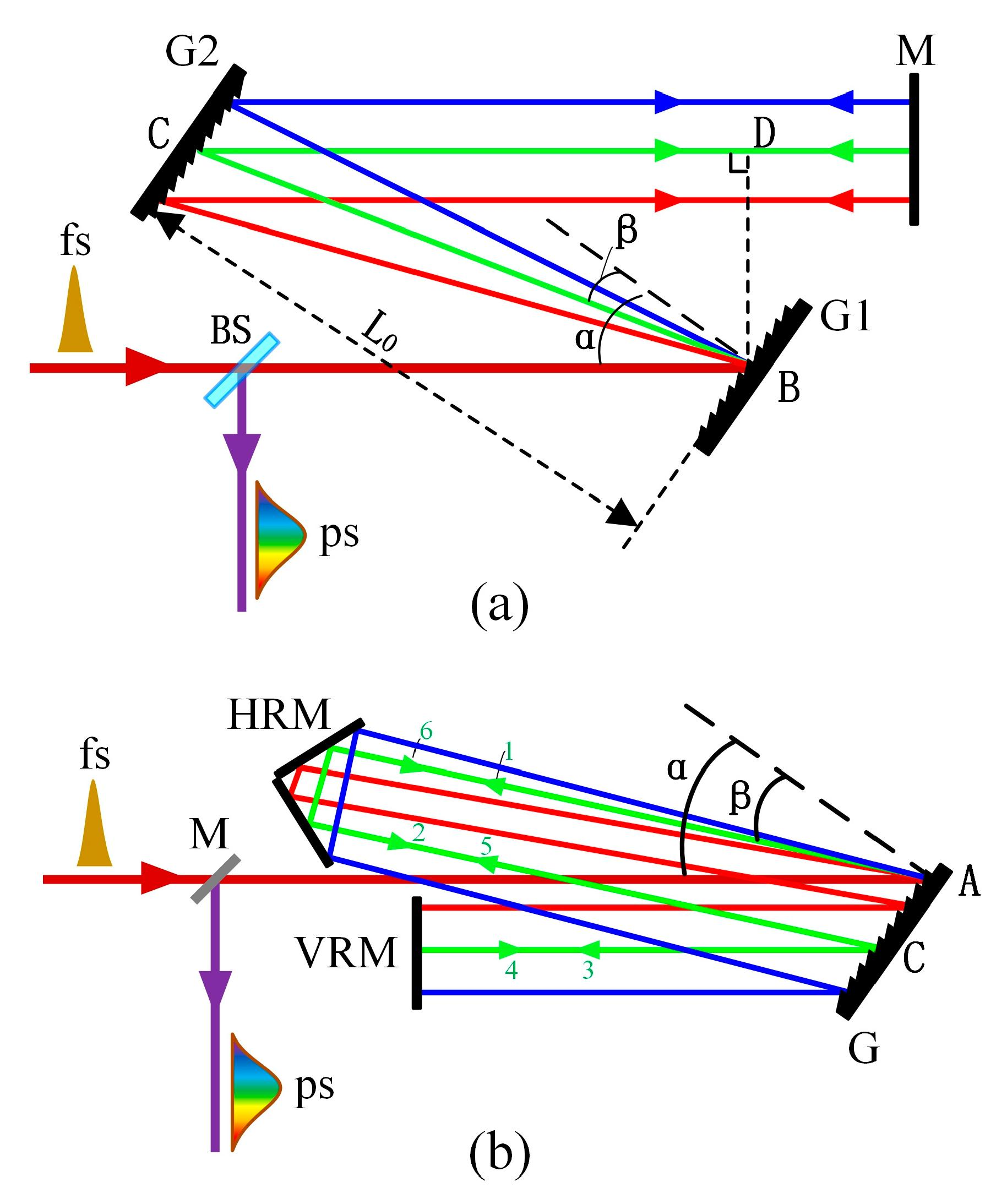
The core of a dispersive stretcher is to introduce strong frequency-dependent group delay. Under normal dispersion (positive GDD), low-frequency (long-wavelength) components travel faster and appear at the leading edge, forming an “up-chirp” (instantaneous frequency rising with time). Taking a grating stretcher as an example, the incoming pulse strikes a diffraction grating, different wavelengths diffract at different angles, and are re-converged by a telescope system, with longer optical paths giving larger delays. A CPA stretcher usually needs positive dispersion (paired with the compressor’s anomalous dispersion), so a telescope is inserted between the gratings to reverse the sign of dispersion.
3. Key Parameters: Understanding Pulse Stretcher Performance Indicators
| Parameter Name | Meaning | Why It Matters |
|---|---|---|
| Group Delay Dispersion (GDD) | Total dispersion, determining the degree of pulse stretching. | The core dispersion amount provided by the stretcher, determining how much the pulse is stretched; it must match the total dispersion of the amplifier chain and compressor. |
| Stretching Ratio | Ratio of output to input pulse width, typically 1000–100000× in CPA. | The ratio of stretched to input pulse width, determining how much peak power is reduced during amplification—key to avoiding nonlinearity. |
| Supported Bandwidth | The spectral range over which it works effectively, determining the shortest processable pulse width. | The spectral range over which the stretcher can effectively disperse light; it must cover the entire pulse spectrum, otherwise the pulse cannot be stretched effectively. |
| Higher-Order Dispersion | Dispersion terms above second order, affecting compressed pulse quality. | Third-order and higher dispersion introduce pulse distortions that are hard to fully compensate after compression, affecting final pulse quality. |
| Insertion Loss | Energy loss as the pulse passes through. | The energy lost as light passes through the stretcher, directly affecting the overall efficiency of the amplification system. |
These parameters are not isolated; they are interrelated and mutually constrained. There is a trade-off between a stretcher’s stretching amount, the compressor’s capability and system size: greater stretching favors high-energy amplification, but the number of compression stages and the footprint also grow.
If you are not familiar with these parameters, that is fine—Soar Laser’s product pages have detailed descriptions, and you can also consult our technical engineers directly to help you select.
4. Main Types: What Kinds of Pulse Stretchers Exist?
Pulse stretchers can be classified in several ways, and different dimensions help us understand them from different angles. The common classification methods are introduced below:
By Type
Fibre-Based Stretcher
Uses the fibre’s own dispersion, the simplest structure; limited by nonlinear effects, suitable only for low-energy pulses.
Prism-Pair Stretcher
Low loss and tunable dispersion, but limited dispersion magnitude.
Diffraction-Grating Stretcher
Largest dispersion, mainstream for high-power CPA; common Martinez and Offner designs.
Chirped Bragg Grating Stretcher
Compact and highly integrable, with precisely designable higher-order dispersion, but difficult to fabricate.
Different types of pulse stretchers have their own advantages and disadvantages; there is no absolute “best,” only “most suitable.” Selection should consider your specific application, power requirements, budget and other factors. For example, for high-power industrial applications fibre lasers may be more suitable; for research with ultrashort-pulse needs, Ti:sapphire may be preferable.
5. Applications: Where Are Pulse Stretchers Relevant?
Pulse stretchers have a very wide range of applications, from industrial manufacturing to healthcare, from communication networks to scientific research—almost anywhere lasers are used. A few fields are briefly described below:
- The main application of a pulse stretcher is in CPA laser systems, which almost no ultrafast amplifier can do without. In high-energy femtosecond amplifiers, a grating stretcher is typically paired with a grating compressor to achieve large pulse energy and high peak power. Fibre CPA systems may use fibre stretchers or chirped Bragg gratings to keep an all-fibre configuration. They are also used in dispersive spectroscopic analysis.
Typical Application Scenarios in Detail
Scenario 1: the main application of a pulse stretcher is in CPA laser systems, which almost no ultrafast amplifier can do without; high-energy femtosecond amplifiers typically pair a grating stretcher with a grating compressor, and fibre CPA systems may use fibre or chirped Bragg grating stretchers
the stretcher lengthens a femtosecond pulse to the nanosecond scale, dropping its peak power by several orders of magnitude to avoid self-focusing and optical damage during amplification; the compressor then restores the width after amplification—the unavoidable route to high-energy femtosecond pulses.
👉 Want to learn more about practical applications of pulse stretchers? Please visit Soar Laser’s application-case page, or contact our technical team directly for professional advice.
6. Common Misconceptions
Many people have somewhat plausible but mistaken notions about pulse stretchers. See whether you fall into any of the following:
Misconception 1: ‘A stretcher and a compressor work on the same principle, so you can just use one in reverse.’
there is symmetry in terms of dispersion, but the practical designs differ greatly; a compressor must handle high power (large-aperture gratings) while the stretcher works at the low-power end
Misconception 2: ‘Fibre stretching is the most convenient, so every system should use it.’
fibre stretching is simple, but nonlinear effects are a fatal limit—SPM severely distorts the pulse at high pulse energies
Misconception 3: ‘The larger the stretching ratio, the better.’
an excessive stretching ratio implies enormous dispersion, introducing more higher-order dispersion and making stretcher–compressor matching harder
Misconception 4: ‘The stretcher can be optimised on its own.’
the stretcher and compressor must be matched precisely, including higher-order dispersion terms; otherwise the amplified pulse cannot be recompressed close to the transform limit. They must be designed as one system
Of course, there are far more misconceptions about pulse stretchers than these. Laser technology develops rapidly, with new materials and processes constantly emerging, so some previous “common knowledge” may already be outdated. If you have other questions, please leave a comment and we will answer them one by one.
Leave a Reply