


What Is a Laser Energy Meter? How to Measure Pulse Laser Energy
How much energy a single pulse carries determines every parameter of a laser process; an energy meter is the instrument dedicated to measuring that quantity.
Table of contents
- 1. What is a laser energy meter? Getting the core concept straight
- 2. Working principle: how a laser energy meter works
- 3. Key parameters: reading the performance specifications of a laser energy meter
- 4. Main types: what kinds of laser energy meters are there
- 5. Applications: where are laser energy meters used
- 6. Common misconceptions: pitfalls to avoid
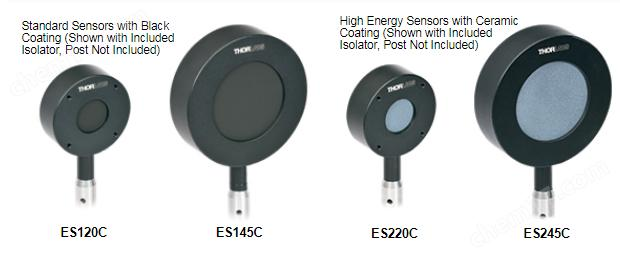
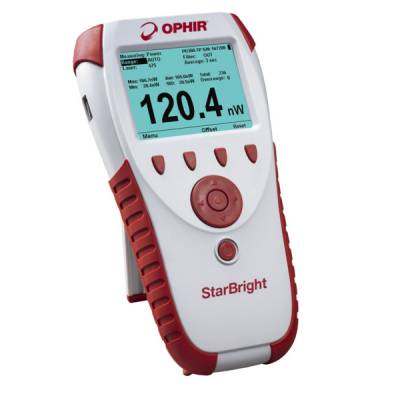
1. Core concept: what is a laser energy meter?
Power and energy are two different quantities, and telling them apart is the first step in choosing an instrument. A laser energy meter is an instrument dedicated to measuring the energy of a single laser pulse, usually in joules (J), millijoules (mJ) or microjoules (μJ). Its difference from the optical power meter is this: the power meter measures energy per unit time (average power), whereas the energy meter measures the total energy carried by each pulse.
As an analogy, if a power meter measures “how much water flows out of the tap per second” (a flow rate), an energy meter measures “how much water comes out each time” (the amount in one glass). For pulsed laser equipment such as Q-switched lasers and ultrafast pulsed lasers, an energy meter is an indispensable tool — it tells you how much energy each pulse actually carries, not merely an average.
It is reasonable to ask why a laser energy meter deserves an article of its own, and why accurate energy measurement matters. Energy measurement is one of the direct determinants of how well a laser application performs: if the spot profile is wrong the cut quality suffers, if the power is measured inaccurately the process is unstable, and if the signal is detected insufficiently the communication distance falls short. Understanding the principle, the parameters and the selection method of laser energy measurement is the first step toward using a laser well.
2. Working principle: how does a laser energy meter work?
The working principle of a laser energy meter can be broken down into a few key steps or mechanisms. Laser physics has the reputation of being obscure, but following this line of reasoning it is not difficult at all. Let us go through it step by step:
The core of an energy meter is to collect all the optical energy of one pulse and convert it into a measurable electrical signal. By sensing principle there are two main families:
### Pyroelectric energy meters (Pyroelectric Energy Meter)
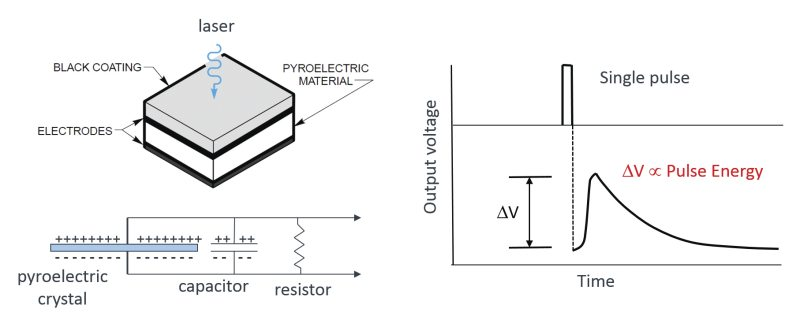
This is the most common solution for pulse energy measurement, based on the pyroelectric effect:
1. Optical absorption and temperature change: the pulsed laser strikes the absorbing coating of the sensor, the optical energy is absorbed and converted into heat, and the temperature of the absorber rises momentarily.
2. The pyroelectric crystal generates a voltage pulse: below the absorber sits a pyroelectric crystal (a ferroelectric material such as lithium tantalate). Pyroelectric materials have a special property: when the temperature changes, charge appears on the crystal surface and forms a voltage pulse. The amplitude of this pulse is proportional to the absorbed heat, and therefore to the incident pulse energy.
3. Signal processing and energy readout: the voltage pulse is amplified, peak-detected and digitised, and the meter computes the pulse energy from the calibration factor and displays it.
The advantages of a pyroelectric energy meter are its broad spectral range, wide energy range and relatively robust construction. It measures the signal produced by a temperature change, so it only produces an output while the temperature is changing — with continuous light the temperature settles and the output returns to zero. Pyroelectric detectors are therefore naturally suited to pulse measurement.
### Photodiode energy meters (Photodiode Energy Meter)
Photodiode-based energy meters work in a different way:
1. Photovoltaic conversion: the pulse falls on the photodiode and produces a photocurrent pulse proportional to the instantaneous optical power.
2. Integration to obtain the energy: the photocurrent pulse passes through an integrating circuit (an integration over time), and the integral is the total energy of the pulse (energy = the integral of power over time).
3. Signal processing and display: the integrated voltage signal is calibrated and displayed in energy units.
The main advantage of a photodiode energy meter is its extremely high sensitivity: it can measure weak pulse energies down to the picojoule (pJ) and even femtojoule (fJ) level, and its fast response makes it suitable for high-repetition-rate pulse measurement. Its drawbacks are the need for wavelength calibration and a low upper power limit.
### Absorber types
For thermal energy meters such as the pyroelectric type, the design of the absorbing layer has a large effect on performance:
Surface absorbers (Surface Absorber)
The absorbing layer sits at the surface and the heat conducts from the surface into the volume. The advantages are fast response and a broad spectral response; the drawback is a relatively low damage threshold, which suits short pulses (nanosecond and picosecond) and small-to-medium energies.
Volume absorbers (Volume Absorber)
The absorption takes place throughout the volume of the material, so the energy is distributed more evenly. The advantages are a high damage threshold and the ability to withstand large energies; the drawback is a slower response and a long time constant. This suits long pulses and high-energy lasers.
| Comparison item | Surface absorber | Volume absorber |
|---|---|---|
| Absorption principle | The absorbing layer is at the surface and the energy is deposited in the top layer | Uniform absorption in the volume, with the energy spread out |
| Damage threshold | Lower (the surface layer is easily damaged) | Higher (the energy is dispersed through the volume) |
| Response speed | Fast (a short heat-conduction path) | Slower (long conduction time through the volume) |
| Applicable pulse width | Short pulses (ns/ps/fs) and small-to-medium energies | Long pulses, large energies, high power |
| Typical materials | Metal black, carbon nanotube coatings and similar | Bulk absorbing materials such as doped glass and ceramics |
3. Key parameters: reading the performance specifications of a laser energy meter
Knowing the concept and the principle is not enough to evaluate a laser energy meter; you also need to understand its key parameters. When people choose a laser they are often faced with a wall of spec sheets and do not know where to start. There is no need to worry: the table below sorts out the core parameters.
| Parameter | Meaning | Why it matters |
|---|---|---|
| Energy measurement range | The upper and lower pulse energies the instrument can measure accurately. Pyroelectric types usually cover nJ to J, while photodiode types cover pJ to μJ/mJ and can be extended with attenuators. | It sets the pulse energies the meter can handle. If the energy is too small it falls below the noise floor and reads inaccurately; if it is too large it exceeds the damage threshold and damages the head. The selected meter must cover the energy of the pulses under test. |
| Spectral response range | The wavelength range over which measurements are accurate. It is very broad for pyroelectric types (from the ultraviolet to the far infrared) and depends on the material for photodiode types. | It is set by the absorber material, since the absorptance differs from wavelength to wavelength. The wavelength of the laser under test must fall inside the calibrated range of the head, or the error will be large. |
| Measurement accuracy | Typically ±3 % to ±5 %, affected by calibration quality, detector uniformity and pulse width. | It determines how much the result can be trusted, usually ±3 % to ±5 %. High-accuracy energy meters need periodic traceable calibration for value transfer and quality control. |
| Maximum repetition rate | The highest pulse repetition rate at which the meter can resolve individual pulses. Pyroelectric types typically handle a few kilohertz to tens of kilohertz, with fast models reaching 100 kHz and above; photodiode types can go higher, to several hundred kilohertz. | It sets the upper limit of the pulse rate that can be measured. At too high a rate the head cannot dissipate heat, which causes the reading to drift and can even overheat and damage it. |
| Applicable pulse width range | An energy meter normally does not resolve the pulse in time, so the reading is essentially independent of pulse width. A very short pulse (a femtosecond pulse, with an extremely high peak power) can however cause damage, while a very long pulse (above the microsecond range) can exceed the response capability of the pyroelectric detector. | The response of an energy meter differs across pulse widths. A pulse that is too short can exceed the energy-density limit and damage the absorber, while a pulse that is too long can fall outside the response time range. |
| Effective photosensitive area | The size of the light-receiving area of the sensor, from a few millimetres to a few centimetres. The laser spot must fall entirely within it. | It determines the spot size the sensor can accept. The beam must fall completely on the effective detection area, or the energy will be underestimated. Large-aperture heads suit beams with a large divergence. |
| Damage threshold (energy density) | The most important safety parameter, usually specified in J/cm². Damage to a sensor under pulsed light is governed mainly by energy density rather than total energy: the smaller the spot, the higher the density for the same energy and the more easily the sensor is damaged. | This is the critical safety parameter, normally in J/cm². Exceeding the threshold causes permanent damage to the absorber, and the shorter the pulse and the smaller the spot, the more easily the limit is exceeded. |
4. Main types: what kinds of laser energy meters are there?
Laser energy meters can be classified in many ways, and each dimension reveals different aspects of their behaviour. The common ones are introduced below:
By sensor principle
Pyroelectric energy meters
The mainstream choice, with a broad spectral range and a wide energy range, suitable for most pulse laser measurements.
Photodiode energy meters
Extremely high sensitivity, suited to weak pulse energies, fast, and requiring wavelength calibration.
Calorimetric energy meters
Based on cumulative heat measurement, extremely accurate but slow, and used mainly as a measurement standard.
By energy range
Micro-energy types
From nJ to μJ, based on photodiodes or highly sensitive pyroelectric detectors.
Medium-energy types
From μJ to mJ, the most commonly used range.
High-energy types
From mJ to J and beyond, based on the pyroelectric or calorimetric principle.
By input configuration
Free-space types
The beam enters directly; the most common arrangement in the laboratory.
Integrating sphere types
With an integrating sphere input, suitable for divergent beams and giving good spatial uniformity.
Fibre-coupled types
Input through a fibre, used for pulse energy measurement in fibre systems.
By function and form factor
Benchtop energy meters
With a separate display unit and full functionality.
USB energy meters
The head connects straight to a computer and is operated in software, which keeps it compact and portable.
Handheld types
Battery powered, convenient for field use.
Combined power/energy meters
One instrument works with different heads, so it measures average power and pulse energy alike.
Each type of laser energy meter has its own advantages and drawbacks; there is no absolute “best,” only the “most suitable.” The choice should follow the specific application, the power requirement, the budget and other practical factors. For an industrial application that needs high power, for example, a fibre laser may suit better; for research work that needs ultrashort pulses, a Ti:sapphire laser may suit better.
5. Applications: where are laser energy meters used?
Laser energy meters are used very widely, from industrial manufacturing to healthcare, from communication networks to scientific research; hardly any application of a laser works without them. A few areas are worth listing:
- Laser energy meters are widely applied in every field that involves pulsed lasers:
- Q-switched laser testing: the pulse energy of a Q-switched laser is the key parameter, ranging from millijoules to joules, and an energy meter is the standard instrument for it.
- Characterisation of ultrafast lasers: measurement of the single-pulse energy of femtosecond and picosecond lasers, which together with the pulse width gives the peak power.
- Laser process development: in marking, drilling and welding, the pulse energy directly affects the processing result and must be precisely controlled and measured.
- Calibration of medical laser equipment: pulsed medical devices such as cosmetic and ophthalmic lasers deliver a dose set by the pulse energy, so they must be calibrated regularly.
- Laser damage threshold testing: measuring the LIDT of an optical component requires precise control and measurement of the pulse energy.
- Scientific research: in nonlinear optics, spectroscopy, laser-induced breakdown spectroscopy (LIBS) and similar experiments, pulse energy is an important parameter.
- Pulse energy statistics and stability monitoring: high-end energy meters can log every pulse and compute the energy fluctuation (such as RMS stability), which is used to assess the output stability of a laser.
- Military and space applications: energy detection in high-power pulsed laser weapons and in LiDAR systems.
🔧 Engineering selection notes
• Compute the energy density before selecting: energy density = pulse energy / spot area, and this is the selection mistake most often overlooked. A small spot can exceed the threshold even when the energy is modest.
• Short pulses call for pyroelectric, high accuracy for calorimetric: nanosecond and picosecond pulses suit a pyroelectric head (fast response); metrology-grade accuracy calls for a calorimetric head (slow but accurate).
• At high repetition rates watch the average power: for pulses at kilohertz rates and above, the ability of the head to dissipate average power can become the bottleneck, so a larger high-power head is needed.
• Calibrate periodically to keep the accuracy: an energy meter should be calibrated once a year, because ageing of the absorber during long use causes the reading to drift.
6. Common misconceptions
Many beliefs about laser energy meters are plausible but wrong. Check whether any of the following misconceptions apply to you:
Misconception 1: dividing the power by the repetition rate gives the pulse energy, so a power meter can do the job
For a stable, evenly spaced pulse train, the average power divided by the repetition rate does indeed equal the average pulse energy. But this method cannot reveal the energy fluctuation between pulses — if the pulse energy varies wildly the average may still look normal while individual pulses are seriously over or under the target. An energy meter measures pulse by pulse and captures the fluctuation and the outliers, which a power meter simply cannot replace. Applications that need every pulse to carry the same energy (precision machining, for instance) must use an energy meter.
Misconception 2: the maximum energy rating of an energy meter is the safety limit
As with a power meter, the safety limit of an energy meter cannot be judged from the total energy alone; what matters is the energy density (J/cm², also called the fluence). A 100 mJ pulse is safe on a spot 1 cm across, but focused to 0.1 mm it can destroy the sensor instantly. When selecting and using an energy meter, always confirm that the pulse energy density stays below the damage threshold. For ultrashort pulses (femtosecond and picosecond) the extremely high peak power means the damage threshold is usually lower than for long pulses, and particular care is needed.
Misconception 3: the shorter the pulse, the less accurate a pyroelectric energy meter reads
Within the rated pulse-width range, the reading of a pyroelectric energy meter is essentially independent of pulse width. It measures the total heat, that is the total energy, and as long as the energy is fully absorbed the heat generated is the same whether the pulse is nanoseconds or microseconds long. What really limits the pulse-width range is this: at very short pulses the peak power can damage the absorbing layer, and at very long pulses heat diffusion and losses make the reading come out low. As long as the pulse width stays within the range specified by the manufacturer, the reading is reliable.
Misconception 4: an energy meter can measure pulses at any repetition rate
Energy meters do have a maximum repetition rate. A pyroelectric detector needs time to recover from the temperature rise of each pulse; if the interval is too short, the heat from the previous pulse has not yet dissipated when the next one arrives, and baseline drift and measurement error appear. At high repetition rates some energy meters switch automatically to an “average power mode” or can only report an average rather than resolving each pulse. When choosing a metre, make sure its maximum repetition rate meets the requirements of the application.
Leave a Reply