


What Is Third-Harmonic Generation (THG)? How 1064 nm Becomes 355 nm Ultraviolet
Third-harmonic generation (THG, usually called tripling) turns 1064 nm infrared into 355 nm ultraviolet. It almost never relies on third-order nonlinearity directly; instead it takes two cascaded steps — double, then sum — both of them second-order processes and far more efficient. This article covers that cascade, the separate matching conditions of the two crystals, seven key parameters and the limits of UV applications.
Contents
- 1. What Is Third-Harmonic Generation? The Core Concept
- 2. How It Works: What Makes THG Possible
- 3. Key Parameters: Reading a THG Device Specification
- 4. Main Types: Which Kinds of THG Set-up Exist
- 5. Applications: Where THG Is Actually Used
- 6. Common Misconceptions: Four Widely Held Myths
1. The Core Concept: What Is Third-Harmonic Generation?
Third-harmonic generation (THG), or tripling, is the nonlinear process that triples the frequency of the input laser, shortening the wavelength to one third. A 1064 nm infrared laser tripled gives 355 nm ultraviolet, one of the most widely used UV wavelengths in industry and research.
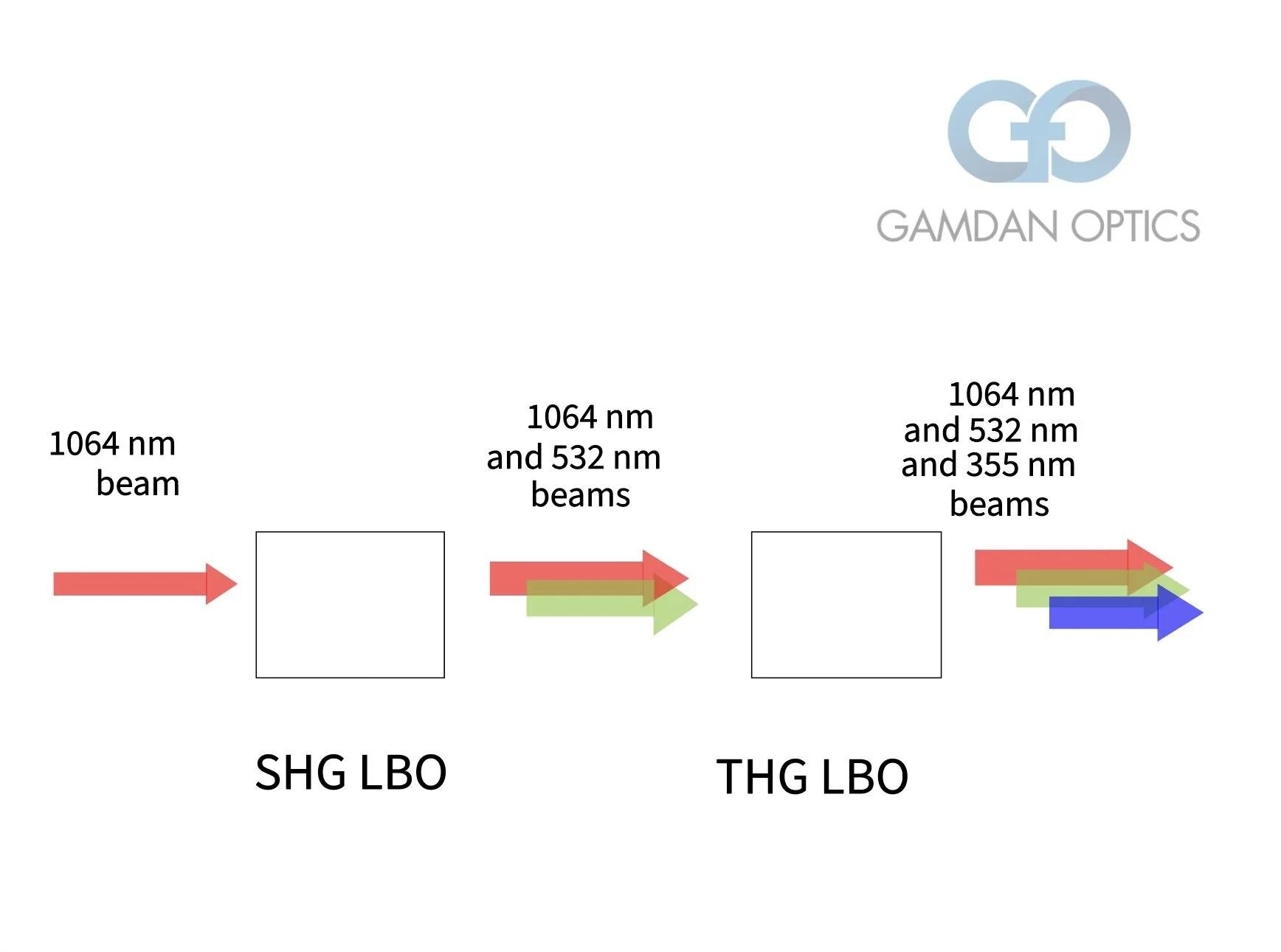
There is an easy misunderstanding here. A third harmonic can in theory be generated directly by third-order nonlinearity (χ⁽³⁾), but χ⁽³⁾ is small to begin with and phase matching is very hard to satisfy, so direct tripling is almost never used. What industry and research actually mean by tripling is a cascaded process: the first crystal doubles, producing the second harmonic; the second crystal sums the remaining fundamental with that second harmonic to give the third harmonic. Both steps are second-order (χ⁽²⁾), with large coefficients and mature matching techniques, and the efficiency is orders of magnitude better than direct tripling.
Because it takes two steps, a 355 nm source is considerably more complex than a 532 nm one: two crystals, two sets of phase-matching conditions, a power ratio between the stages, plus UV absorption and crystal degradation to deal with. The classic use of tripling is making 355 nm ultraviolet; the short wavelength, high photon energy and small focal spot give it advantages in precision machining, lithography and marking that visible light cannot match.
2. How It Works: What Makes THG Possible
The cascade takes only two steps, but each has its own matching condition, and that is what shapes the whole optical design.
Step 1: Doubling, 1064 nm to 532 nm
Fundamental light at ω enters the first doubling crystal, where second-harmonic generation converts part of it to 2ω. This step is ordinary doubling, driven by χ⁽²⁾. The emerging beam carries both the remaining fundamental at ω and the newly generated second harmonic at 2ω, and their power ratio is set by the conversion of that crystal.
Step 2: Sum-frequency mixing, ω + 2ω to 3ω
The mixed beam enters the second crystal, where sum-frequency generation (SFG) merges one ω photon with one 2ω photon into a 3ω photon. This is still a χ⁽²⁾ process, with energy conservation ℏω + ℏ(2ω) = ℏ(3ω). Note that no extra light source is needed here — the fundamental left over from the doubling stage is exactly the second input.
Phase matching, separately for each crystal
Phase matching decides whether tripling is efficient, and it has to be satisfied twice: the first crystal needs the doubling condition 2k₁ = k₂, the second the sum condition k₁ + k₂ = k₃. Because the two crystals handle different wavelength combinations, real systems often use different materials or different cuts, each aimed at its own matching point.
Taking 1064 nm to 355 nm as the example, the common arrangement is LBO or KTP in the first stage to make 532 nm, and LBO or BBO in the second to make 355 nm. The choice balances efficiency, damage threshold, walk-off and temperature behaviour — not a decision that can rest on the nonlinear coefficient alone.
On efficiency, a pulsed system can reach 30%–50% overall, sometimes higher, depending on fundamental peak power, crystal quality and optical design. Continuous-wave systems are far less efficient, because both stages lose something and continuous power density is hard to push high.
◆ An analogy
Tripling is like a dish that has to be cooked in two stages: cut half the ingredient aside first (doubling), then put that half and the remaining half into the pan together (summing). Each stage has its own heat setting, and the first must not use up all the ingredient — if it does, the second has nothing to pair with. That is why the doubling stage is usually designed for 50%–70% conversion rather than as high as possible.
3. Key Parameters: Reading a THG Device Specification
A tripler has more parameters to watch than a doubler because it is two stages in series: whichever stage falls short shows up in the overall efficiency. These seven have to be confirmed before anything else:
| Parameter | What it means | Why it matters |
|---|---|---|
| Overall conversion efficiency | The ratio of third-harmonic output to the original fundamental input. Nanosecond systems typically reach 30%–50%; femtosecond systems usually stay below 20% because of group-velocity mismatch. | The figure of merit for a multistage conversion system, in essence the product of the stage efficiencies. The higher it is, the greater the final output and the less pump power required. |
| Doubling-stage efficiency | The conversion efficiency of the first stage. It is normally designed to convert 50%–70% of the fundamental, so that the second stage has a sensible power ratio to work with. | Sets how much harmonic power the first stage provides, and equally how much fundamental is left for the second — this is not a case of higher being better, but of finding the best ratio. |
| Summing-stage efficiency | The conversion efficiency of the second stage, set by the power ratio of the two inputs, the quality of phase matching and the crystal properties. | Sets the final UV output and the overall efficiency. The closer the two input powers, the higher the summing efficiency — which is exactly why the first stage is designed around a ratio. |
| Phase-matching condition | The matching temperature and angle of each crystal. A tripler has to optimise both stages at once, which is noticeably harder to align than a single doubler. | The precondition for efficient conversion. With matching satisfied the newly generated light adds coherently all the way through; without it the efficiency collapses, sometimes to zero — and in a two-stage chain a mismatch anywhere drags down the total. |
| Pulse walk-off (group-velocity mismatch) | Fundamental, second harmonic and third harmonic all have different group velocities, so in ultrashort-pulse tripling the pulses drift apart in time and efficiency falls sharply. | The main reason femtosecond tripling is limited. The larger the group-velocity difference, the sooner the pulses separate, the shorter the effective interaction length and the lower the efficiency. |
| Spatial walk-off angle | Under critical phase matching, waves of different polarisation carry their energy in different directions, so the beams separate spatially and the effective length is limited. | Bears directly on effective length and beam quality. With severe walk-off the fundamental and the harmonic separate in space, efficiency drops and the spot is stretched into an ellipse. |
| Damage threshold | The maximum intensity the crystal can take. UV photons carry more energy and damage crystals more readily, with the second, summing crystal especially exposed. Usually quoted in J/cm² for pulses or W/cm² for continuous light. | Sets the maximum operating power and the service life. Exceeding the threshold causes irreversible damage, so a high-power UV output is specified by threshold first and efficiency second. |
| Crystal lifetime (grey tracking) | Under UV exposure a crystal gradually develops grey tracking — a local rise in absorption and drop in transmission that shortens device life. It is the reliability figure that matters most for a tripler. | Sets long-term cost and reliability. A longer life means lower replacement cost and longer maintenance intervals, which counts for a great deal in 24-hour industrial operation. |
4. Main Types: Which Kinds of THG Set-up Exist
There are three axes: crystal combination, which sets efficiency and threshold; pump pulse width, which decides whether a long crystal can be used; and output band, which sets the material and process requirements. The three are intertwined.
By crystal combination
- LBO + LBO: both stages use lithium triborate. LBO has a high damage threshold, good UV transmission and reasonable resistance to grey tracking, which makes it the first choice for high-power tripling. The first crystal does type I or type II doubling, the second does the summing.
- KTP + BBO: KTP doubles in the first stage (efficient, low walk-off) and BBO sums in the second (good UV behaviour). Suited to medium power, and cheaper.
- PPLN cascade: quasi-phase-matched material such as periodically poled lithium niobate, with cascaded sections of different period on a single crystal. The most compact arrangement, but the period tolerance is tight and it is sensitive to temperature and wavelength drift.
By pump pulse width
- Nanosecond tripling: the most common type, built on Q-switched lasers, with good efficiency and wide use in industrial marking and precision machining.
- Picosecond and femtosecond tripling: group-velocity mismatch becomes the limiting factor, so only very thin crystals can be used. Efficiency is comparatively low, and the broad spectrum compresses the phase-matching bandwidth at the same time.
- Continuous-wave tripling: low power density and two stages of loss leave efficiency very low; resonant enhancement or intracavity conversion is normally required, and practical use is rare.
By output band
- Near-ultraviolet tripling: 355 nm (one third of 1064 nm) and 343 nm (one third of 1030 nm) being the usual cases.
- Deep-ultraviolet tripling: shorter wavelengths, which raise the demands on crystal transmission, grey-tracking resistance and process cleanliness by another step.
5. Applications: Where THG Is Actually Used
The six directions below cluster where ultraviolet can do what visible light cannot. The deciding figure is usually heat-affected zone, focal spot size or photon energy.
- Ultraviolet laser processing: at 355 nm the wavelength is short, the focal spot small and the photon energy high, which enables cold processing — material is removed by breaking chemical bonds rather than by melting and evaporating, so the heat-affected zone is small and the edge quality good. Widely used for cutting flexible printed circuits, dicing silicon wafers, scribing ceramics and drilling glass.
- Laser marking: UV marking produces fine, clear marks on plastics, glass and metals with little thermal distortion, and is especially common in electronics and medical devices — two industries sensitive to both heat damage and mark durability.
- Lithography and micro/nano fabrication: used for direct-write lithography, stereolithography (SLA) 3D printing and microstructure fabrication. Both 355 nm and 266 nm (which is the fourth harmonic, not the third) are common wavelengths.
- Scientific research: UV light pumps dye lasers and optical parametric oscillators (OPOs), or serves directly in spectroscopy, photochemistry and materials characterisation.
- Lidar and sensing: particular ultraviolet or visible bands can be reached by tripling for environmental monitoring and atmospheric sounding.
- Medical applications: UV lasers are used in some skin treatments and ophthalmic procedures, the mechanism resting on strong absorption by nucleic acids and proteins.
6. Common Misconceptions
A tripler is a step more complex than a doubler, and the misunderstandings cluster around treating it as a single conversion. These four are the ones we are asked about most:
Misconception 1: tripling means passing the fundamental through one crystal and getting three times the frequency
Almost all tripling in industry and research is cascaded — double first, then sum, both steps second-order. Direct third-order tripling is so inefficient as to be of no practical value. This matters, because a cascade means two crystals, two sets of phase-matching conditions and a power ratio between the stages: far more complexity than doubling.
Misconception 2: overall efficiency equals doubling efficiency times summing efficiency
That product only holds if the two stages are independent, and they are not. Converting as much as possible in the first stage is not the goal: if it uses up nearly all the fundamental, the summing stage is short of fundamental photons and efficiency drops. That is why the first stage is usually designed for 50%–70%, so that the two inputs arrive at the summing crystal with comparable power. The two stages have to be optimised together, not each pushed to its maximum.
Misconception 3: for a tripler, any crystal with a large nonlinear coefficient will do
UV tripling demands several things at once. Beyond the nonlinear coefficient, UV transmission, damage threshold, grey-tracking resistance, thermal stability and matchability all matter. Several crystals with large coefficients, lithium niobate among them, have low UV damage thresholds and grey-track readily, which rules them out for high-power tripling. LBO’s coefficient is not the largest, but its high threshold and good UV performance make it the first choice — a textbook case of the coefficient not being the only criterion.
Misconception 4: the UV beam after tripling is as good as the fundamental
It usually degrades somewhat. Two stages of nonlinear conversion, especially with critical phase matching where spatial walk-off is present, tend to spoil beam quality, and thermal effects and crystal inhomogeneity add to it. A high-quality UV beam calls for walk-off compensation in the optical design (two crystals arranged for birefringent compensation, for instance), controlled power density and crystals with good optical homogeneity.
Leave a Reply