


What Is a Nonlinear Crystal? The Core Material of Frequency Conversion
A nonlinear crystal is the material that turns one laser colour into another: 1064 nm in, 532, 355 or 266 nm out, or a mid-infrared wavelength beyond 2 μm in the other direction. The physics rests on a single condition — the crystal must lack a centre of inversion symmetry, otherwise the second-order nonlinear coefficient is identically zero. Four things really decide whether a crystal works: does its transmission range cover your wavelengths, can phase matching be achieved, will the damage threshold hold, and does it absorb moisture. This article covers where χ⁽²⁾ comes from, the two phase-matching routes, ten key parameters and six families of crystal.
Contents
- 1. What Is a Nonlinear Crystal? The Core Concept
- 2. How It Works: Why a Crystal Can Change the Colour of Light
- 3. Key Parameters: Reading a Nonlinear Crystal Specification
- 4. Main Types: Which Kinds of Nonlinear Crystal Exist
- 5. Applications: Where Nonlinear Crystals Are Actually Used
- 6. Common Misconceptions: Four Widely Held Myths
1. The Core Concept: What Is a Nonlinear Crystal?
A nonlinear crystal is a crystal with pronounced optical nonlinearity and the material basis of nonlinear frequency conversion: harmonic generation, sum- and difference-frequency generation, optical parametric oscillation and the rest. Almost every practical device relies on a second-order nonlinearity (χ⁽²⁾), and that exists only in crystals lacking inversion symmetry — a constraint that narrows the field from the material side before any design begins.
Crystal choice therefore determines conversion efficiency, wavelength coverage and reliability directly. It is not a detail to be optimised later; it is the foundation laid down at the start of the design.
Common nonlinear crystals include lithium niobate (LiNbO₃), KTP, lithium triborate (LBO), beta barium borate (BBO) and potassium dihydrogen phosphate (KDP); for the mid-infrared there are narrow-bandgap materials such as silver gallium sulphide (AgGaS₂) and zinc germanium phosphide (ZGP); quasi-phase matching uses periodically poled crystals such as PPLN and PPKTP. What separates them is not only the coefficient but the combination of transmission range, damage threshold, walk-off and process maturity.
2. How It Works: Why a Crystal Can Change the Colour of Light
Second-order susceptibility: the origin of frequency conversion
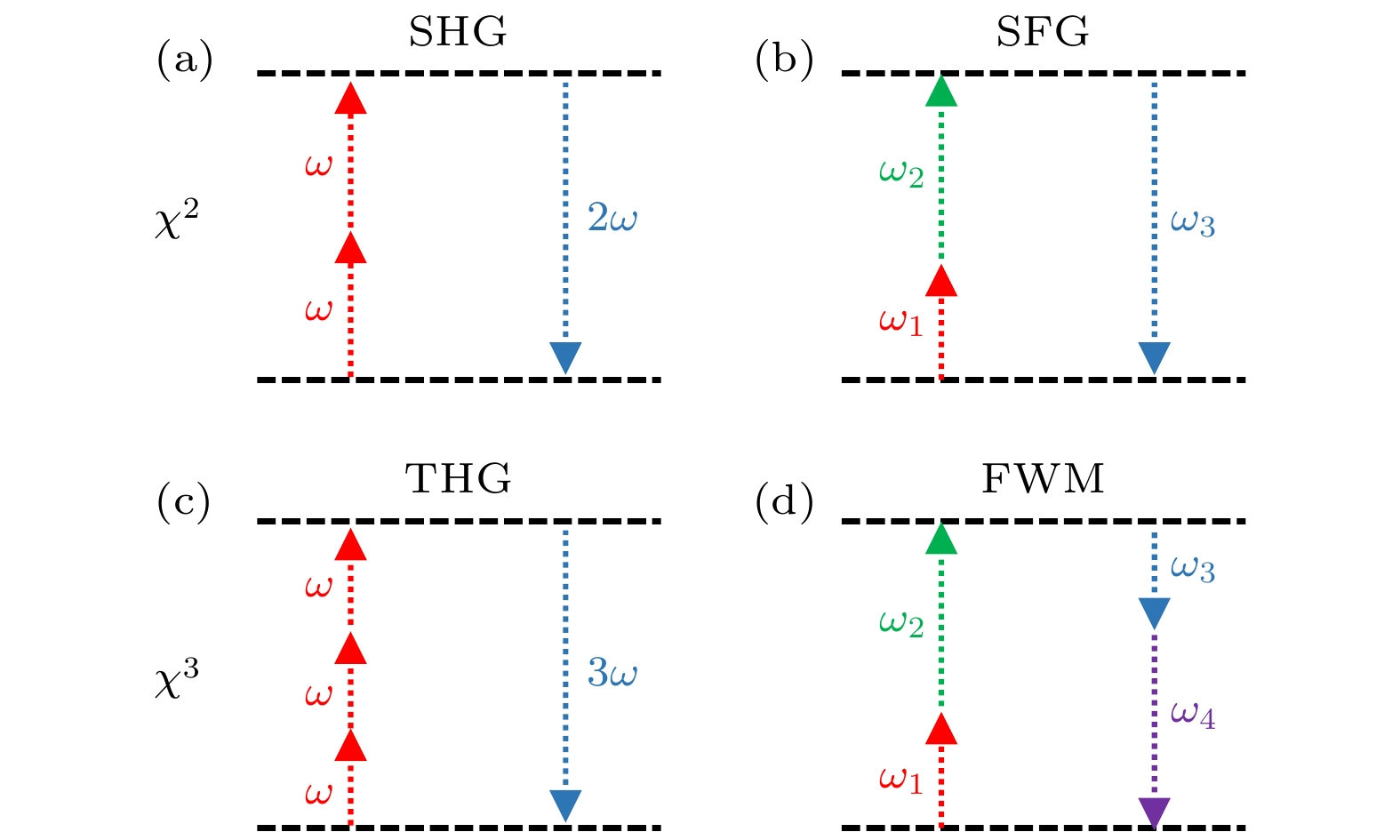
The defining property of a nonlinear crystal is its second-order nonlinear susceptibility χ⁽²⁾. As light propagates, the polarisation of the medium has not only a linear term proportional to the field but a second-order term proportional to its square. Expanded, that square term contains components at the second harmonic, the sum and the difference of the input frequencies — and frequency conversion happens right there.
Why the crystal must be non-centrosymmetric
Symmetry settles it in one line. If a crystal has inversion symmetry, reversing all atomic coordinates (r → −r) must leave it unchanged. But the second-order polarisation P⁽²⁾ ∝ E² is unchanged under inversion (E flips, squaring restores it), whereas polarisation as a vector must change sign. The only way out is χ⁽²⁾ = 0. Materials with a centre of inversion — fused silica, silicon, centrosymmetric crystals — therefore cannot show second-order nonlinearity at all, which is why frequency-doubling devices never use ordinary optical glass.
Phase matching: the hurdle that decides efficiency
Beyond the size of the coefficient, the other decisive factor is phase matching. Because of dispersion, different frequencies see different refractive indices, so the newly generated wave gradually drifts out of phase with the driving wave. Once the mismatch accumulates, energy sloshes back and forth between the waves (back-conversion), the net efficiency stalls, and a longer crystal does not help. The coherence length L_c = π/Δk is the yardstick: the larger Δk, the sooner the energy flows back.
There are two ways to solve it:
- Birefringent phase matching (BPM): uses the crystal’s birefringence so that different frequencies travel on different polarisations (ordinary o and extraordinary e) and their refractive indices meet the matching condition. Rotating the crystal gives critical phase matching (angle tuning); changing the temperature gives non-critical phase matching (NCPM, where the angular dependence of Δk is eliminated, giving a large acceptance angle and no walk-off).
- Quasi-phase matching (QPM): periodically inverts the domain structure so the sign of the nonlinear coefficient flips periodically, turning the phase back just as the energy is about to flow the wrong way. The standard examples are periodically poled lithium niobate (PPLN) and periodically poled KTP (PPKTP). QPM can exploit the largest coefficient of the crystal and the wavelength is designed in, but it needs high-voltage poling and the period, once fixed, is not easily changed.
Choosing a crystal means weighing the nonlinear coefficient, the phase-matching capability, the transmission range, the damage threshold, thermal and chemical stability, cost and availability. Different applications weight these differently and no crystal is best at everything — which is not a platitude but the most practical rule in this field.
Get the order right when choosing a crystal: (1) wavelength first — if the transmission range or phase matching will not cover it, the largest coefficient is useless; (2) power next — an inadequate damage threshold zeroes both efficiency and lifetime; (3) only then the efficiency requirement, where d_eff and length come in; (4) last the practicalities — hygroscopy, temperature control, cost and lead time. Starting from “which coefficient is biggest” almost always means redoing the design.
3. Key Parameters: Reading a Nonlinear Crystal Specification
A nonlinear crystal has more parameters than a laser crystal, because beyond “can it convert” it must also answer “under what conditions”. These ten are the ones to confirm one by one when specifying and accepting a crystal:
| Parameter | Meaning | Why it matters |
|---|---|---|
| Second-order nonlinear coefficient d_ij | The basic parameter of second-order nonlinear strength, in pm/V; the common components are d₃₃, d₃₁ and d₂₄. For example d₃₃ is about 27 pm/V for LiNbO₃, about 15 pm/V for KTP and d₃₂ about 1.1 pm/V for LBO. | The intrinsic nonlinear strength of the material and the basis of d_eff. The larger d_ij, the higher the theoretical ceiling — but it is a tensor component, and whether you can use it depends on the phase-matching geometry. |
| Effective nonlinear coefficient d_eff | The coefficient that actually acts under a given phase-matching condition, set by the d_ij tensor, the matching type (type I or II), the propagation direction and the polarisation configuration. This is the figure used to calculate efficiency. | It determines the real conversion strength. d_eff folds the intrinsic coefficient and the geometric factor together — the same crystal at a different matching angle can differ several-fold. |
| Transmission range | The wavelength range the crystal transmits, and it varies enormously: LBO covers 160–2600 nm, ZGP covers 2–12 μm. | It defines which conversions the crystal can take part in. Outside the range the light is strongly absorbed, which at best kills efficiency and at worst causes thermal damage — the first hard gate in selection. |
| Damage threshold | The maximum intensity or fluence the crystal can withstand, usually in J/cm² (pulsed) or W/cm² (continuous), and dependent on pulse duration, wavelength and surface quality. | It sets the maximum working power and the lifetime. Exceeding it causes irreversible damage, and that damage is usually progressive — a small pit first, then growth. |
| Phase-matching range | The span of wavelengths over which phase matching can be achieved in the crystal, governed by the size of the birefringence and the dispersion. | It sets the wavelength, angle or temperature window in which the device works. The wider the range, the more tolerant the device and the broader its usable applications. |
| Walk-off angle ρ | In critical phase matching, the angle between the Poynting vector and the wavevector of the extraordinary wave. | It splits the beam in space and compresses the effective interaction length to roughly aperture/ρ. The larger ρ, the more a long crystal suffers, with efficiency and beam quality falling together. |
| Acceptance angle Δθ | The angular tolerance of phase matching. Non-critical phase matching usually gives a large acceptance angle, critical matching a much smaller one. | It measures tolerance to beam collimation and angular drift. A large angle means easy alignment and long-term stability; a small one means efficiency falls at the first mechanical wobble. |
| Temperature acceptance bandwidth | The temperature tolerance of phase matching. For quasi-phase matching and non-critical phase matching this is often only a fraction of a kelvin to a few kelvin. | It sets the precision required of the temperature controller. A narrow bandwidth forces an oven, a sensor and feedback; a wide one allows natural cooling. |
| Thermal conductivity | The crystal’s ability to conduct heat, which shapes the thermal distribution and the thermal management design at high power. | It bears directly on beam quality and reliability at high power. The higher the conductivity, the more easily heat leaves and the weaker the thermal lens and thermally induced phase mismatch. |
| Chemical stability | Whether the crystal absorbs moisture, oxidises or decomposes, which sets storage conditions and service life. | It determines the operating environment and maintenance cost. Stable crystals can be used exposed for years; hygroscopic ones (CLBO, KDP) need a dry, temperature-controlled housing or the surface hazes over and the part is finished. |
4. Main Types: Which Kinds of Nonlinear Crystal Exist
There are two threads. By crystal family, which is about the combination of optical and mechanical properties; by phase-matching method, which is about how the mismatch is dealt with. The first decides where it can be used, the second how.
By crystal family
- Borate family (LBO, BBO, CLBO, BiBO): the workhorses from ultraviolet to near-infrared. LBO has a high damage threshold, good UV transmission (from 160 nm) and a wide non-critical matching temperature range, making it the first choice for high-power doubling and tripling, at the cost of a small coefficient (d₃₂ about 1.1 pm/V). BBO has a larger coefficient and a wide matching range, suited to ultraviolet and broadband OPO work, but suffers large walk-off and is hygroscopic. CLBO is excellent in the deep ultraviolet below 266 nm but deliquesces readily. BiBO has an effective coefficient more than three times that of BBO and suits ultrashort-pulse doubling.
- Phosphate family (KDP, DKDP): small coefficients, but they can be grown enormous and have very high damage thresholds. The doubling stages and electro-optic switches of megajoule-class facilities, inertial confinement fusion among them, use almost nothing else — not the best, but the only ones that can be made that large.
- Lithium niobate family (LiNbO₃, PPLN): large d₃₃ (about 27 pm/V), wide transmission (0.4–5 μm) and strong electro-optic coefficients, so one material serves doubling, OPO and electro-optic modulation. PPLN uses periodic poling to exploit the largest coefficient and is the mainstay of mid-infrared OPO and difference-frequency generation; its weaknesses are a low damage threshold and photorefractive damage.
- KTP family (KTP, PPKTP, RTP): moderate coefficient (d₃₃ about 15 pm/V), high damage threshold, non-hygroscopic and low walk-off, which makes KTP one of the most used crystals for doubling 1064 nm to 532 nm. PPKTP serves quasi-phase-matched entangled-photon sources and compact doublers, while RTP is used for electro-optic Q-switching at high repetition rates.
- Infrared family (ZGP, AgGaS₂, AgGaSe₂, GaSe): narrow bandgap and transmission beyond 10 μm, used for OPO, difference-frequency generation and doubling across 3–12 μm. They share a low damage threshold and, in some cases, large walk-off; AgGaS₂ and AgGaSe₂ also absorb near 1 μm, so the pump wavelength has to be chosen around it.
- Selenides and sulphides (LIS, LISe): LiInS₂ and LiInSe₂ combine mid-infrared transmission with a relatively high damage threshold and are an active research direction for mid-infrared OPOs, at the price of small crystals and high cost.
By phase-matching method
- Birefringent phase matching (BPM): relies on the natural birefringence, needs no extra process, and allows large crystals that survive high power. Critical matching (angle tuning) is flexible but has large walk-off and a small acceptance angle; non-critical matching (temperature tuning) has no walk-off and a large acceptance angle but works only near a particular wavelength.
- Quasi-phase matching (QPM): relies on periodically poled domains, exploits the largest coefficient, has no walk-off and puts the wavelength into the design of the period. Suited to mid-infrared, lower power and compact devices. Its weaknesses are a low damage threshold, temperature-only tuning once the period is fixed, and the difficulty of making large, highly uniform crystals.
5. Applications: Where Nonlinear Crystals Are Actually Used
The six areas fall into two groups: those that move the wavelength where you want it (frequency conversion, OPO, sum and difference generation, terahertz) and those that use other properties (the electro-optic effect, parametric down-conversion). The criteria differ, but all pass through the same gate — transmission and phase matching.
- Laser frequency conversion: the largest group. It covers doubling (1064 nm → 532 nm), tripling (1064 nm → 355 nm, done industrially as doubling followed by sum-frequency mixing) and quadrupling (1064 nm → 266 nm deep ultraviolet). Different bands call for different crystals: KTP and LBO for near-infrared doubling; LBO, BBO and CLBO for ultraviolet; KDP and DKDP return for deep ultraviolet and large-energy facilities.
- Optical parametric oscillators (OPO): an OPO needs a nonlinear crystal as its gain medium. Visible and near-infrared OPOs use BBO, LBO or KTP; mid-infrared OPOs use PPLN, ZGP or AgGaSe₂. The tuning range of an OPO is largely set by the crystal’s phase-matching range and transmission range together — the intersection of the two is the band you can actually reach.
- Sum- and difference-frequency generation: used to reach special wavelengths such as the 589 nm sodium guidestar line (1064 + 1319 sum), 593.5 nm yellow (1064 + 1342 sum) and mid-infrared difference generation. Both input wavelengths and the output must transmit, and phase matching must hold for all three at once — three wavelengths constrained together leaves far fewer usable crystals than simple doubling.
- Electro-optic modulators and Q-switches: many nonlinear crystals are also electro-optic (showing the Pockels effect) and can serve as modulators, Q-switches and deflectors. LiNbO₃ modulators are the standard in optical communications and high-speed modulation; RTP and BBO are used for Q-switching at high repetition rates and high voltage.
- Quantum optics: nonlinear crystals are the key devices for entangled photon pairs and squeezed states. Spontaneous parametric down-conversion (SPDC) happens inside a nonlinear crystal and underpins quantum optics experiments. Such work is undemanding on the coefficient but very demanding on phase-matching purity, temperature stability and loss — PPKTP and BBO are the two most used.
- Terahertz generation and detection: through difference-frequency generation or optical rectification, nonlinear crystals can radiate terahertz. ZnTe, GaP and LiNbO₃ (in the tilted-pulse-front scheme) are the usual choices. The bottleneck here is not the coefficient but the material’s absorption and dispersion in the terahertz band.
6. Common Misconceptions: Four Widely Held Myths
A nonlinear crystal datasheet reads as though every number should be as large as possible, and the misunderstandings grow from there.
Misconception 1: The larger the nonlinear coefficient, the better the crystal
Not necessarily. The coefficient is one parameter among many, and damage threshold, transmission range, phase-matching capability, walk-off, temperature stability, chemical stability and cost matter just as much. In many cases a crystal with a smaller coefficient but a high threshold and good stability (LBO, for instance) suits a high-power application better than a larger-coefficient but less robust one. Choosing a crystal is solving a problem with several simultaneous constraints, not comparing magnitudes.
Misconception 2: A crystal with good nonlinearity can convert any wavelength
No. First it must be transparent in that band, and second phase matching must be achievable; both are required. LiNbO₃ has a large coefficient but absorbs strongly in the ultraviolet and cannot serve the deep UV; KDP has a small coefficient yet, because its damage threshold is very high and it can be grown very large, is irreplaceable in very-large-scale facilities. Coefficient and applicability are two different things.
Misconception 3: Periodically poled crystals such as PPLN are more advanced, so they must work better
QPM has real advantages: it uses the largest coefficient, has no walk-off, the wavelength is designed into the period, and devices can be compact. It also has real weaknesses: the damage threshold is comparatively low, so it does not suit very high power; large, highly uniform crystals are hard to make and expensive; and once poled, tuning is by temperature only and limited in range. Conventional birefringent crystals remain irreplaceable at high power, in the ultraviolet and for large energies. Which route to take depends on power, wavelength and budget, not on which is newer.
Misconception 4: A nonlinear crystal has a fixed lifetime and must be replaced after so many years
Lifetime depends strongly on service conditions and cannot be generalised. The factors include operating wavelength (ultraviolet does more damage, through colour centres and absorption), power density, pulse characteristics (ultrashort and high peak power are harsher), and humidity, temperature and cleanliness. Under good conditions a crystal can work reliably for a decade or more; with excessive power density or a poor environment, damage can appear in months or less. Damage is usually progressive — a small pit first, then growth, showing up as falling efficiency and worsening beam quality. Checking the far-field spot and the efficiency curve periodically costs far less than waiting for a failure.
Leave a Reply