


Anyone doing laser equipment maintenance or process commissioning has surely noticed an industry detail: for industrial lasers such as CO₂, 1064nm infrared, and 532nm green lasers, the window mirrors are mostly installed perpendicular to the optical path at 0° incidence; yet on 355nm UV lasers, the window mirror is without exception tilted, and the measured tilt angle consistently sits at around 56°.
Is this an installation mistake, or a deliberate optical design? Why do UV lasers alone get this “special treatment”? Today we explain this core industry detail thoroughly.
The Core Answer First: This Tilted Window Is the Standard Brewster Window
The 56° tilt you measured is not arbitrary — it is the theoretical Brewster angle of a 355nm UV laser on fused silica window material, calculated at about 55.9°, almost exactly matching the industry-measured value.
First, let us make the core principle of the Brewster angle clear. We can split the polarization state of laser light into two parts: P-polarized light parallel to the plane of incidence, and S-polarized light perpendicular to the plane of incidence. When light strikes the interface between two media at the Brewster angle, a remarkable optical phenomenon occurs: the Fresnel reflection loss of the P-polarized component drops directly to 0 — 100% of the energy passes through the interface with nothing wasted.
The formula for the Brewster angle is very simple:
θB = arctan(n₂/n₁)
The refractive index of air n₁≈1
Fused silica (SiO₂), the standard UV window material, has a refractive index at 355nm of n₂≈1.476
The calculated result is θB≈55.9°, which matches the industry-standard 56° design exactly
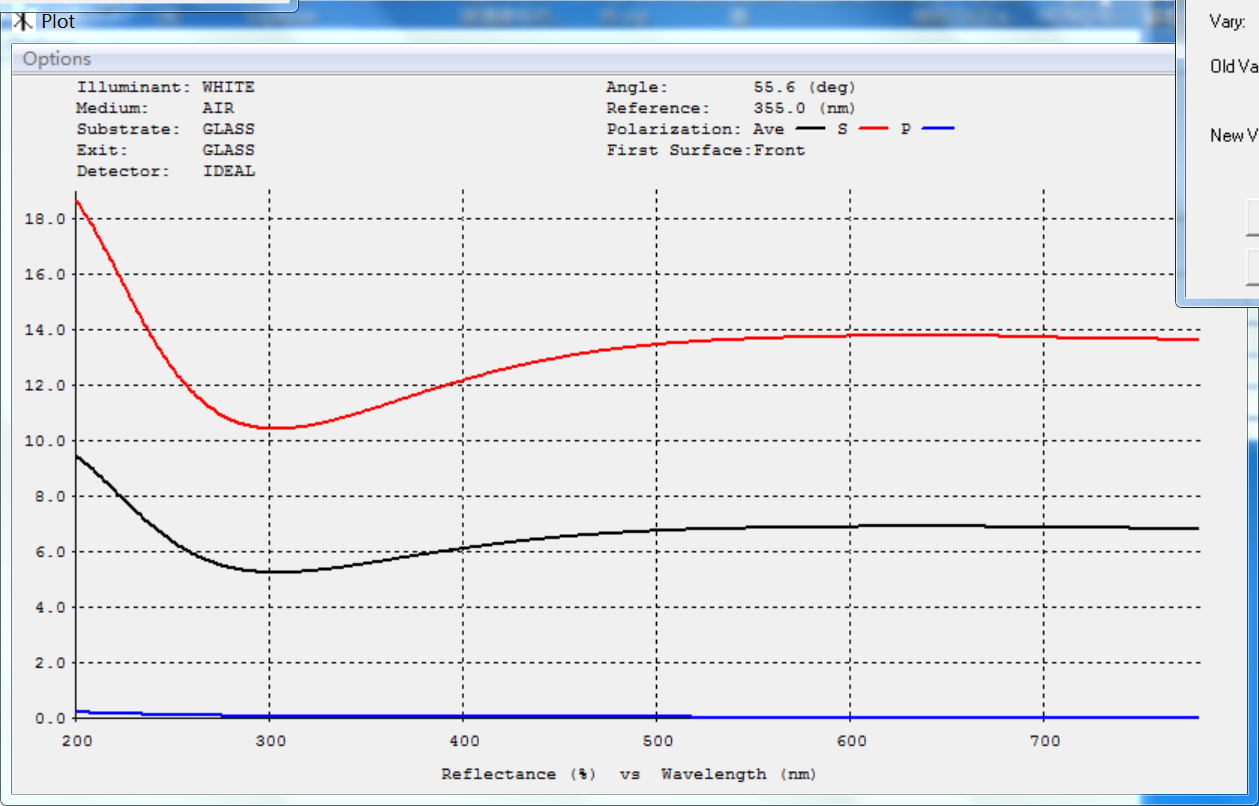
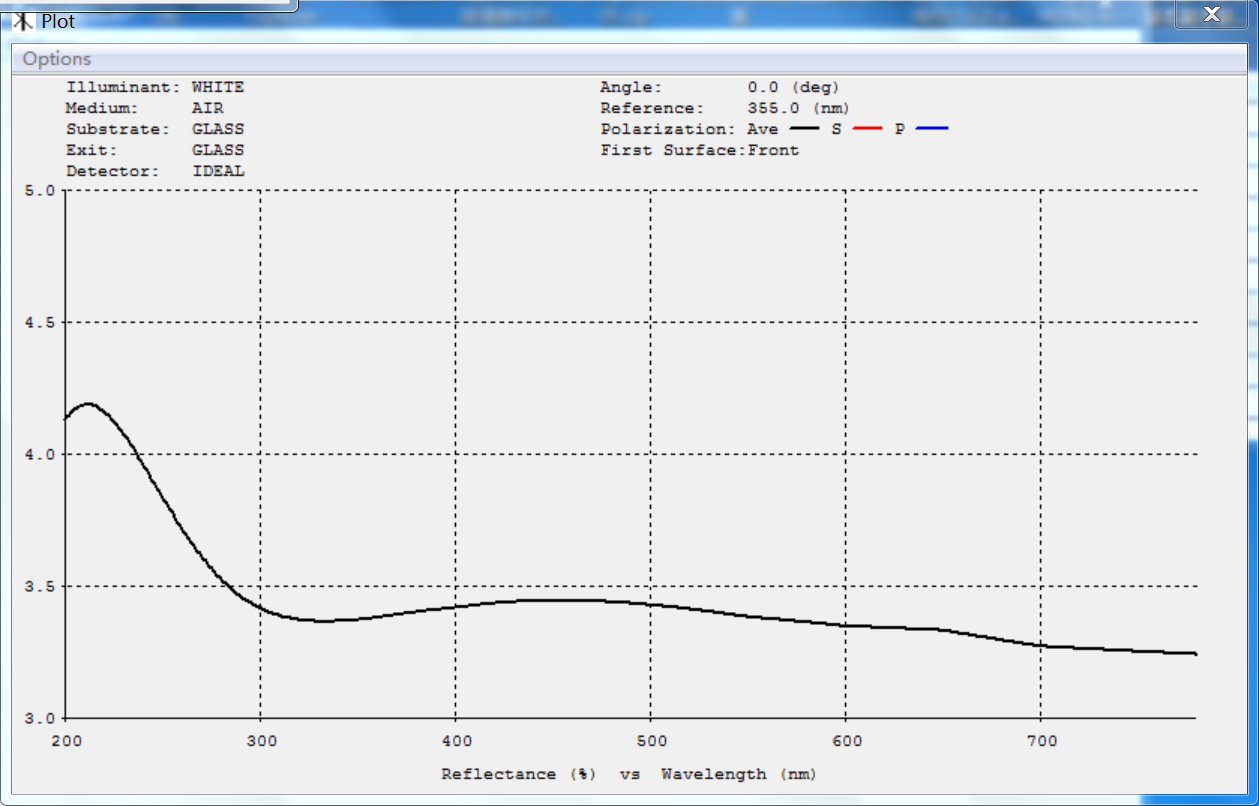
With two measured reflectivity curves, we can see the overwhelming advantage of this design at a glance:
The first is the reflectivity of unpolarized light at 0° normal incidence: in the 200nm UV band, the single-surface reflectivity reaches 4.2%; even in the commonly used 355nm band there is still a fixed reflection loss of about 3.5% — 7% of the energy wasted on both surfaces combined;
The second is the curve at 55.6° tilted incidence: the blue curve, representing P-polarized light, hugs the 0% baseline across the entire 200-700nm range, achieving perfectly zero-loss transmission.
Why UV Lasers Simply Cannot Do Without This Tilted Design
Many people ask: it is only a few percent of loss — is it really worth changing the mounting angle?
The answer is: for a UV laser, yes — it is a design of existential necessity. There are two core reasons that directly determine whether a UV laser can output light at all and keep working stably over the long term.
1. UV Lasers Have Almost Zero Tolerance for Intracavity Loss
The 355nm UV light used in industry is produced by triple nonlinear frequency conversion of 1064nm infrared fundamental light; its optical-to-optical conversion efficiency is inherently very low and its gain capability very weak.
A simple analogy: a 1064nm infrared laser is like a large reservoir — even if it leaks a little water, normal output is completely unaffected; a UV laser is like a thin water pipe — block it even slightly and it may stop flowing altogether.
At 0° normal incidence, even with top-tier UV anti-reflection coatings, the single-surface residual reflectivity can hardly be brought below 0.5%, limited by the high photon energy of UV light and the difficulty of coating processes — a fixed loss of more than 1% on both surfaces. That 1% of loss is enough to seriously suppress oscillation of the UV laser, reduce output power, degrade beam quality, and even prevent the laser from outputting light at all.
The Brewster angle design, by contrast, drives the reflectivity of P-polarized light directly to zero, eliminating interface loss at its root and dedicating all of the limited gain to laser oscillation — an extreme result no anti-reflection coating can achieve.
2. Eliminating the Fatal Damage of Reflected Light Returning to the Cavity at Its Root
A UV photon carries 3 times the energy of a 1064nm infrared photon, and the corresponding laser-induced damage threshold of optical components is extremely low — this is the most critical failure risk of UV lasers.
At 0° normal incidence, even a residual reflection of only 0.5% travels straight back into the laser resonator, superimposing with the intracavity oscillating light to form standing waves that focus on the gain medium, the frequency-conversion crystals, and the cavity mirrors. In mild cases this causes color center formation in the crystals, permanently reduced transmission, and power jumps; in severe cases it burns the optical coatings and cracks the crystals outright, causing irreversible damage to core resonator components — with repair costs easily exceeding 10,000 RMB.
The Brewster angle design drives the reflectivity of the intracavity oscillating P-polarized light directly to zero, eliminating the risk of reflected light returning to the cavity at its root — improving laser performance while greatly reducing the probability of damage to core components. It is the optimal solution that kills two birds with one stone.
The Soul-Searching Question: Why Can CO₂/Infrared/Green Lasers All Use 0° Windows?
Once the UV design logic is clear, many people have a new question: if the Brewster angle is so good, why do other lasers not use it?
The core reason: different lasers differ completely in gain capability, output characteristics, and application scenarios. On other lasers, the advantages of the Brewster angle are not just useless — they become a liability.
| Laser Type | Core Advantages of the 0° Design | Core Reason for Not Using a Brewster Window |
|---|---|---|
| 1064nm infrared solid-state laser | AR coating technology at 1064nm is extremely mature, with single-surface residual reflectivity below 0.1% and extremely low loss; 0° mounting introduces no astigmatism and is polarization-insensitive | The gain medium has extremely high gain and strong tolerance to loss; most industrial scenarios use non-polarized output, and a Brewster window would filter out the S-polarized component, directly sacrificing nearly half of the output power |
| 532nm green laser | Green AR coating processes are mature, with extremely low loss at 0° incidence; the damage threshold of optical components is far higher than for UV, so a small amount of residual reflection poses no damage risk | Produced by second-harmonic generation from 1064nm, with gain far higher than UV; the 0° structure is simple, requires no polarization alignment, and fits most industrial processing scenarios |
| CO₂ laser (10.6μm) | AR coating technology on dedicated ZnSe/Ge materials is mature, with 0° single-surface reflectivity below 0.1%; gas gain is extremely high, with strong tolerance to loss | Industrial mainstream is non-polarized output, and a Brewster window would greatly reduce output power; tilting a large-aperture window brings a series of problems with sealing, astigmatism, and mounting difficulty |
One addition: early sealed-off CO₂ laser tubes with polarized output did adopt Brewster window designs; but in today’s mainstream industrial scenarios, the 0° solution offers better cost-effectiveness and adaptability and is rarely used anymore.
Do Not Confuse Them! A Tilted Window Mirror ≠ a Protective Window — Their Roles Are Worlds Apart
Many newcomers confuse the tilted Brewster window with the protective window of a UV laser, so the key boundary must be drawn clearly:
Brewster window mirror: located inside the laser resonator, it is a core component of the laser oscillation loop, directly determining intracavity loss, laser polarization state, output power, and overall system stability; the angle tolerance requirement is even within ±0.5° — the slightest deviation makes the P-light reflectivity rise significantly;
0° protective window: located outside the resonator, its core role is to block dust, spatter, and oil from entering the cavity during processing and protect the internal core optical components. Its reflected light never returns into the laser resonator, so there is no risk of disturbing laser oscillation or damaging the cavity; a 0° normal-incidence window with a conventional UV AR coating is enough — easy to install and low in cost, exactly the same design logic as the protective windows of other lasers.
A Final Word
Many people say that the core competitiveness of industrial laser equipment lies entirely in details like these that no one sees.
The 56° tilt of the UV laser window mirror is not an arbitrary design choice but the optimal solution optical engineers tailored to the characteristics of UV lasers — with one simple Brewster angle, it simultaneously solves the two most troublesome problems of UV lasers: excessive intracavity loss and back-reflection damage to components.
Once you understand this detail, you not only grasp the underlying design logic of UV lasers, but can also pinpoint problems precisely during equipment maintenance and troubleshooting, avoiding many detours.
After all, true professionalism has always meant knowing every detail inside and out.
Leave a Reply