


Optical Beam Expander Calculator (Beam Expander)
Based on the two afocal configurations, Keplerian and Galilean, this calculates the focal length ratio, lens separation, output beam diameter and divergence angle of a laser beam expander. It enlarges the beam diameter while compressing the divergence angle by the same factor, providing a quick tool for selecting and aligning expanders for laser processing and long-distance transmission.
Galilean: d = f2−|f1 (virtual confocal)
Beam Expander Parameter Calculator
Select the configuration type and enter parameters to automatically calculate the focal length ratio, lens separation, output beam and Rayleigh range. Ideal thin-lens, paraxial, afocal model; the divergence angle is entered as a half-angle (angle between a ray and the optical axis), and the beam diameter defaults to the 1/e² criterion.
Input parameters
Calculation results
📐 Ray diagrams of the two types of beam expander
Drawn strictly to afocal confocal geometry: in the Keplerian type the rays cross at the real focus between the lenses; in the Galilean type they do not cross and the virtual focus lies to the left of the negative lens (dashed lines are back-extensions). Click to switch.
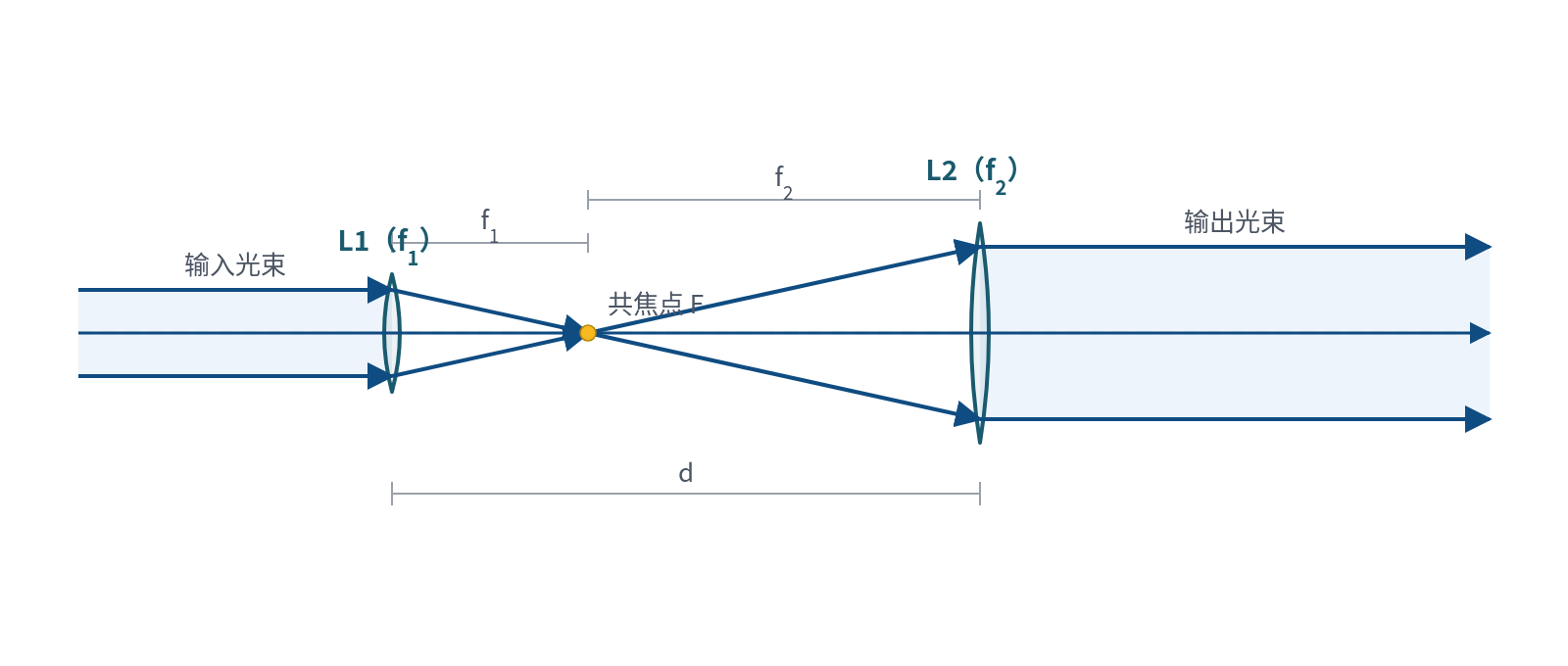
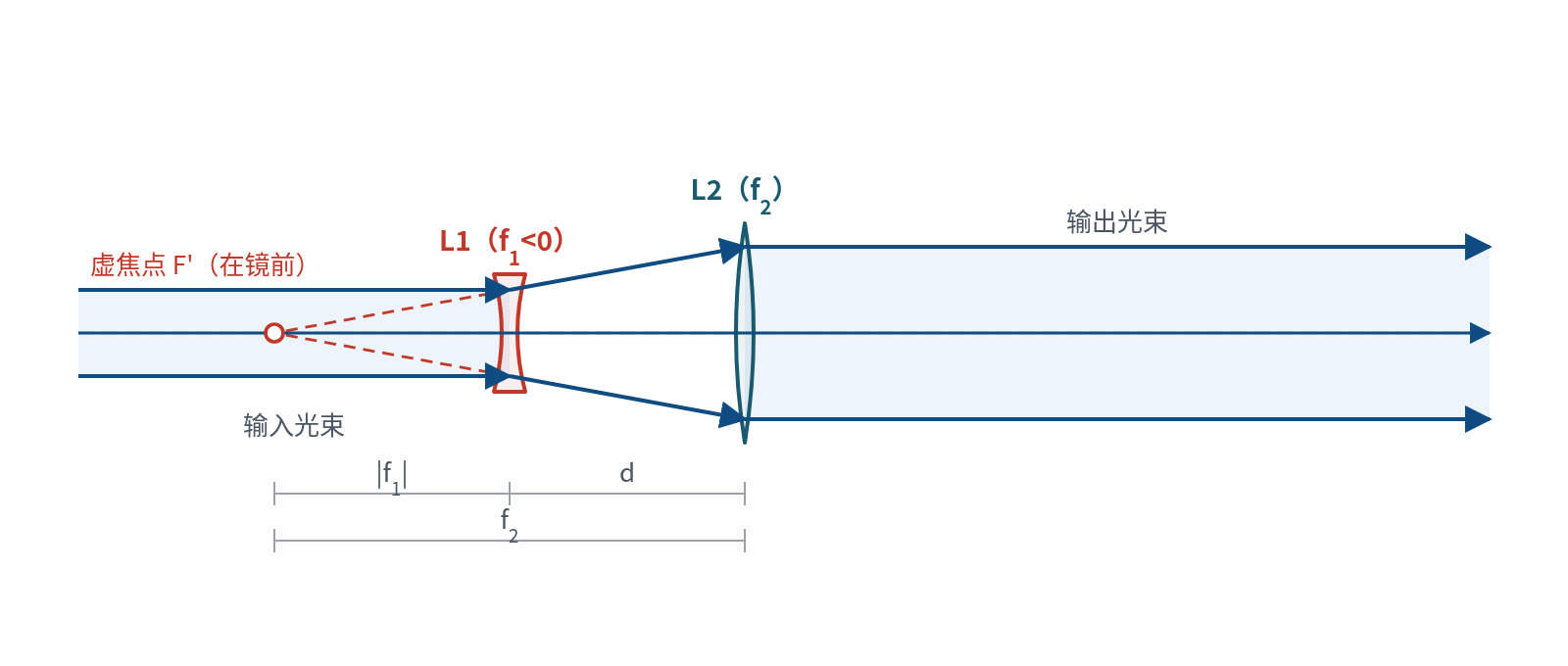
Note: the diagrams show the principle, not to numerical scale; blue biconvex lenses are positive and red biconcave lenses are negative. With ideal confocal alignment the output is collimated light (upper and lower edges horizontal) and output diameter = M × input diameter. The Keplerian type forms an inverted image and the Galilean an upright one, which has no effect on rotationally symmetric laser intensity profiles.
📖 Formula details
Ideal thin-lens, paraxial, afocal (collimated light in → collimated light out) model; d is measured as the separation between the principal planes of the two lenses
🎛️ How to choose parameters
Three key dimensions determine the size and suitability of a beam expander
M=f2/|f1| determines the output diameter and total length. Common values are 2×/3×/5×/8×/10×; higher magnification gives a thicker output beam and smaller divergence, but the lens aperture, total length and alignment difficulty all increase. First infer M from the acceptable downstream far-field divergence angle θout=θin/M, then choose f1 and the configuration type according to the available total length.
Dout=M·Din depends only on the magnification and input diameter; θout=θin/M is independent of wavelength. The wavelength λ enters only the Rayleigh range zR=πw0²/λ: for the same waist, a shorter wavelength gives larger zR. Note the diameter defaults to the 1/e² criterion; if you measured the FWHM diameter, multiply by 1.699 first to convert.
For spatial filtering/pinhole, good beam quality and moderate power → Keplerian; for compactness, high power (marking/cutting/welding) and continuous zoom → Galilean. With the same parameters (f1=25, M=5), the Keplerian is 150 mm long and the Galilean only 100 mm, and the Galilean has no real-focus hot spot between the lenses.
📋 Quick reference table
Geometric parameters for common laser wavelengths and typical expansion magnifications (f1=25 mm, ideal thin lens)
| Wavelength | Type | Typical applications |
|---|---|---|
| 355 nm | Ultraviolet (UV) | UV marking, precision wafer/glass cutting, micromachining |
| 532 nm | Green | Green marking, thin-sheet/transparent material processing, pumping, measurement |
| 632.8 nm | He-Ne | Collimation, alignment, interferometry, teaching experiments |
| 1064 nm | Near-infrared | Fibre/Nd:YAG marking, cutting, welding (the most common industrial wavelength) |
| 10.6 μm | CO₂ | Non-metal cutting and marking, thin-sheet welding, requiring IR-specific optics (ZnSe, etc.) |
| Magnification M | f2 (mm) | Keplerian d (mm) | Galilean d (mm) |
|---|---|---|---|
| 2× | 50 | 75 | 25 |
| 3× | 75 | 100 | 50 |
| 5× | 125 | 150 | 100 |
| 8× | 200 | 225 | 175 |
| 10× | 250 | 275 | 225 |
| 20× | 500 | 525 | 475 |
Galilean column f1 taken as the absolute value 25 mm; dKeplerian=f1+f2,dGalilean=f2−|f1|。
⚠️ Common misconceptions and cautions
Physical mistakes most easily made when selecting a type and reading ray diagrams
Do the rays in a Galilean expander also cross at a point between the lenses?
No. After the negative lens the rays keepdiverging and never cross between the lenses; the so-called ‘convergence point’ is the virtual focus to the left of the negative lens, which can only be shown by a dashed back-extension. Many diagrams (including some reference pages) draw it as a crossing between the lenses, which is a fundamental error.
Can the rays avoid crossing in the middle of a Keplerian expander?
No. In a Keplerian expander the two positive lenses share an internalreal focal point, and the marginal rays must genuinely converge into an X shape between the lenses before diverging; merely ‘narrowing a little without crossing’ is also wrong. This real focus is exactly where a pinhole can be placed for spatial filtering.
Does expansion only enlarge the diameter while leaving the divergence unchanged?
No. An afocal system obeys beam conservation: as the diameter is enlarged M times,the half-divergence angle is reduced to 1/M(θout=θin/M). This is exactly why expansion is used for long-distance transmission to obtain a finer far-field spot.
Galilean f1 also substituted as a positive value into the separation formula?
That gives a wrong answer. Galilean L1 is a negative lens, so in the general formula d=f1+f2 the f1 must be negative, i.e. d=f2−|f1|. Using a positive value gives 150, but the correct result is 100 (f1=−25、f2=125)。
Can a Keplerian expander be chosen arbitrarily for high-power lasers?
There is a risk. In a Keplerian expander the power density at the internal real focus rises sharply with the square of the convergence ratio, and an intense laser may causeair breakdown, dust ablation and air-turbulence disturbance; high-power processing usually prefers the Galilean type with no internal focus, or uses measures such as a large f/# and vacuum evacuation.
Is a higher magnification always better?
No. The magnification is limited by the clear aperture of the lenses (CA2 must at least capture Dout, with a 20% margin recommended), as well as by diffraction and alignment tolerances; too large a value also inflates the total length and size. Choose the smallest magnification that suffices, based on the target far-field divergence angle and space budget.
θout=θin/M and the Gaussian diffraction angle the same thing?
No. The former is the geometric compression ratio of the input ray angle by the afocal system, independent of wavelength; the latter, θG=λ/(πw0, is the diffraction divergence angle of the output beam itself, determined by the waist and wavelength. An input of 1.0 mrad is usually the beam-envelope half-angle, not the diffraction-limited angle.
Can the 1/e² diameter be used directly as the FWHM?
No, they differ by about a factor of 1.699 (D1/e²=1.699·DFWHM). Mixing them up makes the beam waist, Rayleigh range and divergence all off by about 70%. This calculator defaults to 1/e²; FWHM data must be converted first.
💡 Common application scenarios
❓ Frequently asked questions
Disclaimer: this tool is based on an ideal thin-lens, paraxial, single-wavelength afocal model, with separations calculated between the lens principal planes and without thick-lens/multi-element principal-plane shifts, aberrations or material and coating losses; the results are for selection and estimation reference, and precise design should follow actual optical designs and datasheets.
🔗 Related optical calculation tools
The beam and focusing parameters before and after expansion can be further evaluated with the tools below