


What Is a Dye Laser? How Organic Dyes Produce Laser Light
Table of Contents
- 1. What Is a Dye Laser? Understanding the Core Concepts
- 2. Working Principle: How Do Dye Lasers Work?
- 3. Key Parameters: Understanding Dye Laser Performance Indicators
- 4. Main Types: What Kinds of Dye Lasers Exist?
- 5. Applications: Where Are Dye Lasers Relevant?
- 6. Common Misconceptions
1. Core Concepts: What Is a Dye Laser?
A dye gain medium is a type of laser gain medium using organic dye molecules as the laser-active substance, usually dissolved in a liquid solvent. The dye laser is the main form of liquid laser, and its most outstanding feature is extremely broad gain bandwidth and continuously tunable output wavelength.
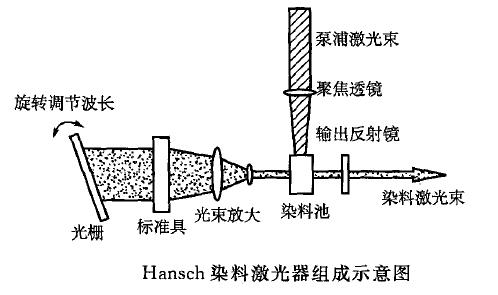
Laser dyes are essentially organic molecules with large conjugated systems, dissolved in solvents such as ethanol, ethylene glycol and DMSO to form dye solutions. Different dyes cover a vast spectral range from ultraviolet to near-infrared—roughly 300 nm to 1200 nm—the broadest wavelength coverage of any gain medium. Dye lasers were very important in the early days of laser development, pioneering ultrashort pulses and wavelength tuning. Although in recent years they have been replaced in many areas by solid-state lasers (such as Ti:sapphire and fibre lasers), they remain irreplaceable in certain specific applications.
2. Working Principle: How Do Dye Lasers Work?
1. Molecular energy-level structure
18 The energy levels of organic dye molecules are far more complex than those of atoms and ions. Besides electronic levels, there are vibrational and rotational levels. These levels overlap densely, forming quasi-continuous energy bands—the root reason for the dye laser’s extremely broad gain bandwidth. The electronic states of a dye molecule are divided into singlet states (S₀, S₁, S₂…) and triplet states (T₁, T₂…). The ground state is S₀ and the first excited singlet state is S₁.
2. Four-level operation
1. Pump absorption: the dye molecule absorbs a pump photon and jumps from ground state S₀ to a higher vibrational level of S₁. 2. Rapid vibrational relaxation: through collisions with solvent molecules, the molecule relaxes rapidly within picoseconds to the lowest vibrational level of S₁. 3. Stimulated emission: the molecule in the low vibrational state of S₁ transitions by stimulated emission to a high vibrational level of S₀, producing laser light. 4. Rapid vibrational relaxation: the molecule in the high vibrational state of S₀ relaxes rapidly again to the S₀ ground state. Because both the upper and lower laser levels are vibrationally excited states (not the ground state) and vibrational relaxation is very fast, the dye laser is a typical four-level system with a very low threshold.
3. The triplet-state problem
Dye molecules have a troublesome triplet state T₁. Molecules in S₁ can fall to T₁ via intersystem crossing (ISC); the T₁ state has a long lifetime (microsecond scale), and molecules in T₁ cannot participate in lasing and also absorb laser-wavelength light (triplet absorption), reducing efficiency or even preventing lasing. Therefore dye lasers usually keep the dye solution flowing, giving excited molecules time to leave the optical region and recover from the triplet state.
3. Key Parameters: Understanding Dye Laser Performance Indicators
The core parameters are described below:
| Parameter Name | Meaning |
|---|---|
| Gain Bandwidth | The dye’s greatest advantage. A single dye can have gain bandwidth of tens to over a hundred nanometres; the whole dye family covers 300–1200 nm. |
| Stimulated-Emission Cross Section | Dye transitions are allowed transitions (rather than the forbidden transitions of rare-earth ions), so the cross section is very large and gain per unit length extremely high, reaching the 10³ cm⁻¹ order. |
| Upper-Level Lifetime | Very short, typically only a few nanoseconds, comparable to semiconductor lasers. This means dye lasers cannot store energy and are unsuitable for Q-switching, but suitable for passive mode locking to generate ultrashort pulses. |
| Optical Conversion Efficiency | Usually 10%–30% with laser pumping, lower with flashlamp pumping. |
| Triplet-State Lifetime | Determines how long a dye needs to recover from the triplet state, affecting the design of the dye-flow system. |
| Chemical Stability | Dye molecules gradually degrade under intense light and have a limited lifetime—one of the main drawbacks of dye lasers. |
| Solvent Compatibility | Different dyes need different solvents; the solvent’s refractive index, viscosity and toxicity all matter. |
4. Main Types: What Kinds of Dye Lasers Exist?
Dye lasers can be classified in several ways, and different dimensions help us understand them from different angles. The common classification methods are introduced below:
By Dye Chemical Structure
| Dye Class | Representative Dye | Wavelength Range | Features |
|---|---|---|---|
| Rhodamines | Rhodamine 6G, Rhodamine B | 550–700 nm (orange-red) | The most classic and most efficient dye family |
| Coumarins | Coumarin 2, 102, 153 | 400–550 nm (blue-green) | Blue-to-green region |
| Stilbenes | Various stilbene derivatives | 400–450 nm (blue) | Blue region |
| Exalites | Exalite series | 300–400 nm (ultraviolet) | Ultraviolet band |
| Pyrromethenes | Pyrromethene 597, etc. | Green to yellow | High efficiency, good photostability |
| Styryls | Various styryl dyes | 700–900 nm (red–near-infrared) | Red and near-infrared |
| Fluoresceins | Fluorescein and derivatives | 500–550 nm (green) | Classic green dye |
By Physical Form
Liquid dyes
Most mainstream; dye dissolved in solvent and recirculated through a flow system
Solid dyes
Dye embedded in a polymer matrix—convenient but degrades faster
Vapor dyes
Dye vaporized for use, very rare
5. Applications: Where Are Dye Lasers Relevant?
Main application areas:
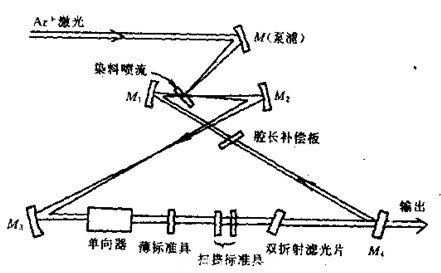
- High-resolution spectroscopy: continuous-wave ring dye lasers achieve extremely narrow linewidth (sub-MHz) and precise wavelength tuning, important tools for atomic physics and precision measurement.
- Medicine and aesthetics: pulsed dye lasers (PDL) emit 585–595 nm yellow light, the gold standard for treating vascular skin lesions (port-wine stains, hemangiomas, telangiectasia)—this wavelength is strongly absorbed by hemoglobin while causing little damage to surrounding normal tissue.
- Combustion diagnostics: tunable dye lasers are widely used in laser-induced fluorescence (LIF) to detect OH, NO and other radicals in flames, an important tool for combustion research.
- Laser guide stars: high-power dye lasers tuned to the sodium D2 line (589 nm) excite sodium atoms in the mesosphere to create an artificial guide star, providing a reference beacon for adaptive optics (though many have now been replaced by solid-state lasers).
- Intracavity absorption spectroscopy: the dye laser’s broad gain bandwidth and high gain suit it to intracavity laser absorption spectroscopy (ICLAS).
- Ultrashort-pulse generation: dye lasers were the earliest femtosecond-pulse sources; colliding-pulse mode-locked (CPM) dye lasers were once the mainstay of ultrafast research—though now largely replaced by Ti:sapphire lasers, they are a milestone in laser history.
6. Common Misconceptions
Here are a few common misconceptions:
Misconception 1: ‘Dye lasers have been completely phased out.’
although dye lasers have indeed been replaced by Ti:sapphire and fibre lasers in ultrashort pulses and many general applications, they remain the best or even only choice for certain wavelengths and scenarios (such as pulsed dye laser treatment of vascular skin disease and some specialised spectroscopy)
Misconception 2: ‘Dyes are just pigments—any pigment can serve as a laser dye.’
laser dyes are carefully designed organic molecules requiring strict optical properties: high fluorescence quantum yield, broad absorption spectrum, suitable triplet characteristics, good photostability, etc. Ordinary pigments or dyes, with low quantum efficiency and poor photostability, simply cannot be laser gain media
Misconception 3: ‘Dye lasers are inefficient.’
the optical-to-optical conversion efficiency of dye lasers is actually not low, reaching 20%–30% with laser pumping, comparable to many solid-state lasers. But because the required pump source (such as an argon-ion laser) is itself inefficient, plus the complexity of the flow system, the overall system efficiency appears low
Misconception 4: ‘Solid-state and liquid dye lasers perform the same.’
embedding dye in a solid matrix (such as polymer) is convenient but causes two serious problems: first, dye molecules cannot flow away from the triplet state, so triplet accumulation is severe; second, heat cannot be dissipated promptly, so the dye degrades faster. Therefore solid-state dye lasers usually perform far worse than liquid dye lasers
Leave a Reply