


What Is a Laser Crystal? The Core Material of Solid-State Lasers
Table of Contents
- 1. What Is a Laser Crystal? Understanding the Core Concepts
- 2. Working Principle: How Do Laser Crystals Work?
- 3. Key Parameters: Understanding Laser Crystal Performance Indicators
- 4. Main Types: What Kinds of Laser Crystals Exist?
- 5. Applications: Where Are Laser Crystals Relevant?
- 6. Common Misconceptions
1. Core Concepts: What Is a Laser Crystal?
A laser crystal is the most classic type of gain medium in solid-state lasers—an optical crystal material based on a single-crystal host doped with a small amount of laser-active ions. These active ions (usually trivalent rare-earth ions or transition-metal ions) achieve population inversion under pump-light excitation and amplify the optical signal through stimulated emission.
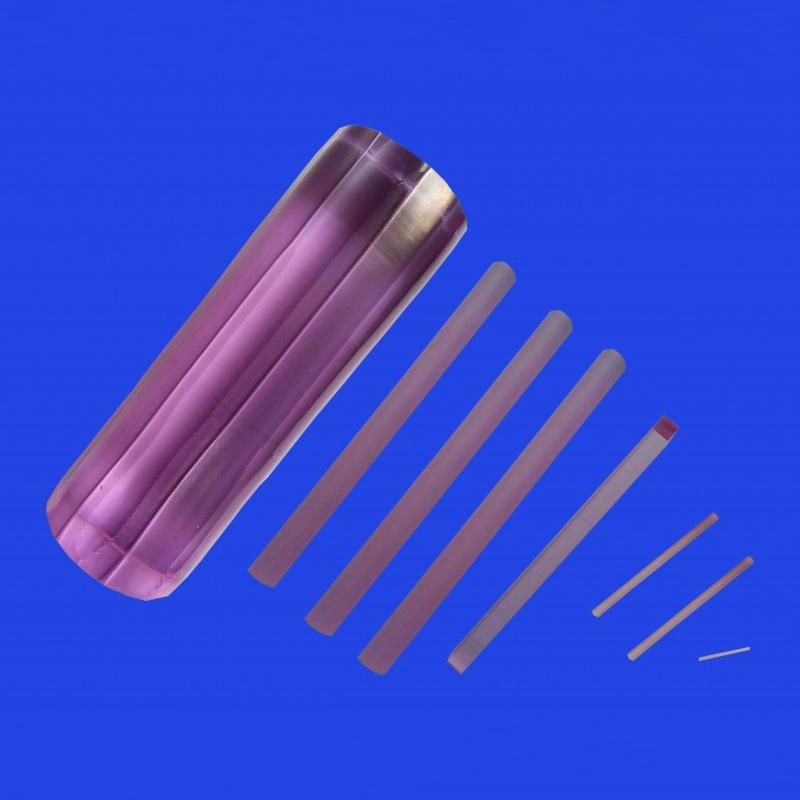
The laser crystal can be called the “heart” of a solid-state laser. In 1960 the world’s first laser—the ruby laser—used a chromium-doped alumina single crystal (ruby crystal). To this day, laser crystals remain the core material of lasers in industrial, medical and research fields.
2. Working Principle: How Do Laser Crystals Work?
The operation of a laser crystal involves three key links:
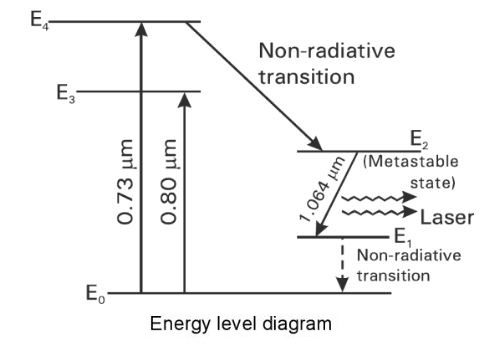
1. Division of labor between host and dopant ions: the crystal host (such as YAG, YVO₄ or sapphire) is a transparent solid providing a stable lattice environment for the active ions; the doped active ions (such as Nd³⁺, Yb³⁺ or Ti³⁺) provide the energy-level structure needed for lasing. The host itself does not emit light; it influences the dopant ions’ level positions and transition characteristics through the crystal field.
2. Optical pumping and energy-level transitions: pump light (usually from a semiconductor laser or flashlamp) is absorbed by the dopant ions, exciting them from the ground state to higher levels. The excited ions relax rapidly by nonradiative transitions (multiphonon relaxation) to the metastable upper laser level, forming population inversion.
3. Stimulated emission produces laser light: ions in the upper level, stimulated by an incident photon, transition to a lower level and release a photon of the same frequency, achieving optical amplification.
Compared with laser glass, the highly ordered lattice structure of laser crystals means the dopant ions sit in a more uniform environment—giving higher stimulated-emission cross sections and narrower emission bandwidths, while crystal thermal conductivity is usually far higher than glass, better suited to high-power continuous operation.
3. Key Parameters: Understanding Laser Crystal Performance Indicators
The core parameters are described below:
| Parameter Name | Meaning |
|---|---|
| Stimulated-Emission Cross Section | Usually in the range 10⁻²⁰–10⁻¹⁸ cm². A larger cross section means higher gain per unit length and lower pump threshold. For example Nd:YAG has an emission cross section of about 28×10⁻²⁰ cm² at 1064 nm, a relatively high level. |
| Upper-Level Lifetime | Determines energy-storage capability. A long lifetime suits Q-switching for high-energy pulses; a short one suits high-speed applications. Nd:YAG has an upper-level lifetime of about 230 μs; Yb:YAG about 1 ms. |
| Thermal Conductivity | The crystal’s most important thermal parameter, directly related to thermal lensing and thermally induced birefringence at high power. YAG has thermal conductivity of about 11–14 W/(m·K), excellent among laser crystals. |
| Gain Bandwidth | Determines wavelength-tuning range and the shortest achievable pulse width. Ti:sapphire has an extremely wide gain bandwidth (about 650–1100 nm), the first choice for femtosecond lasers; Nd:YAG has a narrower bandwidth, suited to narrow-linewidth, high-power applications. |
| Doping Concentration | Must be carefully optimised. High concentration absorbs pump light in a shorter length, but too high causes concentration quenching (ion clustering leading to energy loss). |
| Optical Damage Threshold | The maximum optical power density a material can withstand—of particular concern for pulsed lasers. |
4. Main Types: What Kinds of Laser Crystals Exist?
Laser crystals can be classified in several ways, and different dimensions help us understand them from different angles. The common classification methods are introduced below:
By Dopant Ion Type
Rare-earth-ion-doped crystals
The most mainstream type, using forbidden transitions within the 4f shell
Neodymium-doped (Nd³⁺)
Nd:YAG, Nd:YVO₄, Nd:YLF, etc., emitting around 1064 nm
Ytterbium-doped (Yb³⁺)
Yb:YAG, Yb:vanadate, Yb:tungstate, etc., emitting around 1030 nm
Erbium-doped (Er³⁺)
Er:YAG, emitting at 2.9 μm and 1.6 μm
Thulium-doped (Tm³⁺)
Tm:YAG, emitting at 1.9–2.1 μm
Holmium-doped (Ho³⁺)
Ho:YAG, emitting at 2.1 μm
Transition-metal-ion-doped crystals
Use d-shell transitions, usually with broader bandwidth
Titanium-doped (Ti³⁺)
Ti:sapphire, emitting 650–1100 nm
Chromium-doped (Cr³⁺)
Ruby (Cr:Al₂O₃), Cr:LiSAF, etc.
Chromium-doped (Cr²⁺)
Cr:ZnSe, Cr:ZnS, etc., emitting 2–3.4 μm
By Host Material
Garnets (YAG, etc.)
Good thermal conductivity, high mechanical strength
Vanadates (YVO₄, etc.)
Large absorption cross section, high efficiency
Fluorides (YLF, etc.)
Natural birefringence, weak thermal lensing
Tungstates (KGW, KYW, etc.)
Broad gain bandwidth, suited to femtosecond pulses
Sapphire
Extremely wide transmission range and excellent thermal conductivity
By Geometry
Rod, slab and thin-disk shapes—different geometries mainly address heat dissipation and thermal management at high power.
Rod crystals
The most classic form, simple structure, for low-to-medium power
Slab crystals
Larger cooling area, easing thermal lensing, for medium-to-high power
Thin-disk crystals
Extremely thin crystal plates with axial heat dissipation, minimal thermal effects and good power scalability
Different types of laser crystals have their own advantages and disadvantages; there is no absolute “best,” only “most suitable.” Selection should consider your specific application, power requirements, budget and other factors. For example, for high-power industrial applications fibre lasers may be more suitable; for research with ultrashort-pulse needs, Ti:sapphire may be preferable.
5. Applications: Where Are Laser Crystals Relevant?
Main application areas:
- Industrial processing: Nd:YAG and Yb:YAG crystals for laser marking, welding and cutting; high-power thin-disk lasers use Yb:YAG thin-disk crystals.
- Medical field: Nd:YAG for ophthalmic surgery and tumor treatment; Er:YAG for dentistry and skin aesthetics; ruby lasers for hair removal.
- Research instruments: Ti:sapphire crystals are the core of femtosecond lasers, widely used in ultrafast spectroscopy in physics, chemistry and biology; tunable lasers for precision spectroscopy.
- Defence and rangefinding: passively Q-switched Nd:YAG lasers are the main source for laser rangefinders and LiDAR; eye-safe Er:YAG and Ho:YAG are used for military rangefinding.
- Pump sources: crystals such as Nd:YVO₄ with diode pumping form DPSS lasers, which are pump sources for many applications.
- Micromachining and marking: end-pumped Nd:YVO₄ lasers have good beam quality and high efficiency, the mainstay of precision marking and micromachining.
6. Common Misconceptions
Here are a few common misconceptions:
Misconception 1: ‘A laser crystal is just a piece of glowing glass.’
crystals and glass are fundamentally different. A crystal is an ordered single-crystal structure, while glass is amorphous (disordered). This structural difference gives crystals far higher thermal conductivity and larger emission cross sections but narrower gain bandwidth. Each has advantages and cannot replace the other
Misconception 2: ‘The higher the doping concentration, the higher the laser efficiency.’
doping concentration must be balanced. Too low and pump absorption is insufficient, limiting efficiency; too high and ions are too close, causing concentration quenching (energy dissipated nonradiatively), which lowers efficiency and may aggravate upconversion and photodarkening
Misconception 3: ‘All laser crystals are pumped by semiconductor lasers.’
in fact there is more than one pumping method. Early solid-state lasers were mainly flashlamp-pumped—less efficient but able to produce huge-energy pulses. Today the mainstream is diode pumping (DPSS), with higher efficiency and longer life. But some extremely high-energy lasers (such as laser fusion facilities) still use flashlamps or even other lasers for pumping
Misconception 4: ‘The same dopant ion performs similarly in different hosts.’
the host greatly affects laser performance. Nd-doped YAG and YVO₄ differ significantly in absorption cross section, emission cross section, upper-level lifetime and polarisation characteristics. Choosing the right host is a key part of laser design
Leave a Reply