


Laser Wavelength Reference
Covers the wavelength, linewidth, power range and typical applications of 45 common industrial and scientific lasers, with real-time search and filtering by type/wavelength/keyword and a logarithmic-scale spectral distribution chart
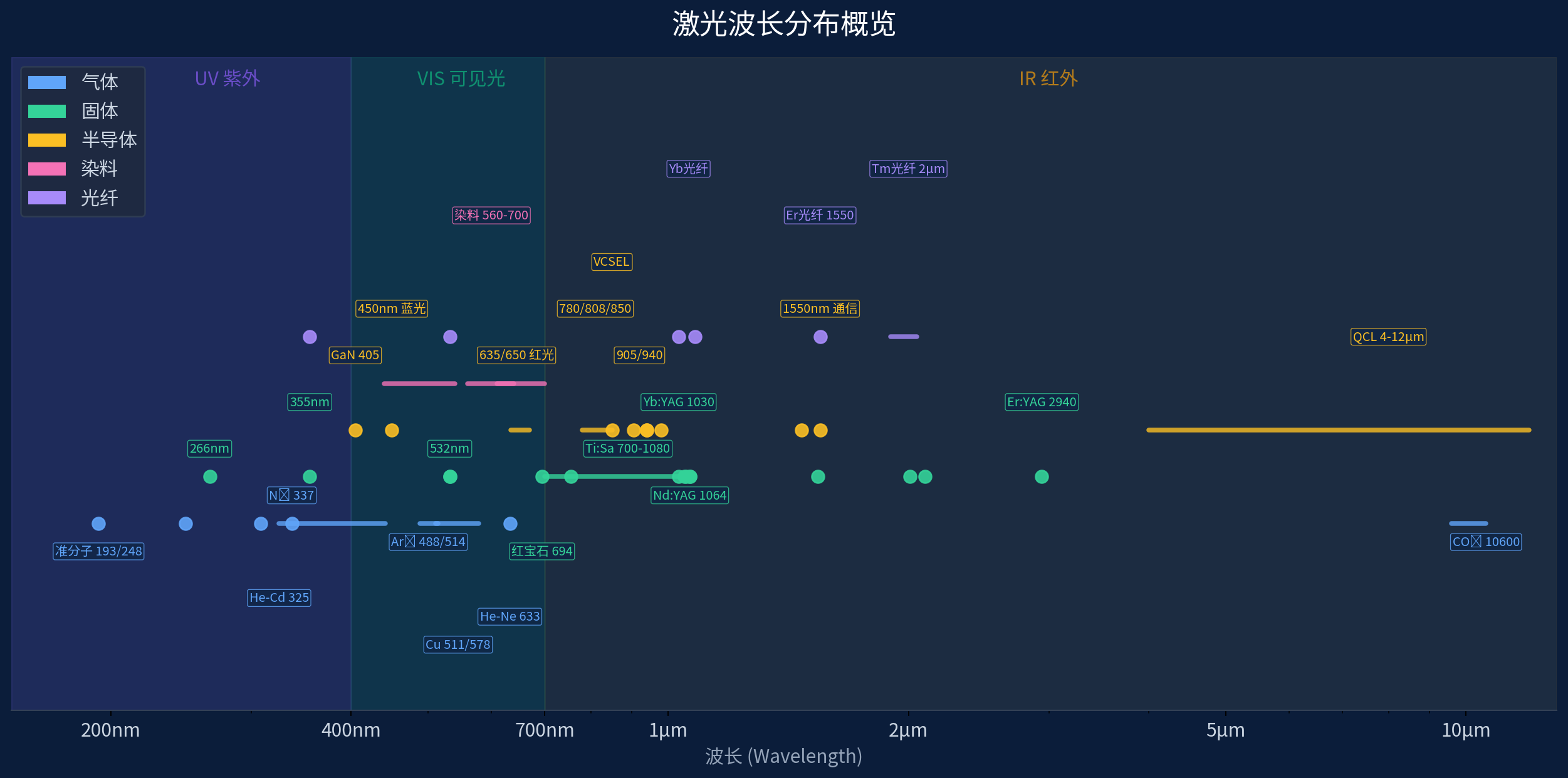
🔍 Interactive laser wavelength reference
Enter keywords to search, or filter by type/wavelength range; results update in real time
—
nm
| Laser type | Type | Wavelength (nm) ↑ | Typical linewidth | Power range | Typical applications |
|---|
How to choose a laser wavelength?
Different wavelengths correspond to different photon energies and material absorption characteristics; choosing the right wavelength is key to laser processing and applications
Ultraviolet band (UV, <400 nm)
Typical sources:Excimer (193/248/308 nm), Nd:YAG fourth harmonic (266 nm), third harmonic (355 nm), excimer (193 nm ArF, 248 nm KrF)
Typical applications:Semiconductor lithography, ophthalmic LASIK, UV marking, precision cutting of polymers/glass, fluorescence spectroscopy excitation
Visible band (VIS, 400–700 nm)
Typical sources:He-Ne (632.8 nm), Ar⁺ (488/514 nm), Nd:YAG frequency-doubled (532 nm), ruby (694 nm), semiconductor red/blue/green light
Typical applications:Holographic interferometry, flow cytometry, laser displays, retinal therapy, pumping dye lasers, barcode scanning
Near-infrared band (NIR, 700–2000 nm)
Typical sources:Nd:YAG/YVO₄ (1064 nm), Yb fibre (1030–1080 nm), semiconductor pump sources (808/915/976 nm), Er fibre (1550 nm)
Typical applications:Metal cutting/welding/marking, laser cleaning, LiDAR rangefinding, optical fibre communications, pumping other lasers
Mid- and far-infrared (MIR/FIR, >2000 nm)
Typical sources:CO₂ (10 600 nm), Er:YAG (2940 nm), Ho:YAG (2100 nm), Tm fibre (2 μm), QCL (4–12 μm)
Typical applications:Wood/acrylic/fabric cutting, skin surgery, lithotripsy, gas detection, atmospheric remote sensing
Nd:YAG harmonic series (1064 → 532 → 355 → 266)
| Harmonic | Wavelength | Nonlinear crystal | Spectral band | Typical applications |
|---|---|---|---|---|
| Fundamental (ω) | 1064 nm | — (laser medium) | Near-infrared | Marking, welding, pumping |
| Second harmonic SHG (2ω) | 532 nm | KTP / LBO | Green light (VIS) | Retinal therapy, pump sources, displays |
| Third harmonic THG (3ω) | 355 nm | LBO (sum frequency 1064+532) | Ultraviolet (UV) | UV marking, fluorescence excitation, PCB processing |
| Fourth harmonic FHG (4ω) | 266 nm | BBO / CLBO | Deep ultraviolet (UV) | Lithography, semiconductor inspection |
Frequently asked questions
Q1: What is the difference between 1064 nm and 532 nm lasers?
1064 nm is the fundamental output of Nd:YAG/Nd:YVO₄; it is near-infrared and invisible, used mainly for metal marking, welding and cutting. 532 nm is its second harmonic (green light), visible to the human eye and commonly used for retinal therapy, fluorescence excitation and pumping dye lasers. The two have different photon energies: a 532 nm photon has about twice the energy of a 1064 nm photon, so absorption is more efficient for some materials.
Q2: Why are UV lasers called “cold processing”?
UV lasers (such as 355 nm and 266 nm) have high photon energy (3.5–4.7 eV) that can directly break the molecular bonds of most organic materials (C–C bond energy about 3.6 eV), removing material “photochemically” rather than by thermal melting. The result is a minimal heat-affected zone, high edge quality and no carbonisation, making them suitable for precision cutting of heat-sensitive materials such as glass, polymers and flexible circuits.
Q3: Why are CO₂ lasers suitable for processing non-metallic materials?
The 10.6 μm wavelength of a CO₂ laser lies in the mid-infrared, a band strongly absorbed by organic materials (wood, acrylic, fabric, leather) and many non-metals (ceramics, glass). By contrast, 1 μm fibre/solid-state lasers penetrate transparent materials readily and are hard to absorb. CO₂ lasers are therefore the preferred source for cutting/engraving non-metals.
Q4: How to choose between semiconductor and solid-state lasers?
Semiconductor lasers (such as 808/915 nm pump sources and direct 976 nm output) are compact, have high electro-optical efficiency (>50%) and low cost, making them suitable for pumping and direct applications; solid-state lasers (Nd:YAG/YVO₄) offer better beam quality (M² close to 1) and can be frequency-doubled to produce green/UV light, making them suitable for precision processing. In industry the two are often combined as diode-pumped solid-state lasers (DPSSL), balancing efficiency and beam quality.
Q5: What is a tunable laser?
A tunable laser can continuously tune its output wavelength over a certain range; typical examples are Ti:Sapphire (700–1080 nm) and dye lasers. They are widely used in spectroscopy (scanning different absorption lines), ultrafast science (mode-locking to generate femtosecond pulses) and multiphoton microscopy. Semiconductor QCLs can also be tuned within specific ranges.
Related optical products
Soar Laser supplies a wide range of laser optics; contact our technical team for wavelength-related selection support
JG-SL-1064 F-Theta scanning lens
Dedicated to 1064 nm, focal length 110 mm, scan field 163 mm. A core component of Nd:YAG/Yb fibre laser marking galvanometer systems.
F-theta lens
1064nm
Galvanometer scanning
Laser protective window guide
Selection guide for protective windows at different wavelengths (1064 nm/532 nm/355 nm/CO₂), covering materials, coatings and damage thresholds.
Protective window
Broadband
Selection guide
Laser beam expander guide
Principles and selection of Galilean/Keplerian beam expanders, supporting beam expansion and collimation from the UV to CO₂ across the full wavelength range.
Beam expander
Beam collimation
Broadband
Telecentric achromatic F-theta lens guide
Technical analysis of telecentric F-theta lenses, eliminating chromatic aberration and telecentricity errors for precision laser processing and measurement.
F-theta lens
Achromatic
Precision processing