


What Is Laser Welding? The Preferred Solution for Precision Welding
Laser welding is an important concept in laser technology, widely used in industrial manufacturing, scientific research and healthcare. This article systematically introduces the core concepts, working principles, key parameters, main types and typical applications of laser welding, helping readers build a complete knowledge framework.
Table of Contents
- 1. What Is Laser Welding? Understanding the Core Concepts
- 2. Working Principle: How Is Laser Welding Achieved?
- 3. Key Parameters: Understanding the Performance Indicators of Laser Welding
- 4. Main Types: What Kinds of Laser Welding Exist?
- 5. Applications: Where Is Laser Welding Used?
- 6. Common Misconceptions: Pitfalls to Avoid
1. Core Concepts: What Is Laser Welding?
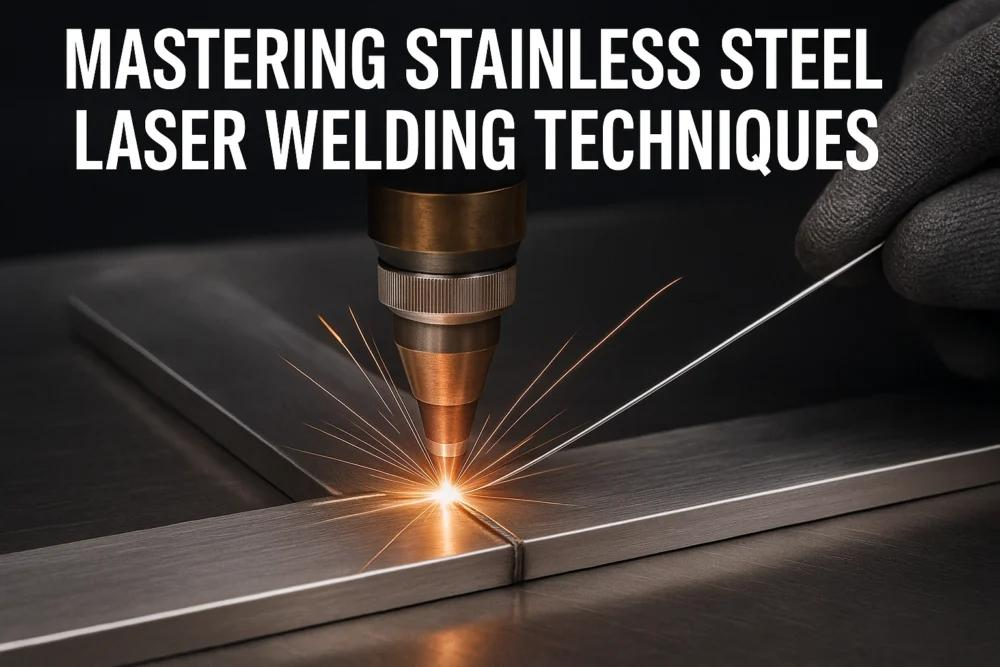
Laser welding is a precision welding process that uses a high-energy-density laser beam as a heat source to melt two or more materials at the joint and achieve a permanent connection. It is an important branch of laser material processing, especially suited to high-precision, high-speed automated welding scenarios. Compared with traditional arc welding, laser welding has low heat input, small welding deformation and a narrow, deep weld, can weld thin-walled parts and precision components, and can even perform internal welding through transparent materials. Laser welding can weld metals and also has unique applications in areas such as plastic welding.
2. Working Principle: How Is Laser Welding Achieved?
The basic principle of laser welding is to focus the laser beam onto the joint to be welded; the material absorbs the light energy and converts it into heat, melting the material at the joint to form a molten pool, which solidifies into a weld. Depending on the energy density and mode of action, laser welding has two main mechanisms: one is conduction-mode welding, where the laser energy melts only the material surface through heat conduction, giving a shallow, wide weld; the other is deep-penetration welding (also called keyhole welding), where when the power density is high enough, the material vaporizes to form a keyhole filled with metal vapor, and the laser beam can penetrate deep into the material through this keyhole, giving a deep, narrow weld with an aspect ratio of 10:1 or even higher. Deep-penetration welding is the main working mode of high-power laser welding.
💡 An analogy
Laser welding is like fusing two materials together with an extremely fine beam of light—the weld in traditional welding is wide and deep with a large heat-affected zone and is prone to deformation; laser welding has a tiny spot and extremely high energy density, giving a narrow weld, small heat-affected zone and little deformation, enabling precision even micrometre-level welding.
In summary, laser welding involves the intersection of optics, materials science and precision manufacturing. Mastering its basic principles and key parameters is the foundation for properly selecting and using related products.
3. Key Parameters: Understanding the Performance Indicators of Laser Welding
Understanding laser welding requires mastering the following key parameters, which directly determine product performance and application scenarios:
| Parameter Name | Meaning | Why It Matters |
|---|---|---|
| Laser Power | Deep-penetration welding usually requires power above the kilowatt level; higher power gives greater welding depth. | Determines the thickness of material that can be welded; higher power gives greater depth, and thick-plate welding needs several kilowatts |
| Welding Speed | At fixed power, higher speed gives shallower penetration; a balance must be struck between speed and penetration. | Affects production efficiency and weld quality; too fast may fail to penetrate, too slow may burn through |
| Spot Diameter and Beam Quality | A small spot and high beam quality give higher power density, making deep-penetration welding easier. | Affects focusing capability and depth of focus; a high-quality beam enables deeper, more stable welding |
| Defocus Amount | The position of the focal point relative to the workpiece surface, affecting penetration and weld shape. | Directly affects laser performance and the choice of application scenarios |
| Pulse Parameters | In pulse welding, pulse width, frequency and energy are crucial to weld formation and heat-input control. | Directly affects laser performance and the choice of application scenarios |
| Shielding Gas | Inert gases such as argon and helium are commonly used to shield the molten pool, preventing oxidation and suppressing the plasma’s shielding effect on the laser. | Prevents weld oxidation and suppresses plasma, crucial to weld quality and stability |
The above parameters are interrelated and mutually constrained. In actual selection, a comprehensive trade-off among performance, cost, reliability and other aspects is needed according to specific application requirements.
For more product parameters or selection advice, please contact the Soar Laser technical team.
4. Main Types: What Kinds of Laser Welding Exist?
Laser welding can be classified in many ways, and different dimensions help us understand its characteristics from different angles. The following introduces the common classification methods one by one:
Conduction-Mode Welding
Lower energy density, with heat melting the material by conduction; the weld is wide and shallow, suitable for thin-walled parts and precision welding.
Deep-Penetration Welding (Keyhole Welding)
A vaporization keyhole forms at high power density; the weld is deep and narrow, the most commonly used laser welding method in industry.
Pulsed Laser Welding
Uses a pulsed laser for spot or seam welding, with low heat input, suitable for precision electronic components and medical devices.
Continuous-Wave Laser Welding
Uses a continuous-wave laser, with fast welding speed and large penetration, suitable for mass production.
Laser Brazing
Strictly speaking in the brazing category, it melts only the filler and not the base material, used for fine joining of electronic components.
Plastic Laser Welding
Uses the laser transmission-welding principle: one plastic transmits light and the other absorbs it, melting and joining at the interface.
Remote Welding
Uses scanning galvanometers to move the beam rapidly over a relatively long distance for welding, with extremely high efficiency.
Different types of laser welding have their own characteristics and suitable scenarios. Actual selection requires comprehensive consideration of specific application needs, performance requirements and budget constraints. If in doubt, you can contact the Soar Laser technical team for professional selection advice.
5. Applications: Where Is Laser Welding Used?
Laser welding has a very wide range of applications, covering industrial manufacturing, scientific research, healthcare, communications and information, and many other fields. The following introduces several main aspects:
- Laser welding is most widely used in the automotive industry; body-in-white welding, transmission gear welding and power-battery tab welding are all typical applications. In aerospace, laser welding joins high-precision components such as engine blades and fuselage structures. In electronics, laser microwelding joins miniature components such as precision connectors, sensors and chip leads. The medical-device industry uses laser welding to process stainless-steel implants and endoscope parts. In addition, laser welding is used in hardware products, jewelry processing, photovoltaic cells and many other fields. With the explosive growth of new-energy vehicles, demand for laser welding in battery manufacturing is rising rapidly.
Typical Application Scenarios in Detail
Scenario 1: Automotive Manufacturing
body tailored-blank welding, transmission gear welding and power-battery welding are the largest application market for laser welding, with high efficiency, small deformation and easy automation.
Scenario 2: Electronics Manufacturing
welding of precision devices such as mobile-phone batteries, connectors, sensors and micromotors, with a small spot and small heat-affected zone, achieving micrometre-level precision.
Scenario 3: Medical Devices
welding of precision medical devices such as cardiac stents, artificial joints and endoscopes, with extremely high quality requirements, for which laser welding is the preferred process.
Scenario 4: Aerospace
welding of aero-engine blades, fuselage structural parts and rocket fuel tanks, with a large aspect ratio and small deformation, suitable for hard-to-weld materials and high-precision requirements.
6. Common Misconceptions
Many people have somewhat plausible but mistaken notions about laser welding. See whether you fall into any of the following misconceptions:
Misconception 1: Laser welding can weld all materials.
in fact, laser welding is very sensitive to the light-absorption characteristics of materials; highly reflective materials (copper, aluminium, gold) and highly conductive materials are harder to weld and often need special wavelengths or process optimisation
Misconception 2: The deeper the weld at higher power, the better.
although deep-penetration welding gives great depth, too-fast cooling can embrittle the weld and cause cracks; different materials and applications need matched welding parameters
Misconception 3: Laser welding does not need filler material.
although autogenous welding is a major feature of laser welding, for some dissimilar materials or where special mechanical properties of the weld are required, filler wire or powder must still be added
Misconception 4: Laser welding does not need filler material.
although laser welding can be autogenous (without filler wire), in many applications filler wire or preplaced powder is still needed to fill gaps, improve weld composition or reduce cracks. Especially in dissimilar-material welding and thick-plate welding, filler material is often indispensable.
The above are several common misconceptions about laser welding. In practical applications, comprehensive judgment is needed based on specific product parameters and use conditions. If in doubt, it is recommended to consult a professional technician.
Leave a Reply