


Imagine a beam of light so pure in colour that it has only one frequency, with a coherence length reaching several kilometres – like a perfect sine wave extending infinitely without end. This is not science fiction, but the real capability of the single-frequency fibre laser.
From gravitational-wave detection to undersea fibre-optic hydrophones, from 5G coherent communication to lidar, single-frequency fibre lasers, with their extreme spectral purity, underpin one high-precision application after another. Today we talk about this “king of precision” in the fibre laser family.
Table of Contents
- I. Core Concepts: What Is a Single-Frequency Fibre Laser?
- II. How It Works: How to Make a Laser “Sing” Only One Note?
- III. Key Parameters: Understanding the 9 Metrics of Single-Frequency Lasers
- IV. Types: The Single-Frequency Fibre Laser Family
- V. Applications: Where Are Single-Frequency Lasers Used?
- VI. Common Misconceptions: Beliefs That May Be Wrong
I. Core Concepts: What Is a Single-Frequency Fibre Laser?
A single-frequency fibre laser (SFFL) is a fibre laser that operates on a single resonator longitudinal mode – simply put, it outputs laser light at a single frequency/wavelength, with extremely high spectral purity.
If an ordinary multimode laser is like an “orchestra playing together,” then a single-frequency laser is a “solo” – just one pure tone. This extreme spectral purity brings three core advantages:
- Ultranarrow linewidth: linewidth typically at kHz to Hz level (even mHz level), orders of magnitude narrower than ordinary lasers
- Long coherence length: coherence length can reach kilometre scale (ordinary lasers only millimetres to metres), suited to long-distance interferometry
- Low phase noise: excellent frequency stability, an ideal light source for precision measurement
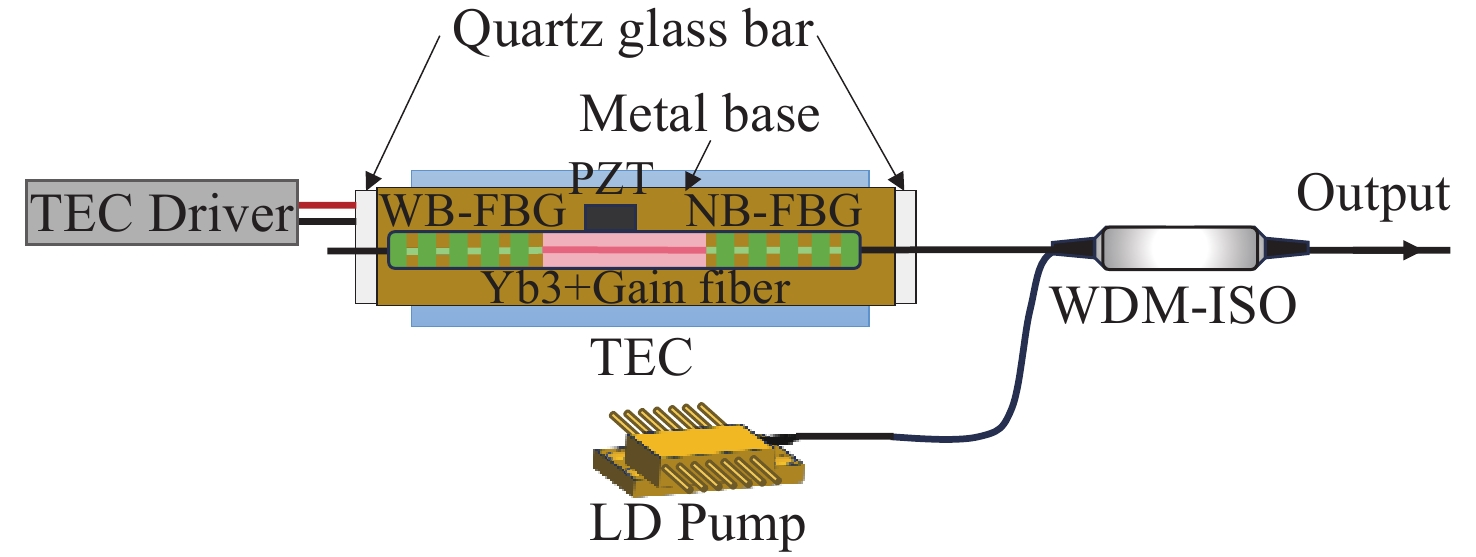
Single-frequency fibre lasers typically use fibre Bragg gratings (FBG) or distributed feedback (DFB) structures for frequency selection, combined with rare-earth-doped fibre as the gain medium. They integrate all the advantages of fibre lasers (all-fibre structure, high efficiency, high beam quality, good heat dissipation, interference resistance) with the extreme spectral purity of single-frequency lasers, making them the most competitive technology route for high-power, high-stability single-frequency lasers today.
II. How It Works: How to Make a Laser “Sing” Only One Note?
1. What Is “Single Frequency”?
A laser resonator contains many longitudinal modes (frequency spacing = c/2L); several modes within the gain bandwidth may oscillate simultaneously, and the output is a mixture of multiple frequencies. A single-frequency laser uses a frequency-selection mechanism to allow only one longitudinal mode to oscillate, suppressing all others.

In the formula above, ΔνFSR is the frequency spacing between adjacent longitudinal modes, c is the speed of light in vacuum, n is the refractive index of the gain medium, and L is the resonator length. The longer the resonator, the smaller the mode spacing, and the more longitudinal modes fit within the same gain bandwidth.

The number of longitudinal modes N within the gain bandwidth Δνg equals the gain bandwidth divided by the mode spacing. When N > 1, the laser may operate in a multimode state; to achieve single-frequency oscillation, a frequency-selection mechanism must make one mode’s loss far lower than the others.
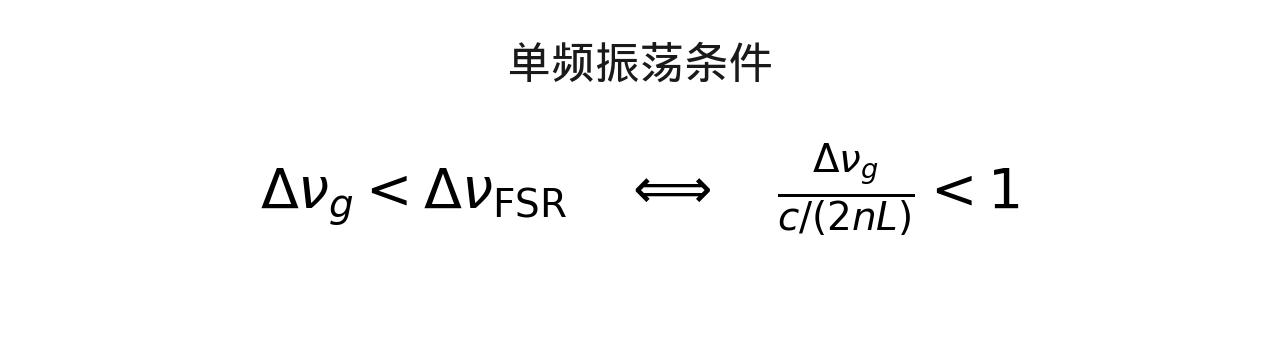
When the gain bandwidth Δνg is smaller than the mode spacing ΔνFSR, at most one longitudinal mode can oscillate within the gain curve – the ideal “naturally single-frequency” case. But real fibre lasers usually have gain bandwidths far larger than the mode spacing, so frequency-selective structures such as DFB gratings and ring cavities are needed to achieve single-frequency operation.
2. Four Core Frequency-Selection Mechanisms
(1) Distributed Feedback (DFB) structure
A Bragg grating with a phase jump is written inside the doped fibre. The grating provides feedback throughout, and the λ/4 phase shift in the middle gives the centre mode the lowest loss. The structure is the most compact (grating length a few millimetres to centimetres), output power is usually tens of milliwatts, and linewidth is typically MHz to kHz.
(2) Distributed Bragg Reflector (DBR) structure
Two separate FBGs serve as cavity mirrors, with gain fibre in between. Only one longitudinal mode in the overlap region of the two FBG reflection spectra satisfies the oscillation condition. Higher power than DFB, but slightly more complex structure.
(3) Ring cavity + frequency-selective filtering
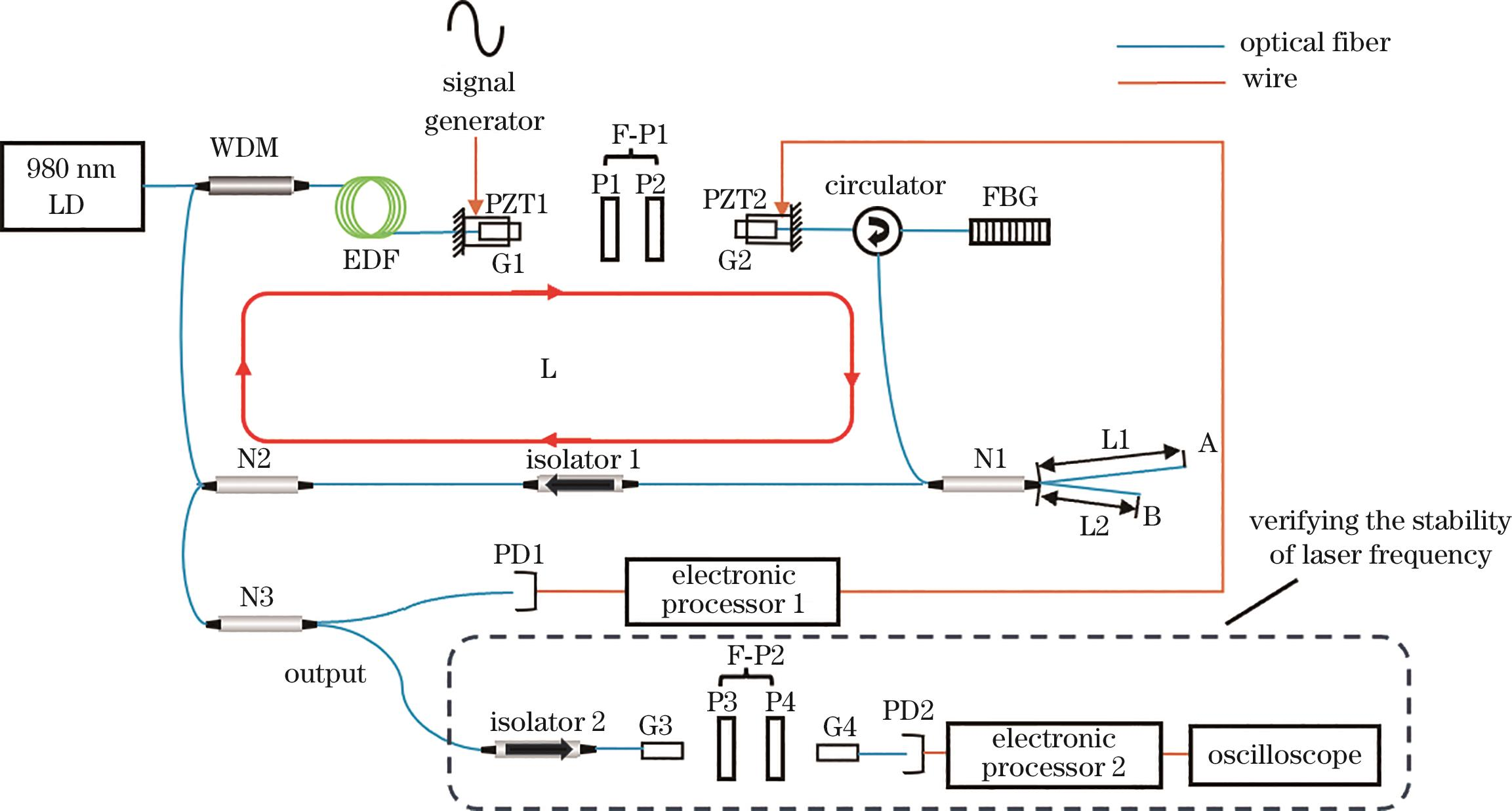
The ring cavity runs in one direction (ensured by an optical isolator), avoiding spatial hole burning. FBGs, Fabry-Perot filters, and other frequency-selective elements are inserted in the cavity. Power can be made higher (up to several watts or even tens of watts), and self-injection locking can further narrow the linewidth.
(4) Stimulated Brillouin Scattering (SBS) frequency selection
The SBS effect in fibre produces an extremely narrow gain line (~MHz level), a natural single-longitudinal-mode selection mechanism, with very narrow linewidth and the ability to achieve relatively high-power single-frequency output.
3. Linewidth Compression and Power Scaling
To obtain ultranarrow linewidth (Hz or even mHz level), technologies such as self-injection locking, reference-cavity locking, and atomic/molecular transition locking are needed. High-power output uses a MOPA (master oscillator power amplifier) architecture: a low-power single-frequency seed source + multistage single-frequency fibre amplifiers, scaling power to tens or even hundreds of watts through SBS suppression techniques.
III. Key Parameters: Understanding the 9 Metrics of Single-Frequency Lasers
| Parameter | Typical Range | Description |
|---|---|---|
| Centre wavelength | 1550 nm/1064 nm/2 um, etc. | Determined by the gain medium |
| Linewidth | mHz~MHz | Core metric of a single-frequency laser |
| Output power | mW to tens of W (hundreds of W after amplification) | Lower at oscillator level, can be increased after amplification |
| Side-mode suppression ratio (SMSR) | >45-50 dB to qualify; high-end products reach over 60 dB | Power ratio of main mode to next-strongest mode |
| Relative intensity noise (RIN) | Around -150 dB/Hz | Close to the shot-noise limit |
| Frequency stability | Depends on the stabilization scheme | Long-term frequency drift |
| Polarisation extinction ratio (PER) | >20 dB (polarisation-maintaining type) | Metric for polarisation-maintaining single-frequency lasers |
| Coherence length | Can reach kilometre scale | Inversely proportional to linewidth |
| SBS threshold | Key metric for high-power types | Determines maximum amplification power |
IV. Types: The Single-Frequency Fibre Laser Family
By gain medium / wavelength
- Er-doped single-frequency fibre laser (Er-doped): wavelength ~1550 nm (C-band), eye-safe, compatible with fibre communication systems, most widely used
- Yb-doped single-frequency fibre laser (Yb-doped): wavelength ~1064 nm, high gain and power, suited to gravitational-wave detection and coherent combining
- Tm-doped single-frequency fibre laser (Tm-doped): wavelength ~2 um, eye-safe band, used for lidar and gas sensing
- Mid-infrared single-frequency fibre laser: fluoride fibre, wavelength up to 3-4 um, for molecular spectroscopy detection
- Visible single-frequency fibre laser: produced by frequency doubling, e.g. 532 nm green, for atomic physics and biomedicine
By structure
- DFB fibre laser: distributed feedback structure, phase-modulated FBG forms the resonator, simplest structure, best single-frequency stability, smallest size; drawback is relatively low output power (usually mW to tens of mW)
- DBR fibre laser: linear cavity with two narrowband FBGs as mirrors, gain fibre in the middle; power slightly higher than DFB (up to hundreds of mW), but needs more precise temperature/wavelength control to ensure single mode
- Ring-cavity single-frequency laser: ring cavity + unidirectional operation (optical isolator), fundamentally avoiding spatial hole burning; power can be higher (several watts or more), and self-injection locking can further narrow the linewidth; drawback is a more complex structure
- Brillouin single-frequency laser: uses the extremely narrow gain line of SBS in fibre (~MHz level) for natural mode selection, very narrow linewidth; but low threshold and low efficiency, suited to low-power applications
V. Applications: Where Are Single-Frequency Lasers Used?
1. Fibre Sensing
Single-frequency fibre lasers are the core light source for distributed fibre sensing. Distributed vibration/acoustic sensing (DAS/DVS) detects vibration and intrusion along pipelines and railways; fibre optic gyroscopes (FOG) are used for high-precision navigation; Brillouin optical time-domain analysis (BOTDA/BOTDR) is used for temperature/strain sensing; hydrophone arrays are used for undersea sonar detection.
2. Coherent Optical Communication
Coherent detection systems require local oscillator light sources that are single-frequency, narrow-linewidth, and low-noise; signal and local oscillator sources for 100G+ high-speed coherent transmission systems; free-space optical communication (inter-satellite/satellite-to-ground laser communication) needs high-power, high-stability single-frequency lasers.
3. Lidar and Precision Measurement
Coherent wind lidar detects atmospheric wind speed distribution; coherent detection lidar improves range resolution and velocity accuracy; Doppler velocimetry measures the speed of moving targets; high-precision ranging and laser interferometry.
4. Gravitational-Wave Detection and Fundamental Science
Large gravitational-wave interferometers such as LIGO need ultrastable, narrow-linewidth, high-power single-frequency lasers; important pump and reference sources for optical frequency combs and optical clocks; high-resolution spectroscopy, laser cooling and trapping, quantum computing, and quantum communication.
VI. Common Misconceptions: Beliefs That May Be Wrong
Myth 1: “A single-frequency laser is a narrow-linewidth laser, exactly the same”
Not quite. Single frequency and narrow linewidth are closely related but emphasise different things. “Single frequency” emphasises the mode state (only one longitudinal mode oscillating), while “narrow linewidth” emphasises the spectral width. All single-frequency lasers are narrow-linewidth, but narrow-linewidth lasers are not necessarily strictly single-frequency – some multimode lasers can also obtain relatively narrow linewidth via injection locking. In everyday usage the two terms are often mixed.
Myth 2: “Single-frequency fibre lasers are all low power”
Wrong. The output power of a single-frequency oscillator is indeed usually low (a few milliwatts to a few watts), but through a MOPA (master oscillator power amplifier) architecture, power can be amplified to tens or even hundreds of watts. The key limiting factor is stimulated Brillouin scattering (SBS); through SBS suppression techniques such as large-mode-area fibre, phase modulation, and temperature gradients, power can be significantly increased. Currently in the lab, amplified single-frequency fibre lasers can reach the sub-hundred-watt level (early literature reported over 20 W).
Myth 3: “The narrower the linewidth, the better”
This needs a balanced view. Linewidth is indeed a core metric of single-frequency lasers, but different applications require different optimal linewidths – communication may need only tens of kHz, while gravitational-wave detection needs Hz or even mHz level. The narrower the linewidth, the more complex the system, the higher the cost, and the more sensitive to the environment. In many industrial applications an overly narrow linewidth can actually cause problems such as speckle due to coherence effects. Choose an appropriate linewidth rather than always the narrowest.
Myth 4: “Single-frequency lasers are not afraid of reflected light”
Wrong. Single-frequency lasers are extremely sensitive to optical feedback (back-reflection) – even one millionth of the output light reflected back can cause a sharp increase in phase and intensity noise, or even chaotic multimode operation. Therefore single-frequency lasers usually must have one or even two Faraday isolators in series to prevent back-reflection interference.
Myth 5: “A DFB laser is a single-frequency fibre laser”
This overgeneralizes. DFB (distributed feedback) is one important structure for achieving single frequency, but single-frequency fibre lasers also have DBR, ring cavity, Brillouin, and other structures. Moreover, DFB comes not only in fibre form but also as semiconductor DFB lasers (DFB chips used in optical communication). DFB is a “method,” single-frequency fibre laser is a “result,” and the two are not one-to-one.
Myth 6: “Single-frequency fibre lasers can only be 1550 nm”
Wrong. 1550 nm (Er-doped) is indeed the most mature and common single-frequency fibre laser band, but by choosing different gain media, single-frequency fibre lasers can cover a wide wavelength range: Yb-doped ~1064 nm, Tm-doped ~2 um, fluoride fibre 3-4 um mid-infrared, and frequency doubling can produce visible light. Different wavelengths suit different applications.
References
- RP Photonics Encyclopedia – Single-frequency Lasers (https://www.rp-photonics.com/single_frequency_lasers.html)
- RP Photonics Encyclopedia – Distributed Feedback Lasers
- China Laser, “Single-Frequency Fibre Laser Technology from the Perspective of Discipline Development” (team of Zhou Pu, National University of Defence Technology)
- Hamamatsu Knowledge Zone – Single-Frequency Laser Technology
- Acta Optica Sinica, “Narrow-Linewidth Yb-Doped Fibre Seed Source” and other academic papers
Related Reading
- Narrow-Linewidth Fibre Lasers Explained
- Fibre Laser Starter Guide
- Ultrafast Laser Principles and Applications
- Q-Switching Technology Explained
Want to learn more about lasers? Browse the Soar Laser Encyclopedia to systematically study laser principles and applications.
Leave a Reply