


In the laser industry, the terms “thin-slice laser” and “thin-disk laser” are often used interchangeably – are they the same thing? The answer is: basically yes, but not entirely.
To use an analogy: if the “thin-disk laser” is an iPhone, then the “thin-slice laser” is a smartphone – the thin disk is the most famous and mainstream member of the thin-slice family, but the family also includes semiconductor slices, ceramic slices, side-pumped slices, and more. Today we systematically survey the “thin-slice laser” family.
Table of Contents
- I. Core Concepts: What Exactly Is a Thin-Slice Laser?
- II. How It Works: Why Does Being Thin Matter So Much?
- III. Key Parameters: Understanding Thin-Slice Laser Specs
- IV. Types: A Complete Map of the Thin-Slice Laser Family
- V. Applications: Where Are Thin-Slice Lasers Used?
- VI. Common Misconceptions: Beliefs That May Be Wrong
I. Core Concepts: What Exactly Is a Thin-Slice Laser?
“Thin-slice laser” is a broad concept in the Chinese context, referring generally to any solid-state laser using a thin-sheet gain medium. The core idea is consistent: by reducing the thickness of the gain medium and increasing the surface-area-to-volume ratio for heat dissipation, thermal effects are effectively suppressed, achieving high-power, high-beam-quality laser output.
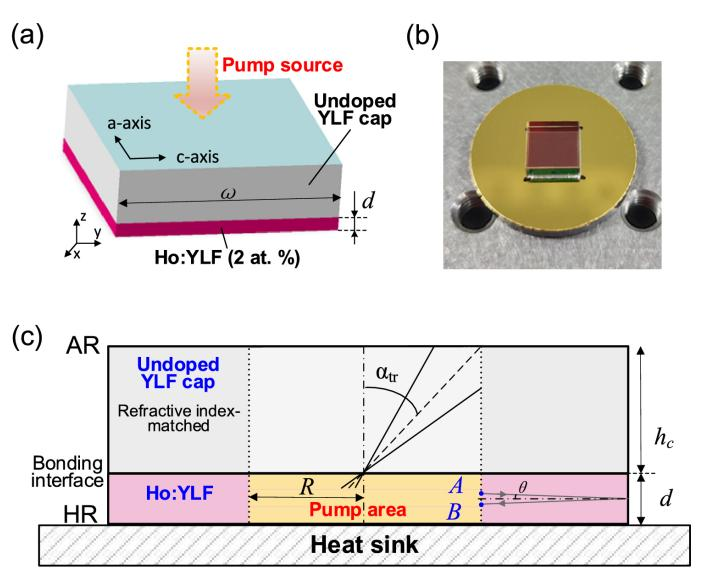
It should be noted that in most everyday contexts, “thin-slice laser” and “thin-disk laser” in Chinese refer to the same technology (English: thin-disk laser) – a scheme using a disk-shaped crystal 100-300 um thick and millimetres to centimetres in diameter, with a heat sink bonded to the back for axial heat dissipation and multipass pumping. But “thin-slice laser” has a broader scope, also including the following variants:
- End-pumped disk type: the commonly called “thin-disk laser,” the mainstream and representative of thin-slice lasers (invented by Giesen in 1993)
- Side-pumped thin slice: about 1-2 mm thick, pump light enters from the side and folds back and forth between the upper and lower surfaces for absorption, with a simpler structure
- Semiconductor thin-slice laser (VECSEL): the gain medium is a semiconductor quantum-well structure, not a crystal; uses optical pumping + external cavity, part of the thin-slice family
- Ceramic thin-slice laser: uses transparent ceramics (e.g. Nd:YAG ceramic) instead of single crystal as the gain medium
In short: all thin-disk lasers are thin-slice lasers, but not all thin-slice lasers are thin-disk lasers. Thin-slice is the broader “family concept,” and thin-disk is its most successful, mainstream branch.
II. How It Works: Why Does Being Thin Matter So Much?
1. Common Physical Basis: High Surface-Area/Volume-Ratio Heat Dissipation
The essence of a thin-slice laser is solving thermal management through geometric optimisation. In a traditional rod laser, heat conducts from the rod centre to the side, giving a large radial temperature gradient – strong thermal lensing – and a sharp drop in beam quality as power scales. The thin-slice structure makes the gain medium thin, so heat can dissipate quickly from the large-area surfaces and the temperature gradient is greatly reduced.
2. End-Pumped Disk Type (Mainstream Scheme)
This is the commonly called “thin-disk laser,” the most mature and highest-power scheme. The gain medium is a disk-shaped Yb:YAG crystal 100-300 um thick, with a high-reflection coating on the back bonded to a diamond/copper-tungsten heat sink for axial water cooling. Because it is so thin, multipass pumping (16-44 passes) is needed to ensure absorption efficiency. The advantage is excellent power scalability – a single disk can reach the tens-of-kilowatts level – with good beam quality.
3. Side-Pumped Thin-Slice Type
The gain medium is a thin slice about 1-2 mm thick (Nd:YAG or Yb:YAG), which can be circular, polygonal, or rectangular. Pump light enters from the side (edge) and folds back and forth between the upper and lower surfaces to achieve a long absorption path. The advantage is a relatively simple pump structure; diode stacks can be used for side pumping, suited to high-energy pulses.
4. Semiconductor Thin-Slice Laser (VECSEL)
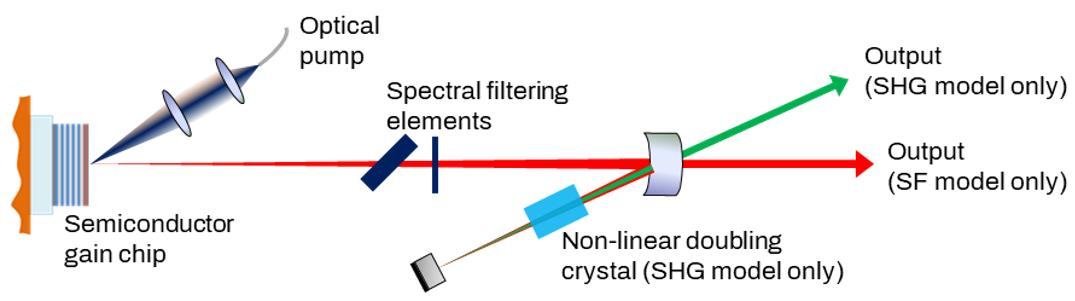
VECSEL (vertical external-cavity surface-emitting semiconductor laser) is the semiconductor scheme that truly belongs to the “thin-slice laser” family: the gain medium is a semiconductor quantum-well structure (not a crystal), with the gain region only a few to tens of nanometres thick; one side uses a DBR as a mirror and the other an external mirror forming an external cavity; it typically uses optical pumping.
It combines the wavelength flexibility of semiconductor lasers with the good beam quality of solid-state lasers, reaching several to tens of watts, and is widely used in laser displays, spectroscopy, biomedicine, and other fields.
💡 Note the distinction: VECSEL ≠ VCSEL
VECSEL (vertical external-cavity surface-emitting laser) = optical pumping + external cavity + semiconductor gain sheet → belongs to the thin-slice laser family discussed here, with relatively high power (watt level and above) and good beam quality.
VCSEL (vertical-cavity surface-emitting laser) = electrical injection + two DBRs forming a vertical internal cavity → not part of the thin-slice laser category, low power (mW level), low cost, can be array-integrated, used for data-centre optical interconnects, phone Face ID 3D sensing, etc.
5. Ceramic Thin-Slice Laser
Transparent laser ceramics (e.g. Nd:YAG ceramic, Yb:YAG ceramic) are used instead of single crystal as the gain medium. Advantages are simple fabrication, large-size capability, uniform doping, and low cost. Thermal performance and optical quality approach those of single crystal, making it a promising alternative. China Academy of Engineering Physics once reported a phi60 mm x 2 mm Nd:YAG transparent ceramic thin-slice laser outputting 2052 W at 500 Hz.
III. Key Parameters: Understanding Thin-Slice Laser Specs
| Parameter | Typical Range | Description |
|---|---|---|
| Slice thickness | End-pumped 100-300 um; side-pumped 1-2 mm | Thinner dissipates heat better but is harder to absorb |
| Slice diameter / size | 5mm~60mm+ | Determines maximum scalable power |
| Output power | Tens of W to 10 kW+ (single disk) | Multimode can reach tens of kW, fundamental mode up to 4 kW |
| Beam quality M2 | Fundamental mode <1.2; multimode 10-20 | End-pumped disk type has the best beam quality and power scalability |
| Optical-to-optical efficiency | Can reach 70%+ | Can reach 80% with 969 nm zero-phonon-line pumping |
| Number of pump passes | End-pumped type 16-44 passes | Determines pump absorption efficiency |
| Pulse energy | mJ to hundreds of mJ (regenerative amplification) | Ultrafast amplification can reach J level |
| Gain medium material | Yb:YAG, Nd:YAG, ceramics, semiconductors, etc. | Yb:YAG is currently the most mainstream |
IV. Types: A Complete Map of the Thin-Slice Laser Family
By gain medium form
- Crystal thin-slice laser: gain medium is single crystal (Yb:YAG, Nd:YAG, etc.), best performance, mainstream
- Ceramic thin-slice laser: gain medium is transparent laser ceramic, low cost, easy to make large sizes, developing rapidly
- Semiconductor thin-slice laser (VECSEL): gain medium is semiconductor quantum well, small size, flexible wavelength
By pumping method
- End-pumped thin-slice laser (i.e. thin-disk laser): pump light enters vertically from the end face, needs multipass pumping structure, good beam quality, high efficiency, mainstream for high power
- Side-pumped thin-slice laser: pump light enters from the side (edge), folds back and forth inside for absorption, simple structure, suited to high-energy pulses
Comparison of technology routes
| Technology route | Typical thickness | Representative power | Beam quality | Core advantage |
|---|---|---|---|---|
| End-pumped disk | 100~300μm | 10 kW+ (multimode) | Excellent (fundamental M2 can be <1.2) | Power scalable, high efficiency |
| Side-pumped thin slice | 1~2mm | Hundreds of W to 2 kW | Average (multimode) | Simple structure, high pulse energy |
| Slab laser | 1 to several mm | 50~500W | Good | High average power, high repetition rate |
| Fibre laser | um-level core | Ten-kW level (multimode) | Excellent | Flexible delivery, maintenance-free |
| Semiconductor VECSEL | nm to um level | A few W to tens of W | Good | Small size, flexible wavelength |
V. Applications: Where Are Thin-Slice Lasers Used?
1. Industrial Material Processing (Largest Market)
- Laser welding: power battery welding, automobile body welding, high-power thin-disk lasers are one of the mainstays
- Laser cutting: thick plate cutting, precision metal cutting, glass cutting
- 3D printing (SLM): high-power multimode thin-disk lasers for metal additive manufacturing
- Precision micromachining: picosecond/femtosecond thin-slice lasers for sapphire cutting, wafer dicing
- Laser annealing / lift-off: laser annealing (ELA) and laser lift-off (LLO) of display panels
2. Scientific Research and Large-Scale Facilities
High-average-power femtosecond oscillators, high-energy regenerative amplifiers; drive sources for strong-field physics / attosecond science; laser fusion driver schemes; laser-triggered lightning / atmospheric filamentation research, etc.
3. Semiconductor and Display
Semiconductor wafer laser annealing, OLED panel laser lift-off, display panel repair. VECSEL has unique applications in laser displays, lidar pump sources, biomedical imaging, etc.
Note: 3D sensing such as phone Face ID uses VCSEL (electrical-injection surface emission), which is not part of the thin-slice laser category discussed here.
4. Medicine, Defence, and Communication
Dermatology treatment, ophthalmic surgery, biomedical imaging pump sources; lidar long-distance ranging, optoelectronic countermeasures; data-centre optical interconnects, etc.
VI. Common Misconceptions: Beliefs That May Be Wrong
Myth 1: “A thin-slice laser is a thin-disk laser, exactly the same thing”
Not quite. In most everyday contexts the two do refer to the same technology (different translations of thin-disk laser). But strictly, “thin-slice laser” is a broader concept that, besides the end-pumped disk type, includes side-pumped slices, semiconductor slices, ceramic slices, and other forms. Thin-slice is the “family name,” thin-disk the most famous “family member.”
Myth 2: “All thin-slice lasers use multipass pumping”
Wrong. Multipass pumping characterises the end-pumped disk type (because it is too thin, a single pass is not enough). A side-pumped thin-slice laser does not need end-face multipass pumping – pump light enters from the side and folds back and forth inside the slice along the upper and lower surfaces to increase the absorption path, a completely different pump structure. Semiconductor thin-slice lasers are pumped differently again.
Myth 3: “The thinner the thin-slice laser, the better”
Wrong. Although thinner dissipates heat better, being too thin brings: (1) end-pumped types need more pump passes and a more complex system; (2) stronger transverse ASE (amplified spontaneous emission), limiting large-aperture gain; (3) reduced mechanical strength, with thermal stress more likely to cause fracture. Thickness is a trade-off among heat dissipation, absorption, ASE, mechanical strength, and other factors.
Myth 4: “Thin-slice lasers and slab lasers are the same”
Easily confused. Both improve heat dissipation by thinning the gain medium, but their form and operation differ importantly: a slab has an elongated rectangular cross-section (like a flat ruler), pump light enters from the side, and the laser propagates along the length; a disk is circular, pump light enters from the end face, and the laser propagates perpendicular to the end face. Slabs have advantages in high repetition rate, disks in power scalability.
Myth 5: “Thin-slice lasers can only do high power, not precision”
Wrong. Quite the opposite – thin-slice lasers (especially the end-pumped disk type) have extremely weak thermal lensing and maintain excellent beam quality even at high power – a fundamental-mode thin-disk laser can keep M2 < 1.2 at the kW level. Combined with Q-switching or mode-locking, they perform excellently in precision micromachining (glass cutting, wafer dicing). High power and high precision can coexist in thin-slice lasers.
Myth 6: “China cannot make thin-slice lasers, all imported”
Inaccurate. Although TRUMPF remains the industry leader, a number of independent Chinese enterprises have emerged. Zhonghui Laser launched a 1000 W industrial thin-disk laser, Huihong Laser completed an intellectual-property layout for thin-disk technology, and Yinggu Laser also launched thin-disk products. Of course, in product maturity and power levels, domestic products still lag the international top level, but the claim that they “cannot be made at all” no longer matches reality.
References
- Acta Photonica Sinica, “High-Efficiency Yb:YAG Thin-Slice Laser Based on Zero-Phonon-Line Pumping”
- Acta Physica Sinica, “Diode-Stack Side-Fold-Pumped Polygonal Thin-Slice Laser”
- Optoelectronics Network, “Thin-Disk Laser Market: Giant Monopoly, Can Chinese Players Break Through”
- Bolight Technology, “TRUMPF Scientific Lasers Ultrafast Laser Systems”
- Xuwei Optoelectronics, “In-Depth Analysis of Femtosecond Laser Technology Routes”
- RP Photonics Encyclopedia – Thin-disk Lasers, VECSEL
Related Reading
- Thin-Disk Laser Explained (Mainstream End-Pumped Scheme)
- Solid-State Lasers Explained
- Fibre Laser Starter Guide
- Ultrafast Laser Principles and Applications
Want to learn more about lasers? Browse the Soar Laser Encyclopedia to systematically study laser principles and applications.
Leave a Reply