


If a traditional solid-state laser is like a “glow stick,” then a thin-disk laser is like a “CD disc” – the same gain medium, but changed from a long thin rod into a thin disk, bringing a revolution in the field of high-power solid-state lasers.
From automobile body welding to phone glass cutting, from femtosecond science facilities to industrial marking machines, thin-disk lasers, with their unique “thin disk + axial heat dissipation” design, find a perfect balance between high power and high quality. Today we talk about this “rising star” of the solid-state laser family – the thin-disk laser.
Table of Contents
- I. Core Concepts: What Is a Thin-Disk Laser?
- II. How It Works: How Does a Thin Disk Emit Ten Kilowatts?
- III. Key Parameters: Understanding the 10 Metrics of Thin-Disk Lasers
- IV. Types: A Complete View of the Thin-Disk Laser Family
- V. Applications: Where Are Thin-Disk Lasers Used?
- VI. Common Misconceptions: Beliefs That May Be Wrong
I. Core Concepts: What Is a Thin-Disk Laser?
A thin-disk laser (also written thin-disc laser), also called a thin-slice laser or an active mirror laser, is a special diode-pumped high-power solid-state laser. Its core innovation lies in the geometry of the gain medium – the traditional rod- or slab-shaped laser crystal is made into a thin slice only 100-300 micrometres thick (typically 5-45 mm in diameter), bonded to a heat sink like a “disk” for heat dissipation.
This “thin as a cicada’s wing” design brings three revolutionary advantages:
- Axial heat dissipation, extremely weak thermal lensing: heat conducts along the disk thickness direction (i.e. the laser beam direction), the temperature gradient is nearly parallel to the optical axis, and thermal lensing is extremely weak. Even at several kilowatts, near-diffraction-limited beam quality is maintained.
- Good power scalability: simply enlarge the pump spot area and disk diameter to scale output power proportionally, while key performance such as temperature, thermal lensing, and beam quality stays essentially unchanged – this is the concept of “power scalability.”
- Extremely low nonlinear effects: the laser path in the gain medium is only a few hundred microns, and the beam diameter is large, so nonlinear effects (SBS, SRS, SPM, etc.) are nearly negligible, ideal for high-peak-power pulses.
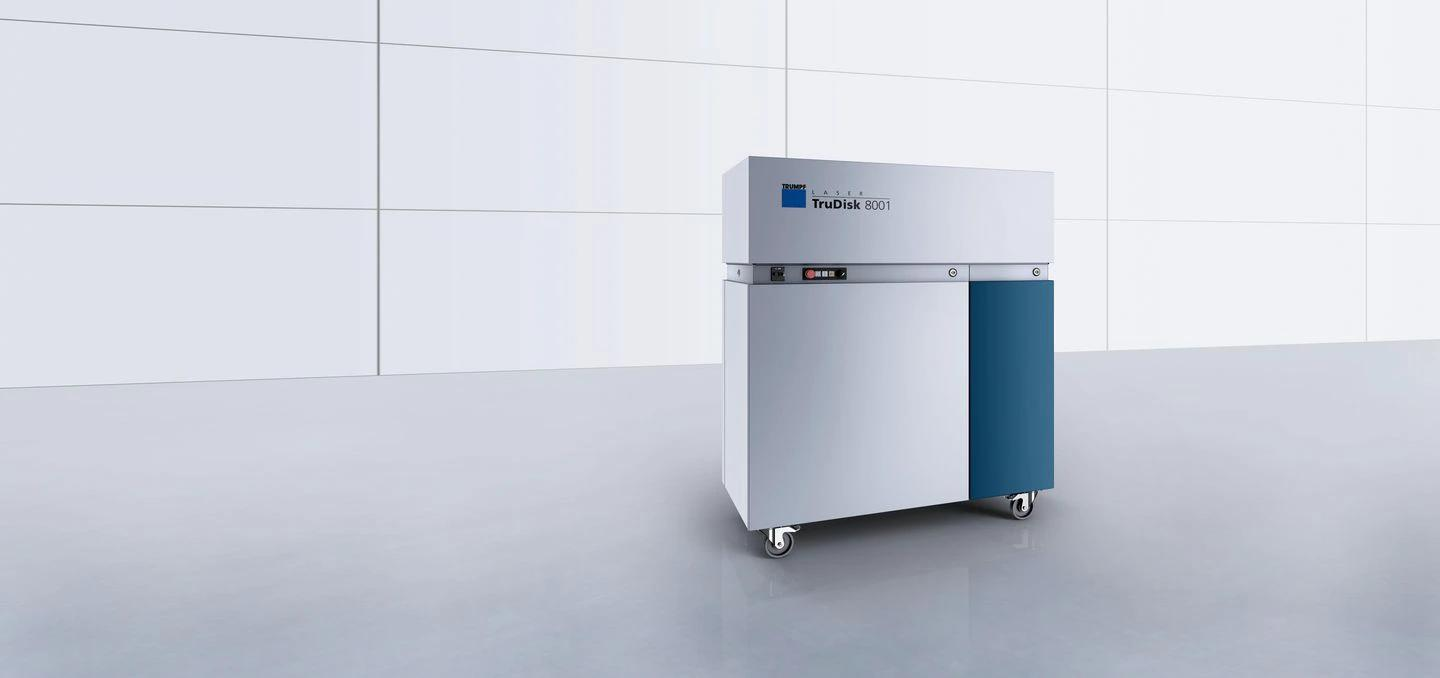
The thin-disk laser was invented in 1993 by Adolf Giesen’s team at the University of Stuttgart, with the paper formally published in 1994. After 30 years of development, it has moved from the lab to the industrial mainstream, with companies such as TRUMPF pushing it to the ten-kilowatt commercial level.
II. How It Works: How Does a Thin Disk Emit Ten Kilowatts?
1. Basic Structure: The “Active Mirror” Architecture
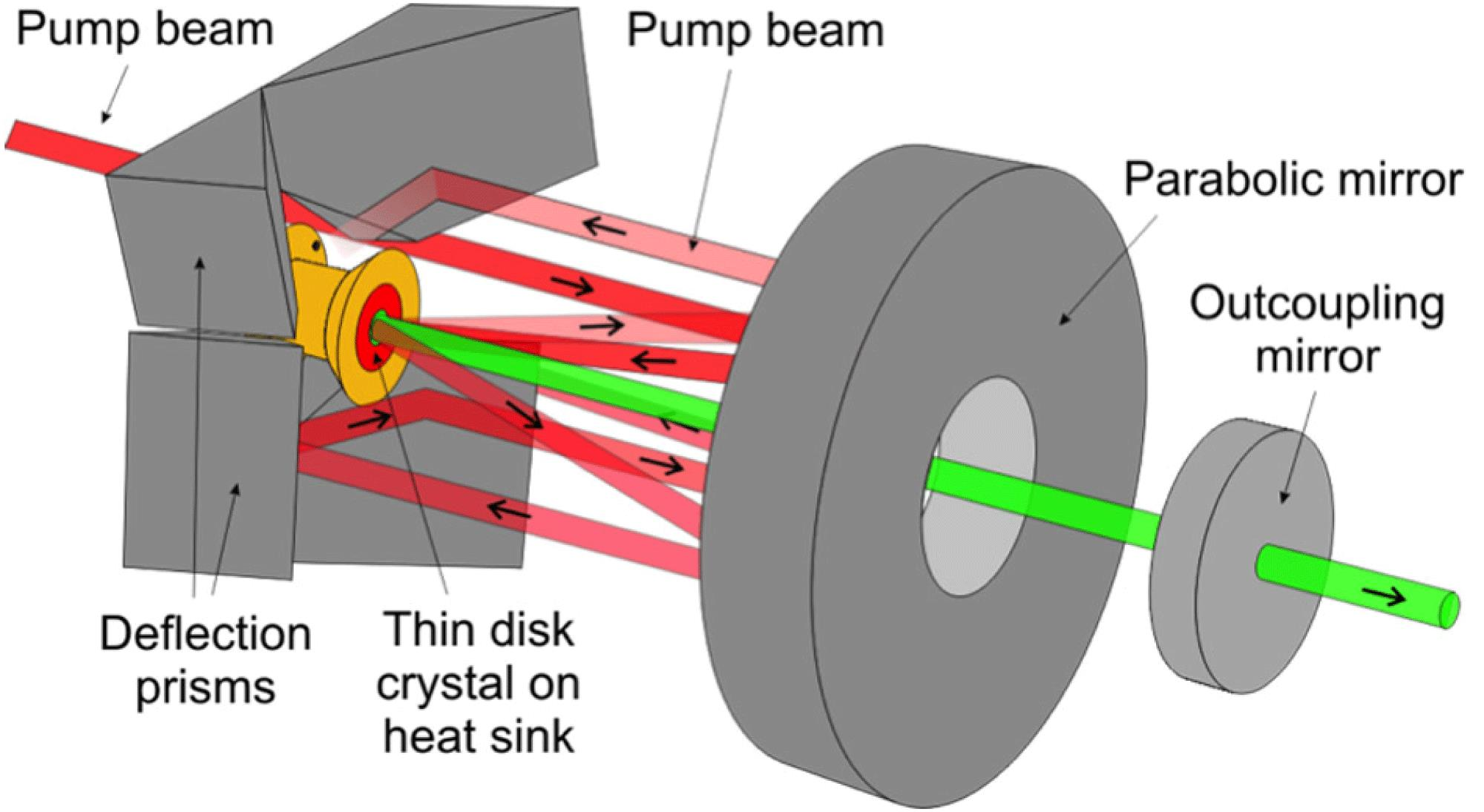
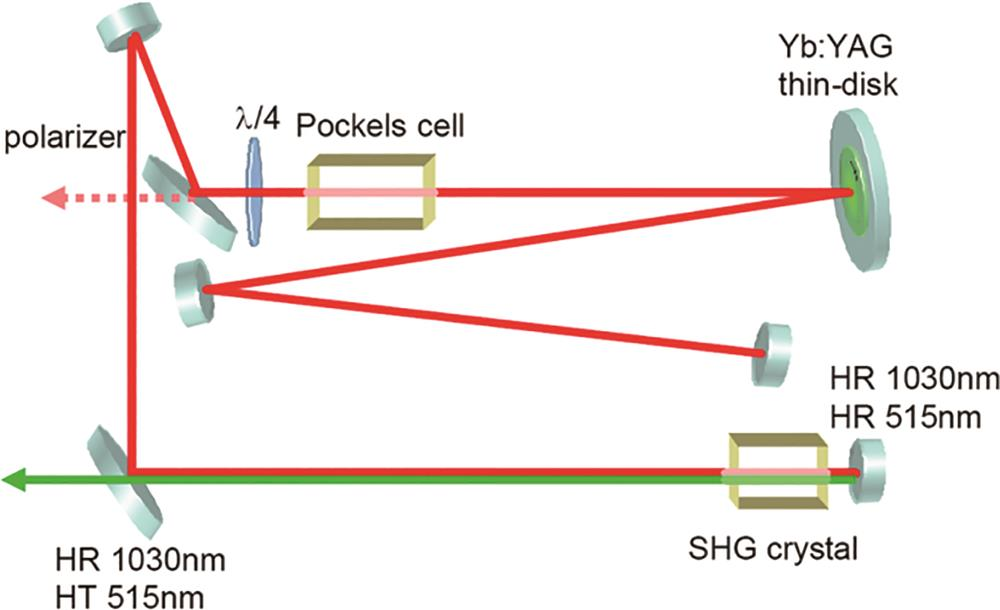
The gain medium of a thin-disk laser is a thin laser crystal (most commonly Yb:YAG), whose back face (the side bonded to the heat sink) is coated with a high-reflection dielectric film that reflects both pump light and laser light, hence the name “active mirror.”
In operation: pump light (typically 940 nm or 969 nm diode laser) enters the disk from the front, passes through the disk and is partly absorbed by Yb ions; the unabsorbed part reaches the back high-reflection film and is reflected back, passing through the disk again for further absorption. The laser resonator is formed by the disk’s back high-reflection film and the front output coupler; heat conducts from the disk back through a diamond or copper-tungsten heat sink to a water-cooling system.
2. Multipass Pumping: Solving “Too Thin to Absorb”
The disk is too thin (only 100-200 um), so the absorption efficiency of a single or double pump pass is low. The solution is multipass pumping: a set of optics (usually a parabolic mirror plus several prisms/mirrors) makes the pump light pass through the disk repeatedly – 16, 24, or even 44 passes – achieving total absorption efficiency above 95%.
3. Why Is Thermal Lensing So Weak?
In a traditional rod laser, heat conducts from the rod centre to the side, forming a radial temperature gradient → refractive-index gradient → thermal lensing; the higher the power, the stronger the thermal lens and the worse the beam quality.
In a thin-disk laser, heat conducts along the thickness (axial) direction, the temperature gradient is nearly parallel to the laser beam direction, and the radial temperature gradient is very small, so thermal lensing is extremely weak. Even better: as power rises the pump spot also enlarges, and the thermal lens optical power actually decreases, just offsetting the effect that a larger beam is more sensitive to thermal lensing – this is the physical basis of thin-disk lasers’ “power scalability.”
4. Pulsed Operation Modes
Thin-disk lasers not only work in continuous wave (CW) but are also very suited to pulsed output: Q-switching yields millijoule-level nanosecond pulses; mode-locking, thanks to very low nonlinearity and good beam quality, produces high-average-power femtosecond/picosecond pulses (currently mode-locked thin-disk lasers have reached over 200 W average power); combined with a regenerative amplifier it is the classic scheme for high-energy ultrashort pulses.
III. Key Parameters: Understanding the 10 Metrics of Thin-Disk Lasers
| Parameter | Typical Range | Description |
|---|---|---|
| Disk thickness | 100~300μm | Yb:YAG typical value; thinner dissipates heat better but needs more pump passes |
| Disk diameter | 5~45mm | Determines maximum scalable power |
| Output power | Tens of W to 10 kW+ | Single-disk multimode reaches ten-kW level, fundamental mode up to 4 kW |
| Beam quality M2 | Multimode 8-24, fundamental <1.4 | One of the core advantages of thin-disk lasers |
| Electro-optic efficiency | Can reach 60%+ | Optical-to-optical efficiency about 70% |
| Centre wavelength | ~1030 nm (Yb:YAG) | Can be frequency-doubled to 515 nm green, 343 nm UV |
| Number of pump passes | 16-44 passes | Determines pump absorption efficiency |
| Pulse energy (Q-switched) | mJ to tens of mJ | Suited to marking, drilling |
| Heat sink material | Diamond, copper-tungsten alloy | Diamond has the best thermal conductivity |
| Repetition rate | kHz~MHz | Depends on operation mode |
IV. Types: A Complete View of the Thin-Disk Laser Family
By operation mode
- Continuous-wave (CW) thin-disk laser: the most mature commercial type, power from hundreds of watts to ten-kW level, widely used in welding, cutting, 3D printing
- Q-switched thin-disk laser: nanosecond pulses, high pulse energy, suited to marking, drilling, medicine
- Mode-locked thin-disk laser: femtosecond/picosecond pulses, high average power, currently the highest-power femtosecond oscillator scheme
- Thin-disk amplifier: including regenerative and multipass amplifiers, used to amplify ultrashort pulse energy
By gain medium
- Yb:YAG thin-disk laser: most mainstream and mature, small quantum defect (~9%), high efficiency, good thermal performance
- Yb:LuAG thin-disk laser: higher thermal conductivity, suited to higher power
- Sesquioxide thin-disk: wider gain bandwidth, suited to ultrashort pulses
- 2 um-band thin-disk (Ho/Tm-doped): for medicine and defence
V. Applications: Where Are Thin-Disk Lasers Used?
1. Industrial Material Processing (Main Application)
- Laser welding: high power, high beam quality, suited to deep-penetration welding, remote welding, widely used in automobile bodies and power batteries
- Laser cutting: thick plate cutting, precision cutting, supports metal and non-metal
- 3D printing (SLM): high-power multimode thin-disk lasers are one of the main light sources for metal 3D printing
- Precision drilling: femtosecond/picosecond mode for fuel injector drilling; Bosch once used a 10 ps thin-disk laser to increase engine fuel efficiency by 20%
2. Ultrafast Scientific Research
As a high-power femtosecond oscillator, it is an important front-end light source for strong-field physics and attosecond science. Thin-disk regenerative amplifiers + multipass amplifiers can deliver sub-picosecond pulses with hundreds of mJ or even J-level energy. It maintains extremely low nonlinearity at very high peak power, making it the first choice for “power-scalable femtosecond lasers.”
3. Defence and Security
High-power pulsed thin-disk lasers are used for long-range lidar ranging and 3D imaging; multiple-disk beam combining can achieve higher power for directed-energy applications.
4. Medicine and Nonlinear Frequency Conversion
Dermatology treatment, ophthalmic surgery, dental treatment, etc. Due to low nonlinearity and good beam quality, they are very suited to intracavity frequency doubling to produce green, UV, and other wavelengths.
VI. Common Misconceptions: Beliefs That May Be Wrong
Myth 1: “The higher the thin-disk laser power, the worse the beam quality”
Not quite. Traditional rod lasers indeed have stronger thermal lensing and worse beam quality at higher power, but thin-disk lasers have a special “power-scalable” characteristic – as long as the pump spot area is enlarged, thermal lensing actually weakens while power rises, and beam quality can stay stable. Of course, in real products, for cost reasons many high-power models use multimode output, but that is a commercial choice, not a technical limit.
Myth 2: “Fibre lasers will eventually replace thin-disk lasers”
Each has advantages. Fibre lasers excel in CW power, efficiency, and flexible delivery, but their nonlinear effects limit high-peak-power pulse output; thin-disk lasers are stronger in high-peak-power, high-beam-quality pulses. In the real market the two coexist – fibre dominates kilowatt-level continuous cutting and welding, while thin-disk has the edge in high-precision micromachining and ultrafast applications.
Myth 3: “The thinner the thin-disk, the better”
Wrong. Although thinner dissipates heat better, being too thin causes: (1) insufficient pump absorption, needing more pump passes and a more complex optical system; (2) more severe transverse amplified spontaneous emission (ASE), limiting gain efficiency at large spots; (3) reduced mechanical strength, with thermal stress more likely to cause fracture. The actual thickness is a trade-off among heat dissipation, absorption, ASE, mechanical strength, and other factors.
Myth 4: “Thin-disk lasers can only output 1030 nm”
Wrong. Yb:YAG around 1030 nm is the most mainstream, but thin-disk lasers support many gain media. By choosing different dopant ions and host materials, different bands such as 1 um (Yb) and 2 um (Ho/Tm) can be output. Through nonlinear frequency conversion, green (515 nm), UV (343 nm), and other wavelengths can also be produced.
Myth 5: “A thin-disk laser is a rotating disk laser”
Easily confused. The disk of a thin-disk laser is fixed, with heat conducted through the back heat sink; another technology called a “rotary disk laser” uses a rotating disk several millimetres thick as the gain medium, dissipating heat by rotation. The two are completely different in principle – do not confuse them.
Myth 6: “Thin-disk lasers and thin-slice lasers are two different things”
Generally they refer to the same technology (different translations of thin-disk laser). But note that in Chinese, “thin-slice laser” is sometimes used broadly for any laser with a thin-sheet gain medium (including semiconductor thin-slice lasers, ceramic slices, etc.), a slightly wider scope – judge by context.
References
- RP Photonics Encyclopedia – Thin-disk Lasers (https://www.rp-photonics.com/thin_disk_lasers.html)
- DLR – History, principles and prospects of thin-disk lasers
- Laser Focus World – Photonic Frontiers: Disk Lasers
- SPIE Optipedia – Thin-Disk Lasers
- Laser & Photonics Reviews – A Decade of Sub-100-fs Thin-Disk Laser Oscillators
Related Reading
- Solid-State Lasers Explained
- Fibre Laser Starter Guide
- Ultrafast Laser Principles and Applications
- Q-Switching Technology Explained
Want to learn more about lasers? Browse the Soar Laser Encyclopedia to systematically study laser principles and applications.
Leave a Reply