


You may have heard that “lasers have good monochromaticity” – but did you know that ordinary fibre lasers typically have linewidths on the order of GHz, while a special kind of fibre laser can compress the linewidth to kHz or even below Hz, equivalent to pinpointing kHz or sub-Hz precision on an optical frequency of 192 THz (top products reach sub-Hz). This is the narrow-linewidth fibre laser – like the “precision tuner” of the laser family, pushing the frequency purity of light to the extreme.
From distributed fibre sensing detecting microstrain in pipelines, to coherent optical communication supporting 400G long-haul transmission, and lidar capturing subtle changes in wind fields – narrow-linewidth fibre lasers, with their ultrahigh frequency purity, are becoming indispensable core light sources for many precision applications. Today we take a comprehensive look at them.
Table of Contents
- I. Core Concepts: What Is Narrow Linewidth?
- II. How It Works: How Is Linewidth Narrowed?
- III. Key Parameters: Understanding Narrow-Linewidth Laser Specs
- IV. Types: Differences Among Narrow-Linewidth Schemes
- V. Applications: What Can Narrow Linewidth Do?
- VI. Common Misconceptions: Don’t Be Misled by Specs
I. Core Concepts: What Is Narrow Linewidth?
A narrow-linewidth fibre laser is, simply put, a fibre laser with an exceptionally narrow output optical spectral linewidth. Its core feature is “monochromaticity” – the output light has extremely pure frequency content.
Linewidth is the core metric describing laser monochromaticity, quantified by the full width at half maximum (FWHM) of the frequency spectrum. The smaller the linewidth, the higher the spectral purity, the better the monochromaticity, and the longer the coherence length.

In the formula above, Δνlaser is the laser linewidth (FWHM), hν is the photon energy, Δνc is the cavity bandwidth (inversely proportional to cavity length), and Pout is the output power. The formula shows that high intracavity power, a long resonator, and low loss are the three key factors for obtaining narrow linewidth. The linewidth of real lasers is usually far larger than this theoretical limit, because of technical noise such as mechanical vibration and temperature drift.
To use an analogy: linewidth is like the “purity” of a laser – the narrower the linewidth, the purer the colour, the stronger the coherence, and the more precise the measurements that can be made.
A few figures for intuition:
- Ordinary unselected-mode Nd:YAG laser: linewidth ~100 GHz, coherence length a few millimetres
- Narrow-linewidth laser with longitudinal-mode selection: linewidth ~100 MHz, coherence length a few metres
- High-quality narrow-linewidth fibre laser: linewidth ~1 kHz, coherence length on the order of tens of kilometres (top single-frequency products reach hundreds of km)
- Ultrastable-cavity-locked ultranarrow-linewidth laser: linewidth ~mHz level, coherence length hundreds of thousands of km
Easily confused: narrow linewidth ≠ single frequency
This is a frequently confused issue. Single frequency emphasises the “number of modes” – only one longitudinal mode oscillates in the resonator; narrow linewidth emphasises the “spectral width” – the total linewidth of the output spectrum is narrow.
A single-frequency laser is necessarily narrow-linewidth, but a narrow-linewidth laser is not necessarily strictly single-frequency: some lasers have 2-3 or even more closely spaced longitudinal modes, yet the total linewidth can still be at kHz or narrower, also called “narrow linewidth” but not truly “single frequency.” Such multimode narrow-linewidth lasers can be used in some applications (e.g. directly modulated optical communication), but in phase-noise-sensitive scenarios such as interferometry, beat noise between multiple longitudinal modes degrades coherence, and a true single-frequency laser must be used.
⚠ Note: the “linewidth” measured with an ordinary optical spectrum analyser (OSA) is the total spectral envelope width, not the true instantaneous phase-noise linewidth. An OSA typically has resolution on the order of GHz to MHz and simply cannot resolve kHz- or Hz-level instantaneous linewidth. To measure the true linewidth, specialised methods such as delayed self-heterodyne are needed.
II. How It Works: How Is Linewidth Narrowed?
The core idea for a fibre laser to achieve narrow-linewidth output is: use frequency-selective devices to limit the number of longitudinal modes in the resonator, while suppressing spectral broadening caused by phase noise and environmental disturbance.
1. DFB Type (Distributed Feedback) – the Most Mainstream and Stable
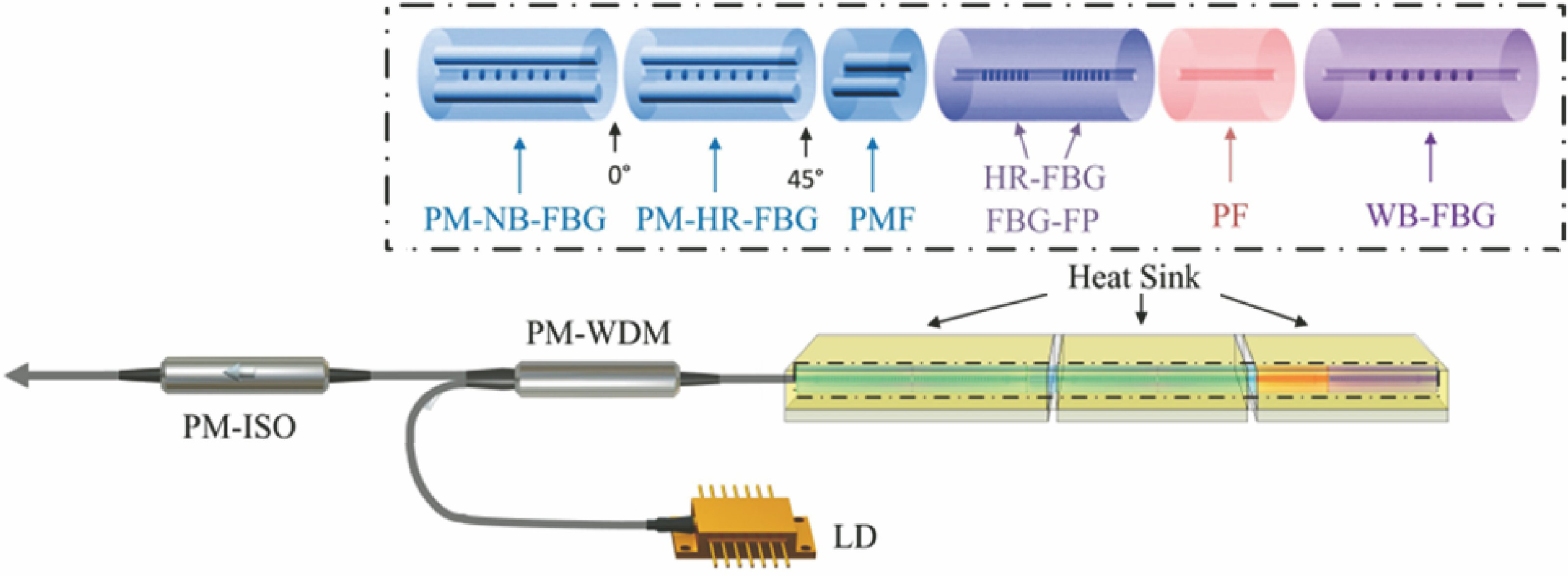
A pi-phase-shifted fibre Bragg grating is written directly into the rare-earth-doped fibre; the grating itself serves as both resonator and frequency-selective element. A defect mode forms at the phase-shift point, and only the longitudinal mode satisfying the Bragg condition with the lowest loss can lase.
- ✅ Short cavity (usually a few cm), large longitudinal-mode spacing, naturally prone to single longitudinal mode
- ✅ Compact structure, best stability, highest level of productization
- 📐 Linewidth level: typically 1-100 kHz, high-end products below 100 Hz
2. DBR Type (Distributed Bragg Reflector) – Can Achieve Narrower Linewidth
Two fibre Bragg gratings (FBG) serve as cavity mirrors, with a section of active gain fibre in between. The two FBGs act as the high-reflection mirror and the output coupler respectively.
- ✅ The cavity can be made longer, giving a theoretically narrower linewidth
- ⚠️ A longer cavity means smaller longitudinal-mode spacing, requiring extra measures to ensure stable single longitudinal mode
- 📐 Linewidth level: can reach below kHz or even Hz level
3. Ring Cavity + Narrowband Filter – Flexible but Less Stable
A narrowband filter (e.g. FP interferometer, fibre grating, Sagnac loop) is inserted into a ring fibre resonator, and the filter’s frequency selectivity suppresses unwanted longitudinal modes.
- ✅ Flexible cavity length, easy to introduce various functional devices
- ⚠️ Long cavity, small mode spacing, prone to mode hopping; strongly affected by the environment
4. Stimulated Brillouin Scattering (SBS) Linewidth Compression
The stimulated Brillouin scattering effect in fibre transfers pump energy to the Stokes wave. Because the Brillouin gain bandwidth is extremely narrow (tens of MHz), the output linewidth can be compressed to Hz or even sub-Hz level.
Why Does Linewidth Broaden?
The theoretical lower limit of laser linewidth is set by the Schawlow-Townes formula. But in practice many factors make the linewidth “fatter”: temperature fluctuations change the cavity length, mechanical vibration causes phase noise, pump noise brings gain fluctuation, and 1/f flicker noise broadens the spectral line at low frequencies… So making narrow linewidth is essentially a fight against all kinds of noise sources.
III. Key Parameters: Understanding Narrow-Linewidth Laser Specs
| Parameter | Meaning | Typical Value |
|---|---|---|
| Centre wavelength | Centre wavelength of the output laser | 1550 nm, 1064 nm, 2 um, etc. |
| Spectral linewidth | Full width at half maximum (FWHM) of the spectrum | Hz to kHz order |
| Side-mode suppression ratio (SMSR) | Ratio of main-mode power to side-mode power | >30 dB (>50 dB for high quality) |
| Relative intensity noise (RIN) | Intensity noise level | -140 ~ -160 dB/Hz |
| Frequency stability | Wavelength drift over time | MHz/h to Hz level |
| Coherence length | Propagation distance over which light remains coherent | Hundreds of metres to thousands of kilometres |

Coherence length lc is inversely proportional to linewidth Δν: the narrower the linewidth, the longer the coherence length. For example, a 1550 nm laser with a 1 kHz linewidth can have a coherence length of about 300 km. This is why narrow-linewidth lasers are so important in interferometry, fibre sensing, and other fields.
 Formula 3: coherence time τc and coherence length lc
Coherence time τc is the timescale over which the optical field maintains phase correlation, and is the reciprocal of linewidth. Coherence length is the distance light travels during the coherence time, i.e. lc = c · τc, where c is the speed of light in vacuum.
IV. Types
By cavity structure
- DFB fibre laser: phase-shifted grating distributed throughout the gain region, best stability, mainstream for industrial applications
- DBR fibre laser: FBGs at both ends sandwiching the gain fibre, can achieve narrower linewidth
- Ring-cavity narrow-linewidth fibre laser: filter inserted in the cavity, flexible but less stable
- Compound cavity type: short cavity + long cavity combined, balancing stability and narrow linewidth
By linewidth order
- kHz-level narrow linewidth: 1-100 kHz, mainstream for industrial applications
- Hz-level ultranarrow linewidth: 1 Hz to 1 kHz, for precision measurement and research
- sub-Hz/mHz-level ultranarrow linewidth: achieved after locking to an ultrastable cavity, for frontier research such as optical clocks
SBS – the core limit for high-power narrow-linewidth fibre
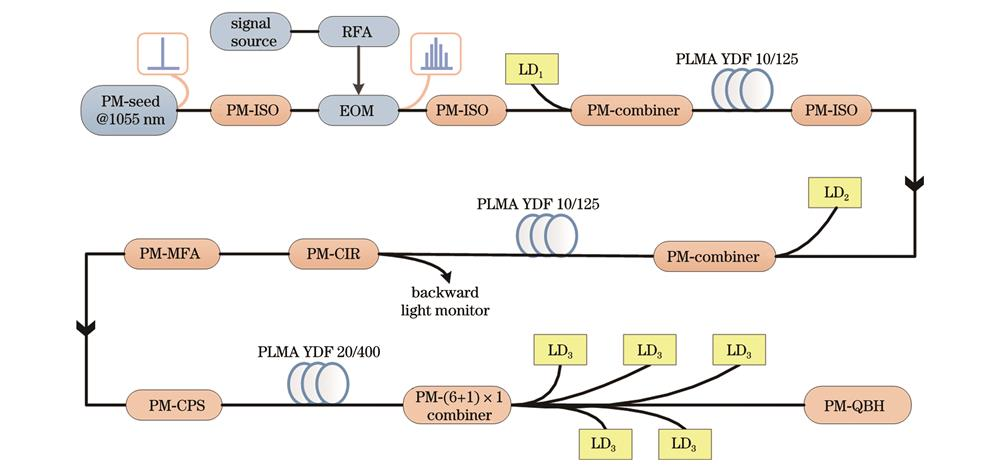
Narrow-linewidth fibre lasers face a core obstacle when power is scaled up: stimulated Brillouin scattering (Stimulated Brillouin Scattering, SBS). When the power of narrow-linewidth light propagating in fibre exceeds the SBS threshold, most energy is converted into backward-propagating Stokes light, which not only limits the forward output power but may also damage upstream optical components.
The SBS threshold is closely related to linewidth: the narrower the linewidth, the lower the SBS threshold. For single-frequency (kHz-level linewidth) 1550 nm fibre, the SBS threshold is often only a few milliwatts to tens of milliwatts. This is why high-power narrow-linewidth fibre lasers must use various SBS suppression techniques – large-mode-area fibre, temperature gradient, strain gradient, phase-modulation spectral broadening, etc.
V. Applications
1. Distributed Fibre Sensing (DAS/DVS/BOTDR)
Narrow-linewidth, high-coherence laser is the core light source for distributed fibre sensing. Systems based on Brillouin scattering or phase-sensitive OTDR can detect temperature and strain changes along the entire fibre, with resolution down to 0.1 C and 1 microstrain. Widely used in oil and gas pipeline monitoring, bridge health detection, perimeter security, etc.
2. Coherent Optical Communication
In 5G fronthaul and 400G/800G coherent optical communication systems, narrow-linewidth lasers serve as local oscillator sources; linewidth directly affects system bit error rate and transmission distance. The narrower the linewidth, the lower the phase noise and the more accurate demodulation.
3. Lidar
Especially coherent-detection lidar and Doppler wind lidar, where narrow-linewidth laser can greatly improve velocity and range accuracy.
4. Fibre Optic Gyroscope
Resonant fibre optic gyroscopes (R-FOG) need narrow-linewidth laser as a light source; only narrow linewidth yields sufficient gyro precision and sensitivity.
5. Quantum Science and Atomic Physics
Quantum key distribution (QKD), laser cooling and atom trapping, optical clocks and precision metrology – these frontier fields all need lasers with extremely narrow linewidth and high frequency stability.
6. Spectroscopy and Biomedicine
High-resolution laser spectroscopy, optical coherence tomography (OCT), etc. need narrow-linewidth sources to achieve high spectral resolution.
VI. Common Misconceptions
Myth 1: “Narrow linewidth” is the same as “single frequency,” completely equivalent
Correction: Single frequency is necessarily narrow-linewidth, but narrow linewidth is not necessarily strictly single frequency. Some lasers may have 2-3 closely spaced longitudinal modes with total linewidth at kHz level, which can also be called “narrow linewidth.” Only those with a single longitudinal mode oscillating can be called “single frequency.” When selecting, check whether it is “narrow linewidth” or “single-frequency narrow linewidth.”
Myth 2: The narrower the linewidth, the better and more advanced
Correction: Linewidth is a key metric, but not the only one. Also consider power, SMSR, RIN, frequency stability, tuning range, environmental adaptability, etc. Many industrial applications are fully served by kHz-level linewidth; blindly pursuing Hz level only sharply increases cost. Moreover, ultranarrow-linewidth lasers usually have stricter environmental requirements.
Myth 3: The specified linewidth is the linewidth in actual use
Correction: The linewidth specified by manufacturers is usually instantaneous linewidth (intrinsic linewidth over a short measurement time), but in actual use, due to temperature, vibration, and other environmental factors, the integrated linewidth observed over long periods is wider. The longer the timescale, the wider the measured linewidth (mainly from 1/f noise). Pay attention to measurement conditions when reading specs.
Myth 4: DFB and DBR differ only in name, with similar performance
Correction: The two differ greatly in structure: DFB has the grating distributed throughout the gain region, short cavity (a few cm), naturally resistant to mode hopping, good stability, but linewidth generally at kHz level; DBR has gratings at both ends sandwiching the gain fibre, the cavity can be longer and the theoretical linewidth narrower (down to Hz level), but a longer cavity means smaller mode spacing and greater tendency to hop modes. In short – DFB is stable, DBR is narrow, each with its own emphasis.
Myth 5: Narrow-linewidth fibre lasers can only be low power
Correction: The narrow-linewidth seed source itself is indeed not high-power, but through a MOPA configuration – narrow-linewidth seed source + multistage fibre amplifiers – power can be scaled to several watts or even tens of watts while maintaining narrow-linewidth characteristics. The key is that the amplifier must not introduce obvious linewidth broadening or noise degradation.
Myth 6: Linewidth testing is simple – just scan with a spectrometer
Correction: An ordinary optical spectrum analyser has only GHz-level resolution and simply cannot measure kHz- or Hz-level narrow linewidth. Narrow-linewidth measurement requires delayed self-heterodyne/self-homodyne methods, phase-noise analysis, or beat-note methods. The narrower the linewidth, the more complex the test method and the higher the cost.
References
- RP Photonics Encyclopedia – Single-frequency Lasers
- “Review of Short-Cavity Ultranarrow-Linewidth Low-Noise Fibre Laser Technology” | Progress in Laser and Optoelectronics
- “Narrow-Linewidth Laser Technology” | China Optics and Optoelectronics Industry Network
- NKT Photonics – Koheras single-frequency fibre lasers product technical data
- Sichuan Ziguan Optoelectronic Technology – narrow-linewidth single-frequency fibre laser technical data
References
- RP Photonics Encyclopedia — Narrow-linewidth Lasers
- RP Photonics Encyclopedia — Single-frequency Lasers
- RP Photonics Encyclopedia — Distributed Feedback Lasers
- RP Photonics Encyclopedia — Coherence Length
- RP Photonics Encyclopedia — Stimulated Brillouin Scattering
- “Fibre Lasers” (2nd edition) | Yan Ping et al., National Defence Industry Press
Leave a Reply