


You may have heard of laser “thermal processing” – machining by melting and vaporizing material at high temperature. But there is a kind of laser that does not work by “burning,” but by directly breaking the chemical bonds of the material, with a heat-affected zone so small it is almost negligible. This is the UV laser – the “cold-processing master” of the laser family.
From precision cutting of phone screens to photolithography of chips, and laser eye surgery – UV lasers, with their extremely short wavelength and very high photon energy, play an irreplaceable role in precision manufacturing, semiconductors, medicine, and more. Today we take a comprehensive look at UV lasers.
Table of Contents
- I. Core Concepts: What Is UV Laser?
- II. How It Works: How Is UV Light Generated?
- III. Key Parameters: Understanding UV Laser Specs
- IV. Types: Which Members Are in the UV Laser Family?
- V. Applications: What Can UV Lasers Do?
- VI. Common Misconceptions: Beliefs That May Be Wrong
- VII. References and Further Reading
I. Core Concepts: What Is UV Laser?
A UV laser is a laser whose output wavelength lies in the ultraviolet band, typically in the range 100 nm to 400 nm, on the short-wavelength side of visible light (400-760 nm), and completely invisible to the human eye.
From long to short wavelength, the UV band is subdivided into:
- Near UV (UVA): 315-400 nm – most commonly used in industry (e.g. 355 nm)
- Mid UV (UVB): 280-315 nm
- Deep UV (DUV / UVC): 200-280 nm – e.g. 266 nm, 248 nm, 193 nm, in the UVC band
- Vacuum UV (VUV): 100-200 nm – strongly absorbed by air (oxygen), requires a vacuum or nitrogen-purge environment
UV lasers have three core characteristics:
- Short wavelength → small diffraction limit, can focus to an extremely small spot (micrometre scale), enabling ultrahigh-precision machining
- High photon energy → UV photons have enough energy to directly break the chemical bonds of materials (photochemical action), rather than thermal melting
- Cold-processing characteristic → extremely small heat-affected zone, clean machined edges, no obvious thermal damage, slag, or microcracks
In short: a UV laser is a “light knife that can cut molecular bonds” – it does not burn, but directly “cuts” molecules to process materials.
II. How It Works: How Is UV Light Generated?
UV lasers are generated in two broad ways: direct generation and nonlinear frequency conversion.
Method One: Direct Generation of UV Laser Light
The laser gain medium itself emits in the UV band:
1. Excimer Laser
Uses a mixture of rare gas (Ar, Kr, Xe) and halogen gas (F, Cl) to form unstable “excimers” under high-voltage pulsed discharge. When the excimer transitions from the excited state back to the ground state, it releases a UV photon, then dissociates into atoms.
- Typical wavelengths: ArF 193 nm, KrF 248 nm, XeCl 308 nm, XeF 351 nm
- Features: large pulse energy, high peak power, but bulky, requires high-pressure gas, complex maintenance
2. Gas Ion Lasers
- Argon-ion laser: main lines at 351.1 nm and 363.8 nm (both near UV), low efficiency (~0.1%), requires water cooling
- Helium-cadmium laser (He-Cd): 325 nm, continuous output, low power (tens of mW)
- Nitrogen laser: 337.1 nm, pulsed operation, simple structure
3. UV Semiconductor Laser Diodes
Based on AlGaN (aluminium gallium nitride) wide-bandgap semiconductors, current injection directly produces UV light.
- Wavelength 370-400 nm (near UV), power mostly in the milliwatt range
- Smallest size, high efficiency, easy to modulate, but short wavelengths are hard to achieve
Method Two: Nonlinear Frequency Conversion (the Mainstream in Industry)
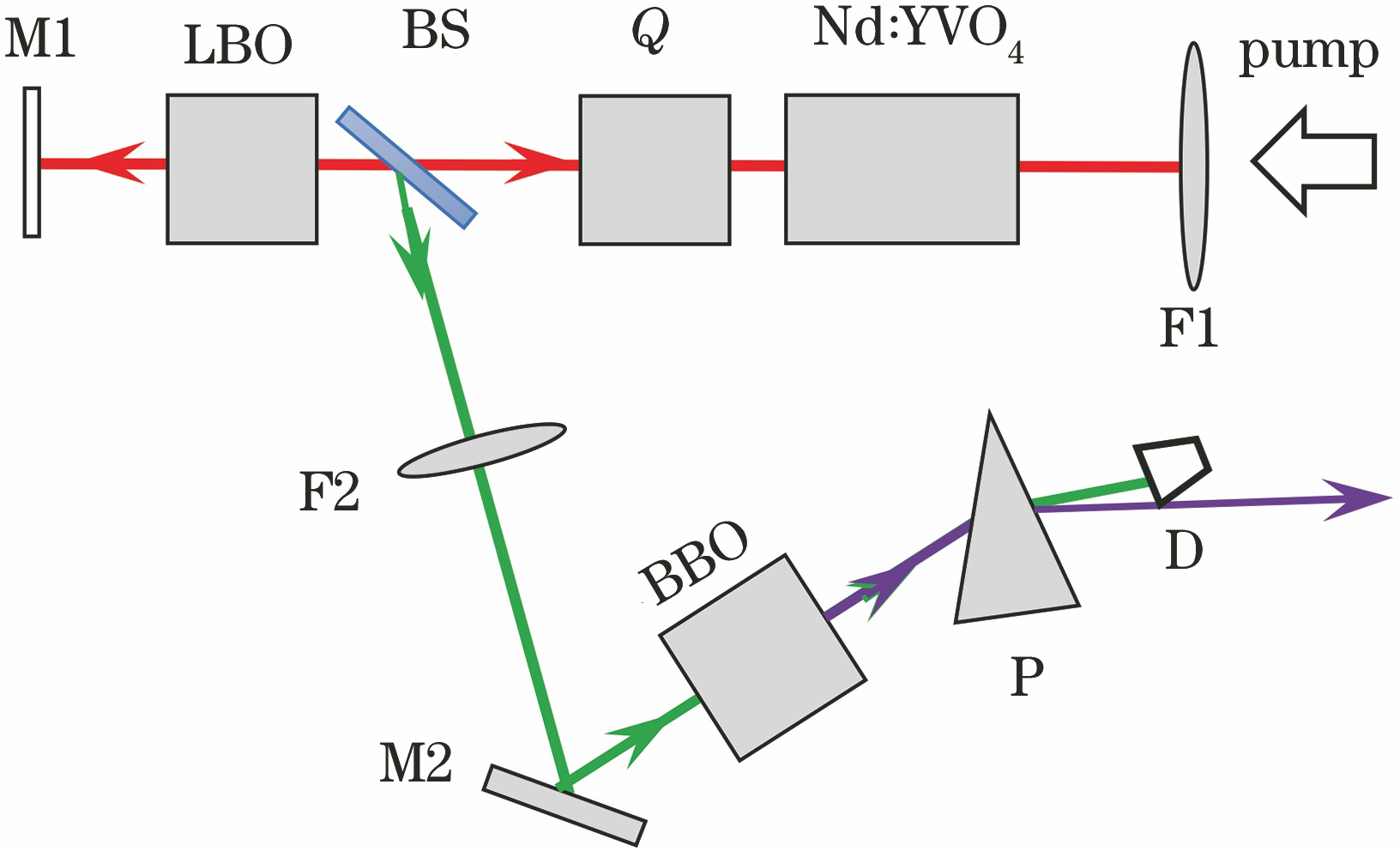
This is currently the main way industrial UV lasers are realised – a mature infrared solid-state laser serves as the “seed,” then nonlinear crystals up-convert the frequency to obtain UV light.
Take the classic 355 nm UV laser as an example:
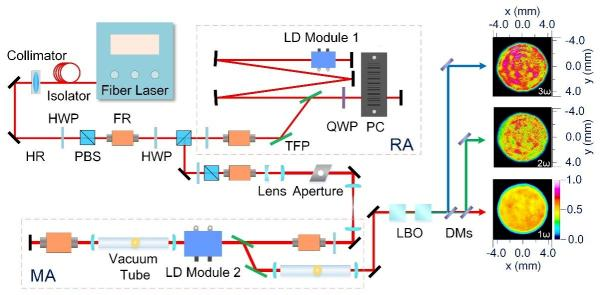
1064 nm infrared (fundamental) → KTP/LBO crystal doubling → 532 nm green (second harmonic) → 532 nm + 1064 nm sum frequency → 355 nm UV (third harmonic)
Generation of shorter wavelengths:
- 266 nm deep UV: fourth harmonic of 1064 nm (frequency doubling twice)
- 213 nm deep UV: fifth harmonic of 1064 nm (fourth harmonic + sum frequency)
Common nonlinear crystals: BBO (barium metaborate), LBO (lithium triborate), CLBO (cesium lithium borate), CBO (cesium triborate).
Technical Challenges
- Large material dispersion in the UV band makes phase matching difficult
- High photon energy at short wavelengths easily damages crystals and optics
- Multistage frequency conversion gives low overall efficiency (a few percent to teens)
- Ordinary glass absorbs strongly; UV-grade materials such as fused silica and CaF2 are required
III. Key Parameters: Understanding UV Laser Specs
| Parameter | Meaning | Typical Value |
|---|---|---|
| Centre wavelength | Wavelength of the output UV laser | 355/266/248/193 nm |
| Average power | Energy output per unit time | A few mW to tens of W (solid-state) |
| Pulse energy | Single-pulse energy | uJ to mJ class |
| Pulse width | Duration of a single pulse | ns / ps / fs |
| Beam quality M2 | Closeness to an ideal Gaussian beam | Usually < 1.5 |
| Power stability | Power fluctuation over time | < ±2% @ 8h |
IV. Types
By generation method
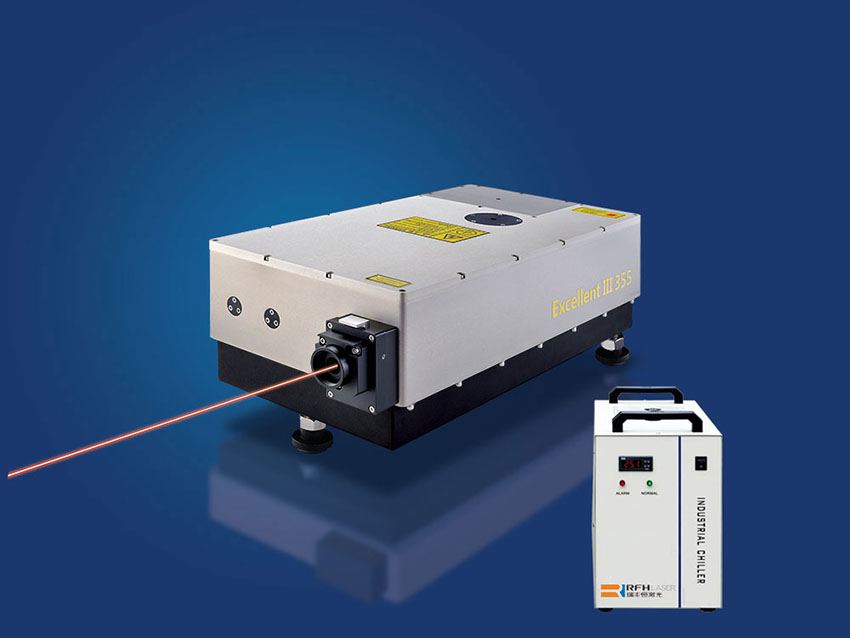
- Solid-state UV laser (DPSS): infrared solid-state laser + nonlinear crystal frequency conversion, 355 nm most mainstream, mainstay of industrial micromachining
- Excimer laser: gas-discharge type, short wavelength (193/248/308 nm), irreplaceable for lithography and eye surgery
- Gas ion laser: argon-ion, helium-cadmium, etc., low efficiency, gradually replaced by solid-state
- UV semiconductor laser: AlGaN laser diode, small and low-power, for UV curing and sterilization
- UV fibre laser: fibre laser + frequency conversion, compact, rapidly developing
- Dye laser: some dyes can output UV, tunable, for research
By pulse characteristic
- Continuous UV laser: low power (mW level), mainly for lithography inspection, spectroscopy, bio-instruments (e.g. flow cytometers, confocal microscopes)
- Nanosecond pulsed UV laser: the absolute mainstream for industrial applications, almost all Q-switched solid-state lasers + third-harmonic generation (355 nm), widely used for PCB/FPC cutting, marking, wafer dicing, and other micromachining
- Picosecond/femtosecond UV laser: ultrafast UV, shorter pulse width, smaller heat-affected zone, suited to scenarios with extremely high machining quality requirements (e.g. flexible OLED cutting, medical stent processing)
- Excimer pulsed laser: ns-level pulse width, large pulse energy, short wavelength (193/248 nm), irreplaceable for lithography and eye surgery
💡 Selection tip: in industrial micromachining, the Q-switched nanosecond 355 nm UV laser offers the best value – mature technology, simple maintenance, meeting most precision cold-processing needs. Only when the heat-affected zone requirement is extremely strict (e.g. medical implants, ultrathin flexible materials) should picosecond or femtosecond UV be considered.
V. Applications
1. Precision Micromachining (the Largest)
The “cold-processing” characteristic of UV lasers makes them the first choice for precision machining:
- PCB/FPCB microhole drilling (<25 um), precision cutting, scribing
- Semiconductor wafer dicing, film removal, chip marking
- Flexible OLED/LCD panel cutting, lift-off, repair
- Phone glass and sapphire screen cutting, drilling, engraving
- Precision cutting of medical catheters, stents, and other polymers
2. Laser Marking and Engraving
Fine marking on the surface of almost any material – metal, plastic, glass, ceramics – serial numbers, QR codes, logos, anti-counterfeit marks.
3. Photolithography and Semiconductor Manufacturing
The ArF 193 nm excimer laser is the core light source of current mainstream chip manufacturing, supporting the entire semiconductor industry.
4. 3D Printing (Photocuring)
The core light source of SLA/DLP photocuring 3D printing; a UV laser irradiates photosensitive resin to cure it layer by layer.
5. Medicine and Biotechnology
- Ophthalmic surgery: excimer laser keratomileusis (LASIK/PRK)
- Dermatology treatment: spot removal, skin rejuvenation
- Bio-instruments: flow cytometers, confocal microscopes, DNA sequencing
6. Scientific Research and Others
Laser spectroscopy, photochemistry research, FBG grating writing, lidar, ozone monitoring, UV curing, disinfection and sterilization, etc.
VI. Common Misconceptions
Myth 1: A UV laser is a “purple laser”
Correction: UV light is invisible to the human eye! The “purple light” we see is usually near-violet light around 405 nm, at the boundary between visible and UV. True 355 nm and 266 nm UV light is completely invisible. The purple spot seen on equipment is often a fluorescence effect or a small visible component – never use the naked eye to judge whether a UV laser is on.
Myth 2: All UV lasers are 355 nm
Correction: 355 nm is only the most common type (third harmonic of 1064 nm). The UV laser family covers a broad band from 100 to 400 nm, and different wavelengths have completely different uses: 355 nm for industrial micromachining, 266 nm for research and precision marking, 193/248 nm for lithography and eye surgery. The wavelength must be specified when selecting.
Myth 3: The higher the UV laser power, the better
Correction: Power is not the only metric; pulse width, repetition rate, beam quality, and pulse energy matter more. Many micromachining scenarios need appropriate pulse energy and high peak power, not high average power. Moreover, high UV power accelerates optic aging and demands more of cooling and stability.
Myth 4: “Cold processing” means no heat effect at all
Correction: “Cold processing” is a relative concept – UV photons have high energy (e.g. about 3.5 eV at 355 nm), enough to directly break the chemical bonds of many materials (C-C bond energy about 3.6 eV, C-H about 4.3 eV), so the processing mechanism is mainly photochemical rather than the thermal melting of infrared lasers, and the heat-affected zone is indeed much smaller (micrometre or even submicrometer).
But “cold” is not absolute: when single-pulse energy is too high or the repetition rate too fast, heat accumulation between pulses is still significant, causing an enlarged heat-affected zone, material recast, and microcracks. Moreover, in UV laser processing part of the photon energy still turns into heat (non-radiative relaxation). Therefore high-quality cold processing requires careful matching of pulse width, energy, and repetition rate.
Myth 5: All materials are suitable for UV laser processing
Correction: Although UV lasers absorb well in most materials, the optimal processing wavelength and parameters vary widely among materials. UV laser processing is also usually slower and costlier than fibre laser processing, so it is not economical in every scenario.
Myth 6: UV laser protection just means wearing sunglasses
Correction: UV lasers harm the eyes and skin far more than visible light! They can directly damage the cornea and lens (photokeratitis, cataracts) and may induce skin cancer. You must use protective glasses designed for the specific UV wavelength; ordinary sunglasses are useless. Deep UV also generates ozone and requires ventilation.
Myth 7: UV lasers have short lifetime and troublesome maintenance
Correction: This is outdated. Today’s all-solid-state UV lasers (especially 355 nm) are very mature, with lifetimes of tens of thousands of hours and little routine maintenance. Excimer lasers do need regular maintenance because of high-pressure gas, but their place in lithography is irreplaceable.
VII. References and Further Reading
- RP Photonics Encyclopedia — Ultraviolet Lasers
- RP Photonics Encyclopedia — Ultraviolet Light
- RP Photonics Encyclopedia — Excimer Lasers
- “UV Lasers and Their Applications in Laser Processing” | Acta Optica Sinica
- “Principles of Lasers” (7th edition) | Zhou Bingkun et al., National Defence Industry Press
- Electronics Fans – UV laser technology analysis
- Laser Manufacturing Network – Understanding UV lasers in one article
Leave a Reply