


What Is Nonlinear Optics? How Materials Behave Under Intense Light
Nonlinear optics studies what happens when intense light meets matter and the medium’s response is no longer proportional to intensity: double the input and the output does more than double, while frequencies that were never there appear. This article covers the physical origin, the make-or-break role of phase matching, six key parameters, two families of effect and six application areas.
Contents
- 1. What Is Nonlinear Optics? The Core Concept
- 2. How It Works: What Makes Nonlinear Optics Possible
- 3. Key Parameters: Reading a Nonlinear Device Specification
- 4. Main Types: Which Kinds of Nonlinear Effect Exist
- 5. Applications: Where Nonlinear Optics Is Actually Used
- 6. Common Misconceptions: Four Widely Held Myths
1. The Core Concept: What Is Nonlinear Optics?
Nonlinear optics is the branch of optics that studies how light and matter interact when the medium’s response is not linearly related to intensity. The test is direct: double the incident intensity and the output does not simply double, and frequencies that did not exist before may appear. That sets it apart from the linear optics we are used to — reflection, refraction, interference, diffraction — where the output stays strictly proportional to the input no matter how strong the light is.
The field started late, for an obvious reason: under ordinary light sources nonlinear effects are so weak as to be unobservable. Only in 1961 did Franken focus a ruby laser (694.3 nm) into a quartz crystal and record the second harmonic at 347 nm — the line was so faint it was barely visible, but it proved that the intensity a laser provides is enough to make a medium behave nonlinearly. Nonlinear optics then moved from theory into the laboratory and gradually became a routine tool in laser technology, optical communication and spectroscopy.
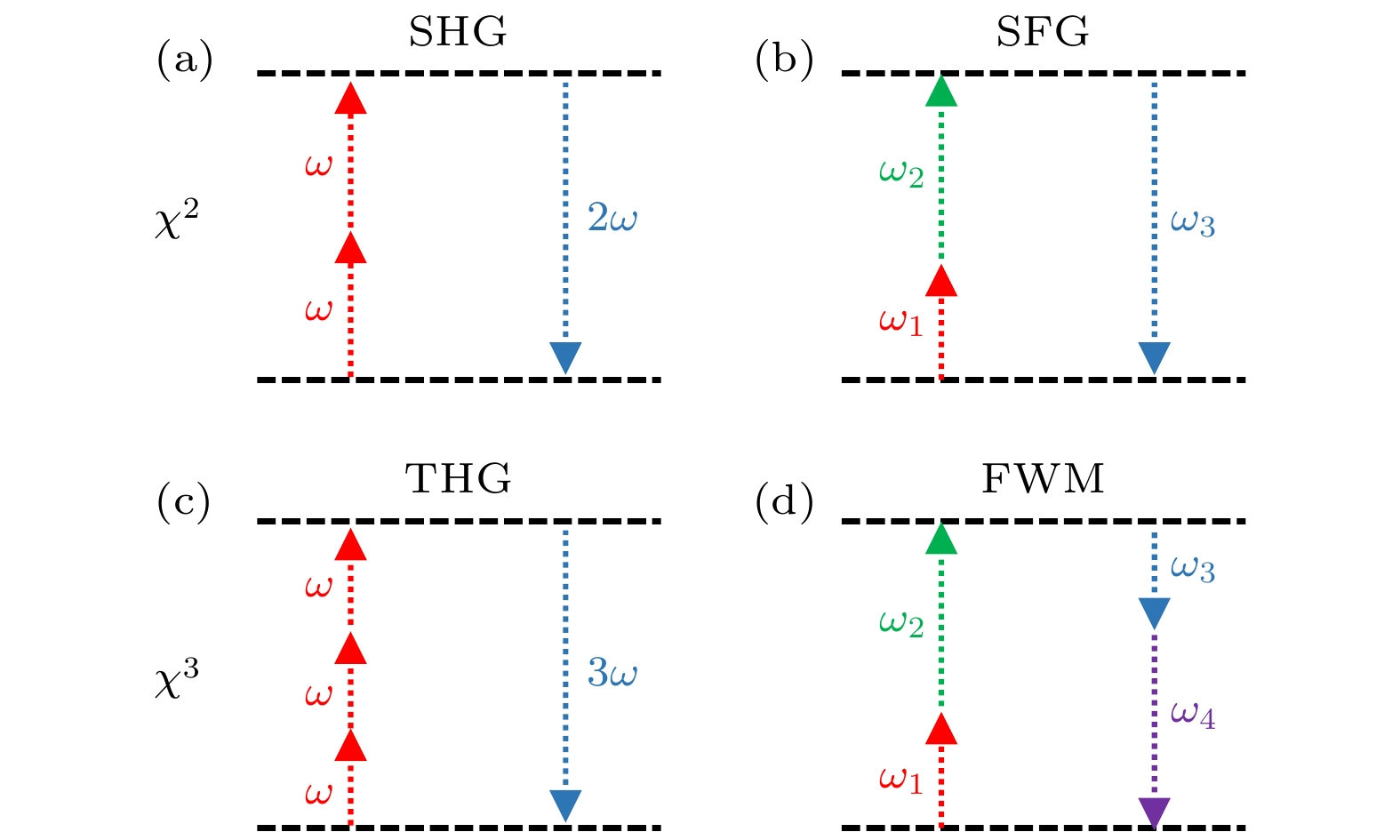
Physically, the nonlinearity comes in two families. Second-order nonlinearity (χ⁽²⁾) exists only in materials lacking inversion symmetry — nonlinear crystals being the standard case — and gives rise to second-harmonic generation, sum- and difference-frequency generation, and optical parametric amplification and oscillation. Third-order nonlinearity (χ⁽³⁾) exists in almost every medium, glass, fibre, gas and even liquid included, and gives rise to the Kerr effect, self-phase modulation, four-wave mixing, stimulated Raman scattering and stimulated Brillouin scattering. The two differ in magnitude by more than ten orders, and the applications they serve are just as distinct.
2. How It Works: What Makes Nonlinear Optics Possible
The physical basis is the polarisation response of a medium under intense light. When light enters, the optical field pushes the electron cloud of each atom or molecule away from equilibrium, creating an electric dipole moment. At low intensity the polarisation is proportional to the field, which is linear optics; at high intensity the electrons are pushed far enough that the restoring force stops being proportional to the displacement, and the polarisation has to be described by higher-order terms:
P = ε₀(χ⁽¹⁾E + χ⁽²⁾E² + χ⁽³⁾E³ + …)
Here χ⁽¹⁾ is the linear susceptibility, and χ⁽²⁾ and χ⁽³⁾ are the second- and third-order nonlinear susceptibilities. The E² term means two photons can merge into one photon of twice the frequency, which is where second-harmonic generation comes from; the E³ term accounts for third-order processes such as four-wave mixing.
Second-order nonlinearity (χ⁽²⁾) exists only in materials without inversion symmetry, nonlinear crystals being the standard example. It produces second-harmonic generation (SHG), sum-frequency generation (SFG), difference-frequency generation (DFG), optical parametric amplification and oscillation (OPA/OPO) and optical rectification. The symmetry requirement is not arbitrary: in a centrosymmetric medium the polarisation reverses exactly when the field reverses, so the E² term cancels itself out.
Third-order nonlinearity (χ⁽³⁾) carries no such restriction and exists in almost all materials, isotropic glass and fibre included. It brings the Kerr effect (refractive index varying with intensity, and from that self-phase modulation, cross-phase modulation and self-focusing), four-wave mixing, stimulated Raman scattering, stimulated Brillouin scattering and two-photon absorption. Coefficient for coefficient, third order is far weaker than second, but fibre can stretch the interaction length to kilometres, and the accumulated effect becomes just as pronounced — which is precisely what makes fibre nonlinear devices viable.
High intensity, though, is only the entry ticket. What decides efficiency is phase matching. Materials are dispersive, so waves of different frequency travel at different speeds, and the light newly generated by the nonlinear polarisation gradually falls out of step with the polarisation driving it. After a certain distance the new light is in antiphase with what is already there and starts handing the energy back. That distance is the coherence length lc = π/Δk, where Δk = k₃ − k₁ − k₂ is the wave-vector mismatch. Only with Δk = 0 does the energy keep flowing one way.
Engineering offers two routes to that condition. The first uses the birefringence of the crystal, choosing an angle or a temperature at which the fundamental and the harmonic see the same refractive index (angle matching, temperature matching). The second is quasi-phase matching: flip the spontaneous polarisation of the crystal once every coherence length (the poling period of PPLN is Λ = 2lc), so the phase error turns around half a step before it would cancel, and the contribution keeps accumulating over the whole crystal. The first tunes flexibly; the second can exploit the crystal’s largest nonlinear coefficient d₃₃ and is several times more efficient.
◆ An analogy
Phase matching is like a group of people pushing a swing in turn: each one pushes at the instant the swing reaches its highest point, and after a few rounds it is flying; let one person’s timing slip by half a beat and that push undoes the work the others just did. The coherence length is the time before the rhythm starts to slip, and quasi-phase matching is what happens when, just as it is about to slip, someone takes over and pushes from the other side.
3. Key Parameters: Reading a Nonlinear Device Specification
The datasheet of a nonlinear device is shorter than that of a laser, but every entry maps onto either efficiency or damage risk. These six are the first to check when assessing a material or a device:
| Parameter | What it means | Why it matters |
|---|---|---|
| Nonlinear susceptibility (χ⁽²⁾/χ⁽³⁾) | The core measure of how nonlinear a material is. χ⁽²⁾ is usually quoted in pm/V, while χ⁽³⁾ relates directly to the nonlinear refractive index n₂. The larger the value, the stronger the effect at a given intensity. | Sets the strength of the effect at a given intensity and is the first criterion in choosing a nonlinear material. A large χ⁽²⁾ gives more efficient harmonic generation; a large χ⁽³⁾ makes optical switching and Kerr effects more pronounced. |
| Effective nonlinear coefficient (d_eff) | The coefficient that actually does the work in a real frequency-conversion setup — it varies with crystal cut and polarisation configuration and is usually smaller than the crystal’s maximum. The unit is pm/V. | Sets conversion efficiency and the crystal length required. The larger d_eff, the higher the output for the same conditions, or the shorter the crystal needed for the same efficiency. |
| Nonlinear refractive index (n₂) | The coefficient describing how refractive index changes with intensity in a third-order process, usually in cm²/W or m²/W. Fused silica fibre has n₂ of about 3×10⁻¹⁶ cm²/W. | The physical origin of self-focusing, self-phase modulation and Kerr-lens mode locking. A large n₂ makes nonlinear effects easier to reach, but at high power it also makes beam distortion and damage easier to reach. |
| Phase-matching bandwidth | The range of wavelengths or angles over which conversion still works efficiently around the phase-matching point. The wider the band, the greater the tolerance in wavelength, angle and temperature. | Sets how forgiving the device is about operating wavelength and temperature. A wide band is more stable and easier to align, and is a prerequisite for ultrashort pulses and tuneable lasers. |
| Nonlinear coefficient γ | The parameter commonly used for fibre, combining n₂, wavelength and effective mode area: γ = 2πn₂/(λA_eff), in rad/(W·m). | The core figure in fibre nonlinear design. The larger γ, the easier self-phase modulation and Raman scattering become; highly nonlinear fibre is used for wavelength conversion, while ordinary telecom fibre has to keep nonlinearity to a minimum. |
| Damage threshold | The maximum intensity a material can take (W/cm² for continuous light, GW/cm² for pulses); beyond it the damage is irreversible. It is the first limit in any high-power nonlinear application. | Sets the maximum operating power and the lifetime of the device. High-power work demands a high-threshold material and a spot size chosen so that peak intensity stays below the threshold. |
4. Main Types: Which Kinds of Nonlinear Effect Exist
There are two main ways to classify: by nonlinear order, which is about physical mechanism, and by application, which is about what you do with it. Real devices cross the two.
By nonlinear order
- Second-order effects (χ⁽²⁾): these need a non-centrosymmetric medium and cover second-harmonic generation, sum-frequency generation, difference-frequency generation, optical parametric amplification and oscillation, and optical rectification. The coefficients are large and conversion efficient, which makes this the main route to nonlinear frequency conversion today.
- Third-order effects (χ⁽³⁾): present in virtually every medium, covering the Kerr effect (and the self-phase modulation, cross-phase modulation and self-focusing that follow from it), four-wave mixing, stimulated Raman scattering, stimulated Brillouin scattering and two-photon absorption. Weak at any one point, but in a long medium such as fibre the accumulated effect is pronounced.
By application
- Nonlinear frequency conversion: using nonlinear effects to reach new wavelengths — second and third harmonic generation, sum and difference frequency, parametric oscillation — the main way to obtain lasers at unusual wavelengths.
- Nonlinear propagation: the study of how intense light behaves as it travels through a medium, including soliton propagation in fibre, supercontinuum generation and pulse compression.
- Nonlinear signal processing: optical switching, wavelength conversion and optical logic gates built on nonlinear effects.
- Nonlinear measurement techniques: pulse characterisation (autocorrelators, FROG) and material characterisation (Z-scan measurement of n₂).
5. Applications: Where Nonlinear Optics Is Actually Used
The six directions below cover almost all practical use today. The first two make new wavelengths, the middle three process light with nonlinearity, and the last one uses nonlinearity to see.
- Laser wavelength conversion: the most mature and most widespread application. A 1064 nm Nd:YAG laser frequency-doubled gives 532 nm green, tripled gives 355 nm ultraviolet, and quadrupled reaches 266 nm deep ultraviolet — the green and UV light used in industrial marking, precision machining and ophthalmic treatment comes almost entirely from this step.
- Tuneable laser sources: an optical parametric oscillator (OPO) tunes continuously over a wide range simply by changing crystal angle or temperature, and it reaches well beyond 3 μm into the mid-infrared — a region short of usable laser gain media, where the OPO is close to the only option. Widely used in spectroscopy, environmental monitoring and infrared countermeasures.
- Optical communication and signal processing: fibre nonlinearity cuts both ways. Stimulated Brillouin scattering caps the power a single-mode fibre can carry at a few dBm, and stimulated Raman scattering shifts energy from short-wavelength channels to long-wavelength ones; both limit system power and channel count. Turn it around and four-wave mixing gives wavelength conversion, Raman scattering gives distributed amplification, and nonlinearity underpins phase-sensitive amplification and all-optical regeneration.
- Ultrafast lasers and supercontinuum: launch femtosecond pulses into photonic crystal fibre and self-phase modulation plus soliton fission broaden the spectrum by more than an octave, producing a supercontinuum — the light source behind optical frequency combs, broadband absorption spectroscopy and optical coherence tomography (OCT).
- Pulse compression and shaping: self-phase modulation imposes a chirp on the pulse, and a grating or prism pair supplies the negative dispersion to compress picosecond and femtosecond pulses down to tens of femtoseconds or even few-cycle durations; multi-pass cell compression and self-similar amplification follow the same logic.
- Biomedical imaging: second-harmonic generation imaging needs no fluorescent label, because structures such as collagen are themselves non-centrosymmetric and generate the signal, which suits the study of tissue fibrosis. Two-photon fluorescence microscopy excites in the near-infrared and only generates signal at the focus, giving better penetration depth and less phototoxicity than single-photon confocal imaging.
6. Common Misconceptions
Nonlinear optics spans physics, materials and devices, and the misunderstandings tend to come from taking one family of effects for the whole. These four are the ones we are asked about most:
Misconception 1: nonlinear effects are bad and should be avoided
Nonlinearity is a double-edged sword. In optical communication and high-power laser systems, stimulated Brillouin and Raman scattering really do limit performance and have to be suppressed; but in many settings they are the mechanism that delivers the function — wavelength conversion, supercontinuum and pulse compression all depend on them. The point is not to avoid nonlinearity but to judge where it must be pushed down and where it must be pushed up.
Misconception 2: raise the intensity high enough and conversion efficiency rises without limit
Efficiency depends on intensity but is capped by phase matching. With a phase mismatch the energy oscillates back and forth between the interacting waves, returns after one coherence length, and no amount of intensity buys net conversion. Push the intensity far enough and you hit the damage threshold first, or trigger higher-order processes that scatter the energy elsewhere.
Misconception 3: nonlinear optics only happens in crystals
Second-order nonlinearity does need a non-centrosymmetric medium, so harmonic generation cannot do without a crystal. But third-order nonlinearity exists in almost every transparent medium: glass, fibre, gas, liquid and semiconductor alike. Fibre nonlinearity became a field of its own because a small core and a long interaction length build a weak χ⁽³⁾ effect up to a useful magnitude.
Misconception 4: there was no nonlinear optics before the laser
The theory came first. Göppert-Mayer predicted two-photon absorption in her doctoral thesis in 1931, when no light source could possibly have confirmed it; Franken observed second-harmonic generation in quartz with a ruby laser in 1961, and that is when the field truly began. Put accurately: theory ran thirty years ahead, and experiment was held back thirty years by the light source.
Leave a Reply