


What Is a Fibre Amplifier? EDFA (Erbium-Doped Fibre Amplifier) Is Only One of Them
A fibre amplifier is an optical amplifier whose gain medium is a speciality fibre doped with rare-earth ions; pump light excites those ions and stimulated emission does the rest. It is the core component of optical communication, high-power lasers and fibre sensing, and its advantages are good beam quality, excellent heat dissipation and easy integration. This article sets out the principle, parameters, types and applications.
Contents
- 1. What Is a Fibre Amplifier? The Core Concept
- 2. How It Works: What Makes Fibre Amplification Possible
- 3. Key Parameters: Reading a Fibre Amplifier Specification
- 4. Main Types: Which Kinds of Fibre Amplifier Exist
- 5. Applications: Where Fibre Amplifiers Are Actually Used
- 6. Common Misconceptions: Four Widely Held Myths
1. The Core Concept: What Is a Fibre Amplifier?
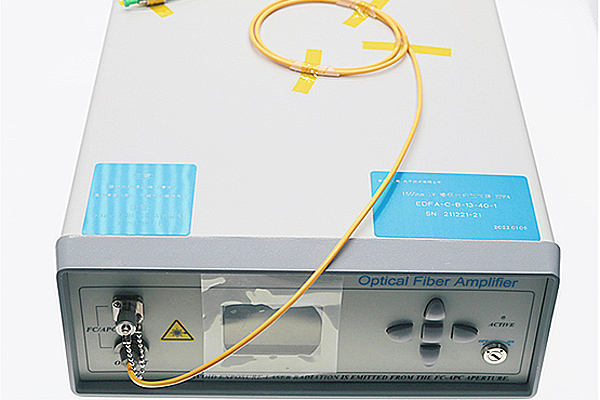
A fibre amplifier is a class of optical amplifier that uses a rare-earth-doped optical fibre as its gain medium. Put simply, a length of active fibre — fibre doped with laser-active ions — serves as the amplifying medium: pump light lifts the rare-earth ions to a higher level, and when the signal passes through that stretch of fibre it is amplified by stimulated emission.
Fibre amplifiers are the most important and most widely used type of optical amplifier. They inherit the virtues of optical fibre — good beam quality, excellent heat dissipation, a compact footprint and easy integration with fibre systems. From low-noise preamplifiers to high-power units of several kilowatts, they cover an unusually wide range of applications and sit at the core of both the modern laser industry and optical telecommunications.
In a link, the fibre amplifier is often not the most expensive device yet frequently the first to limit the system: too little gain and the receiver cannot resolve the signal; a noise figure 1 dB higher and the usable span shrinks accordingly; too little saturated power and the pulse peaks get clipped. What matters at selection is therefore not the absolute value of any one figure but how these figures work together in your particular system.
In device terms a fibre amplifier is an active component: it needs a pump to work, and once the pump is switched off the gain vanishes. That is also where it parts company with passive parts such as attenuators, couplers and isolators — a passive device only redistributes the optical power already present, whereas a fibre amplifier converts the electrical and optical power of the pump into signal power, so the output can exceed the input. And because the gain comes from energy stored on the rare-earth ions, it cannot respond instantaneously the way a parametric amplifier does: the upper-state lifetime is of the order of milliseconds. That governs how it amplifies ultrashort pulses — they must be stretched first — and it also brings the unavoidable cost of amplified spontaneous emission noise.
2. How It Works: What Makes Fibre Amplification Possible
A fibre amplifier works on stimulated emission, with energy-level transitions of the doped rare-earth ions at its core. In short: pump light excites the ions to a higher level, creating population inversion; when the signal passes, ions in the upper level hand their energy to it by stimulated emission, and the light is amplified.
The whole thing can be broken down into three key elements plus one amplification process:
Element 1: The Gain Medium — Doped Rare-Earth Ions
A small quantity of rare-earth ions is doped into the fibre core, and each ion corresponds to a different amplification band. The common ones are:
| Rare-earth ion | Main amplification band | Typical applications |
|---|---|---|
| Erbium (Er³⁺) | 1550 nm (C and L bands) | Optical communication, EDFA |
| Ytterbium (Yb³⁺) | ~1064 nm (1 μm band) | High-power industrial lasers, YDFA |
| Thulium (Tm³⁺) | ~2 μm (mid-infrared) | Medical surgery, gas sensing |
| Neodymium (Nd³⁺) | 1064 nm / 1300 nm | Low-power amplifiers, pulse amplification |
| Praseodymium (Pr³⁺) | ~1300 nm | O-band optical communication amplification |
Element 2: Pumping — How the Energy Gets In
Pump light is coupled into the fibre through a wavelength-division multiplexing (WDM) coupler and supplies energy to the rare-earth ions. Depending on the relative direction of pump and signal there are three common arrangements:
| Pumping scheme | Characteristics | Typical use |
|---|---|---|
| Co-directional pumping | Pump and signal travel in the same direction; inversion is strong at the input, so noise is low | Low-noise preamplifiers |
| Counter-directional pumping | Pump and signal travel in opposite directions; gain is high at the output, so output power is high | Power amplifiers, high-power output |
| Bi-directional pumping | Pumped from both ends; the gain distribution is more even and noise and power are balanced | High-performance amplifiers needing both low noise and high power |
Element 3: Fibre Structure — What Sets the Power Ceiling
High-power fibre amplifiers generally use a double-clad fibre: a very thin core that preserves single-mode beam quality, surrounded by a much larger inner cladding that can carry multimode pump light. The pump bounces back and forth in the inner cladding, crossing the core repeatedly until the rare-earth ions absorb it. That allows a high-power multimode pump laser to be used while the output stays single-mode.
The Amplification Process: Three Steps
With the three elements in place the process itself has only three steps, and the order cannot be reversed:
- Population inversion: pump light enters the doped fibre and the rare-earth ions absorb photons and move to a higher level. “Inversion” means there are more ions in the upper level than the lower one — without it, the signal is absorbed more than it is emitted and is simply attenuated.
- Stimulated emission: as the signal propagates along the core it induces stimulated emission from the excited ions, which release photons of the same frequency, phase and direction. One incoming photon leaves as two, and that is where the gain comes from.
- Output: after accumulating gain over a few metres to a few tens of metres of fibre, the signal exits at the output end. Longer is not better — amplified spontaneous emission grows with length too, and beyond the optimum length the signal-to-noise ratio actually degrades.
◆ Gain coefficient formula

The gain coefficient g is proportional to the upper-level population density Nexc and the stimulated-emission cross-section σem.
The total gain is G = exp(g·L), where L is the length of the gain medium. This explains why a longer fibre gives more total gain.
◆ An analogy
If an optical link is an old post road, a fibre amplifier is the staging post along it: the horse is tired (the signal has attenuated), so a fresh one is harnessed (the power is restored), while direction and destination stay the same. The difference is that a staging post really does keep horses in reserve, whereas a fibre amplifier keeps ions in the upper level — and only for milliseconds. That is why it handles continuous light and nanosecond pulses but not femtosecond ones, which have to be stretched before they are amplified.
Put the three elements and the one process together and the design space of a fibre amplifier comes down to three things: which ion is doped in, which sets the band; how the pump is injected, which sets how noise and power are shared; and how the fibre is structured, which sets how high the power can go. The rest of the work is getting the three to give way to one another in a particular system.
3. Key Parameters: Reading a Fibre Amplifier Specification
A fibre amplifier datasheet is shorter than a laser datasheet, but every entry maps onto a bottleneck somewhere in the system. These five are the first to confirm at selection:
| Parameter | What it means | Why it matters |
|---|---|---|
| Small-signal gain | The gain when the input signal is very weak. A single stage typically gives 20–40 dB and cascaded stages more; the unit is the decibel (dB). | Sets how far a weak signal can be raised and is the key figure for a preamplifier; too little gain and the signal drowns in noise. |
| Saturated output power | The output power at which the gain falls to half its small-signal value. Telecom-grade EDFAs reach 10–23 dBm, high-power single-mode units several watts, and multimode units several kilowatts. | Sets the maximum output capability and is the key figure for a power amplifier; it bears directly on reach and on how much the system can drive. |
| Noise figure (NF) | How much the amplifier degrades the signal-to-noise ratio, in dB. A good EDFA reaches 4–5 dB, close to the 3 dB quantum limit. | Sets the final signal-to-noise ratio and the reach of the system, and matters most in a preamplifier; the lower the NF, the better the receiver sensitivity. |
| Gain bandwidth | The wavelength range over which useful gain is available. The C band of an EDFA is about 35 nm, and a Raman amplifier can go wider with multiple pumps. | Sets how many WDM channels can be amplified at once and is the core figure for a wavelength-division multiplexed system. |
| Pump efficiency | The signal gain per unit of pump power (dB/mW), set by doping concentration, mode overlap and pump wavelength. | Affects power consumption, cost and thermal design; the higher the efficiency, the less pump power is needed for a given gain. |
These parameters are not independent; they constrain one another. Gain trades against noise, bandwidth against efficiency, power against beam quality — a high-gain design usually carries stronger ASE noise, broadband amplification gives lower gain per unit pump, and high output power has to be balanced against nonlinear effects. Judging a product on a single figure therefore tells you very little.
If these parameters are unfamiliar, the Soar Laser product pages document them in detail, and our engineers can help with selection directly.
4. Main Types: Which Kinds of Fibre Amplifier Exist?
A fibre amplifier has more classification axes than a laser, because dopant, power, fibre structure and cascading are each independent. These five are the ones that matter in practice.
By dopant ion
| Type | Operating band | Characteristics and applications |
|---|---|---|
| Erbium-doped fibre amplifier (EDFA) | 1550 nm (C and L bands) | The mainstay of optical communication: high gain, low noise, mature technology |
| Ytterbium-doped fibre amplifier (YDFA) | ~1064 nm (1 μm band) | The mainstay of high-power industrial lasers: high conversion efficiency and kilowatt-level output |
| Thulium-doped fibre amplifier (TmDFA) | ~2 μm (mid-infrared) | Medical surgery, lidar, gas sensing and similar |
| Other dopants | Their own bands | Neodymium, praseodymium, holmium and others, for amplification in specific bands |
By power class
| Power class | Output power range | Typical applications |
|---|---|---|
| Low power | mW to tens of mW | Telecom preamplification, sensing systems |
| Medium power | Hundreds of mW to a few W | Telecom power amplification, fibre sensing, seed amplification |
| High power | Tens of W to several kW | Industrial cutting and welding, materials processing, research |
By fibre structure
| Structure | Characteristics | Applications |
|---|---|---|
| Single-clad fibre amplifier | Pump and signal both travel in the core, so power stays low | Low-power communication amplifiers |
| Double-clad fibre amplifier | The pump travels in the inner cladding, allowing a high-power multimode pump and high output | High-power industrial lasers (the mainstream approach) |
| Polarisation-maintaining fibre amplifier | Built on polarisation-maintaining fibre, so the output polarisation is stable | Coherent communication, interferometric sensing, seed sources |
| Large-mode-area (LMA) fibre amplifier | A larger core reduces nonlinear effects and raises pulse peak power | High-power ultrashort pulse amplification |
By configuration
| Configuration | Characteristics | Typical use |
|---|---|---|
| Single-stage amplifier | Simple, with limited gain (typically 20–30 dB) | Straightforward low-gain applications |
| Multi-stage amplifier chain | Two or three cascaded stages give high gain (50 dB and beyond), with filters and other parts inserted between them | Systems needing high gain |
| MOPA configuration | Master oscillator power amplifier — a low-power seed followed by several amplifying stages, keeping linewidth and power together | Narrow-linewidth high-power lasers, pulse amplification |
Special types
| Type | Characteristics | Applications |
|---|---|---|
| Ultrafast fibre amplifier | Amplifies femtosecond and picosecond pulses, so nonlinear effects and dispersion management have to be handled | Ultrafast science, precision machining |
| Superfluorescent fibre source (SFS) | Produces broadband light from ASE (amplified spontaneous emission); not strictly an amplifier | Fibre-optic gyroscopes, optical sensing, white-light interferometry |
| Raman fibre amplifier | Uses the nonlinear Raman effect in fibre and is not a doped amplifier; the gain band can be placed flexibly through the pump wavelength | Ultra-long-haul communication, amplification in unusual bands |
Each type has its strengths and weaknesses; there is no absolute best, only the best fit. The choice follows the application, the power requirement and the budget. Long-haul optical communication points to an EDFA, high-power industrial processing to a Yb-doped double-clad fibre amplifier, and noise-sensitive sensing to a low-noise preamplifier.
5. Applications: Where Fibre Amplifiers Are Actually Used
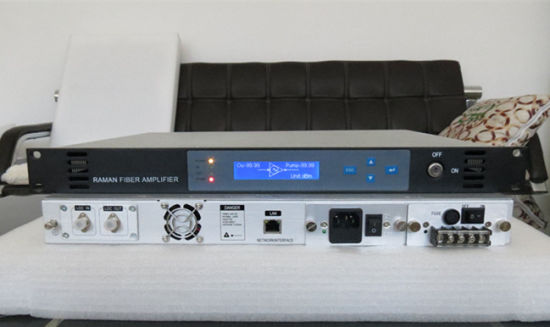
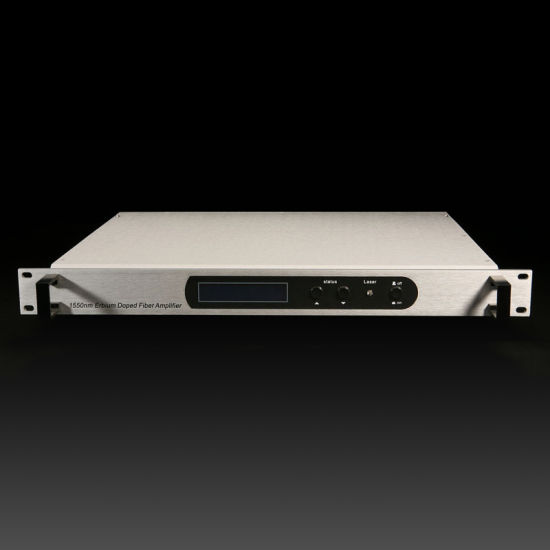
Fibre amplifiers are the only type of optical amplifier in large-scale commercial use, and the applications cluster in four directions: in-line amplification in communication links, high-power sources for industrial processing, pulse amplification for ultrafast science, and sensing and medicine. The list comes first, then the detail.
- Optical communication: the largest application area by far. EDFAs provide power amplification, in-line amplification and preamplification in long-haul systems and are the foundation of the modern optical network; without them, transoceanic links and high-capacity WDM would not exist.
- Laser materials processing: high-power Yb-doped fibre amplifiers reach several kilowatts and beyond with good beam quality, and are widely used for cutting, welding, marking, cladding and additive manufacturing.
- Ultrafast laser science: fibre amplifiers raise femtosecond and picosecond pulses to high energy for research, precision measurement and medical procedures; combined with chirped-pulse amplification (CPA) they reach very high peak power.
- Fibre sensing and measurement: low-noise amplifiers boost weak sensing signals and extend the sensitivity and reach of distributed temperature sensing, fibre-optic gyroscopes and fibre hydrophones.
- Medical and biomedical: different bands serve different procedures — 2 μm thulium fibre lasers for prostate enucleation, 2.1 μm holmium lasers for lithotripsy, and 1 μm and frequency-doubled green light for dermatology and ophthalmology.
- Military and aerospace: high-power fibre amplifiers are used in lidar, laser directed-energy weapons and free-space optical communication; the reliability and efficiency of fibre lasers have made them increasingly important in this field.
Representative applications in detail
Optical communication: three positions, three sets of requirements
The same EDFA placed at different points in a link calls for quite different trade-offs. A booster amplifier (BA) sits at the transmitter and must push per-channel power above +13 dBm, so saturated output power is what counts. A line amplifier (LA) is inserted roughly every 80 km and must stay quiet with an input near −20 dBm, so the noise figure is what counts. A preamplifier (PA) sits right before the receiver, where the input is only around −35 dBm; every 1 dB off the noise figure buys 1 dB of receiver sensitivity. The 35 nm C band spans about 4.4 THz, which carries more than 80 channels at 100 Gb/s — the reason WDM only became practical once EDFAs arrived.
Laser materials processing: Yb-doped double-clad is the workhorse
An industrial fibre laser is essentially a Yb-doped fibre amplifier in MOPA form: a single-mode seed followed by several double-clad stages, with wall-plug efficiency above 30% and M² held near 1.1 even at kilowatt output. At 1 μm, steel, stainless steel and aluminium absorb a moderate fraction of the light, which makes this the workhorse band for cutting and welding; copper and gold absorb far less, a gap that blue and green sources have only recently begun to close.
Ultrafast laser science: CPA hides the peak power
Amplify a femtosecond pulse directly in fibre and the moment the peak power rises it triggers self-phase modulation and stimulated Raman scattering: the spectrum is torn apart and energy leaks into bands you did not want. Chirped-pulse amplification stretches the pulse to picoseconds or even nanoseconds first, pushing peak power below the nonlinear threshold, and compresses it back afterwards. Fibre CPA currently reaches the hundred-microjoule, hundred-watt average-power level; beyond that the options are large-mode-area fibre or coherent combination of several channels.
Fibre sensing and measurement: it is the pump that gets amplified
In distributed temperature sensing (DTS) and distributed acoustic sensing (DAS) the amplifier usually boosts the pump pulse entering the sensing fibre rather than the weak backscattered return: double the pulse energy and both reach and signal-to-noise ratio improve. Fibre-optic gyroscopes more often use a superfluorescent fibre source, whose broadband ASE suppresses coherence noise from Rayleigh backscatter — something a narrow-linewidth source cannot do.
Medical and biomedical: water absorption decides the band
Tissue is mostly water, and the absorption peak near 2 μm makes thulium fibre lasers ideal for cutting soft tissue while sealing small vessels; transurethral enucleation of the prostate is the textbook case. A 2.1 μm holmium laser shatters stones by instant vapourization, while 1 μm and frequency-doubled green light serve vascular skin lesions and ophthalmic photocoagulation. The wavelength is always chosen on one principle of contrast: strong absorption in the target, weak absorption in everything around it.
Military and aerospace: reliability and efficiency outrank single-unit figures
Fibre lasers are all-solid-state with no optical path to drift out of alignment, and they tolerate vibration and wide temperature swings far better than bulk solid-state lasers, which is why they lead in directed energy, 1550 nm eye-safe lidar and free-space optical communication. Directed-energy systems combine many kilowatt-class fibre amplifiers by spectral beam combination to reach tens of kilowatts; the difficulty lies not in the power of one channel but in the beam quality and thermal management after combination.
◆ Want to see more fibre amplifier applications in practice? Visit Soar Laser’s application notes, or contact our technical team for advice.
6. Common Misconceptions
Fibre amplifiers are used so widely and come in so many models that the misunderstandings cluster in a few places. These four are the ones we are asked about most.
Misconception 1: a fibre amplifier is an EDFA
An EDFA is only one kind — the erbium-doped one, for the 1550 nm communication band. There are many others, ytterbium-doped at 1 μm and thulium-doped at 2 μm among them, and each dopant corresponds to a different band and a different application. Most high-power industrial fibre amplifiers are ytterbium-doped, not EDFAs.
Misconception 2: the higher the output power of a fibre amplifier, the worse the beam quality
This is precisely where fibre amplifiers excel — even at several kilowatts, a single-mode fibre amplifier can stay close to the diffraction limit (M² ≈ 1), far better than a bulk solid-state laser of the same power. The waveguide structure guarantees single-mode propagation, and power is scaled by lengthening the fibre rather than enlarging the core.
Misconception 3: a fibre amplifier can only amplify continuous light
Fibre amplifiers amplify pulses just as well, from nanoseconds down to picoseconds and femtoseconds. Ultrafast fibre amplifiers are an important direction in ultrafast laser development today. That said, ultrashort pulses travelling in fibre are strongly shaped by dispersion and nonlinear effects, so techniques such as chirped-pulse amplification are needed to manage them.
Misconception 4: the gain of a fibre amplifier can be raised indefinitely
Gain is limited by ASE. At very high gain — above 40 dB, say — ASE becomes strong, consumes a large share of the inverted ions and stops the signal gain from rising further, or even pulls it down. High gain also invites parasitic oscillation. Practical single-stage fibre amplifiers are therefore kept near 30 dB, and anything higher calls for a multi-stage design.
All four misconceptions come from one habit: treating “fibre amplifier” and “telecom EDFA” as synonyms. Change the dopant and the band, the power class and the place in the system all change with it, so asking first which part of the link it serves is far more useful than comparing datasheets line by line.
◆ Further reading
- What Is an EDFA? The Signal Refuelling Station of Fibre Communication
- What Is a Raman Amplifier? The Optical Amplifier That Uses a Scattering Effect
- What Is an Optical Amplifier? Amplifying a Weak Optical Signal Directly
- What Is Gain? How the Amplification Capability of an Optical Amplifier Is Measured
- What Is an SOA? The Principle and Characteristics of a Semiconductor Optical Amplifier
Leave a Reply